

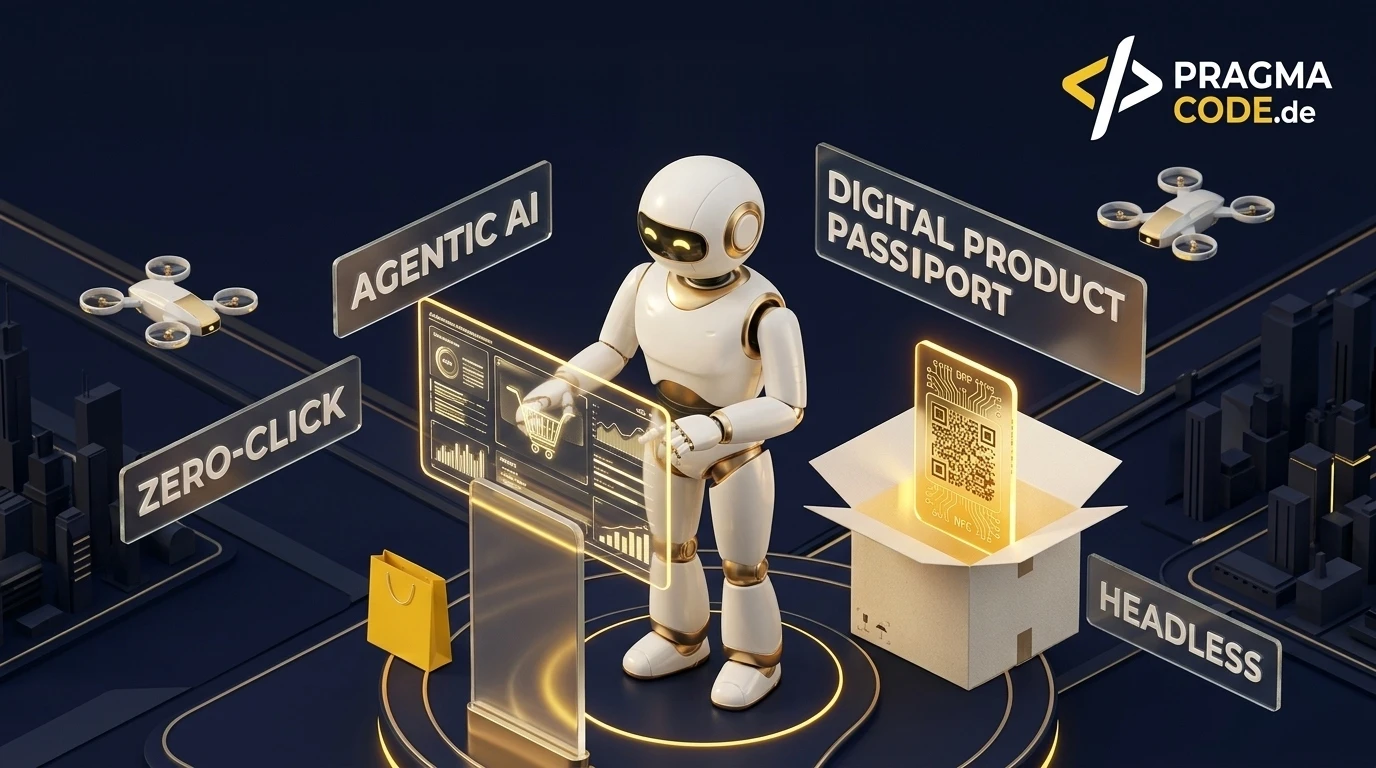
The world of e-commerce is undergoing a historic shift in 2026. Traditional search queries are giving way to autonomous shopping bots, and the boundaries between physical and digital retail are increasingly disappearing. In this comprehensive guide, we present the eight most important e-commerce trends and show you how to future-proof your online shop.
This article is an in-depth expert contribution from our content cluster. Discover the complete overview on our main page:E-Commerce Solutions →
The Era of Agentic Commerce
Why traditional e-commerce marketing must be redefined in the age of autonomous shopping bots, and how you can remain visible in the AI era through structured product data and GEO (Generative Engine Optimization).
- Agentic Commerce: AI agents and shopping bots are increasingly taking over product selection and purchasing on behalf of consumers.
- Phygital & Social: The purchase process is moving directly into social media (one-click checkout) and merging offline with digital showrooms.
- Sustainability & Transparency: With the Digital Product Passport (DPP), seamless sustainability becomes a legal requirement and a critical competitive advantage.
Introduction: The Great Upheaval in Digital Retail
A decade is an eternity in the digital age. But in e-commerce, time seems to turn even faster. Remember 2016? Mobile shopping was still in its infancy, TikTok wasn't globally relevant yet, and AI was more science fiction than reality for many retailers. Today, in 2026, we look at a landscape that has changed radically. Online retail is no longer just one sales channel among many; it has become the dominant nervous system of the global economy.
But it is no longer the e-commerce we knew. The days when it was enough to set up a Shopify store and run a few Facebook ads are finally over. We are entering the era of Agentic Commerce, of hyper-personalized experiences, and the seamless merging of the physical and digital worlds (Phygital). Customers today expect not just products, but experiences. They expect not just fast delivery, but instant gratification. And they expect brands to represent values – above all sustainability and ethical practice.
In this comprehensive guide, we take a detailed look at the eight decisive trends that will shape e-commerce in 2026 and beyond. We not only analyze the phenomena themselves but also give you concrete recommendations for action. Because one thing is certain: Those who don't adapt now will be swallowed by the market. The winners of tomorrow will not be the largest, but the fastest and most adaptable. Welcome to the future of shopping.
- 1. Agentic Commerce – When AI Shops for Us
- 2. Social Commerce & UGC – The Shop is Everywhere
- 3. Phygital & Hybrid Shopping – The Best of Both Worlds
- 4. Logistics 4.0 – Faster, More Precise, Automated
- 5. Sustainability as a Standard – Green is the New Normal
- 6. Hyper-Personalization & Zero-Click Commerce
- 7. Marketplace Dominance – The Consolidation of Platforms
- 8. Next-Gen Payments – Paying Becomes Invisible
- 9. Conclusion: Adapt or Die
Chapter 1: Agentic Commerce – When AI Shops for Us
The Rise of Autonomous Shopping Bots
Imagine your refrigerator not only noticing that the milk is empty but automatically reordering your favorite brand, comparing prices in three different supermarkets, and choosing the provider with the fastest and most sustainable delivery. Or think of a digital assistant looking for the perfect birthday present for your partner – based on her Pinterest board, her latest Spotify playlists, and her current calendar. This is no longer a pipe dream. This is Agentic Commerce.
In 2026, we see a massive shift from "Search-Based Shopping" (the customer actively searches) to "Agent-Based Shopping" (an AI searches and buys on behalf of the customer). Personal AI assistants – successors to Siri, Alexa and Co., but with real intelligence and autonomy of action – are becoming the new gatekeepers of consumption. They filter the flood of information, make pre-selections, and execute transactions autonomously.
Advantages of Agentic Commerce for Consumers
Time-saving
Hours of active searching and comparison are completely eliminated.
Objectivity
AI shopping agents ignore emotional advertising, making rational decisions based purely on price, quality, and verified reviews.
Better Deals
Shopping bots negotiate prices in real-time and automatically apply active discounts or coupons at checkout.
Comparison: Traditional E-Commerce vs. Agentic Commerce
- Buying Process: Customer actively searches via keywords, compares manually, and completes checkout themselves.
- Marketing: Focus on emotional ads, visual shop design, and conversion rate optimization.
- Pricing: Static pricing, coupons must be manually found and entered by the user.
- Logistics: Reactive shipping after manual order; delivery times of 2–3 business days.
- Buying Process: Autonomous shopping bots handle search, comparison, and checkout in the background.
- Marketing: Focus on structured product data (APIs), GEO (Generative Engine Optimization), and digital reputation.
- Pricing: Bots negotiate prices in real-time and apply discounts/coupons fully automatically.
- Logistics: Predictive shipping and ultra-fast same-day or sub-hour delivery.
Challenges for Brands
For brands, this is a double-edged sword. How do you market to a machine? When the purchasing decision process is taken over by an algorithm, classic marketing instruments like emotional TV commercials or influencer campaigns lose their direct impact on the sale. Instead, "Algorithm Optimization" (AO) becomes the new SEO. Brands must ensure that their product data is so structured and detailed that it is favored by shopping bots.
In concrete terms, this means: Maximum transparency regarding ingredients, supply chains, and prices. APIs (interfaces) that allow bots to query inventory levels in real-time. And a reputation that is digitally measurable. Because the AI will not look at the most beautiful packaging design, but at the aggregated review data from millions of users.
Expert Tip: Bot Readiness & Machine-Readable APIs
Beyond traditional product feeds for Google Shopping, implement structured OpenAPI and JSON-LD endpoints delivering sub-second price and inventory updates. Autonomous shopping agents (including WebMCP-based browser agents) prioritize storefronts whose catalog data can be queried friction-free without brittle scraping.
Agentic Commerce will also revolutionize the B2B sector. Purchasing C-parts (office supplies, screws, etc.) will run almost completely automatically. Purchasing bots negotiate prices and conditions with sales bots, conclude contracts, and process payments – all in milliseconds.
Chapter 2: Social Commerce & UGC – The Shop is Everywhere
From Endless Scrolling to One-Click Purchasing
Social media platforms have transformed from places of inspiration into full-fledged marketplaces. In 2026, the division between "social media" and "e-commerce" has completely disappeared. We no longer leave the app to buy. The checkout happens directly in the stream, during the live video, or in the story. Social Commerce has matured into a primary driver of revenue, particularly for Gen Z and Gen Alpha.
Platforms like TikTok, Instagram, and YouTube have perfected their integrated payment systems so much that the buying impulse is converted into a transaction without any friction. "Shoppable Content" is the standard. An influencer is wearing a dress? One click on the video shows the brand, price, and availability, a second click buys it.
The Power of User Generated Content (UGC)
Trust is the currency of the internet, and nothing creates more trust than User Generated Content. Glossy advertising brochures seem old-fashioned and untrustworthy in 2026. Consumers trust "real" people – be it their friends or micro-influencers who are perceived as authentic.
For online shops, this means: The product page of the future no longer consists of sterile studio photos but a feed of customer photos and videos. Reviews are no longer pure text deserts, but video testimonials ("unboxing", "try-on"). Brands must actively encourage their customers to create content and integrate it prominently into the shop.
Community building is not a buzzword, but essential for survival. Brands like Gymshark or Glossier have led the way: They don't just sell products; they sell belonging to a "tribe". Successful e-commerce brands in 2026 are actually media companies that happen to sell products as well. They curate communities, moderate discussions, and use their fans' feedback directly for product development.
"The feed is the new shop window. If you're not happening there, you're invisible to Generation Alpha."
Chapter 3: Phygital & Hybrid Shopping – The Best of Both Worlds
The Death of Brick-and-Mortar Retail Was a Lie
For years, the end of inner cities was prophesied. But 2026 shows: Physical retail is more alive than ever – but it has changed. It is no longer the place where you go to take goods off a shelf and pay at a cash register. It is an experience space, a showroom, a service hub.
"Phygital" – the merging of physical and digital – describes this state. Customers inform themselves online, try on in the store, buy via app, and have it delivered to their home. Or they buy online, pick it up in the store ("Click & Collect" / BOPIS - Buy Online, Pick Up In-Store) and have a coffee at the in-store bar while doing so.
Technology as a Bridge
In the store itself, technology supports the experience. Smart mirrors in fitting rooms recognize the garment via RFID, show it in other available colors, and suggest matching accessories. Is the size not there? A tap on the mirror orders it directly to the customer's home.
Augmented Reality (AR) plays a huge role here. With the smartphone, customers navigate the supermarket, see ingredients and allergens overlaid on the products, or receive personalized discounts when standing in front of a specific shelf.
Conversely, AR brings the store home. Virtual try-ons for glasses, make-up, or even shoes have become so precise that the return rate drops drastically. Furniture is projected virtually into your own living room with millimeter precision before purchase. The difference between "online shopping" and "shopping in store" becomes semantically irrelevant. It's simply "shopping".
Chapter 4: Logistics 4.0 – Faster, More Precise, Automated
Quick Commerce as the New Standard
Consumer patience tends towards zero. "Same Day Delivery" was a premium service in 2020. In 2026, it is the standard, and "Sub-Hour Delivery" (delivery in under an hour) is the new premium segment, especially in urban agglomerations.
This is made possible by a close-knit network of micro-fulfillment centers ("dark stores") right in the cities. Instead of coming from a huge warehouse on the outskirts, the goods come from a small hub in the neighborhood. These hubs are highly automated: Robots pick and pack the goods in record time.
The Last Mile: Drones and Delivery Robots
On the "last mile" to the customer, we see more autonomous solutions in 2026. Delivery robots roll over sidewalks to bring pizza or medicine. In rural areas, drones close the supply gaps that would be unprofitable for delivery vans.
But Logistics 4.0 is more than just speed. It is Predictive Shipping. Based on AI analyses, retailers already know what is being ordered in a certain district before the order even comes in. Assumed goods are transported nearby "just in case." This reduces delivery times and optimizes vehicle utilization.
At the same time, return management ("Reverse Logistics") is revolutionizing. Returns can simply be handed to any delivery service at the front door or dropped off in intelligent drop-off boxes on every street corner. Credit is issued immediately upon drop-off thanks to automatic product recognition.
Predictive Demand Forecasting
AI models analyze purchasing trends in real-time and pre-deploy products to local micro-fulfillment centers.
Automated Picking
As soon as an order is placed, robots in the dark store pick and pack the goods automatically in record time.
Autonomous Last-Mile Delivery
Delivery robots or drones handle the distribution in urban areas, bringing the package to the customer in under an hour.
Chapter 5: Sustainability as a Standard – Green is the New Normal
From Marketing Gag to Compliance Duty
Sustainability in 2026 is no longer a niche topic for eco-brands, but a hard economic and legal requirement. The EU regulation "Ecodesign for Sustainable Products Regulation" (ESPR) and the "Digital Product Passport (DPP)" force retailers to radical transparency.
Every product – from a t-shirt to a toaster – has a digital twin that can be read via a QR code. Customers see immediately: Where do the raw materials come from? Who sewed it? How much CO2 was emitted? Is it repairable? How do I dispose of it correctly?
Circular Economy and Re-Commerce
The market for used goods (pre-loved) is exploding. Many large brands have integrated their own second-hand platforms ("Resale-as-a-Service"). One click in the customer account is enough to offer a previously purchased product for sale again. The data is already there. The transition to a Circular Economy drives long-term customer loyalty and environmental compliance.
Packaging waste is socially ostracized. Reusable shipping bags that the customer simply throws into the mailbox are widespread. Algorithms for "cartonization" calculate the smallest possible packaging size for each order to avoid shipping "air".
Customers in 2026 actively decide against retailers who mess up on sustainability. "Greenwashing" is immediately exposed thanks to blockchain-based supply chain tracking and leads to shitstorms that can ruin brands.
Transparent Supply Chain
Transparent documentation of the origin of raw materials and manufacturing conditions, securely recorded for the Digital Product Passport (DPP).
Circular Economy Integration
Easy reselling of pre-loved products directly through the customer's account with a single click (Resale-as-a-Service).
Intelligent Cartonization
Optimized packaging sizes to eliminate empty space and save shipping resources, alongside reusable mailers.
Chapter 6: Hyper-Personalization & Zero-Click Commerce
When the Shop Knows You Better Than You Know Yourself
The days of "Customers who bought X also bought Y" are over. Hyper-personalization in 2026 means that every customer sees a completely individual shop. The layout, the displayed products, the prices, the tone – everything is generated in real time.
Generative AI creates product texts and even product images on-the-fly, tailored exactly to the viewer's preferences. An outdoor fan sees the jacket staged against an alpine panorama, an urban explorer sees the same jacket in a subway station.
Zero-Click Commerce: The Subscription Model for Everything
The highest level of personalization is "Zero-Click Commerce". Based on consumption patterns and sensor data (IoT), products are delivered without the customer even having to actively order. Detergent, coffee, dog food, but also socks or toothbrushes arrive automatically in the perfect interval.
This model requires massive trust. The customer relinquishes control. In return, they receive maximum convenience and often price advantages. For retailers, this is the holy grail: Maximum customer retention (lock-in) and predictable revenues. The challenge is not to cross the fine line between "helpful" and "creepy".
Chapter 7: Marketplace Dominance – The Consolidation of Platforms
The Winner Takes It All
The trend towards centralization continues. In 2026, an estimated almost 90% of global e-commerce revenue will run through marketplaces. Amazon and Alibaba remain the giants, but specialized niche marketplaces (Vertical Marketplaces) have also established themselves – for example, for luxury fashion, industrial machinery, or sustainable products.
For small and medium retailers, the question "Own shop or marketplace?" becomes increasingly difficult. The answer in 2026 is usually: Both. The marketplace serves as a customer acquisition channel with massive reach; the own shop (D2C - Direct to Consumer) serves brand building and customer retention (CRM).
Headless Commerce as the Technological Answer
To serve this variety of channels (marketplaces, social media, own shop, voice assistants, IoT devices), Headless Commerce is the technological foundation. The backend (inventory management, logic) is decoupled from the frontend (the "head", i.e., what the customer sees).
Data is distributed to all touchpoints via APIs. Changes to product prices only need to be maintained in one place and are immediately up-to-date everywhere. This enables the extreme flexibility and speed demanded in 2026. Anyone still relying on monolithic shop systems is too slow and too inflexible.
Chapter 8: Next-Gen Payments – Paying Becomes Invisible
Biometrics Instead of PINs
The wallet often stays at home in 2026. Payment is made with the face (FaceID), the fingerprint, or even the vein pattern of the palm. "Smile to Pay" is normal at supermarket checkouts and in cafes. In online retail, we authenticate ourselves via biometric sensors in the smartphone or laptop. Passwords and entering credit card numbers are a thing of the past.
Crypto and Stablecoins in the Mainstream
Cryptocurrencies have left their niche. Thanks to state-regulated stablecoins (Digital Euros/Dollars), volatility is no longer a problem for everyday purchases. Smart Contracts on the blockchain handle complex transactions – such as escrow services for expensive purchases or automatic royalties for digital goods.
Buy Now, Pay Later (BNPL) 2.0
Financing is integrated directly into the checkout. AI checks creditworthiness in milliseconds and makes an individual credit offer for installment purchases. This increases the conversion rate for high-priced products enormously, but also harbors risks of debt, which is why the area is heavily regulated in 2026.
Quick-Check: Your E-Commerce Roadmap for 2026
Conclusion: Adapt or Die
E-commerce in 2026 is a technological high-performance field. The barriers to entry are low, but the barriers to sustainable success are higher than ever. It is no longer enough to have goods and put them online.
Successful retailers must be technology experts, logistics wizards, and community managers all in one. They must master AI before the AI replaces them. They must operate radically sustainably while remaining extremely customer-centric.
But despite all the technology: The core of trade remains the same. It's about trust, solving problems, and fulfilling desires. The tools have changed, human psychology has not. Use the new tools to get closer to your customers than ever before.
At Pragma-Code, we support you on this journey. We build the technological infrastructure for your success in 2026. From headless architectures to AI-supported personalization and the integration of next-gen payment. Let's shape the future of your online retail together.
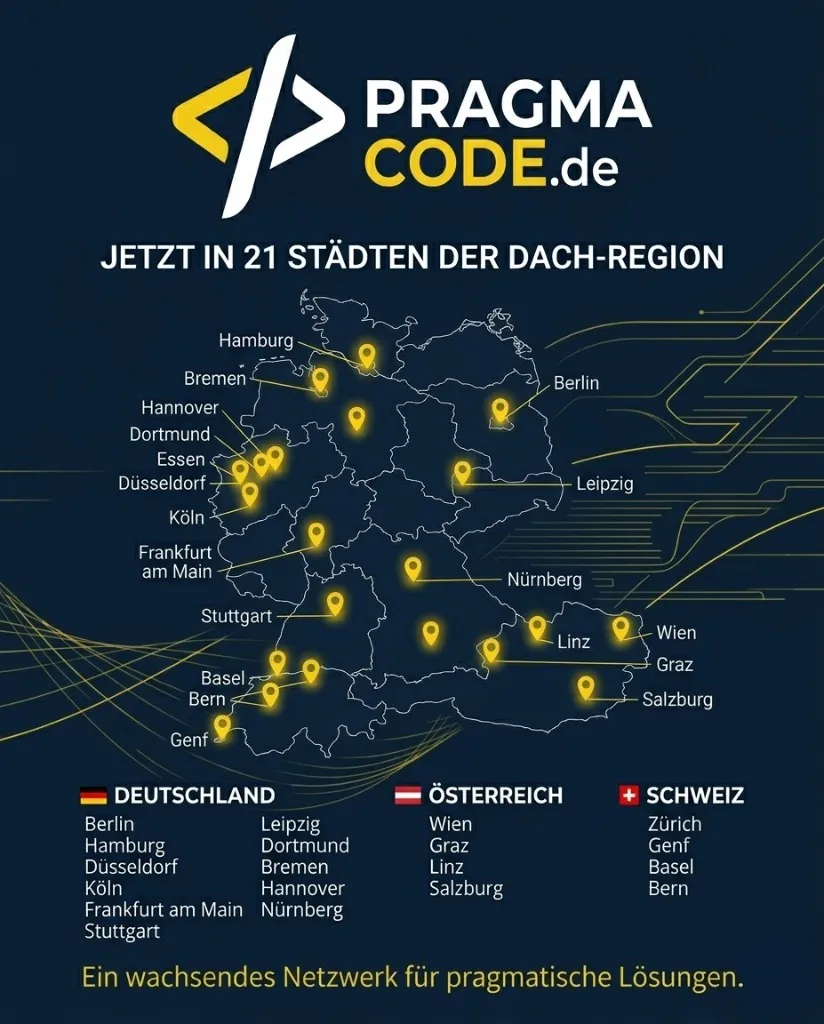
Our Regional Expertise
We are your digital partner – regionally anchored and successfully scaling across borders.
Have a vision?
Let's check together how we can make your idea take flight.
Book your free strategy call nowExtended Specialized Glossary
Agentic Commerce
A commerce model in which autonomous AI agents (bots) search for, compare, and buy products on behalf of consumers.
Headless Commerce
An e-commerce architecture where the frontend (presentation) is separated from the backend (logic). Enables maximum flexibility for various output channels.
Phygital
An artificial word combining 'Physical' and 'Digital'. Describes the seamless blending of online shopping and the brick-and-mortar shopping experience.
Dark Store
A small, often automated warehouse in inner cities used exclusively for the fast delivery of online orders (Quick Commerce), not for public foot traffic.
Digital Product Passport (DPP)
A digital dataset that stores all sustainability-relevant information of a product across its entire lifecycle, accessible to customers (e.g., via QR code).
Social Commerce
The direct sale of products via social networks, often integrated seamlessly into the content feed or live streams ('Live Shopping').
Zero-Click Commerce
A model where products are delivered automatically and predictively without the customer needing to trigger an active order (e.g., via IoT sensors or AI predictions).
Circular Economy
A model aimed at sharing, leasing, reusing, repairing, refurbishing, and recycling products and materials for as long as possible.