Headless CMS
for maximum flexibility
Manage your content efficiently and distribute it across all channels. Website, app, smartwatch – everything from a single source.

 One source · all channels
Our CMS services.
From selection to integration.
Consulting & Strategy
We analyze your requirements and find the suitable Headless CMS (SaaS or Self-Hosted) for your company.
Implementation
Setting up the CMS, defining content models, and configuring API interfaces for your frontend.
Frontend Integration
Seamless connection to your website or app (React, Next.js, Vue.js, etc.) for dynamic content.
Migration & Relaunch
Secure migration of existing WordPress or Typo3 sites to a modern headless architecture.
Performance & SEO
Optimization for Core Web Vitals. Static Site Generation (SSG) for extremely fast load times.
Maintenance & Support
Regular updates of the CMS and frontend for maximum security and stability.
Which headless CMS fits?
There is no best system, only a fitting one. Three questions decide it: who maintains the content, where may the data live, and what already exists technically.
Strapi — when data stays in-house
Open source on Node.js, self-hosted on your server or in a European cloud. Own database (PostgreSQL or MySQL), REST and GraphQL out of the box. First choice when personal data must not leave the house or a data processing agreement with a US vendor is off the table. The price: you operate it — updates, backups and servers included.
Storyblok — when marketing maintains it
The visual editor shows changes live in a real page preview instead of an abstract form. That is the practical difference when editors and marketing work without developers. Content is assembled from components, EU hosting is available. A hosted product with a subscription — but no operational burden on your side.
Sanity — when structure beats layout
Strong when the same content flows into several targets — website, app, newsletter, partner feed — and must stay cleanly structured. Its own query language (GROQ), real-time collaboration, highly flexible modelling. Tailoring the editing interface is developer work; if you only run one website, you buy complexity you do not need.
Directus — when the database already exists
Sits on top of an existing SQL database instead of bringing its own. Useful when product data, inventory or master data already live somewhere clean and the CMS only needs to add an interface and API on top. Saves a second data store and the sync between the two.
Headless WordPress — the middle step
WordPress stays as the editing interface while the front end is rebuilt and pulls content via REST or WPGraphQL. Editors learn nothing new and the switch can run in stages. The catch: WordPress maintenance remains — updates, plugins, security holes. A good middle step, rarely the destination.
When headless is the wrong answer
For a manageable single-channel website with rare changes and no app on the roadmap, headless mainly adds more moving parts to maintain. A classic CMS or a statically built site is then cheaper and calmer. We say so in the first call, before a quote exists.
Our process.
5 steps to your Headless CMS.
Analysis & Modeling
Definition of content types and relations fitting your business model.
CMS Setup
Setup and configuration of Strapi, Contentful, or Sanity.
API-First Design
Development of interfaces and selection of the perfect frontend framework.
Implementation
Frontend development and seamless integration of CMS data.
Go-Live
Deployment, caching strategy, and training of your content team.
Questions on headless CMS.
What prospects almost always want to know before deciding.
What does a headless CMS project cost?
Can we migrate our WordPress content?
Will our SEO suffer from the switch?
Is a headless CMS GDPR-compliant?
How long does implementation take?
Can editors work without developers?
Can AI features be connected?
More on the topic.
Deep-dives on content architecture, performance and scaling.

Web Development 2026
Intelligent ecosystems, headless architectures and AI-native web applications.
Read more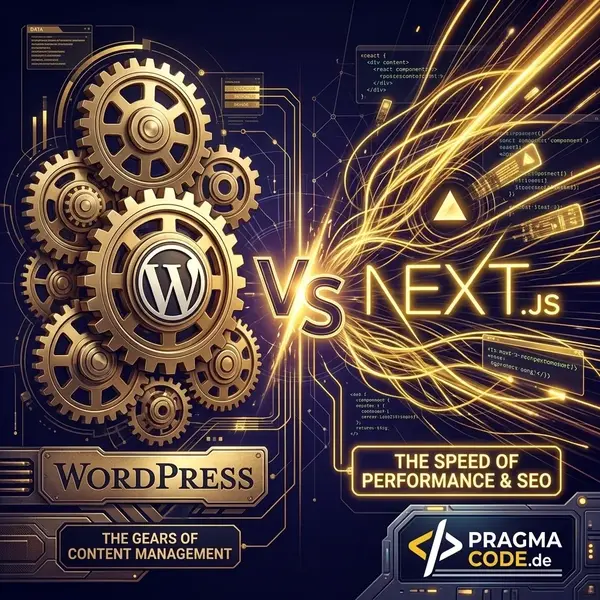
Core Web Vitals: WordPress vs. Next.js
Performance comparison: Which framework delivers better loading times?
Read more
Agentic AI Workflows
How autonomous AI agents optimize modern web infrastructures.
Read moreReady for modern content management?
End rigid systems. Switch to a headless solution now.