


This article is an in-depth expert contribution from our content cluster. Discover the complete overview on our main page:Web Development & Progressive Web Apps →
Most companies still view their corporate website as a digital business card – a static online storefront that displays who they are and what services they provide. But in 2026, the rules of competitive digital engagement have fundamentally shifted. Anyone seeking to capture qualified B2B leads, retain existing clients, and be cited as an authoritative primary source by generative AI systems like Google AI Overviews, ChatGPT Search, or Perplexity requires far more than an aesthetically pleasing online presence.
In this guide, we explore why modern web projects must evolve into intelligent, interconnected digital ecosystems, which architectural pillars make the decisive difference – and how these strategic technical investments deliver sustainable returns through measurably higher conversion rates and automated operational workflows.
From Digital Storefront to Intelligent Transactional Ecosystem
In the era of Agentic AI and Generative Engine Optimization (GEO), your website is no longer merely a destination for human clicks—it is a programmable, machine-readable platform. Modern web ecosystems combine PWA speed, API-first connectivity, and flawless Core Web Vitals into a scalable enterprise infrastructure.
- Paradigm Shift: Static websites are losing ground in the AI era. Generative Engine Optimization (GEO) prioritizes technical excellence, semantic HTML hierarchy, and structured JSON-LD data as key trust signals.
- The 3 Performance Pillars: The synergy of Progressive Web Apps (PWA), API-First Architecture, and Core Web Vitals forms the operational backbone for customer retention without app store dependencies.
- Measurable Business ROI: Sub-second load times (LCP < 2.5s, INP < 200ms) and automated backend pipelines via Webhooks slash operational processing costs while boosting conversion rates by up to 30%.
- 1. The Status Quo: Why Static HTML Fails in 2026
- 2. Progressive Web Apps: The App Revolution Without the App Store
- 3. API-First Architecture: The Nervous System of the Modern Business
- 4. Core Web Vitals: The New Currency Standard for Online Visibility
- 5. The Convergence: PWA + API-First + Core Web Vitals as an Ecosystem
- 6. Technology Stack Recommendation 2026
- 7. Implementation Roadmap: 5 Phases to an Intelligent Ecosystem
- 8. Total Cost of Ownership: Modern vs. Static Website
- 9. Conclusion & Action Checklist
1. The Status Quo: Why Static HTML Fails in 2026
Static HTML pages and traditional monolithic CMS setups formed the bedrock of the early web: they were straightforward, comparatively inexpensive to build, and met the simple requirement of displaying informational copy. However, the commercial and technical realities of 2026 have definitively ended that era. Four fundamental forces necessitate the transition to a modular, intelligent web architecture for SMEs and digital enterprises:
1. Generative AI Search Engines
Google AI Overviews, Perplexity, and ChatGPT Search prioritize websites with strict semantic HTML, structured Schema.org data, and pristine load metrics. Unstructured pages without clean API feeds are routinely bypassed by AI scrapers.
2. Mobile-First & PWA Expectations
Over 68% of web traffic originates from mobile devices. Users no longer tolerate load delays exceeding 2 seconds. Without offline caching, instant page transitions, and app-like tactile fluidity, high-intent prospects bounce immediately.
3. Decoupled Integration
Modern enterprises operate multifaceted software stacks encompassing CRMs (HubSpot, Salesforce), ERPs, and marketing automation. An isolated brochure site creates severe media disruptions and manual data entry overhead.
4. Conversion Optimization
Empirical studies consistently prove that every additional second of latency reduces conversion rates by an average of 7%. Outdated, sluggish page architectures cost businesses real revenue daily in missed lead opportunities.
"A slow, static website in 2026 is no longer just a visual or convenience issue—it is an existential ranking and conversion risk. Modern AI search systems treat technical excellence as the primary validator for business credibility and content authority." – Alexander Ohl, Founder of Pragma-Code
2. Progressive Web Apps: The App Revolution Without the App Store
What Are PWAs and Why Are They Essential in 2026?
Progressive Web Apps (PWAs) bridge the historical divide between traditional websites and native iOS and Android applications. By leveraging modern browser APIs, PWAs provide the native look, tactile feel, and responsive fluidity of an installed app—including offline functionality, push notifications, and direct home screen installation—without the friction, delays, or 30% revenue cuts of app stores.
The four core architectural pillars of a modern PWA include:
1. Service Worker & Caching
A Service Worker acts as a programmable network proxy running in the browser background. It intercepts network requests, manages granular caching strategies, and ensures uninterrupted operation during network drops.
2. Web App Manifest v2
A structured JSON manifest file specifies app metadata, high-resolution icons, brand theme colors, start URLs, and standalone display mode, launching the application without distracting browser chrome.
3. HTTPS & Web Security
Mandatory TLS 1.3 encryption is a strict prerequisite for all PWA browser APIs, simultaneously providing the foundational trust and ranking signals required by major search engines.
4. Adaptive Container Queries
Modern CSS container queries and fluid typography ensure that complex data interfaces render with pristine visual clarity and responsiveness across smartphones, foldables, tablets, and ultrawide desktop monitors.
Pro-Tip: Stale-While-Revalidate for Maximum B2B Speed
Configure your Service Worker so that static assets and frequently accessed product catalogs render instantaneously from local cache (zero-latency display), while fresh updates are fetched silently in the background. This consistently drives perceived LCP scores below 0.4 seconds.
Measurable Business Impact of PWAs
Leading global brands and forward-thinking B2B enterprises demonstrate significant commercial returns after adopting Progressive Web Apps:
Starbucks Global PWA
Launched a lightweight PWA to serve customers globally even in low-connectivity mobile environments.
+2× Online OrdersDoubled daily active web orders while requiring 99.84% less storage than their native mobile app.
Pinterest Web Experience
Completely replaced their sluggish legacy mobile site with an optimized PWA architecture.
+60% EngagementTime spent on the platform surged by 60%, while user-generated ad revenue increased by 44%.
B2B SaaS Self-Service
Implemented PWA capabilities and offline-first form caching across client portal onboarding flows.
+30% Conversion RateDramatically boosted completed trial signups while reducing onboarding abandonment by 28%.
ROI Calculation: When Does a PWA Pay Off for SMEs?
Consider a mid-sized B2B enterprise or specialized e-commerce provider with 50,000 monthly visitors, a baseline conversion rate of 2.0% (1,000 inquiries or transactions per month), and an average transaction value of €80:
Initial investment of approx. €15,000–25,000 in a customized PWA architecture with service worker caching, offline lead capture, and performance-optimized rendering pipelines.
Page load times drop by over 50%. Removing latency friction lifts conversion rate from 2.0% to 2.5%, generating +250 incremental deals/month = +€20,000 monthly gross margin.
Within four to five months, the cumulative incremental revenue fully covers development costs. Concurrently, organic traffic climbs due to top-tier Core Web Vitals rankings.
Automated re-engagement campaigns via Web Push for form and checkout drop-offs yield sustained additional revenue with negligible marginal operating overhead.
3. API-First Architecture: The Nervous System of the Modern Business
What Does API-First Mean?
In an API-First Architecture, application programming interfaces (APIs) are treated as first-class digital products and primary connective tissues before specific frontends or applications are engineered. The corporate website ceases to be an isolated data silo and becomes one of many agile "consumers"—alongside mobile applications, client portals, internal ERPs, and autonomous AI agents.
The Four Core Paradigms of the Modern API-First Era
1. RESTful APIs
Stateless, resource-oriented HTTP interfaces utilizing standardized methods (GET, POST, PUT, DELETE). The bedrock for reliable third-party integrations and robust microservice communication.
2. GraphQL Layer
Allows frontend components to query exactly the structured fields required in a single round-trip. Eliminates network over-fetching and significantly enhances mobile performance.
3. Headless CMS Integration
Platforms like Storyblok or Contentful decouple editorial content creation from the frontend codebase. Content creators enjoy intuitive visual editors while engineers deploy lightning-fast serverless frontends.
4. Webhooks & Event Streams
Asynchronous push notifications: critical on-site user actions (form submissions, downloads, checkouts) immediately trigger automated background workflows in orchestration platforms like n8n or Make.
Practical Enterprise Integration Scenarios
An API-first architecture delivers tangible, day-to-day operational efficiencies across the organization:
Automated CRM Synchronization
Every website contact submission is automatically validated, enriched, and pushed instantly into your CRM (HubSpot, Salesforce) as a scored lead—triggering immediate sales alerts.
Real-Time Content Personalization
Through low-latency API queries, the web platform recognizes returning accounts and dynamically adapts case studies, pricing tiers, and contact persons to the visitor's industry.
Event-Driven Marketing Pipelines
On-site engagement triggers (such as whitepaper downloads or calculator interactions) automatically execute multi-channel email sequences and ad retargeting via n8n workflows.
AI Agent & WebMCP Integration
Internal and external AI assistants query real-time product inventories, pricing schedules, or booking availability via standardized APIs to resolve customer requests autonomously.
4. Core Web Vitals: The New Currency Standard for Online Visibility
What Are Core Web Vitals?
Google established Core Web Vitals as standardized metrics to evaluate real-world user page experience. In 2026, these metrics not only govern classic search rankings but also serve as a decisive quality benchmark for generative AI engines. The core performance dimensions include:
1. LCP – Largest Contentful Paint
Measures the time required to render the largest visible content element in the viewport (hero graphic, video poster, or primary H1 heading). Target: under 2.5 seconds.
2. INP – Interaction to Next Paint
Evaluates the delay between user interactions (clicks, taps, keyboard inputs) and the subsequent visual feedback rendered on screen. Target: under 200 milliseconds.
3. CLS – Cumulative Layout Shift
Quantifies unexpected visual movement during page load that causes frustrating misclicks and poor usability. Target: under 0.1.
4. TTFB – Time to First Byte
Measures server responsiveness from initial HTTP request dispatch to the arrival of the first byte of data. Target: under 800 milliseconds.
Pro-Tip: INP Optimization via Islands Architecture
Monolithic Single-Page Apps (SPAs) frequently suffer from poor INP scores because bulky JavaScript bundles block the main thread. Adopt modern frameworks like Astro with Islands Architecture: deliver pure static HTML by default and hydrate interactive UI components only where strictly required.
Core Web Vitals and AI Search Engines: The GEO Connection
An essential strategic reality: AI engines such as Google AI Overviews, Bing Copilot, and Perplexity rely heavily on technical quality indicators when selecting authoritative citation sources. The algorithmic logic is straightforward: a digital platform exhibiting clean semantic structure, sub-second response times, and visual stability is identified as professionally maintained and inherently trustworthy (E-E-A-T).
Five Technical Pillars for Green Core Web Vitals
-
Modern Image Formats & Responsive Srcsets
Convert all graphic assets to WebP or AVIF formats. Implement lazy loading for below-the-fold media and declare explicit aspect ratios to prevent Cumulative Layout Shifts (CLS).
-
Critical CSS & Granular Code Splitting
Inline critical above-the-fold CSS rules while deferring non-essential styles and JavaScript modules to prevent blocking the browser's primary render tree.
-
Global CDN & Serverless Edge Delivery
Distribute static files across global Content Delivery Networks close to the end user. Execute dynamic personalization logic via edge functions (e.g., Cloudflare Workers) with near-zero latency.
-
Tiered Caching & Service Worker Strategies
Configure immutable Cache-Control HTTP headers for versioned static assets and leverage service worker caching for instantaneous subsequent page loads.
-
Self-Hosted Fonts & WOFF2 Subsetting
Self-host optimized WOFF2 fonts with
font-display: swapto eliminate external render-blocking network requests and avoid Flash of Unstyled Text (FOUT).
5. The Convergence: PWA + API-First + Core Web Vitals as an Ecosystem
These three disciplines achieve their full transformative impact when deployed as a unified architecture. Consider the journey of a modern high-value B2B prospect:
Discovery via AI Search & GEO
Driven by semantic HTML, rich JSON-LD data, and top-tier Core Web Vitals, AI search engines select your platform as the authoritative source for AI Overviews and featured snippets.
Instantaneous Page Load
The edge-delivered PWA renders content in under 1 second. Zero latency prevents bounce drop-offs, allowing the user to engage with your insights immediately.
Context-Aware Interaction via API
Lightweight API endpoints power interactive on-page tools (such as ROI calculators and configurators) that deliver instantaneous results without perceptible lag.
Frictionless Lead Conversion
Forms support offline staging and instantaneous validation (INP < 100ms), ensuring high-intent inquiries are never lost due to momentary network drops.
Automated Downstream Processing
Webhooks stream the lead directly into your CRM, alerting your sales reps and initiating personalized automated nurture sequences.
6. Technology Stack Recommendation 2026
For SMEs, scale-ups, and digital enterprises, Pragma-Code recommends a modern, low-maintenance, and highly scalable technology stack:
Astro ships zero unnecessary JavaScript by default for unbeatable Core Web Vitals, allowing developers to embed interactive React or Vue components precisely where needed.
Empowers marketing teams with intuitive visual editing while completely decoupling presentation from data delivery via fast GraphQL and REST APIs.
Cloudflare Workers or Node.js microservices for API middleware, business logic, and real-time data transformations with global sub-50ms execution latency.
Low-code automation platforms connecting web events, CRM systems, email infrastructure, and internal databases without extensive bespoke backend code.
GDPR-compliant hosting infrastructure with global edge CDN caching, automated SSL management, and enterprise DDoS mitigation (e.g., Cloudflare Pages, Hetzner, IONOS Cloud).
Privacy-first analytics with Plausible or Umami alongside automated performance benchmarking integrated directly into CI/CD pipelines via Lighthouse CI.
7. Implementation Roadmap: 5 Phases to an Intelligent Ecosystem
-
Phase 1: Technical Audit & Strategic Alignment (Weeks 1–2)
Comprehensive baseline audit of the existing web property: measure Core Web Vitals under real-world field conditions, isolate bottlenecks, evaluate system API readiness, and set clear KPIs.
-
Phase 2: Performance Foundation & PWA Setup (Weeks 3–6)
Establish modern frontend architecture (Astro/Next.js), configure automated WebP/AVIF pipelines, critical CSS, service worker caching, and Web App Manifest to achieve green Core Web Vitals.
-
Phase 3: Headless CMS & API Layer Construction (Weeks 5–10)
Integrate the Headless CMS, structure content schemas, and build modular API endpoints for CRM synchronization, lead processing, and third-party services.
-
Phase 4: Workflow Automation & GEO Optimization (Weeks 9–14)
Implement event-driven workflows via webhooks (n8n/Make), integrate comprehensive Schema.org graph metadata for AI citation, and execute rigorous end-to-end testing.
-
Phase 5: Rollout, Monitoring & Iteration (Ongoing)
Production launch with automated indexing notifications (IndexNow/Google API), continuous performance monitoring via Google Search Console, and monthly data-driven optimization sprints.
8. Total Cost of Ownership: Modern vs. Static Website
When assessing web investments, businesses frequently over-index on upfront development costs while overlooking the true Total Cost of Ownership (TCO) across a 3-year operating horizon:
3-Year TCO Comparison: Static Monolith vs. Intelligent Web Ecosystem
- Initial Build Cost: €5,000–15,000 (low initial barrier)
- Maintenance & Plugin Patches: €2,000–4,000 / year (elevated vulnerability risk)
- Manual Data Entry Overhead: €10,000–20,000 / year due to missing APIs
- Opportunity Cost (Lost Leads): €30,000–80,000 / year due to poor conversion & latency
- AI Search Visibility: Poor (inadequate structured GEO semantics)
- Total 3-Year Cost: €75,000–150,000 (including opportunity loss)
- Initial Investment: €20,000–40,000 (scalable modular infrastructure)
- Maintenance & Hosting: €3,000–6,000 / year (high reliability & security)
- Operational Savings: -€15,000–30,000 / year via CRM & webhook automation
- Incremental Conversion Revenue: +€40,000–100,000 via instant loading & PWA
- AI Search Visibility: Maximum (comprehensive Schema.org & GEO excellence)
- Net 3-Year Outcome: Substantial Positive ROI & Measurable Profit Growth
9. Conclusion & Action Checklist
Transforming your corporate web presence from a static business card into an intelligent digital ecosystem is not merely a design refresh in 2026—it is a core strategic decision for sustainable enterprise competitiveness. Organizations that invest in modern architectures featuring PWA capabilities, API-first interoperability, and flawless Core Web Vitals secure top positions in generative AI engines and maximize their B2B deal flow.
Quick-Check: Is Your Web Architecture Ready for 2026?
Ready for the Web Architecture of 2026?
Let us analyze how we can transform your existing website into a high-performance, AI-optimized, and high-converting digital ecosystem.
Schedule Your Free ConsultationOur Regional Expertise
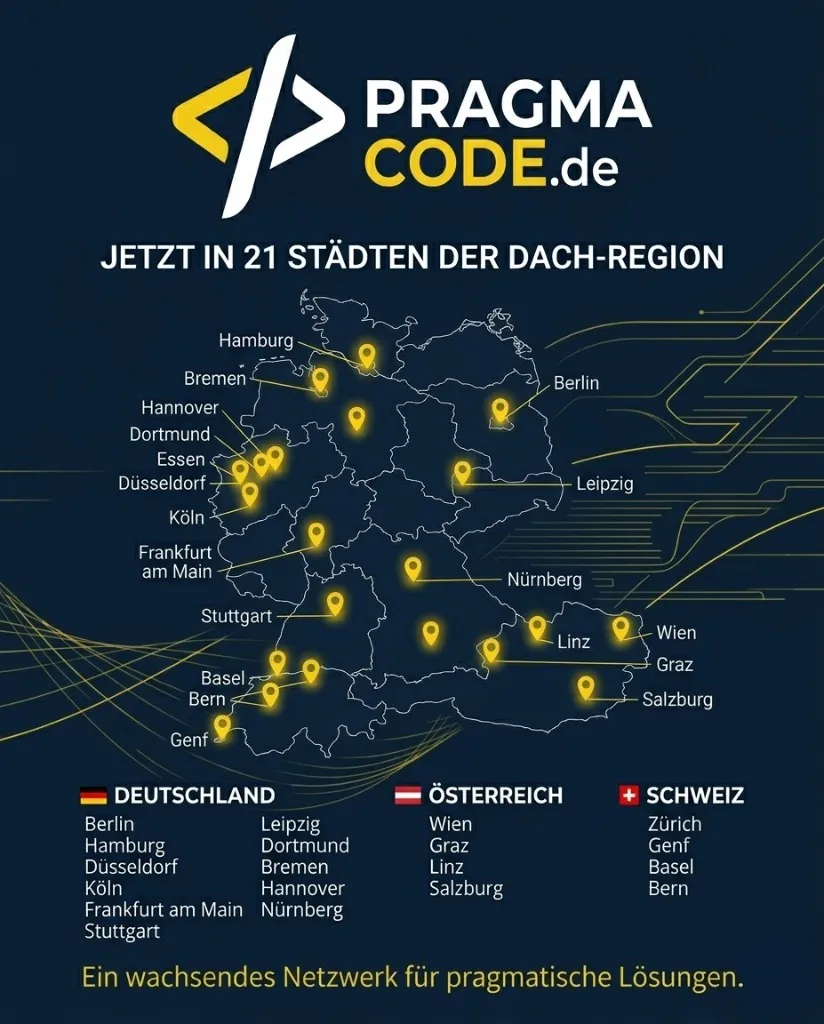
We are your digital partner – regionally anchored and successfully scaling across borders.
Have a vision?
Let's check together how we can make your idea take flight.
Book your free strategy call nowExtended Specialized Glossary
Progressive Web App (PWA)
A web application that offers native app-like features (offline operation, push notifications, home screen installation) via modern web APIs, without requiring an app store.
API-First Architecture
A design principle where APIs are defined as the primary interface between systems before frontends or other consumers are developed. Enables maximum flexibility and scalability.
Core Web Vitals
Google's metrics for measuring user experience: LCP (load speed), INP (interactivity), and CLS (visual stability). Official ranking factor since 2021, essential for AI visibility in 2026.
Headless CMS
A content management system without an integrated frontend. Content is delivered via APIs and can be rendered in any frontend (website, app, smart device).
Service Worker
A JavaScript script running in the browser background that intercepts network requests. Enables offline functionality, background synchronization, and push notifications for PWAs.
Generative Engine Optimization (GEO)
The evolution of SEO for AI search engines. GEO optimizes web pages to be cited by AI systems (ChatGPT, Perplexity, Google AI Overviews) through technical excellence, structured data, and E-E-A-T signals.
Edge Computing
Execution of code and delivery of data at geographically distributed servers close to the end user. Dramatically reduces latency and improves TTFB and LCP values.
Largest Contentful Paint (LCP)
A Google Core Web Vital measuring the render time of the largest visible content element. An optimal LCP score is under 2.5 seconds.
Interaction to Next Paint (INP)
Measures responsiveness to user interactions (clicks, taps, key presses). Target score is under 200 milliseconds for stutter-free experience.
Cumulative Layout Shift (CLS)
Quantifies unexpected visual layout shifts during page loading. Target score is below 0.1.
Time to First Byte (TTFB)
The time from initial HTTP request to the arrival of the first byte of data from the web server. Target score: under 800ms.
GraphQL
A query language for APIs that enables clients to request exactly the data they need in a single round-trip without over- or underfetching.
Webhooks
Event-driven HTTP callbacks enabling web applications to send automated, real-time notifications to third-party systems when specific events occur.