


Introduction: From Static Text to a Digital Universe
When we pull out our smartphones today to order food with a tap, make a bank transfer, or immerse ourselves in virtual worlds, we often forget how young this technology actually is. The history of web development is not a story of centuries, but of a few, rapid decades. It is a tale of visionaries, of wars over market share, of the bursting of huge bubbles, and of a continuous democratization of knowledge.
What began as a tool for physicists to exchange information is today the nervous system of our global society. In this post, we take you on a journey. We start in the gray offices of CERN, traverse the wild years of the dot-com boom, and finally look at the AI-driven future that is just beginning.
Dieser Artikel ist ein vertiefender Fachbeitrag aus unserem Content-Cluster. Entdecken Sie die vollständige Übersicht auf unserer Hauptseite: WordPress to Next.js Migration →
Chapter 1: The Birth of the World Wide Web (1989-1993)
The Big Bang in Geneva
It all began in 1989 at CERN in Switzerland. Tim Berners-Lee, a British physicist, was frustrated by how difficult it was to share information between different computers and scientists. His solution: An "Information Management: A Proposal". This was the birth of the World Wide Web.
Berners-Lee developed three fundamental technologies that still form the backbone of the internet today:
- HTML (HyperText Markup Language): The formatting language for the web.
- URI (Uniform Resource Identifier): A kind of "address" to uniquely find resources on the web (today known as URL).
- HTTP (HyperText Transfer Protocol): The protocol through which this information is retrieved.
Did you know?
The very first website in the world went online on August 6, 1991. It explained what the World Wide Web is and how to use it. It is still accessible today at its original address at CERN – a digital world heritage site.
Chapter 2: The Browser Wars and the Dot-com Boom (1994-2001)
In the mid-90s, the web left academic circles and reached the mass market. The first popular browser, Mosaic, made the web graphical. Images and text could now be displayed together – a revolution.
Netscape vs. Microsoft
The first major "browser war" followed. Netscape Navigator was the undisputed top dog until Microsoft launched Internet Explorer (IE) and bundled it for free with Windows. During this heated phase, a technology emerged that would change the web forever: JavaScript. Developed by Brendan Eich in just ten days, it brought interactivity to the previously static pages. Suddenly, you could validate forms or create small animations without having to reload the page.
The Bubble Bursts
Towards the end of the 90s, a gold rush mood prevailed. Investors pumped billions into any company that had a ".com" in its name, regardless of whether it had a business model or not. In 2000, the dot-com bubble burst. Many companies went bankrupt, but the infrastructure – the fiber optic cables, the server farms, and the broad knowledge of web technologies – remained and formed the foundation for the next phase.
Chapter 3: Web 2.0 – The Social Web (from 2004)
After the crash, "Web 2.0" emerged. The term does not describe a new technology, but a new way of using it. The web transformed from a "read-only" library to a "read-write" platform. Users were no longer just consumers, but producers (prosumers).
Platforms like Facebook, YouTube, and Twitter were created. Technologically, this was made possible by AJAX (Asynchronous JavaScript and XML). Web pages no longer had to reload completely to display new content. Google Maps was a prime example: You could move the map without waiting for a reload. The web felt like a real application for the first time.
Chapter 4: The Mobile Revolution and Responsive Design (from 2007)
In 2007, Steve Jobs presented the first iPhone. Suddenly, people carried the entire internet in their pockets. But most websites were built for large desktop monitors and were unusable on small screens.
Ethan Marcotte provided the answer to this in 2010 with the concept of Responsive Web Design. Instead of building a separate website for each device (e.g., m.facebook.com), the layout now smoothly adapted to the screen size. CSS Media Queries became the standard tool of every developer. The "Mobile First" approach prevailed: Design first for the smartphone, then expand it for the desktop.
Chapter 5: The Era of Frameworks and SPAs (Today)
The complexity of web applications exploded. To keep the code maintainable, powerful JavaScript frameworks like React (by Facebook), Angular (by Google), and Vue.js emerged.
We entered the era of Single Page Applications (SPAs). Websites today feel like native apps. If you click on a link, only the content is exchanged, the page does not reload. Technologies like Node.js suddenly allowed developers to use JavaScript on the server as well ("JavaScript Everywhere").
Chapter 6: A Look into the Future – Web 3.0 and AI
Where is the journey heading? We are on the threshold of several upheavals:
- Artificial Intelligence (AI): AI already writes parts of the code today (like GitHub Copilot) and generates content. Soon, websites will adapt to the user in real-time – in design and content.
- WebAssembly (Wasm): This allows highly performant applications (like video editing or games) that previously only ran on the desktop to be executed in the browser – almost at native speed.
- Web 3.0 / Decentralization: Even though the hype over crypto has subsided, the idea of a decentralized web, where users own their data themselves instead of handing it over to tech giants, remains a strong driver for innovation.
"The web is not finished. It is a living organism that is constantly reinventing itself. For companies, this means: Standing still is a step backward."
Conclusion: Stay on the Ball
The history of web development teaches us one thing: The only constant is change. Technologies that are standard today can be obsolete tomorrow. For companies, it is essential not to blindly follow every trend, but not to miss the big waves either.
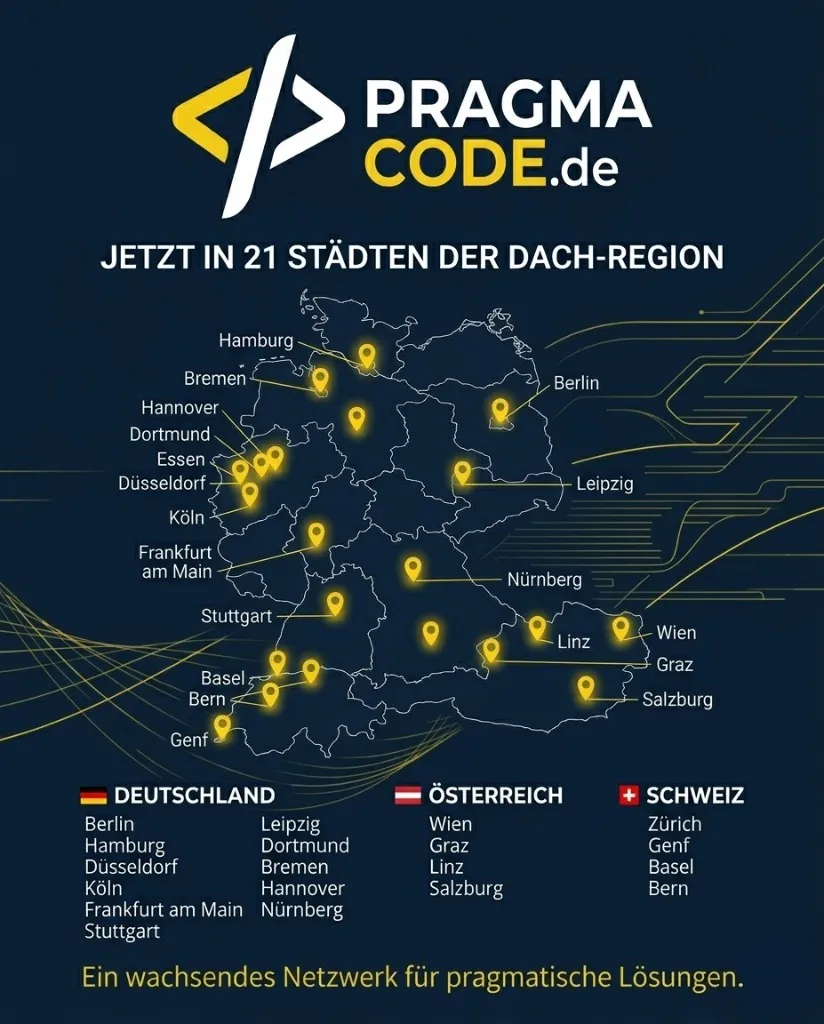
Our Regional Expertise
We are your digital partner – regionally anchored and successfully scaling across borders.
Does your web presence need an update?
Whether Responsive Design, modern frameworks or AI integration – we bring you up to the latest state of the art.
Arrange a Consultation NowGlossary: Web Development Briefly Explained
CMS (Content Management System)
Software like WordPress that allows content to be created and managed on a website without programming knowledge.
Frontend vs. Backend
Frontend is what the user sees (design, interaction). Backend is the logic in the background (databases, servers).
API (Application Programming Interface)
An interface that allows different software applications to communicate and exchange data with each other.
Full Stack
A developer who masters both the frontend and the backend and can thus build the entire web application.
SEO (Search Engine Optimization)
Measures to bring websites to higher positions in the organic search engine ranking (e.g., on Google).