
HomeWeb DevelopmentGWT Modernization
Specialty · Web Development / 08

GWT Modernization
Replacing Java Legacy

Free your software from the GWT trap. We migrate your Google Web Toolkit (GWT) frontend incrementally to Angular, React, or Vaadin — for modern performance and easy maintenance.

Legacy Modernization

From heavy monolith to fast web.

GWT has served well for over a decade for writing complex web UIs in Java. In 2026, however, unbearable compile times and developer shortages heavily slow down progress. **We use the Strangler Fig Pattern** to migrate your GWT application incrementally and safely to a decoupled, modern Single Page Application (Angular/React) with a REST/JSON backend.
Alexander Ohl Alexander OhlFounder · Pragma-Code
Architecture · GWT vs. Modern SPA

The technological comparison.

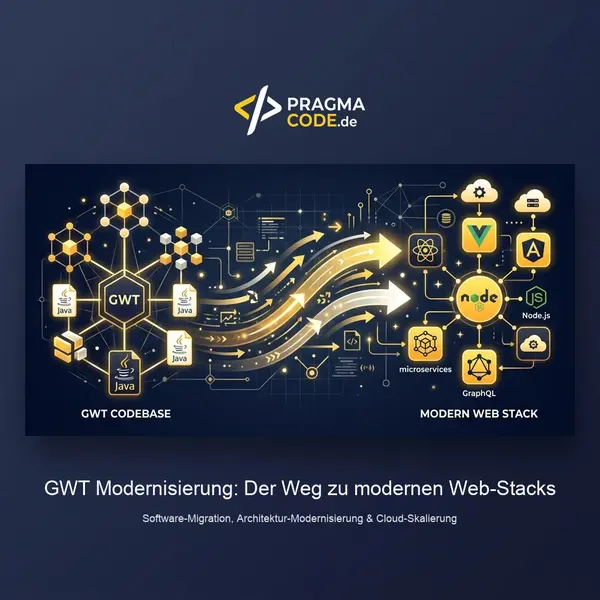
The monolithic Java coupling becomes a clean separation of frontend and backend.

Interface comparison
Enterprise architecture
Before · GWT Monolith
UI technologyGoogle Web Toolkit (Java)
API communicationGWT-RPC (proprietary)
Developer feedbackNo hot reloading
Maintenance / RecruitingExtremely difficult
LCP / Render speed> 4.5s (large bundles)
After · Modern Stack
UI technologyAngular / React (TypeScript)
API communicationRESTful JSON / OpenAPI
Developer feedbackInstant hot reload (Vite)
Maintenance / RecruitingEasy (industry standard)
LCP / Render speed< 1.2s (code splitting)
Packages · 03

Three paths out of the legacy dead end.

From API relaunch to step-by-step modernization of the entire portal.

"The API Decoupling"
Essential
4.900 – 7.500 €
approx. 2-3 weeks

We sever the GWT-RPC connection and build standardized REST/JSON APIs into your Java backend.

What's included
Replacement of GWT-RPC / RequestFactory
Spring Boot / Jakarta EE REST controller
Automated OpenAPI/Swagger schema
API documentation & testing
Preparation for Angular/React client
Request
"The Enterprise Portal Relaunch"
Enterprise
from 45.000
12+ weeks

Complete rebuild of the frontend, session & state management, and connection to complex microservices structures.

What's included
Full portal relaunch (Angular/React)
System integrations (SAP, ERP, PIM)
Custom UI/UX & design system
Automated E2E test suites (Cypress)
DevOps CI/CD pipelines & SLA support
Request
Migration Roadmap

Our structured migration process.

In 5 phases we eliminate your technological risk with zero downtime for your users.

01

Audit & Code Analysis

Inventory of all GWT views, modules, and RPC connections.

02

REST/API Relaunch

Replacing RPC interfaces in the Java backend with JSON REST controllers.

03

Frontend Architecture

Setting up the Angular/React project with modern CSS and TypeScript.

04

Incremental Rollout

Integrating new modules in production using the Strangler Fig Pattern.

05

Go-Live & Cleanup

DNS switch, go-live, and safe deprecation of the old GWT compiler.

FAQ · Frequently Asked

Questions on GWT Modernization.

Answers to the most important questions about replacing and migrating Google Web Toolkit (GWT) applications.

Why is Google Web Toolkit (GWT) considered an IT risk in 2026?
GWT has extremely slow build and compile times (often 20+ minutes), lacks native support for modern browser APIs, and suffers from a critical shortage of qualified developers. The risk of unpatched libraries in GWT's shrinking ecosystem also threatens security.
How does a GWT migration work without user downtime?
We use the Strangler Fig Pattern. First, we decouple the Java backend and migrate RPC calls to REST/JSON. Then, we migrate the UI module-by-module to the new framework (Angular/React) while the legacy GWT modules run in parallel, until the old application is completely deprecated.
Which framework is the best successor to GWT?
Angular is excellent for Java teams due to its structured architecture and built-in dependency injection. React is ideal for maximum flexibility and rapid UI scaling. Vaadin Flow is best if your team wants to continue programming 100% in Java.
Do we need to rewrite our entire backend?
No. The business logic in your Java backend remains intact. We only replace GWT-RPC endpoints with standardized REST APIs (e.g., Spring Boot or Jakarta EE), which also makes your software ecosystem more interoperable and future-proof.
How much does a typical GWT modernization cost?
Costs depend on the number of views and complexity of the data models. Small GWT applications start around €15,000, while complex enterprise portals start from €45,000. ROI is typically achieved in months due to heavily reduced development cycles.
Non-binding analysis

Secure the future of your software!

We analyze your GWT instance and develop a safe modernization roadmap.