

The European NIS2 Directive and national cybersecurity transposition laws make cyber resilience an inescapable executive responsibility in 2026. For small and medium-sized enterprises (SMEs), this introduces strict technical minimum standards, mandatory 24-hour incident reporting, and personal management liability. This comprehensive guide provides an actionable roadmap for implementing NIS2 pragmatically and cost-effectively.
This article is an in-depth expert contribution from our content cluster. Discover the complete overview on our main page:IT Security →
From Paper Tiger to Unforgiving Reality
In 2026, the European NIS2 Directive confronts an unprecedented cyber threat environment. Automated exploit frameworks, AI-generated phishing campaigns, and polymorphic ransomware necessitate a fundamental shift in executive strategy. With national transposition acts across EU member states, IT security is no longer an isolated technical task — it is a personal, non-delegable duty of executive leadership.
- Broad Scope Expansion: Tens of thousands of European companies are directly regulated (from 50 employees or €10M turnover). Hundreds of thousands more SMEs are indirectly affected through supply chain security audits.
- Personal Executive Liability: Corporate directors and executives face direct personal liability for negligent breaches of risk management duties — corporate liability waivers or shareholder resolutions waiving damages are legally void.
- Strict 24-Hour Reporting Mandate: Significant security incidents must be reported to national cybersecurity authorities (e.g., BSI) within 24 hours as an early warning, followed by a 72-hour detailed report. Without continuous monitoring and mature incident response workflows, compliance is impossible.
- 1. The Paradigm Shift: Why NIS2 Changes the Game in 2026
- 2. Applicability Analysis: Thresholds, Sectors & Supply Chain
- 3. The 10 Core Pillars of Risk Management (Article 21 NIS2)
- 4. Management Liability & Sanctions Framework
- 5. Incident Reporting: The 3-Tier Notification Mechanism
- 6. Supply Chain Security: When Enterprise Customers Audit You
- 7. The 5-Phase Implementation Roadmap for SMEs
- Conclusion: Establishing Cybersecurity as a Competitive Advantage
1. The Paradigm Shift: Why NIS2 Changes the Game in 2026
The threat environment confronting European businesses has escalated dramatically in 2026. Cybercrime has matured into a highly specialized, industrialized ecosystem. Ransomware-as-a-Service, automated vulnerability probing, and AI-driven social engineering target medium-sized enterprises on a daily basis. Small and medium-sized enterprises (SMEs) are prime targets: they possess valuable proprietary intellectual property, critical operational data, and deep integrations into global corporate supply chains — yet frequently lack enterprise-level cyber defenses.
The European Union addressed this systemic vulnerability with Directive (EU) 2022/2555, universally known as the NIS2 Directive. Through national transposition legislation across all EU member states, lawmakers have executed a radical policy shift. While cybersecurity in mid-market companies was historically treated as an operational IT matter delegated to external contractors, it has now been elevated to a legally binding, enforceable governance mandate for the entire executive board.
The statutory objective is comprehensive cyber resilience across the single market. Theoretical compliance manuals stored on internal servers no longer satisfy regulatory scrutiny. Enterprises must demonstrate proven, verifiable technical and organizational measures (TOMs) to detect threats early, contain breaches immediately, and preserve business operations through structured Business Continuity Management (BCM).
"In 2026, cybersecurity is no longer an isolated technical support function. It is a core strategic responsibility of executive leadership — backed by direct personal liability."
2. Applicability Analysis: Thresholds, Sectors & Supply Chain
One of the most impactful changes in NIS2 compared to its 2016 predecessor is the massive expansion of covered industries. While the original directive focused almost exclusively on operators of Critical Infrastructure (KRITIS) such as major power grids and telecom carriers, NIS2 sweeps across manufacturing, logistics, chemical production, and digital services.
The General Size Threshold for Mid-Market Enterprises
In general, an organization falls directly under the scope of NIS2 if it operates in one of the 18 designated sectors and satisfies or exceeds the standard EU SME size thresholds:
Employee Headcount
At least 50 employees (full-time equivalents) on an annual average.
Financial Metrics
Annual turnover exceeding €10 Million or balance sheet total exceeding €10 Million.
The regulatory framework classifies covered entities into two distinct tiers: Essential Entities and Important Entities. While the technical risk management requirements are virtually identical for both categories, they differ significantly in supervisory scrutiny and maximum penalty exposure:
Comparison: Essential vs. Important Entities under NIS2
- Sectors: Energy, Transport, Banking, Financial Market, Health, Drinking Water, Digital Infrastructure, Public Administration, Space.
- Size: Large enterprises (>250 employees or >€50M turnover) in high criticality sectors (Annex I).
- Supervision: Ex-ante proactive oversight (routine regulatory audits, on-site inspections, binding security instructions).
- Maximum Fine: Up to €10 Million or 2% of total worldwide annual turnover.
- Sectors: Postal/Courier, Waste Management, Chemicals, Food, Manufacturing (Machinery, Electronics, Automotive), Digital Providers (Cloud, Marketplaces).
- Size: Medium-sized enterprises (50–249 employees and €10M–€50M turnover) across Annex I & II.
- Supervision: Ex-post reactive oversight (inspections triggered by security incidents, customer complaints, or evidence of non-compliance).
- Maximum Fine: Up to €7 Million or 1.4% of total worldwide annual turnover.
3. The 10 Core Pillars of Risk Management (Article 21 NIS2)
Article 21 of the NIS2 Directive constitutes the operational core of the legislation. Covered organizations must implement appropriate, proportionate technical and organizational measures (TOMs) aligned with the "state of the art." The ten mandatory risk management pillars comprise:
Systematic identification, assessment, and documentation of cyber risks across all IT, OT, and cloud environments.
Deployment of an actionable Incident Response Plan for rapid threat containment and remediation.
Operational continuity via resilient backup strategies (Immutable Backups), redundant infrastructure, and regular disaster recovery exercises.
Systematic Vendor Risk Management governing relationships with direct suppliers and cloud providers.
Secure Software Development Lifecycle (SSDLC), vulnerability management, and rapid patch deployment workflows.
Regular internal security reviews, vulnerability assessments, and authorized professional Penetration Testing.
Continuous training on phishing, social engineering, password security, and operational hygiene for all staff.
Comprehensive encryption of data at rest and data in transit using modern, robust cryptographic protocols.
Granular inventory of all hardware/software assets combined with role-based access controls following the Principle of Least Privilege.
Universal enforcement of Multi-Factor Authentication (MFA) across all corporate systems and secured emergency voice/video channels.
Technical Deep Dive: Four Operational Pillars of Hardening
To translate these ten statutory duties into a typical mid-sized enterprise environment (hybrid cloud, Microsoft 365, on-premise ERP, connected shop-floor machinery), organizations should structure their remediation into four operational domains:
1. Identity & Zero Trust
Eliminate plain password authentication. Deploy phishing-resistant MFA (FIDO2 / Passkeys) across VPNs, administrator accounts, SaaS apps, and remote maintenance portals. Adopt a Zero Trust Architecture (ZTA) rooted in continuous verification.
2. Resilient Backup Architecture
Enforce the 3-2-1-1-0 backup rule featuring immutable cloud storage and an isolated, air-gapped copy. Conduct automated, quarterly disaster recovery simulations to validate recovery time objectives (RTO).
3. Microsegmentation & Patching
Strictly isolate corporate IT, development environments, and industrial operational technology (OT/SCADA). Automate vulnerability scanning with strict 14-day remediation SLAs for public-facing attack surfaces.
4. Continuous Monitoring (SOC)
Implement enterprise-grade Endpoint Detection and Response (EDR) coupled with a 24/7 Security Operations Center (SOC) for automated behavioral anomaly detection and immediate threat isolation.
Expert Pro-Tip: Prioritize High-Impact Quick Wins
Do not attempt to overhaul all ten areas simultaneously through a multi-year project. Focus immediately on the three highest-leverage controls: 1. Universal MFA on every employee account; 2. Immutable, air-gapped backups for all business-critical databases; 3. Ruthless removal of stale administrative privileges under Least Privilege. These three actions mitigate more than 80% of common ransomware intrusion vectors.
4. Management Liability & Sanctions Framework
The most powerful mechanism compelling corporate boards to prioritize cybersecurity is the severe personal liability regime established by Article 20 of NIS2:
1. Direct Approval & Oversight
Executive management must formally approve cybersecurity risk measures and continuously oversee their implementation. Delegating security entirely to IT without active governance does not release leadership from legal responsibility.
2. Mandatory Executive Training
Corporate directors and board members are legally required to undergo regular cybersecurity training to acquire verified skills for evaluating cyber risks and assessing their operational business impacts.
3. Invalidity of Liability Waivers
Shareholder resolutions or board agreements attempting to waive executive liability or settle damages arising from NIS2 non-compliance are legally void under national transposition laws.
4. Liability with Private Assets
If leadership culpably breaches risk management and supervisory duties and the company suffers harm (regulatory fines, downtime, extortion losses), executives face unlimited personal civil liability for damages.
Essential Entities
High-criticality economic sectors
Up to €10 Millionor at least 2% of total worldwide annual turnover (whichever is higher).
Important Entities
Manufacturing, trade, and digital providers
Up to €7 Millionor at least 1.4% of total worldwide annual turnover (whichever is higher).
In cases of continuous and willful non-compliance, national supervisory authorities are empowered to petition courts for temporary management bans, temporarily prohibiting non-compliant executives from exercising managerial functions.
5. Incident Reporting: The 3-Tier Notification Mechanism
NIS2 enforces extremely compressed mandatory notification windows for "significant cybersecurity incidents." An incident is classified as significant if it causes severe operational disruption, substantial financial damage, or impacts other natural or legal persons with considerable material or non-material losses.
The directive institutes a rigorous three-tiered reporting mechanism to national Computer Security Incident Response Teams (CSIRTs) and competent authorities:
Initial formal notification: Indicates whether the incident is suspected of being caused by unlawful or malicious action and whether it possesses cross-border ramifications.
Comprehensive update: Initial evaluation of severity and impact, alongside known indicators of compromise (IoCs) and containment measures implemented.
Detailed root-cause analysis, forensic findings, quantified damages, and long-term mitigation measures implemented to prevent recurrence.
These demanding timelines underscore that organizations cannot rely on ad-hoc manual responses during a breach. Meeting statutory deadlines requires automated SIEM/SOC event logging, pre-drafted notification templates, and designated incident commanders.
6. Supply Chain Security: When Enterprise Customers Audit You
In practice, supply chain governance (Article 21(2)(d) NIS2) is the primary driver compelling mid-market enterprises into compliance. Large enterprise buyers in automotive, machinery, pharmaceuticals, and finance are directly regulated and undergo intensive supervisory scrutiny. To protect their own compliance posture, they cascade cybersecurity requirements down to every tier of their supply chain.
Mid-market suppliers regularly face rigorous third-party risk questionnaires, technical audits, and strict contractual covenants, including:
1. Certified ISMS Proof
Proof of an established Information Security Management System certified under ISO/IEC 27001, TISAX (Automotive), or BSI IT-Grundschutz as a standardized foundation of trust.
2. Mandatory Penetration Testing
Contractual commitments to conduct recurring professional Penetration Testing across all exposed endpoints and furnish executive summaries to enterprise buyers.
3. End-to-End Cryptography & Incident SLAs
Certified encryption of all customer interfaces, databases, and APIs, coupled with binding contractual breach notification SLAs (frequently within 12 to 24 hours directly to client security teams).
4. On-Site Audit & Verification Rights
Granting comprehensive audit and inspection privileges to corporate customers, including technical spot-checks, standardized security questionnaires (e.g., CAIQ/VSA), and review of disaster recovery playbooks.
Suppliers that fail these assessments face disqualification from corporate procurement pools. Conversely, organizations with certified, demonstrable NIS2 compliance turn regulatory requirements into a compelling B2B competitive differentiator.
7. The 5-Phase Implementation Roadmap for SMEs
How can mid-sized companies implement NIS2 systematically without overwhelming daily operations or exceeding realistic IT budgets? Pragma Code recommends a structured 5-phase approach:
-
Phase 1: Applicability Assessment & Gap Audit
Determine your exact classification under NIS2 (Essential, Important, or Critical Vendor). Conduct a thorough gap audit against the ten risk management pillars to identify critical deficiencies.
-
Phase 2: Asset Inventory & Risk Quantification
Catalog all IT, OT, and cloud assets, data pipelines, and third-party vendors. Perform structured risk assessments to prioritize remediation based on business criticality.
-
Phase 3: Technical Hardening & Quick-Win Remediation
Deploy mission-critical controls: Universal phishing-resistant MFA, immutable cloud backups, zero-trust network segmentation, and rapid vulnerability patching.
-
Phase 4: Process Architecture, Incident Response & BCM
Document actionable incident response playbooks, establish the 24h/72h regulatory notification workflow, conduct tabletop crisis exercises, and integrate 24/7 security monitoring (SOC/EDR).
-
Phase 5: Executive Training, Auditing & Continuous Compliance
Execute mandatory board-level risk training, deliver continuous employee security awareness simulations, conduct external penetration tests, and maintain ongoing audit readiness.
Cost Trap & The Risk of Inaction
The primary financial risk of NIS2 is not the implementation investment, but the catastrophic cost of non-compliance: Crippling regulatory fines, immediate termination of enterprise customer contracts following failed vendor audits, and personal civil liability for corporate officers in the wake of ransomware outages dwarf the cost of proactive security measures.
Quick-Check: Your Pathway to NIS2 Compliance
Conclusion: Establishing Cybersecurity as a Competitive Advantage
The NIS2 Directive presents European mid-market enterprises with significant organizational and technological requirements. However, organizations that approach compliance proactively gain far more than legal immunity from fines and liability claims.
In a digital economy defined by interconnected supply chains and escalating cyber threats, verifiable resilience is one of the most powerful trust signals in B2B commerce. Enterprise customers, insurers, and financial partners gravitate toward suppliers that prove their operational resilience under pressure.
Pragma Code partners with mid-sized businesses to achieve seamless, audit-proof cybersecurity: from comprehensive gap assessments and cloud architecture hardening to managed detection and incident response capabilities. Let us transform your compliance mandate into a permanent competitive edge.
Have Questions About Implementing NIS2 in Your Business?
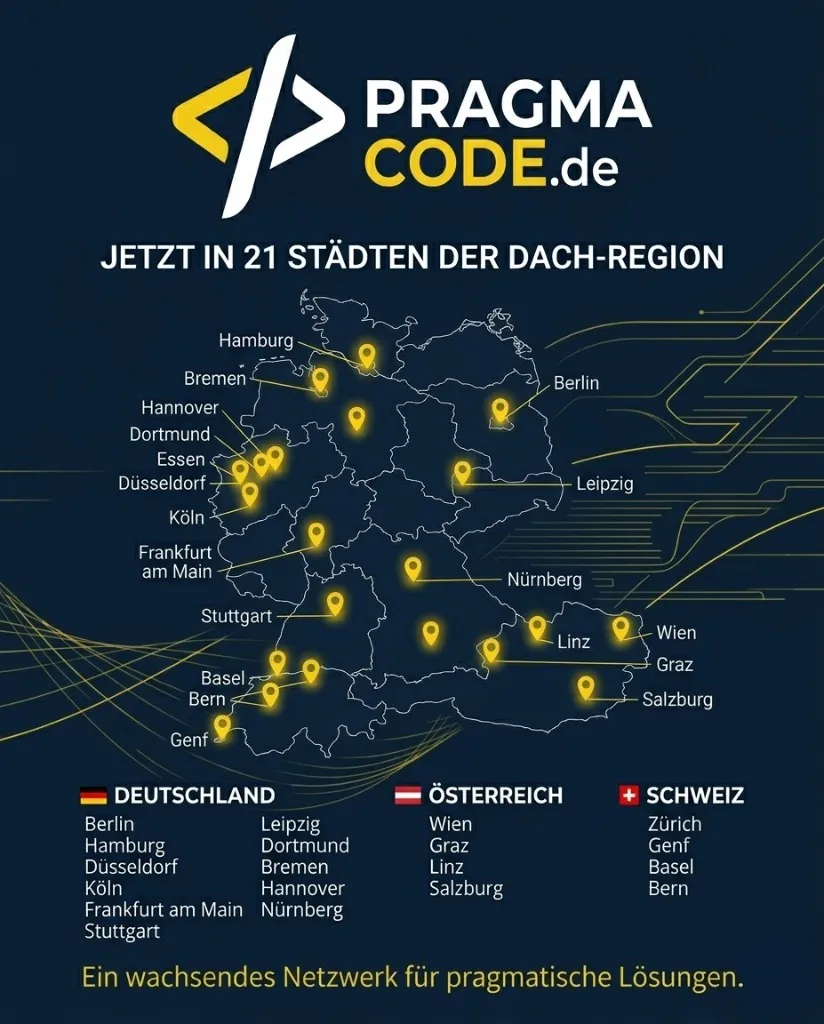
Schedule Free Initial ConsultationOur Regional Expertise
We are your digital partner – regionally anchored and successfully scaling across borders.
Is Your Company Ready for NIS2?
Let us review your cybersecurity architecture and establish fully audit-proof, resilient compliance for your business.
Schedule Free Initial ConsultationExtended Specialized Glossary
NIS2 Directive
The "Network and Information Security Directive 2" (EU 2022/2555) is an EU law strengthening cybersecurity across critical sectors and the broader economy.
Essential Entities
Sectors of high criticality (e.g., energy, transport, health) subject to strict ex-ante oversight, proactive audits, and the highest penalty tier.
Important Entities
Sectors such as manufacturing, chemicals, food, and digital services subject to ex-post reactive oversight and substantial fines.
Multi-Factor Authentication (MFA)
A security mechanism requiring users to present two or more independent authentication factors to verify their identity.
Business Continuity Management (BCM)
A holistic management process designed to maintain and rapidly restore critical business operations during severe IT outages or crises.
Security Operations Center (SOC)
A centralized unit responsible for continuously monitoring, detecting, analyzing, and responding to cybersecurity threats.
Incident Response Plan
A structured, documented action plan for rapidly detecting, containing, remediating, and reporting cybersecurity incidents.
Vendor Risk Management
The systematic process of identifying, assessing, and continuously monitoring cyber risks introduced by third-party suppliers and service providers.