

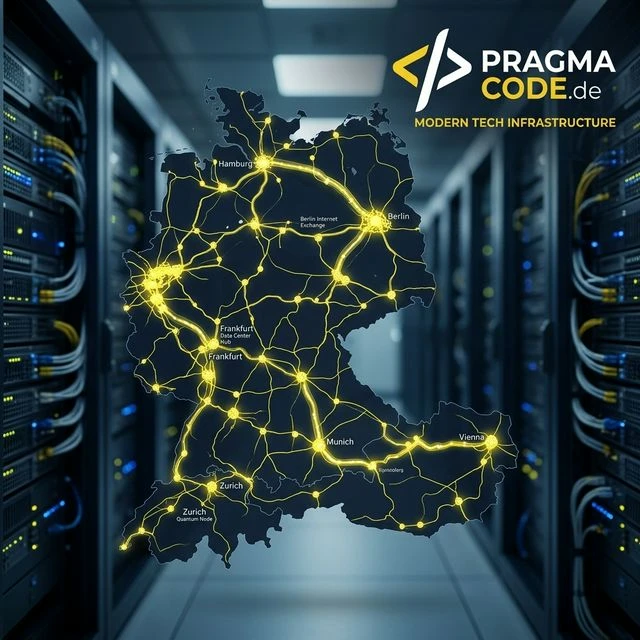
The modernization of enterprise IT infrastructure across the DACH region has reached a pivotal moment in 2026: Between mandatory NIS-2 cybersecurity compliance, the Energy Efficiency Act (EnEfG), and the rise of edge AI, digital sovereignty dictates long-term business competitiveness.
Digital Sovereignty & AI-Ready Infrastructure
Why modernizing legacy core systems, enforcing NIS-2 compliance, and adhering to new data center sustainability laws (EnEfG) in 2026 are not isolated IT projects, but existential imperatives for European enterprises.
- Infrastructure Disparity & Acceleration: While Switzerland leads globally in broadband and 5G penetration, Germany and Austria are rapidly closing the gap through aggressive nationwide fiber-to-the-home (FTTH) and 5G Standalone (SA) deployments.
- Regulatory Rigor: NIS-2 (enacted through Germany's NIS2UmsG) and the Energy Efficiency Act (EnEfG) mandate comprehensive cybersecurity audits, strict PUE thresholds (≤ 1.2), and waste heat utilization for tens of thousands of B2B companies.
- Breaking the Legacy Cost Trap: Monolithic legacy systems (COBOL, outdated ERPs) consume up to 80% of corporate IT budgets and obstruct agentic AI pipelines — phased refactoring and hybrid cloud architectures offer a proven path forward.
- 1. Introduction: The Digital Giant Awakens
- 2. Status Quo: The Infrastructure Fact Check
- 3. The Legacy Trap: Legacy Systems as Brakes on Innovation
- 4. Cloud Adoption: From German Angst to German Pragmatism
- 5. Cybersecurity: The New Rigidity Through NIS-2
- 6. Green IT: Sustainability by Law
- 7. Future Tech: Edge Computing & AI Infrastructure
- 8. Action Plan: Roadmap for Decision Makers
- 9. Conclusion: Investing in Digital DNA
1. Introduction: The Digital Giant Awakens
"Made in Germany" – a hallmark that for decades stood for unsurpassed engineering, precision, and durability. From high-performance automotive powertrains to intricate industrial machinery: The DACH region (Germany, Austria, Switzerland) perfected the physical world of Industry 3.0. But in 2026, the metrics of global economic leadership have fundamentally shifted. In a hyper-connected, AI-driven global economy, enterprise competitiveness is no longer decided solely by metallurgy and mechanical engineering, but by transmission latency, cloud resilience, and sovereign ownership over digital assets.
Looking across the digital map of Central Europe today reveals a landscape of fascinating contrasts. We observe cutting-edge smart factories still reliant on legacy copper backbones. We see global market leaders whose core transactional systems depend on COBOL code authored in the 1980s. And we see an economic powerhouse region mastering the balance between stringent data privacy and aggressive cloud innovation with fresh pragmatism.
The question facing every CEO, CIO, and IT director today is no longer: "Do we need this?" But rather: "How do we modernize our core infrastructure without compromising our foundational principles – security, reliability, and data privacy?" In this comprehensive analysis, we examine the digital engine room of the DACH economy. We dissect the physical infrastructure (broadband, 5G SA, data centers), the software architecture (cloud solutions), the regulatory mandates (NIS-2, EnEfG), and the frontier technologies shaping the future.
2. Status Quo: The Infrastructure Fact Check
To chart the path ahead, we must evaluate our current digital baseline with complete transparency. Infrastructure serves as the nervous system of modern commerce. Is it prepared for the throughput and reliability demands of agentic AI workflows and real-time operational technology?
2.1 Broadband & Fiber Optics: The Catch-Up Phase
For years, Germany faced criticism for lagging behind international peers in direct fiber-to-the-home/building (FTTH/FTTB) coverage. The prolonged reliance on "vectoring" – extracting marginal bandwidth from legacy copper lines – delayed structural fiber investments by nearly a decade. In 2026, however, substantial capital expenditure is driving rapid progress, though notable regional differences across the DACH territory persist.
*Sources: VATM, Breko Market Analysis, BAKOM, RTR
Switzerland (CH): The Benchmark
Switzerland remains an international benchmark. With 99% internet penetration and ultra-reliable broadband reaching deep into alpine valleys, Swiss infrastructure demonstrates the power of long-term planning. Swisscom and municipal utilities continue their aggressive rollout, targeting direct FTTH coverage for over 80% of all households and commercial premises by 2030.
Germany (DE) & Austria (AT): Accelerating Deployment
Germany has gained significant momentum. Substantial private and public investments by Deutsche Telekom, Deutsche Glasfaser, and municipal utilities are expanding the fiber footprint daily. Nonetheless, a clear urban-rural divide remains: Rural commercial zones ("Hidden Champion Country") still encounter asymmetrical connections that bottleneck large-scale cloud synchronization and multi-gigabit off-site backups. Austria presents a similar dynamic, where metropolitan hubs enjoy world-class connectivity while alpine topographies require innovative hybrid wireless-fiber approaches.
2.2 5G: Industrial Campus Networks over Consumer Speed
For industrial enterprises, the true value of 5G lies far beyond consumer streaming. The strategic focus is on 5G Standalone (SA) and Private Campus Networks. These deployments deliver guaranteed quality of service, dedicated bandwidth slices, and sub-10ms latencies – the vital prerequisites for autonomous guided vehicles (AGVs), real-time machine telemetry, and computer-vision robotics on the shop floor.
In this domain, Germany is an international frontrunner: By reserving dedicated local spectrum (3.7–3.8 GHz) for enterprise use, the Federal Network Agency has empowered hundreds of industrial leaders – including BMW, BASF, Siemens, and Lufthansa Technik – to deploy private, fully isolated 5G networks. Sensitive operational telemetry never traverses public telecom routes, ensuring maximum data sovereignty coupled with carrier-grade reliability.
3. The Legacy Trap: Legacy Systems as Brakes on Innovation
Beneath the surface of enterprise innovation initiatives lies an entrenched vulnerability across Central Europe: Legacy Systems.
"Legacy code is like technical debt compounded: Paying only the interest prevents investment in new growth – and invites catastrophic operational default."
3.1 Banking & Insurance Core Monoliths
The challenge is acutely evident in the financial and insurance sectors. Core transaction engines continue to run on legacy mainframes built on COBOL and PL/1 architectures. While proven to be remarkably resilient for batch processing, these architectures are rigid, opaque, and poorly suited for real-time open-banking APIs, algorithmic compliance monitoring, and instant payment protocols.
The operational risk compounds each year: The founding generation of mainframe engineers is fully retired. Contemporary software engineers specialize in modern paradigms – Rust, Go, TypeScript, and cloud-native frameworks. Maintaining vintage mainframes incurs astronomical contracting costs, while wholesale migration attempts without modular API encapsulation carry severe operational risks.
Critical Skill Depletion
Retirement of legacy COBOL/PL/1 specialists leaves severe talent voids. Rising consulting rates and shrinking talent pools turn routine maintenance into high-risk budget drains.
Security & Patch Deficits
Discontinued operating environments and proprietary middleware receive no vendor patches, creating unshielded attack vectors for ransomware and breaching NIS-2 compliance.
AI & API Integration Barriers
Rigid monoliths lacking standardized REST and event-driven interfaces block the adoption of autonomous AI agents, machine learning pipelines, and cloud microservices.
3.2 Automotive & Machinery: Software-Defined Everything
Traditional manufacturing and automotive engineering are undergoing an identical architectural shift. Historically, products were designed around mechanical assemblies; in 2026, software architectures ("Software-Defined Vehicle", "Software-Defined Manufacturing") determine product value. Companies that fail to replace fragmented ECU silos with unified data buses and modular middleware lose their edge in cloud-connected ecosystems.
4. Cloud Adoption: From German Angst to German Pragmatism
For years, DACH enterprises were governed by strict data localization conservatism. Concerns regarding extraterritorial reach under the US CLOUD Act fostered skepticism toward public hyperscalers. By 2026, pragmatic realism has prevailed: The compute demands of enterprise LLMs, multi-modal search, and global supply chain platforms cannot be economically sustained on isolated basement servers.
4.1 The Hybrid Reality & Sovereign Clouds
The dominant architecture is the Hybrid Cloud. Highly proprietary assets (CAD schematics, chemical formulations, confidential R&D) reside on-premise or in hardened Colocation facilities, while customer-facing workloads, dynamic scaling, and AI inference run seamlessly in sovereign public cloud regions.
Leading hyperscalers have adapted to stringent European regulatory expectations with dedicated sovereignty offerings:
Microsoft Azure & Cloud for Sovereignty
Dedicated cloud regions in Frankfurt and Berlin provide local data residency. The "EU Data Boundary" and public-sector collaborations (such as Delos Cloud) enforce strict GDPR-compliant governance.
Google Cloud Sovereign Solutions
Through strategic alliances with T-Systems and European partners, Google provides sovereign environments featuring externally managed encryption keys and full operational isolation.
AWS European Sovereign Cloud
Multibillion-euro investments across Frankfurt (eu-central-1), Zurich (eu-central-2), and the standalone European Sovereign Cloud in Brandenburg – operated entirely by EU resident personnel within the EU.
4.2 The Evolution of Gaia-X
Gaia-X has matured from its initial depiction as a European public cloud competitor into an impactful architectural standard for trusted Data Spaces. In manufacturing (Manufacturing-X) and automotive supply chains (Catena-X), Gaia-X frameworks allow suppliers and OEMs to exchange emissions data, material passports, and logistics telemetry securely without relinquishing proprietary data ownership.
5. Cybersecurity: The New Rigidity Through NIS-2
As industrial OT and enterprise IT converge, corporate attack surfaces expand dramatically. Automated threat actors and AI-augmented vulnerability exploitation represent an immediate operational risk for mid-sized enterprises.
5.1 NIS-2: The Regulatory Gamechanger
The European Union's NIS-2 Directive – codified in German law under the NIS2UmsG – shifts cybersecurity from advisory recommendations to strict statutory obligation. The legislation applies directly to an estimated 30,000 to 40,000 companies across 18 essential and important sectors, encompassing mid-sized organizations with 50+ employees or €10M+ annual revenue.
Core statutory requirements:
Personal Executive Liability
Managing directors and board members face direct personal financial liability for gross compliance failures in cybersecurity governance. Delegation without effective oversight is legally invalid.
Strict Incident Reporting
Significant security incidents require an early warning notification within 24 hours and a comprehensive assessment within 72 hours to designated authorities (e.g., BSI).
Supply Chain Cascades
Enterprises are legally mandated to audit and enforce cybersecurity standards across direct suppliers and service partners, creating a ripple effect across the entire vendor ecosystem.
These legal mandates are accelerating the adoption of 24/7 Managed Detection and Response (MDR), Zero Trust architectures, and automated vulnerability management, enabling mid-market companies to achieve enterprise-grade defense without prohibitive internal SOC overhead.
6. Green IT: Sustainability by Law
Data center infrastructure is among the most energy-intensive components of modern industry. In response, Germany's Energy Efficiency Act (EnEfG) establishes legally binding energy efficiency standards for all server infrastructure.
Facility operators and enterprise data centers must comply with mandatory metrics that govern operational licensing and expansion approvals:
PUE Threshold of 1.2
New data centers must deploy ultra-efficient cooling architectures, restricting auxiliary energy overhead to a maximum of 20% of total compute power (PUE ≤ 1.2).
Mandatory Waste Heat Reuse
Operators must channel thermal server exhaust into municipal district heating networks or neighboring industrial facilities, accelerating the deployment of liquid and immersion cooling.
100% Renewable Power & Reporting
Facilities must secure 100% unsubsidized renewable energy supply and submit validated operational metrics to the federal energy efficiency registry annually.
These regulatory demands are driving a decisive migration from inefficient in-house server rooms to certified green colocation centers and cloud regions purpose-built for thermal recovery.
7. Future Tech: Edge Computing & AI Infrastructure
Following a decade of continuous centralization into the hyperscale cloud, 2026 marks the rise of intelligent distributed systems: the synergy of cloud scale and Edge Computing.
Field Application: Edge AI Quality Inspection on Manufacturing Lines
In high-speed manufacturing environments, optical sensors capture 120 high-resolution images per second of passing workpieces. A computer-vision AI model inspects surfaces for micro-defects in real time. If raw video streams had to travel to a centralized cloud in Frankfurt for processing, the latency would cause the sorting arm to miss defective components.
The Edge Solution: A ruggedized industrial edge server adjacent to the line processes telemetry with sub-5ms latency. Only compressed defect telemetry and model refinement batches are asynchronously synchronized with the central cloud.
Combined with efficient on-device neural processing units (NPUs), "AI at the Edge" empowers factories across Germany, Austria, and Switzerland to maintain autonomous, highly secure operations even during external network interruptions.
8. Action Plan: Roadmap for Decision Makers
Navigating simultaneous regulatory mandates, legacy dependencies, and AI adoption requires strategic clarity. The following 5-phase framework outlines an actionable path for 2026:
-
Status Quo Audit & Infrastructure Assessment
Conduct an exhaustive audit of your technical footprint: Identify end-of-life servers, unauthorized shadow IT, bandwidth constraints, and redundancy gaps across all operational locations.
-
NIS-2 & Cybersecurity Gap Analysis
Formally assess your organization's statutory exposure under NIS-2. Implement mandatory risk assessments, incident response protocols, multi-factor authentication (MFA), and zero-trust segmentation to mitigate personal executive liability.
-
Legacy Modernization & Decommissioning (3R Strategy)
Categorize legacy debt and execute against the 3R framework: Encapsulate (wrap vintage core logic in REST/gRPC APIs), Refactor (migrate code to cloud-native stacks), or Replace (transition to standard SaaS platforms).
-
Refine Hybrid Cloud & Data Sovereignty
Establish strict data classification: Determine which core IP remains in sovereign private zones versus public cloud hyperscalers. Deploy an agile Cloud Center of Excellence (CCoE) to govern architecture and FinOps.
-
Future-Proof Sourcing & Talent Strategies
Specialized talent in Kubernetes security, cloud architecture, and DevSecOps remains scarce and expensive in the DACH market. Partner with Managed Service Providers (MSPs) like Pragma-Code to access elite technical expertise on demand.
9. Conclusion: Investing in Digital DNA
The technology infrastructure in the DACH region possesses formidable strengths: critical internet exchange hubs, a robust electrical grid, and gold-standard data protection frameworks that command global trust.
Yet the velocity of the AI transformation demands continuous modernization. Organizations anchored to outdated infrastructure architectures from the previous decade face mounting risks of obsolescence, security breaches, and escalating maintenance overhead. In 2026, IT infrastructure is no longer a cost center to be minimized, but the foundational strategic asset that enables agility, resilience, and sustainable enterprise value.
Do you have questions about modernizing your IT infrastructure?
We analyze your IT architecture, audit your NIS-2 resilience, and architect tailored hybrid cloud and edge AI strategies for mid-market enterprises.
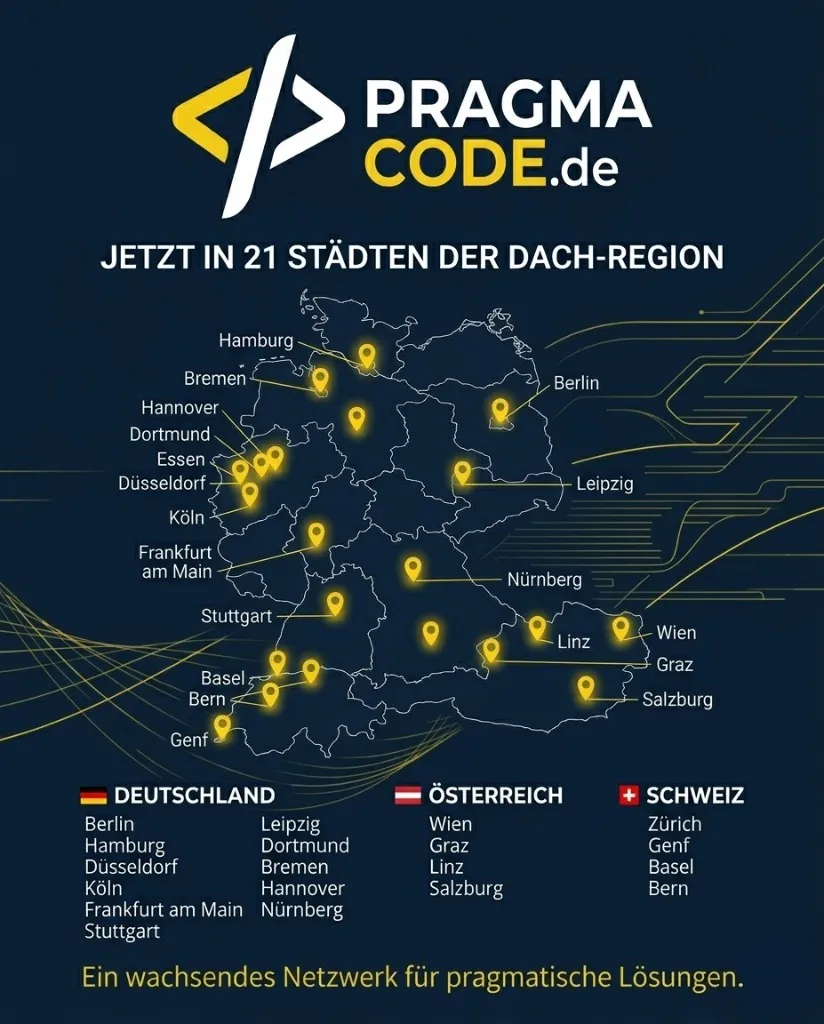
Schedule a Free Initial ConsultationOur Regional Expertise
We are your digital partner – regionally anchored and successfully scaling across borders.
Have a vision?
Let's check together how we can make your idea take flight.
Book your free strategy call nowExtended Specialized Glossary
Edge Computing
Decentralized data processing at the edge of the network, close to the data source (e.g., IoT sensor). Drastically reduces latency times and relieves the central cloud. Essential for autonomous driving and Industry 4.0.
Hybrid Cloud
A mix of private IT infrastructure (on-premise/private cloud) and public cloud services (hyperscalers). Combines the security and control of local data with the infinite scalability of the public cloud.
Data Sovereignty
The ability of a natural or legal person to retain full control over their own data. Also: The concept that data is subject to the laws and regulations of the country in which it is stored.
NIS-2 (Network and Information Security)
EU directive to strengthen cybersecurity. Extends obligations (risk management, reporting) to significantly more sectors and introduces personal liability for executives.
Legacy Systems
Outdated software or hardware that is still in use but is difficult to maintain, poorly documented, and often incompatible with modern technology. A high security risk.
PUE (Power Usage Effectiveness)
Key figure for the energy efficiency of a data center. The closer the value is to 1.0, the more efficiently the DC operates. A value of 1.2 is the new target standard for Green IT.
5G Standalone (SA)
A mobile network based entirely on 5G technology (even in the core network) and no longer based on 4G infrastructure. Enables Network Slicing and extremely low latencies.
Colocation
"Server Housing". A company rents space (racks) in a professional data center for its own hardware, but uses the operator's power, cooling, and security.