

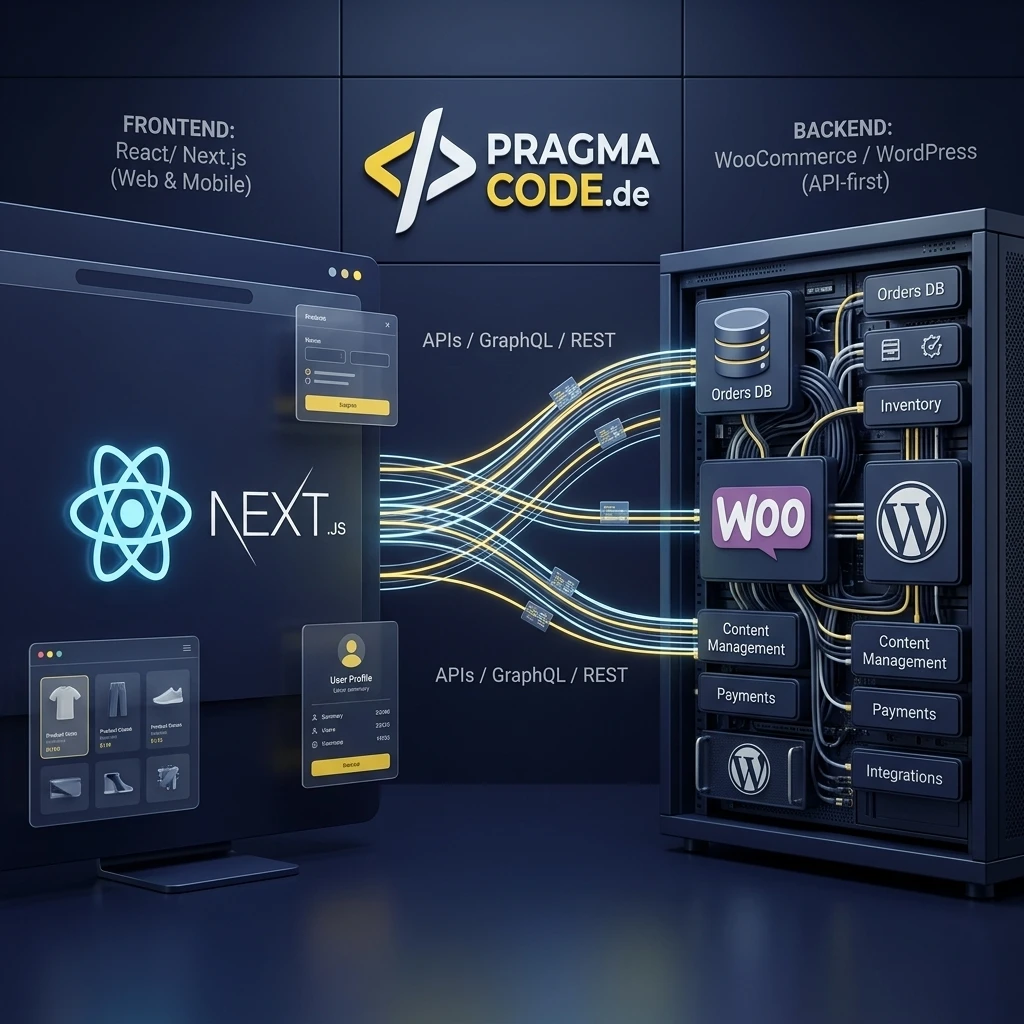
Classic monolithic e-commerce systems struggle with page speed, security vulnerabilities, and AI-driven shopping workflows. Discover how to build an uncompromisingly fast, scalable, and future-proof e-commerce platform with Headless WooCommerce and Next.js 15.
This article is an in-depth expert contribution from our content cluster. Discover the complete overview on our main page:E-Commerce Solutions →
Decoupling as the Foundation for Agentic Commerce
In 2026, human users are no longer the only shoppers online. Autonomous AI agents, Large Language Models (LLMs), and intelligent shopping assistants scan the web for machine-readable, structured product data and complete transactions autonomously. A modern headless architecture with Next.js and WPGraphQL provides the exact API-first performance, strong typing, and edge reliability needed to remain discoverable and purchasable in the era of agentic commerce.
- Sub-Second Page Speed: Decoupling the frontend reduces Largest Contentful Paint (LCP) to under 0.8s and Interaction to Next Paint (INP) to under 50ms, proven to boost e-commerce conversion rates by up to 30%.
- Machine Readability & GEO: Strongly-typed GraphQL queries and a lightning-fast, statically generated frontend allow search engines and AI agents (Perplexity, SearchGPT, OpenAI Operator) to index inventory levels and product variations in real time without HTML bloat.
- Isolated Security & Scalability: Because the WordPress backend operates entirely behind a protected API and is never exposed directly to public web traffic, vulnerabilities like plugin exploits, brute-force attacks on
wp-login.php, and frontend SQL injections are eliminated.
- Introduction: Why Headless WooCommerce in 2026?
- What is Headless WooCommerce? Technical Definition & Separation
- The 4 Layers of Modern Headless Architecture
- Core Web Vitals & Performance Engineering
- WPGraphQL Deep Dive: Efficiency Without Overfetching
- Next.js 15, ISR & Partial Prerendering (PPR) in Detail
- Cart & State Management with React 19 Server Actions
- Payment Integration: Stripe Elements & Express Checkout
- Enterprise Security & Caching for Edge CDNs
- Agentic Commerce: Product Catalogs for Autonomous AI Shoppers
- Challenges & SEO Strategies for Headless Deployments
- Step-by-Step Architecture Blueprint & Migration Plan
- The Business Case: ROI, Scalability & Cost Analysis
- Conclusion: The Future Belongs to the Decoupled
Introduction: Why Headless WooCommerce in 2026?
The digital commerce landscape has undergone a profound transformation. While classic monolithic WordPress shops frequently hit performance ceilings when managing complex catalogs, large order volumes, and modern web vitals, the headless approach provides the necessary architectural freedom. WooCommerce remains the proven, customizable administrative engine for managing products, pricing, stock levels, and tax rules, while a modern frontend built on Next.js delivers instant user experiences across global Edge networks.
In an era of mobile micro-moments, any lag in page transitions is immediately penalized. Search algorithms evaluate Core Web Vitals as critical ranking signals, and online shoppers abandon their carts when product pages take longer than a fraction of a second to render. Headless is no longer an experimental niche—it is the gold standard for ambitious online retailers looking to combine extreme page speed with design freedom and bulletproof software infrastructure.
What is Headless WooCommerce? Technical Definition & Separation
In software architecture, "headless" refers to the strict decoupling of the presentation layer (frontend) from the data storage and business logic (backend). In a traditional WordPress setup, the web server executes PHP scripts on every request, issues dozens of SQL queries, loads numerous plugin stylesheets, and delivers a monolithic HTML payload. In headless WooCommerce, WordPress is streamlined to its core strength: it acts purely as a Headless CMS and transactional e-commerce engine.
Backend: WordPress & HPOS
WooCommerce serves as the administrative interface for product management, inventory, order processing, and ERP integrations with dedicated SQL tables.
API Layer: WPGraphQL
A strongly-typed GraphQL schema delivers precise product attributes, variants, and filters in lightweight JSON payloads without overfetching.
Frontend: Next.js 15 & Edge CDN
Static pre-rendering, Server Actions, and global CDN distribution guarantee sub-second load times for customers across the globe.
Product data and inventory changes are communicated to the independent frontend via standardized APIs. This allows the user interface to be deployed across global Edge servers with double-digit millisecond latency, while the database-heavy WordPress backend remains secure and isolated behind a strict corporate firewall.
Comparison: Monolithic vs. Headless WooCommerce
- Time to First Byte (TTFB): Slow response times ranging from 800ms to 2000ms due to synchronous PHP rendering and database bottlenecks.
- Frontend Constraints: Restricted by WordPress theme hierarchies, PHP template tags, and conflicting plugin scripts.
- Security Exposure: Direct attack surface on the WordPress core via public URLs (
/wp-login.php,/xmlrpc.php). - Maintenance Fragility: Plugin updates risk breaking the visual layout or triggering incompatibilities in the checkout flow.
- Scaling Bottlenecks: Traffic spikes require massive server hardware because every visitor hits the PHP application server.
- Time to First Byte (TTFB): Instant response times under 50ms powered by static HTML served directly from global Edge CDNs.
- Frontend Freedom: 100% design flexibility using React 19, Tailwind CSS, fluid animations, and client-side page transitions.
- Enterprise Security: The WordPress backend is shielded behind an API gateway, completely hidden from public traffic.
- Independent Deployments: Frontend and backend teams deploy independently via modern CI/CD pipelines with zero downtime.
- Predictable Scaling: Thousands of concurrent shoppers place zero load on WordPress because 95% of traffic is served by the CDN.
The 4 Layers of Modern Headless Architecture
To run a decoupled e-commerce platform that is resilient, low-maintenance, and ultra-fast, we structure the technology stack into four dedicated layers. Each layer performs a specialized function and can be independently scaled, secured, and updated:
1. WordPress HPOS Core
WooCommerce handles products, inventory, coupons, taxes, and customer profiles. With HPOS (High-Performance Order Storage), orders are stored in dedicated transactional SQL tables, preventing database locks during high-volume sales.
2. WPGraphQL Schema Layer
The WPGraphQL plugin serves as the typed bridge. It converts relational WooCommerce data into an efficient GraphQL schema, supports smart cache tags, and eliminates payload bloat.
3. Next.js 15 Edge Frontend
Hosted on Vercel or Cloudflare, Next.js utilizes React Server Components and Partial Prerendering (PPR). Static catalog shells are cached globally, while dynamic price and stock data stream via Edge Suspense boundaries.
4. Headless Checkout & Gateway
Sensitive payment credentials flow directly to payment gateways like Stripe Elements, Apple Pay, or PayPal Vault. Server Actions validate checkout sessions and create orders via the backend API.
Core Web Vitals & Performance Engineering
In modern e-commerce, site speed directly influences revenue and customer loyalty. Empirical studies consistently demonstrate that reducing page load times by just 100 milliseconds can increase e-commerce conversion rates by up to 8%. In traditional WordPress setups, render-blocking CSS files, unoptimized media assets, and third-party tracking scripts degrade real-world user metrics. Next.js grants complete control over every single byte sent to the browser.
LCP (Largest Contentful Paint)
The time it takes to render the largest visual element on the page (e.g., hero banners or product hero images).
< 0.8sAchieved through Next.js Image Optimization, AVIF compression, and automatic asset preloading at the Edge CDN.
INP (Interaction to Next Paint)
The latency of user interactions (e.g., clicking product filters, variant selectors, or add-to-cart buttons).
< 50msAchieved via lean JavaScript bundles, React Server Components, and the removal of heavy client-side DOM manipulations.
Optimizing Core Web Vitals is not only essential for consumer satisfaction—it represents a decisive search ranking factor. While heavy monoliths frequently drop into poor mobile health ranges (LCP > 2.5s), a decoupled Next.js architecture consistently maintains perfect green scores across all key metrics.
WPGraphQL Deep Dive: Efficiency Without Overfetching
The primary drawback of conventional REST APIs in e-commerce is overfetching. When a frontend requests a list of 20 products for a collection page via /wp-json/wc/v3/products, WordPress responds with hundreds of unused fields: full HTML descriptions, raw tax data, post meta arrays, and nested taxonomy objects. This inflates the JSON payload into several megabytes and stalls mobile data connections.
By leveraging WPGraphQL alongside WPGraphQL for WooCommerce, we query only the precise fields needed for the active view. The following query demonstrates an optimized category listing:
query GetCategoryProducts($categorySlug: String!, $first: Int = 12) {
  productCategory(id: $categorySlug, idType: SLUG) {
    name
    products(first: $first) {
      nodes {
        id
        databaseId
        name
        slug
        ... on SimpleProduct {
          price(format: FORMATTED)
          regularPrice(format: FORMATTED)
          stockStatus
        }
        ... on VariableProduct {
          price(format: FORMATTED)
          regularPrice(format: FORMATTED)
        }
        featuredImage {
          node {
            sourceUrl(size: MEDIUM_LARGE)
            altText
          }
        }
      }
    }
  }
}
This query slashes the payload size by over 85% compared to the default REST API. Furthermore, GraphQL enables request batching: product listings, navigation trees, sitewide announcements, and currency rates can be fetched in a single unified network request, eliminating redundant HTTP roundtrips.
Next.js 15, ISR & Partial Prerendering (PPR) in Detail
Historically, e-commerce engineering required choosing between pure Static Site Generation (SSG) and dynamic Server-Side Rendering (SSR). SSG provides unrivaled page speeds but suffers from multi-hour build times on catalogs with tens of thousands of SKUs. SSR, on the other hand, dynamically renders HTML on every visit, leading to noticeable Time to First Byte (TTFB) delays during high-traffic campaigns.
Next.js 15 solves this dilemma through the integration of Incremental Static Regeneration (ISR) and Partial Prerendering (PPR). ISR revalidates static pages asynchronously in the background based on a configurable time window or on-demand webhook triggers:
// app/products/[slug]/page.tsx
import { notFound } from 'next/navigation';
import Image from 'next/image';

interface ProductPageProps {
  params: Promise<{ slug: string }>;
}

// On-demand revalidation or time-based ISR (e.g., every 3600 seconds)
export const revalidate = 3600;

export async function generateStaticParams() {
  const topProducts = await fetchTopProductSlugs();
  return topProducts.map((slug) => ({ slug }));
}

export default async function ProductPage({ params }: ProductPageProps) {
  const { slug } = await params;
  const product = await getProductBySlug(slug);

  if (!product) {
    notFound();
  }

  return (
    <article className="product-layout grid grid-cols-1 md:grid-cols-2 gap-8">
      <div className="product-gallery relative aspect-square">
        <Image
          src={product.featuredImage.node.sourceUrl}
          alt={product.featuredImage.node.altText || product.name}
          fill
          priority
          sizes="(max-width: 768px) 100vw, 50vw"
          className="object-cover rounded-xl"
        />
      </div>
      <div className="product-details flex flex-col justify-center">
        <h1 className="text-3xl font-bold text-navy">{product.name}</h1>
        <div className="price-tag text-2xl font-bold text-primary mt-2">
          {product.price}
        </div>
        <p className="text-slate-600 mt-4 leading-relaxed">{product.shortDescription}</p>
      </div>
    </article>
  );
}
With Next.js 15 Partial Prerendering, the static skeleton of a product page (branding, typography, images, product specs) is served instantly from the nearest Edge CDN. Meanwhile, dynamic elements like live stock levels, personalized customer pricing, and cart drawers stream in parallel via React Suspense boundaries. Shoppers experience content rendering in under 300 milliseconds without waiting for heavy database lookups.
Cart & State Management with React 19 Server Actions
In traditional WordPress architectures, shopping carts depend on PHP sessions and server cookies that mandate frontend and backend sharing the same domain. In a headless setup, however, the frontend (e.g., www.shop-brand.com) and the administrative backend (e.g., admin.shop-brand.com) often live on separate hostnames.
In modern Next.js deployments, cart state is managed via React 19 Server Actions coupled with encrypted HTTP-only cookies or stateless JWT tokens. This removes client-side API boilerplate and protects sensitive session tokens from cross-site scripting (XSS) attacks:
// app/actions/cart.ts
'use server';

import { cookies } from 'next/headers';
import { revalidateTag } from 'next/cache';

export async function addToCartAction(productId: number, quantity: number = 1) {
  const cookieStore = await cookies();
  const cartSessionToken = cookieStore.get('wc_cart_token')?.value;

  const mutation = `
    mutation AddToCart($input: AddToCartInput!) {
      addToCart(input: $input) {
        cart {
          total
          contents {
            itemCount
          }
        }
      }
    }
  `;

  const response = await fetch(process.env.WORDPRESS_GRAPHQL_ENDPOINT!, {
    method: 'POST',
    headers: {
      'Content-Type': 'application/json',
      ...(cartSessionToken && { 'woocommerce-session': `Session ${cartSessionToken}` }),
    },
    body: JSON.stringify({
      query: mutation,
      variables: { input: { productId, quantity } },
    }),
  });

  const { data, headers } = await response.json();

  // Revalidate cart cache tag across the application
  revalidateTag('user-cart');
  return data?.addToCart?.cart;
}
This pattern ensures cart state persists seamlessly across user sessions, devices, and domain boundaries without bombarding the WordPress database on every page navigation.
Payment Integration: Stripe Elements & Express Checkout
The checkout funnel is the highest-stakes phase in digital retail. Redundant form fields, slow payment gateways, or jarring third-party redirects increase cart abandonment. In a headless environment, the entire checkout experience is embedded natively into the React application.
Stripe Elements & Payment Intents
Fully styled, on-page credit card fields that avoid redirects. Payment card details never touch your server (SAQ-A PCI compliance).
1-Click Express Checkout
Integration of the W3C Payment Request API for instant transactions via Apple Pay and Google Pay directly from product or cart views.
Asynchronous Webhook Settlement
Reliable background processing of payment confirmation events to generate customer invoices and trigger automated warehouse fulfillment.
Pro Tip: Accelerating Conversions with Stripe Link
Enable Stripe Link in your headless checkout. Customers save their billing and shipping details once and complete subsequent purchases across all participating stores in under 10 seconds via SMS verification. This reduces mobile checkout abandonment by up to 35%.
Enterprise Security & Caching for Edge CDNs
Decoupling the frontend from the backend provides formidable security advantages over monolithic WordPress installations. Because the Next.js frontend strictly serves static assets and interacts with APIs via secured server routes, the underlying WordPress server remains completely hidden from malicious actors.
1. Complete Backend Isolation & IP Whitelisting
The WordPress administration endpoint (/wp-admin) is locked down via Web Application Firewalls (WAF) or corporate VPN tunnels. Only authorized staff and the Next.js deployment servers have access.
2. On-Demand Cache Invalidation via WordPress Webhooks
When an editor updates a product price or inventory count in WooCommerce, a webhook notifies Next.js (res.revalidate()) to re-render only the affected product URL in the global CDN cache.
3. Rate Limiting & Query Complexity Protection
The GraphQL endpoint is fortified against denial-of-service attacks by enforcing strict query depth limits, cost analysis rules, and disabling unauthenticated schema introspection in production.
4. Zero Customer PII Exposure in Static Builds
Personal customer data, order histories, and payment logs remain safely encrypted in the backend database and are never leaked into static build artifacts.
Agentic Commerce: Product Catalogs for Autonomous AI Shoppers
E-commerce is undergoing a structural paradigm shift: consumers increasingly delegate shopping tasks to autonomous AI agents (such as Perplexity Pro, ChatGPT Search, and OpenAI Operator) to research, compare, and purchase products autonomously. For this emerging Agentic Commerce era, legacy monoliths with tangled HTML structures and intrusive popups present severe obstacles.
A headless architecture with Next.js produces clean, semantic, machine-readable HTML and injects comprehensive Schema.org JSON-LD entities (Product, Offer, AggregateRating, ItemAvailability). Furthermore, retailers can expose dedicated, token-efficient JSON or Markdown endpoints allowing LLMs to parse product specifications and stock levels instantly without interference from client-side scripts.
Challenges & SEO Strategies for Headless Deployments
During a migration to a decoupled frontend, SEO stakeholders must ensure that search rankings, structured data schemas, and legacy link equity are preserved without loss. Because Next.js pre-renders HTML on the server, search engine bots receive fully rendered, indexable pages.
Yoast & RankMath GraphQL Bridging
Canonical tags, Open Graph cards, and meta descriptions are pulled directly from WordPress SEO plugins via WPGraphQL into the Next.js Metadata API.
Dynamic XML Sitemaps
Next.js generates high-performance XML sitemaps for products, collections, and articles that update automatically upon catalog modifications.
Edge-Level 301 Redirects
Legacy URL paths are mapped and redirected directly at the Edge CDN layer or via next.config.js, maintaining redirect latencies under 10ms.
This clean separation eliminates duplicate canonical tag issues and header conflicts that frequently plague multi-plugin WordPress themes.
Step-by-Step Architecture Blueprint & Migration Plan
Transitioning to an enterprise-grade headless architecture follows a structured four-stage implementation blueprint designed to de-risk migration and preserve business continuity:
Backend Audit & HPOS Activation
Prune legacy plugins, migrate WooCommerce databases to HPOS dedicated tables, and configure WPGraphQL with secure JWT authentication.
Schema Design & GraphQL Optimization
Define typed queries and mutations, set up WPGraphQL Smart Cache with cache-tag invalidation, and configure server-side query whitelisting.
Next.js 15 Frontend Development
Construct the design system with Tailwind CSS, implement React Server Components, ISR catalog routes, and React 19 Server Actions for the cart.
Payment Integration & End-to-End Testing
Embed Stripe Elements and 1-click payment methods. Execute automated Playwright E2E checkout tests under peak traffic load simulations.
The Business Case: ROI, Scalability & Cost Analysis
Investing in a headless infrastructure delivers quantifiable commercial returns. While upfront implementation costs are higher than buying an off-the-shelf theme, growing e-commerce businesses typically reach full ROI within months through conversion gains and infrastructure efficiency:
| Economic Factor | Classic WooCommerce (Monolith) | Headless WooCommerce (Next.js) |
|---|---|---|
| Conversion Rate | Industry average approx. 1.5% to 2.2% | 15% to 30% increase driven by sub-second page loads |
| Hosting Costs at Scale | Exponential growth during high-traffic spikes | Linear and predictable (Edge CDN absorbs 95% of traffic) |
| Security & Maintenance | High (frequent patching, malware scans, downtime risk) | Minimal (isolated backend, zero public attack surface) |
| Stack Longevity | Tied to legacy PHP themes and plugin dependencies | High adaptability via standardized API-first design |
Beyond immediate conversion lifts, development agility accelerates significantly: marketing teams can deploy new campaign landing pages or A/B tests in the Next.js frontend within hours without touching core backend database operations.
Conclusion: The Future Belongs to the Decoupled
Headless WooCommerce powered by Next.js 15 defines the technological benchmark for modern e-commerce in 2026. By slashing page load times to sub-second levels, securing customer transactions behind isolated APIs, and making product catalogs natively readable for autonomous AI agents, retailers establish an enduring competitive advantage in digital commerce.
Quick Check: Is Your Shop Ready for Headless Commerce?
Do you have questions about Headless WooCommerce?
We analyze your existing e-commerce setup and collaborate with you to create a tailored blueprint for migrating to a lightning-fast, decoupled Next.js storefront.
Book your free strategy call nowOur Regional Expertise
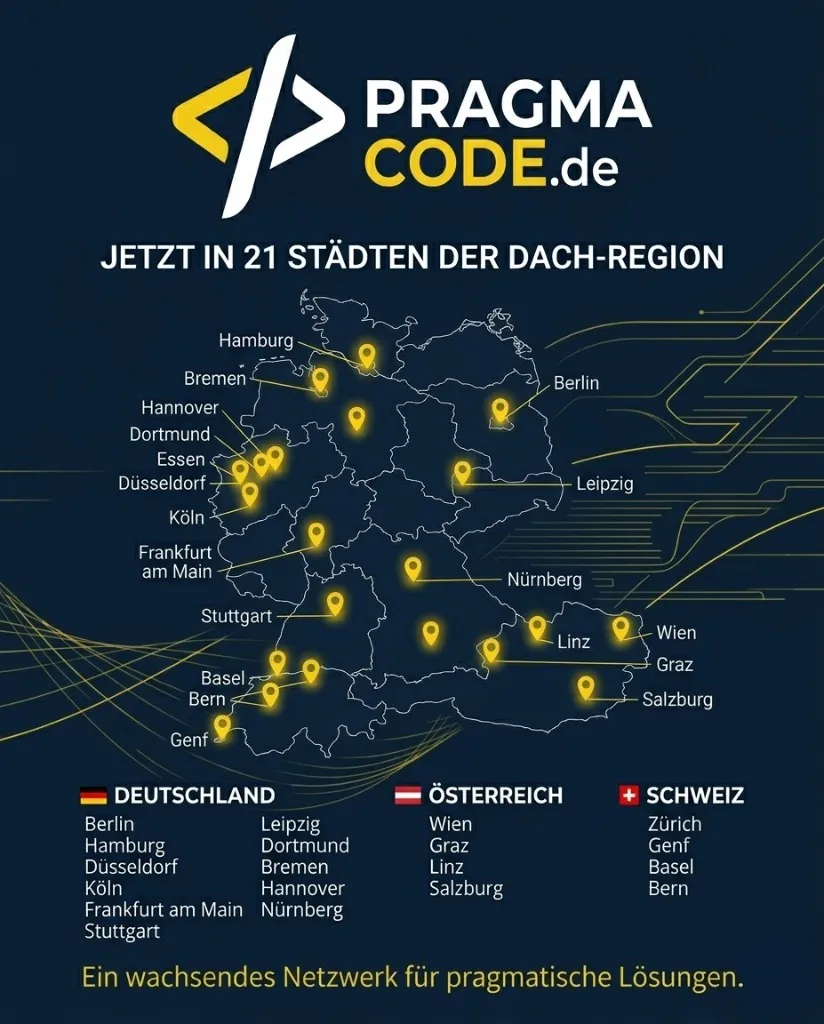
We are your digital partner – regionally anchored and successfully scaling across borders.
Have a vision?
Let's check together how we can make your idea take flight.
Book your free strategy call nowExtended Specialized Glossary
Headless WooCommerce
An e-commerce architectural model where WooCommerce is used exclusively for data management (backend), while the user interface (frontend) is developed completely independently using modern frameworks like Next.js.
WPGraphQL
A WordPress plugin that provides a GraphQL interface. It allows for more efficient data queries than the standard REST API by requesting only the needed fields.
ISR (Incremental Static Regeneration)
A Next.js technology that allows static pages to be updated in the background without having to rebuild the entire shop. Ideal for price changes.
SSG (Static Site Generation)
A process where web pages are generated as static HTML files during build time. This leads to extremely fast loading times and SEO benefits.
HPOS (High-Performance Order Storage)
A dedicated database table architecture for WooCommerce that stores order data in optimized SQL tables instead of the bloated WordPress postmeta table.