


The Role of AI and Autonomous Agents in SME Scaling
In 2026, scaling operations no longer strictly requires linear headcount growth. By leveraging LLMs and agentic workflows, administrative processes can scale almost limitlessly. SMEs that standardize their processes today are building the perfect foundation to deploy AI agents tomorrow.
- Standardization is Mandatory: Any growth without clear, documented processes only multiplies existing chaos. Standardization is the bedrock of scaling.
- Automation Leverage: Cloud solutions and workflow engines like n8n eliminate media breaks. Routine tasks are fully automated, allowing staff to focus on high-value work.
- From Operator to Architect: Successful scaling requires a leadership transformation – shifting from working in the daily business to working on the system itself.
Introduction: The Growth Dilemma in SMEs
Small and medium-sized enterprises (SMEs) are the backbone of the global economy. Yet many face a paradoxical problem: success can be dangerous. When order books are full, the team grows, and sales increase, something unexpected often happens. Instead of cheering, chaos erupts. The processes that worked perfectly for a 5-person team collapse when the headcount reaches 20 or 50.
Quality suffers, customer complaints mount, delivery times slip, and the CEO becomes the ultimate bottleneck because "everything has to cross their desk." Every approval, every question, and every strategic decision blocks daily operations. The workload of the founders and key staff rises to unsustainable levels, while productivity per employee often decreases.
This is the classic growth dilemma. Scaling does not simply mean "more of everything" – more employees, more customers, and more revenue. True scaling means creating structures that can withstand and promote growth without costs rising linearly. It is the transition from a person-dependent operation to a system-supported company.
In this leading article, we analyze how you can master this transition. We show why standardization is not boring bureaucracy, how cloud solutions and modern automation act as multipliers, and how you can increase your profitability – without losing the flexibility that made you successful in the first place.
- Introduction: The Growth Dilemma in SMEs
- Chapter 1: The Foundation – Standardization Before Scaling
- Chapter 2: The Digital Turbocharger – Cloud Systems and Workflow Automation
- Chapter 3: Predictable Growth – Performance Marketing & Lead Systems
- Chapter 4: HR as a Scaling Driver – Digital Onboarding
- Chapter 5: The Complexity Trap – Profitability vs. Flexibility
- Roadmap: The 5-Step Blueprint for Successful SME Scaling
- Conclusion: From Operator to Architect
- Glossary: Key Terms in Scaling
Chapter 1: The Foundation – Standardization Before Scaling
Why Chaos Does Not Scale
A common misconception among SME business owners is that standardization kills employee creativity and makes the company rigid. The opposite is true: standardization creates the necessary space for creativity by making routine tasks predictable, error-free, and fast. If your team has to think from scratch every day about how to issue an invoice, onboard a customer, or generate a report, they waste valuable cognitive resources.
The golden rule of digitalization is: You can only automate and scale what you have first standardized. If you digitalize a bad, manual, and chaotic process, you simply get a fast, digital, and automated chaotic process. The chaos becomes faster and more severe, but not better.
The 'Bus Factor' in the Organization
Standardization reduces the so-called "Bus Factor" (sometimes called the "lottery factor"). This describes the number of key employees who would have to suddenly drop out (e.g., due to illness or winning the lottery) for a project or the entire company to come to a standstill. If all operational knowledge exists only in the minds of individual staff and is not recorded in documented processes, your company is extremely vulnerable and impossible to scale.
The Playbook Principle in Practice
Every growing SME needs a written "company operating system." We call this the Playbook. A Playbook documents your company's core processes in the form of simple, clear, step-by-step instructions (SOPs – Standard Operating Procedures).
These documents should not be dusty PDF binders on a network drive, but living documents in a modern, collaborative knowledge management system (like Notion, Confluence, or BookStack). An effective process for documentation looks like this:
Identify the Process
Focus on repetitive workflows with high error rates (e.g., onboarding new clients).
Document the Steps
Record the current best-practice path in writing and ideally with short screen recording videos (e.g., via Loom).
Assign Responsibilities
Who executes which step? Who is responsible for keeping the document updated?
Regular Reviews
Processes change. A quarterly review ensures that the SOPs remain accurate and relevant.
Through this principle, new employees become productive in days instead of months, and the quality of your service remains consistently high, regardless of individual daily variations.
Chapter 2: The Digital Turbocharger – Cloud Systems and Workflow Automation
Once a process is standardized and freed from logical errors, the digital leverage comes into play. Many SMEs still work with isolated Excel spreadsheets or outdated on-premise software. Data is manually copied from one system to another – a monotonous, error-prone task that drains valuable working hours. Scalable companies instead rely on integrated cloud ecosystems.
The Power of Modern SaaS Architectures
Cloud software (Software-as-a-Service, SaaS) has democratized the technology landscape. In the past, powerful ERP and CRM systems were only affordable for large corporations with million-dollar budgets. Today, SMEs can build a digital backbone using systems like Salesforce, HubSpot, Microsoft Dynamics, or flexible open-source alternatives, tailored exactly to their needs.
The goal is a "Single Source of Truth": a central location where all customer data, project states, and financial flows merge. This offers three fundamental advantages for scaling:
Real-time Control
You don't have to wait for the tax advisor's report from last month. Via live dashboards, you can see your conversion rates, project margins, and cash flow daily.
Location Independence (Remote-Ready)
Your team can perform from anywhere in the world. This is a gamechanger in the "war for talent" since you are no longer limited to searching for local specialists.
Scalability at the Push of a Button
When you grow, you simply add licenses or storage space. There are no physical server rooms to maintain or expensive hardware upgrades to manage.
Workflow Automation with n8n and iPaaS
The real gamechanger in scaling is the seamless connection of these cloud tools. This is where modern iPaaS (Integration Platform as a Service) platforms like n8n or Zapier come in. These tools act as digital glue between your systems.
A real-world example of an automated Lead-to-Customer workflow highlights the potential:
Form Submission
A potential customer fills out an inquiry form on your website.
Lead Qualification via n8n
n8n captures the lead, verifies company data via API, and creates a qualified contact in the CRM (e.g., HubSpot).
Team Notification
Simultaneously, a notification is posted in the team chat (Slack or Teams), and the assigned sales rep receives a task.
Automated Email
The customer automatically receives a personalized email with a link to book an initial call (via Calendly).
Calendar & Preparation
Once booked, the calendar event is created, and preparation materials are sent to the sales representative.
This entire process requires zero seconds of human labor, reduces response time to seconds, and guarantees that no lead is ever forgotten. That is scalable efficiency.
Chapter 3: Predictable Growth – Performance Marketing & Lead Systems
Many SMEs rely entirely on referrals and word-of-mouth for customer acquisition. While this is a testament to excellent quality, it has a major drawback: it is not controllable. If you want to scale, you must transform your sales from a random model into a predictable machine.
The Economics of Customer Acquisition: CAC vs. LTV
To use marketing investments as a scaling lever, you must precisely track and control two metrics:
How much money must you invest in marketing and sales to acquire a single new customer?
How much revenue (or ideally gross margin) does a customer generate over the entire duration of their relationship with your company?
The Golden Law of Scaling: LTV : CAC ≥ 3:1
For healthy scaling, the LTV to CAC ratio should be at least 3:1. This means a customer must be worth at least three times what it cost to acquire them. When this ratio is stable, marketing becomes a mathematical equation: you put $1 into the machine and reliably get $3 out.
The Marketing Funnel in the Era of Performance and Brand
A scalable marketing system combines immediate traffic (performance marketing) with long-term trust building (branding & content marketing):
Allows you to be visible instantly when users search for your services. The results are measurable, and traffic can be dialed up or down as needed.
High-quality expert articles, whitepapers, and case studies position your SME as an industry leader. This lowers CAC over time because customers find you organically.
Again, data integration is key: marketing data must flow seamlessly into your CRM so you know exactly which campaigns yield the most profitable clients, not just the highest click counts.
Chapter 4: HR as a Scaling Driver – Digital Onboarding
The biggest bottleneck in scaling SMEs is almost always the human factor. Acquiring new orders is often easier than finding qualified talent and onboarding them to productivity quickly. When onboarding is unorganized, it drains huge capacities from your experienced staff and leads to frustration on both sides.
The Structured 30-60-90-Day Onboarding Plan
A scalable HR system relies on a standardized training process that guides new hires step by step through their responsibilities:
Integration & Learning
The new hire learns the company culture, the tool stack, and the basic processes. They work primarily with training materials and the company Playbook.
Collaboration & Practice
The employee takes on their first tasks under close supervision of a mentor (buddy system). The focus is on practical application of what was learned.
Independence & Optimization
The employee assumes full responsibility for their domain and begins bringing in their own ideas for process improvement.
Knowledge Management as a Scalable Asset
To scale knowledge transfer, you must switch from synchronous ("I'm explaining this to you for the tenth time") to asynchronous learning. Use video onboarding platforms or internal Learning Management Systems (LMS).
When an experienced employee explains a process, they record it once as a screencast. This video is stored in the internal knowledge base. Future employees can watch the video as many times as needed without interrupting anyone's work, saving hundreds of hours of team time.
Chapter 5: The Complexity Trap – Profitability vs. Flexibility
Many entrepreneurs fear growth because they worry that rigid processes will kill the agility and closeness to customers that make them competitive against huge corporations. This worry is unfounded if you balance standardization and autonomy correctly. True flexibility is built on a stable, standardized foundation.
Controlling Hidden Complexity Costs
As a company grows, complexity increases exponentially rather than linearly. At 5 employees, there are 10 potential communication paths. At 15 employees, there are 105 paths. Without clear structures, you pay a "complexity tax": you make more revenue, but the administrative overhead eats your profit margins.
To prevent this, you must regularly measure revenue per employee. If revenue rises while revenue per capita falls, it is a clear warning sign of an inefficient overhead and lack of automation.
Warning Signals for Poor Scalability
CEO Overload
The business owner works over 60 hours a week, primarily on daily operations.
Decision Bottleneck
Decisions take days because approvals are bottlenecked by a single person.
Rising Error Rates
Error rates in customer projects spike as soon as order volume increases.
Manual Data Transfer
Employees spend more than 20% of their working hours manually copy-pasting data.
Roadmap: The 5-Step Blueprint for Successful SME Scaling
Scaling is not an event, but a continuous journey. Use this proven 5-step roadmap to systematically align your business for growth:
Process Inventory and Bottleneck Analysis
Identify the current bottlenecks in your operations. Which process causes the most errors or delays? Where does work get stuck waiting for the owner? This is your starting point.
Standardization & Documentation (SOPs)
Write down the best practices for the bottleneck process. Create simple step-by-step guides and store them centrally in the company wiki so everyone can access them.
Tool Consolidation & Cloud Integration
Eliminate Excel islands. Consolidate your customer data into a central CRM system and link your core tools via automated interfaces (e.g., n8n) to eliminate manual data entry.
Automation of Routine Tasks
Let software do the work. Automate administrative tasks such as invoicing, appointment scheduling, and lead routing. Free your team from repetitive work.
Delegation & Building Autonomy
Hand over responsibility for standardized processes to your team. Trust the established systems and systematically pull yourself out of the operational details.
Conclusion: From Operator to Architect
Successfully scaling an SME is ultimately a journey of personal transformation for you as an entrepreneur. As long as you view yourself as the primary operator of your business (working in the business), you limit growth to your personal hours.
Your job is to become the architect of your company. An architect does not work in the system; they work on the system. They design machines (processes and software) that create value – whether they are physically present in the office or not.
The triad of people, processes, and technology is your toolkit. Begin today with the first step: take an hour, document a single important workflow, and think about how software or an automated workflow can take that work off your hands permanently.
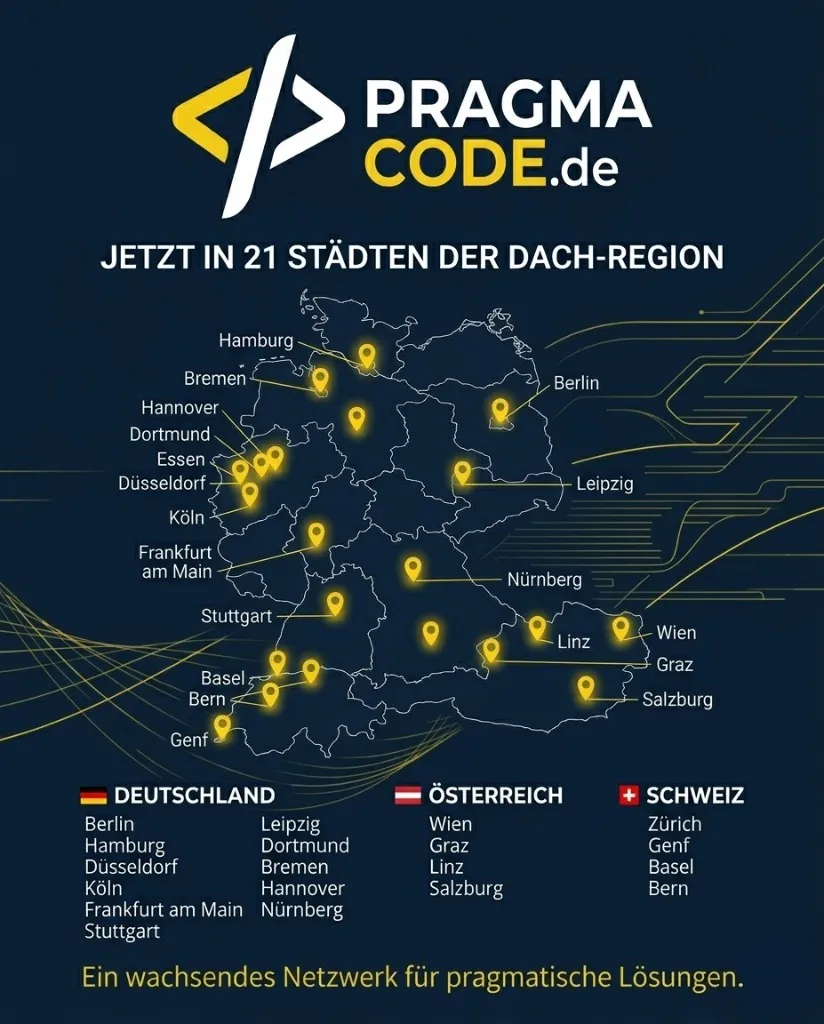
Our Regional Expertise
We are your digital partner – regionally anchored and successfully scaling across borders.
Ready for the next step in your SME's growth?
Whether strategic process analysis, implementing modern cloud systems, or bespoke automation workflows – Pragma-Code supports you on your journey from operational bottleneck to scalable market leader.
Request Free Scaling Audit NowExtended Specialized Glossary
Scaling
The ability of a company to significantly increase sales and business volume without operating costs growing linearly to the same extent.
Standardization
Establishing uniform, repeatable workflows and quality standards to minimize errors and simplify onboarding.
Cloud Computing
Providing computing power, storage, and software over the internet, enabling maximum flexibility and location independence.
Marketing Automation
Using software to execute and analyze marketing campaigns automatically, such as automated email nurturing flows.
KPI (Key Performance Indicator)
Operational metrics (like CAC, LTV, or revenue per employee) that provide insights into the success and efficiency of the company.
Onboarding
The structured process of hiring and training new employees to integrate them socially and professionally into the team as quickly as possible.
CRM (Customer Relationship Management)
Software-based systems to manage customer relationships, centralizing all interactions and customer records.
ATS (Applicant Tracking System)
Software application for applicant tracking, organizing the recruitment process digitally from job listing to hiring.