


Process blindness is the single most expensive operational cost driver for SMEs in 2026. Discover how modern Process Intelligence, OCEL 2.0, and autonomous Agentic Workflows uncover and eliminate hidden inefficiencies in real time.
This article is an in-depth expert contribution from our content cluster. Discover the complete overview on our main page:AI Automation & Intelligent Agents →
The Transparent Process: From Passive Dashboards to Autonomous Execution
Why Process Mining combined with Agentic AI forms the foundation for the autonomous enterprise infrastructure of tomorrow: At Pragma Code, we transform static event logs into self-governing, proactive workflow pipelines.
- Fact-Based Process Transparency: Rather than relying on subjective employee interviews, Process Mining reconstructs real workflows with 100 % audit-proof precision from system event logs across ERP, CRM, e-commerce, and ticketing tools.
- The Shift to OCEL 2.0 & Causal AI: Object-Centric Process Mining (OCPM) and Graph Neural Networks (GNN) overcome traditional single-case limitations, enabling predictive root-cause diagnostics across multi-object enterprise ecosystems.
- Autonomous Action Engines Over Expensive Lock-In: By combining modular open-source mining engines (PM4Py), LLM agent swarms, and sovereign orchestration pipelines (n8n), SMEs slash TCO by up to 75 % compared to monolithic enterprise suites while retaining full GDPR data sovereignty.
- 1. The Invisible Efficiency Leak: Why Process Blindness Paralyzes SMEs
- 2. Event Logs & OCEL 2.0: The Multi-Dimensional DNA of Your Workflows
- 3. The 4 Pillars of Modern Process Intelligence
- 4. The Mathematics of Discovery: Mining Algorithms & GNNs
- 5. Benchmark Comparison: Discovery Throughput & Latency
- 6. E-Commerce & Retail Deep-Dive: Order-to-Cash & Returns
- 7. Customer Support & Service: Process Mining in Zendesk & CRM
- 8. Industry Scenarios: Healthcare, Finance & Public Sector
- 9. Sustainability & ESG: Green Process Mining
- 10. EU AI Act & GDPR Compliance: Audit Trails via Privacy by Design
- 11. Tooling & TCO: Celonis vs. Open-Source & n8n
- 12. Common Cost Traps & Misconceptions in Practice
- 13. Case Study: Müller Maschinenbau – 60 % Idle Time Eliminated
- 14. Roles in the Project: Who is Required for Success?
- 15. The 7-Step Master Plan for Autonomous Process Control
- 16. Quick-Check: Your Roadmap to Operational Excellence
- 17. Conclusion: The Autonomous Future Starts Today
1. The Invisible Efficiency Leak: Why Process Blindness Paralyzes SMEs
In modern enterprise management, ignorance is the single most expensive luxury. Many small- and medium-sized enterprises (SMEs) invest substantial budgets into ERP upgrades, CRM platforms, and digitization roadmaps without knowing where their operational execution actually stalls in everyday business. Management frequently relies on the gut feeling of veteran department heads or on idealized flowchart diagrams slumbering inside static PowerPoint slide decks. Yet the hard reality recorded inside relational database logs and transactional message queues looks fundamentally different: an acute state of process blindness.
Picture your company as an intricate industrial piping network. You can clearly observe what enters at the intake valve (capital, human labor, raw materials, supplier invoices) and what emerges at the outlet (shipped orders, invoiced revenue, operating margin). However, what transpires within hundreds of intermediary valves, bypasses, and junctions remains an opaque black box. Invoices become trapped in endless manual approval loops. Incomplete product master data silently stalls automatic warehouse fulfillment. Lacking objective instrumentation, managers attempt guesswork fixes – frequently worsening systemic latency by introducing ad-hoc manual workarounds that render operations even more fragmented.
Traditional business process re-engineering suffers from a structural cognitive bias: human stakeholders describe workflows as they should theoretically function according to standard operating procedures, not how they are executed under real-world deadline pressure. Process Mining resolves this disconnect. Rather than querying subjective opinions, the technology mines the incorruptible digital footprints generated by every transactional system, including SAP, Salesforce, Microsoft Dynamics, Shopify, and Zendesk. Every mouse click, automated API call, status change, and approval creates an immutable record – the event log.
2. Event Logs & OCEL 2.0: The Multi-Dimensional DNA of Your Workflows
To establish Process Mining effectively, one must understand the foundational data schema. Historically, legacy process mining architectures relied on the flat XES Standard (eXtensible Event Stream). A standard traditional event log rests upon three mandatory pillars:
Case ID
A unique identifier that tracks a distinct business instance across all operational stages (e.g. Purchase Order Number, Support Ticket ID, or Invoice Number).
Activity
The exact granular action performed (e.g. "Order Created", "Credit Limit Verified", "Goods Picked", "Payment Settled").
Timestamp
The high-precision moment of execution (recorded down to the millisecond for precise chronological ordering and queue time calculation).
Contextual attributes such as Resource (which employee, department, or automated background worker executed the action), Cost (direct operational cost incurred), and Lifecycle State (Start, Complete, Reverted) enrich raw event tables to provide granular insights into team capacity and throughput constraints. However, without high-quality source telemetry, the timeless GIGO principle applies without exception: Garbage In, Garbage Out.
The 2026 Technological Leap: From Flat Logs to OCEL 2.0
In modern enterprise environments, single-case tabular logs encounter severe structural limitations. Real business processes rarely conform to isolated 1:1 relationships. A single Customer Order may encompass multiple distinct Deliveries, while several Deliveries might be consolidated into a single collective Invoice. Forcing this interconnected multi-entity reality into a single flat Case ID introduces synthetic data duplication (divergence) or catastrophic loss of relational context (convergence).
The state-of-the-art solution is Object-Centric Process Mining (OCPM) built upon the open OCEL 2.0 standard. Rather than binding an event rigidly to a single case identifier, OCEL 2.0 dynamically links each atomic event to a graph of multiple interacting entities. An event such as "Order Packaged" simultaneously references Order Items #12 and #14, Shipping Container #881, and the fulfillment operator. This creates a 100 % authentic Digital Twin of your entire enterprise value stream.
3. The 4 Pillars of Modern Process Intelligence
Transforming fragmented enterprise software architectures into a highly transparent, self-orchestrating organization demands an integrated engineering framework. At Pragma Code, we structure modern Process Intelligence around four balanced pillars:
1. Multi-Source ETL & Streaming
Automated connectors extract transactional change logs via Change Data Capture (CDC) and REST APIs directly from ERP, CRM, and SQL stores into standardized OCEL 2.0 event streams.
2. Graph Discovery & Conformance
Inductive mining algorithms and graph engines reconstruct all real-world workflow variants and benchmark real execution against compliant target models (Conformance Checking).
3. Causal AI & Root-Cause Analysis
Graph Neural Networks analyze graph topology to pinpoint non-linear causal drivers, predicting SLA breaches and delivery delays hours before they occur.
4. Autonomous Action Engines
Insights do not sit idle on dashboards: Autonomous agent swarms (Hermes Agent, n8n pipelines) trigger corrective workflows to resolve operational bottlenecks autonomously.
4. The Mathematics of Discovery: Mining Algorithms & GNNs
At the technological core of Process Mining lies mathematical discovery algorithms that translate unstructured timestamped event sequences into directed process models (Petri nets, BPMN diagrams, or directly-follows graphs). Over the past two decades, algorithmic engineering has undergone massive breakthroughs:
Alpha Miner (Foundational Baseline)
The original discovery algorithm that evaluates strict directly-follows relations (footprint matrix). Its key limitation: extreme sensitivity to noise, incomplete logs, and complex concurrent executions.
Heuristic Miner (Frequency & Noise Filtering)
Introduces statistical dependency thresholds to filter out infrequent outliers. It transforms chaotic 'spaghetti diagrams' into legible mainstream paths, though it does not strictly guarantee deadlock-free Petri nets.
Inductive Miner (Industry Benchmark)
Applies recursive divide-and-conquer logic on process trees. It guarantees formal mathematical correctness (soundness), ensuring discovered models contain neither deadlocks nor infinite liveloops.
Graph Neural Networks & Agentic Co-Pilots (2026 Frontier)
GNNs process entire process networks as interconnected topological graphs. They capture complex non-linear dependencies across multi-step transactions. Paired with LLM agents, they explain operational anomalies in natural language and generate actionable remediation scripts.
A practical scenario: A GNN determines that whenever the attribute Payment_Terms in your ERP is manually modified from "Net 30" to "Advance Payment", average Throughput Time in outbound shipping surges by exactly 18.4 hours because accounting lacks an automated confirmation webhook. By identifying this causal root driver, engineering teams can eliminate the friction permanently.
5. Benchmark Comparison: Discovery Throughput & Latency
When ingesting and discovering models across millions of enterprise transactional records, computational efficiency and memory footprints become mission-critical. The following benchmark highlights typical throughput metrics across standardized enterprise datasets:
6. E-Commerce & Retail Deep-Dive: Order-to-Cash & Returns
In digital commerce and omnichannel retail especially, a lack of process transparency translates directly into severe margin erosion. The two most critical processes are the Order-to-Cash (O2C) and Returns-to-Refund (R2R) cycles.
Typical Vulnerabilities in Order-to-Cash
E-commerce operations are frequently burdened by undocumented shadow processes. For instance, a customer support agent manually modifies a shipping address inside Shopify at a buyer's request. However, the downstream ERP or Warehouse Management System (WMS) only syncs periodically or throws a validation error. The measurable real-world consequences:
Misdeliveries & Return Shipments
Parcels are dispatched to obsolete customer addresses and returned as costly failed shipments.
Manual Inquiry Overhead
Support staff lose hours conducting tedious phone calls and complex email investigations.
Surging Resolution Cycle Times
Average manual processing time per erroneous order skyrockets from 4 minutes to over 45 minutes.
Process Mining clearly separates the friction-free Happy Path from costly exceptions. In commercial environments, the 80/20 rule is ubiquitous: approximately 20 % of orders generate 80 % of all manual rework and support overhead. Automating remediation for this critical 20 % immediately restores margins and elevates customer retention.
Pro-Tip: Accelerating Returns-to-Refund (R2R)
Connect your warehouse barcode scanner streams directly to your payment gateway via n8n. As soon as a returned parcel is scanned in the WMS as "Condition Grade A (Pristine)", an automated n8n workflow triggers the refund in Stripe or PayPal within 3 seconds. This cuts customer refund inquiries by up to 40 %.
7. Customer Support & Service: Process Mining in Zendesk & CRM
Process Mining is by no means limited to accounting or ERP transactions. Analyzing communication and ticket logs from platforms such as Zendesk, Freshdesk, HubSpot, or Salesforce Service Cloud enables management to pinpoint structural customer service deficits:
Ping-Pong Tickets & Endless Reassignments
Uncovering tickets bounced more than three times between Tier-1, Tier-2, and engineering specialists before receiving a substantive response.
Escalation Patterns & CSAT Drops
Pinpointing specific inquiry categories that disproportionately trigger supervisor escalations or negative customer review scores.
Queue Latency & Response Gaps
Identifying hidden bottlenecks where urgent buyer tickets linger unnoticed in unassigned holding queues during peak demand.
Pairing Process Mining with intelligent AI agents such as the Hermes Agent closes the loop between diagnostics and action: incoming inquiries are classified semantically in real time, missing data is requested autonomously, and routine requests are resolved without human delay.
8. Industry Scenarios: Healthcare, Finance & Public Sector
1. Healthcare & Hospitals: Clinical Pathways & OR Utilization
In healthcare environments, process optimization saves lives while maintaining financial viability. Mining digital tracks inside Hospital Information Systems (HIS) reveals patient flows from emergency intake to diagnostic imaging (CT/MRI) and surgical discharge:
OR Turnaround & Idle Reduction
Identifying surgical suite idle time caused by delayed patient transport and handover bottlenecks.
Laboratory Diagnostic Delays
Uncovering prolonged inpatient stays caused entirely by delayed lab report transmissions.
Comprehensive Clinical Records
Ensuring complete clinical compliance documentation adhering strictly to statutory standards.
2. Finance & Banking: KYC, Lending & Anti-Financial-Crime
Across banking and insurance, execution speed and stringent regulatory compliance are paramount. 'Know Your Customer' (KYC) reviews and commercial credit approvals frequently stall due to opaque approval hierarchies:
Eliminating Verification Loops
Eliminating multi-day verification loops during corporate balance sheet submissions.
AML & Conformance Checking
Automating Conformance Checking to prevent violations of Anti-Money-Laundering (AML) directives.
Radical Time-to-Yes Acceleration
Compressing Time-to-Yes for standardized SME loans from an industry average of 8 business days to under 2 hours.
3. Public Sector: Digital Government & Citizen Satisfaction
Public sector digitization succeeds only when analog filing routines are not merely copied into digital PDF forms. Process Mining maps municipal administrative workflows (e.g. building permits, commercial licensing, social benefit claims):
Seamless Citizen Portals
Eliminating manual media breaks between online citizen portals and municipal backend databases.
Reliable Processing Forecasts
Providing transparent, reliable processing time estimates for citizens and enterprises.
Dynamic Caseworker Allocation
Optimizing caseworker allocation during seasonal peaks in application volume.
9. Sustainability & ESG: Green Process Mining
Under the European Corporate Sustainability Reporting Directive (CSRD) and supply chain due diligence mandates, Green Process Mining has evolved into a strategic imperative. Operational inefficiencies directly drive excess carbon emissions:
Logistics & Scope 3
Fragmented partial shipments and unplanned expedited freight triggered by inventory mismatches needlessly drive up logistics carbon footprints.
Digital Energy Waste
Runaway database query loops, orphaned cloud computing instances, and redundant batch ETL jobs waste significant data center kilowatt-hours.
Manufacturing Scrap Prevention
Real-time conformance checking on factory floor machinery detects operational drift before defective production batches are fabricated.
Green Process Mining quantifies the environmental footprint of each distinct workflow step, establishing an audit-proof data foundation for ESG reporting.
10. EU AI Act & GDPR Compliance: Audit Trails via Privacy by Design
Deploying Process Mining within European enterprises requires strict alignment with GDPR requirements and worker council co-determination rules. Employees rightfully fear illegitimate surveillance. At Pragma Code, we implement Process Mining strictly under the Privacy by Design framework:
Cryptographic Pseudonymization
User names and employee identifiers are irreversibly hashed at the ingestion boundary using Salted SHA-256 keys. Identifying individual workers inside mining analytics is mathematically precluded.
Differential Privacy & Timestamp Blurring
Sub-second timestamps for non-critical activities are systematically blurred (e.g. rounded to 15-minute windows) to prevent reconstructing personal working routines.
Role-Based Access Control (RBAC)
Granular permission tiers ensure process analysts access only aggregated macro performance metrics while operational raw event tables remain strictly segregated.
EU AI Act Conformity Verification
Process Mining delivers an immutable audit trail for downstream AI systems, providing regulators with transparent proof of the exact validated decision paths executed by autonomous models.
11. Tooling & TCO: Celonis vs. Open-Source & n8n
When selecting a Process Intelligence architecture, business leaders face a critical decision: an expensive monolithic suite or a sovereign best-of-breed stack? The following matrix compares the leading market approaches:
Comparison: Legacy Enterprise Monolith vs. Modular Process Intelligence (Pragma Stack)
- Licensing: High six-figure annual subscriptions scaling aggressively with data volume
- Infrastructure: Mandatory cloud hosting on US-governed hyper-scalers
- Execution: Proprietary action modules with constrained third-party extensibility
- Vendor Lock-in: Severe architectural lock-in reliant on costly certified consulting partners
- Licensing: Open-source core with predictable fixed-price deployment packages
- Infrastructure: 100 % self-hosted or EU sovereign cloud (fully GDPR-compliant)
- Execution: Limitless low-code and agentic pipelines via n8n and Python scripts
- Flexibility: Complete data ownership and unrestricted API extensibility
12. Common Cost Traps & Misconceptions in Practice
Many process digitization initiatives fail not due to algorithmic limitations, but because of organizational and methodological pitfalls. Avoid these common blunders:
Trap 1: The 'Big-Bang' Approach
Attempting to map every enterprise process simultaneously leads to analytical paralysis and team exhaustion. Solution: Start with a focused pilot workflow (e.g. Accounts Payable).
Trap 2: Analysis Paralysis Without Action
Staring at colorful dashboard graphs generates zero financial return if operational remediation pipelines are neglected. Solution: Wire discovery directly to n8n automation from week 1.
Trap 3: Neglecting Data Hygiene
Inconsistent or missing timestamps in legacy ERP databases fatally distort graph generation. Solution: Implement automated data schema pre-validation prior to graph discovery.
Trap 4: Missing Stakeholder Buy-In
If operational teams perceive mining as a surveillance weapon, internal friction is inevitable. Solution: Involve workers councils early and enforce mathematical anonymization.
13. Case Study: Müller Maschinenbau – 60 % Idle Time Eliminated
A precision engineering manufacturer in southern Germany employing 450 staff struggled with severe delivery delays in their spare parts business. Despite maintaining complete stock in their automated high-bay warehouse, average Throughput Time from order placement to shipping dock exceeded 11 business days. Customer satisfaction declined and expensive express couriers eroded margins.
Manual interviews yielded no actionable clues, as each department claimed to process orders within standard 24-hour SLA windows.
Process Mining revealed that 68 % of total lead time was spent in the status 'Awaiting Technical Drawing Approval' – idling silently in engineering email inboxes.
An n8n workflow now validates order specifications against CAD metadata automatically. Standard orders are approved in under 5 seconds, escalating only genuine design exceptions to human engineers.
The Measurable Result: Average fulfillment time plummeted from 11.4 days to 1.8 days. 82 % of all standard spare parts now ship on the same business day. Operational processing costs dropped by $260,000 in year one, delivering an ROI of 410 %.
14. Roles in the Project: Who is Required for Success?
A thriving Process Intelligence initiative depends upon a cohesive, cross-functional collaboration between business, IT, and data teams:
1. Process Owner (Business Lead)
Defines core business objectives (e.g. slashing cycle times by 30 %), articulates operational pain points, and validates discovered process models for practical plausibility.
2. Data Engineer & System Integrator
Builds robust ETL connectors to enterprise data repositories (SAP, Salesforce, PostgreSQL) and ensures clean data transformation into the OCEL 2.0 standard.
3. Process Analyst & Mining Specialist
Performs the core mathematical discovery and Bottleneck Analysis, isolates execution loops, and translates quantitative metrics into strategic improvements.
4. Automation Engineer (n8n / AI Agents)
Transforms diagnostic insights into executable automation pipelines, crafting resilient agentic workflows for automated remediation.
5. Change Manager & Data Protection Officer
Guides staff through the cultural evolution toward a data-driven enterprise, conducts feedback workshops, and certifies ongoing GDPR and AI Act compliance.
15. The 7-Step Master Plan for Autonomous Process Control
To advance from initial transactional event streams to an automated, continuously optimized enterprise, execute this structured 7-step roadmap:
-
Step 1: Scoping & Strategic Alignment
Select a single pilot process with high commercial leverage (e.g. Order-to-Cash, Support Ticketing) and define measurable target KPIs.
-
Step 2: Connectivity & Data Ingestion
Establish automated read connectors to source transactional tables and transform raw change streams into structured OCEL event logs.
-
Step 3: Data Cleansing & Validation
Strip irrelevant technical system noise, harmonize heterogeneous timestamps, and verify event records against reference business transactions.
-
Step 4: Exploratory Discovery & Variant Analysis
Generate the empirical baseline process graph, map the core Happy Path, and illuminate hidden rework loops and bypasses.
-
Step 5: Conformance Checking & Root-Cause Mining
Benchmark execution against statutory compliance mandates and apply AI models to isolate the causal drivers of operational latency.
-
Step 6: Implementation of the Action Engine (n8n)
Deploy automated correction triggers and agentic feedback loops to remediate identified bottlenecks autonomously.
-
Step 7: Continuous Monitoring & CoE Scaling
Establish an enterprise-wide Center of Excellence (CoE) and progressively scale process intelligence across adjacent operational departments.
"Process Mining is not a one-off IT project, but a continuous operational mindset. Anyone who claims to fully control their business processes without having measured them empirically is flying blind." – Alexander Ohl, Founder of Pragma Code.
16. Quick-Check: Your Roadmap to Operational Excellence
Evaluate your enterprise readiness for modern Process Intelligence using the following executive checklist:
Quick-Check: Is Your Organization Ready for Process Mining?
17. Conclusion: The Autonomous Future Starts Today
Process Mining combined with frontier AI represents the only reliable mechanism for modern enterprises to maintain operational control in increasingly dynamic markets. Those who understand their empirical process flows without illusion can eliminate waste. Those who mathematically comprehend the root causes of friction can prevent bottlenecks proactively. And those who connect real-time discovery directly to agentic execution establish the foundational architecture for the coming decade.
At Pragma Code, we support SMEs across every milestone of this transformation: from initial data extraction and privacy-preserving modeling to turn-key autonomous action engines. Let us unlock the black box of your operational workflows together.
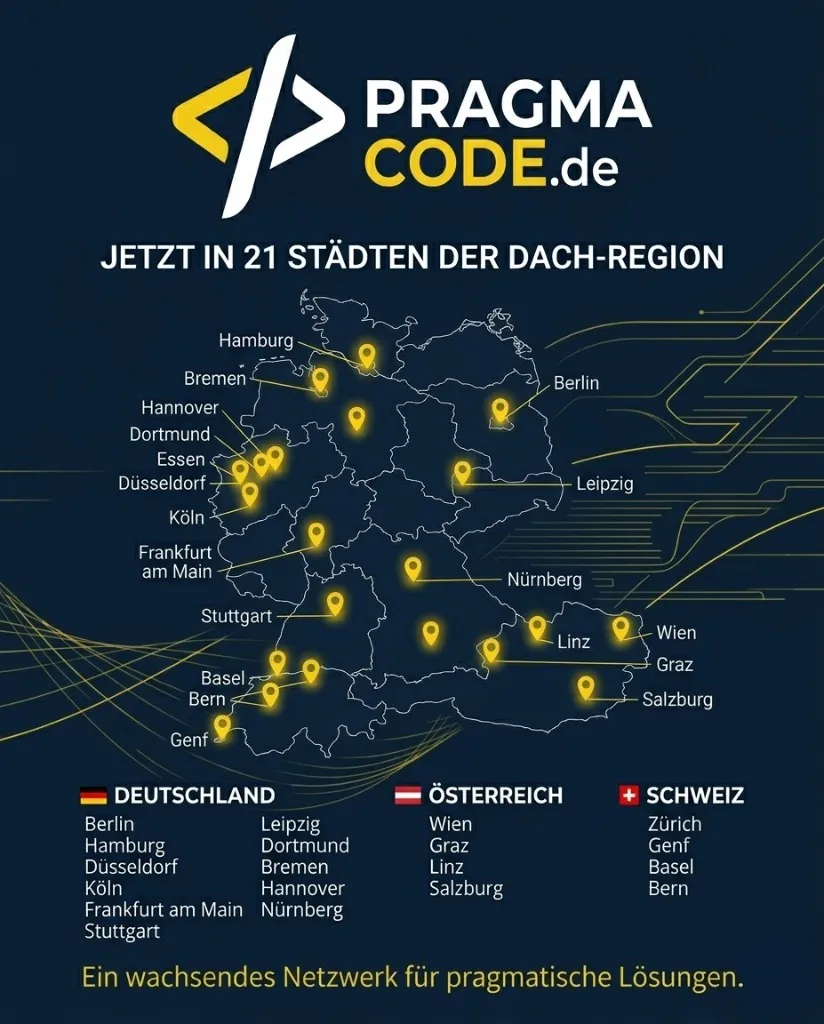
Our Regional Expertise
We are your digital partner – regionally anchored and successfully scaling across borders.
Have a Vision for Your Processes?
Let us review together how we can put your operational data to work and reduce your throughput costs sustainably.
Request Free Consultation NowExtended Specialized Glossary
Process Mining
Scientific analysis of business processes based on digital event logs.
Process Intelligence
The automated combination of process mining, AI, and workflow orchestration for continuous real-time execution and optimization.
Object-Centric Process Mining (OCPM)
Advanced methodology where events relate to multiple interacting business objects simultaneously, eliminating data convergence and divergence issues.
OCEL 2.0
Object-Centric Event Log 2.0 – the open standard for capturing multi-entity workflows across enterprise architectures.
XES Standard
XML-based open exchange format for traditional, single-case event log data (eXtensible Event Stream).
Digital Twin
A realistic digital replica of an enterprise operational system for simulating changes without risking live operations.
Happy Path
The ideal, error-free execution of a case without rework loops or manual interventions.
Conformance Checking
Automated comparison between real event logs and target reference models to reveal compliance deviations.
Maverick Buying
Purchasing outside established framework contracts – frequently indicating shadow process workflows.
Throughput Time
The total duration required for a case to traverse the entire operational process from initiation to completion.
Bottleneck Analysis
Identification of workflow stages where cases accumulate and create systemic latency.
Graph Neural Networks (GNN)
Deep learning models specialized in graph-structured data used to predict workflow delays and reveal causal bottlenecks.