


With the EU AI Act, the European Union has established the world's first comprehensive legal framework for Artificial Intelligence. As of August 2, 2026, obligations for high-risk AI systems are legally enforceable. This guide provides actionable insights for European SMEs on determining risk tiers, fulfilling governance duties, and avoiding severe penalties.
This article is an in-depth expert contribution from our content cluster. Discover the complete overview on our main page:IT Security →
- Enforceable Law as of August 2026: The transition periods for high-risk AI under Annex III have officially concluded. Businesses deploying affected systems (e.g., automated recruitment, credit scoring, critical infrastructures) must maintain fully documented risk management and logging architectures.
- The Hidden Provider Trap: SMEs fine-tuning foundation models or building sophisticated agentic wrappers into business-critical workflows often transition from mere deployers to legal providers—triggering extensive conformity assessments and EU registry filings.
- Fines of up to €35 Million: Penalty ceilings significantly exceed GDPR limits. Beyond administrative sanctions, management faces personal liability for governance failures and immediate disqualification from enterprise B2B supply chains.
From Experimental Sandboxes to Industrial Governance
The era of unregulated AI experimentation in European business is over. With the full enforcement of high-risk mandates in August 2026, EU AI Act compliance has transformed from a theoretical IT issue into an indispensable requirement for enterprise risk management and B2B vendor qualification.
- 1. The 2026 Paradigm Shift: Why AI Compliance is a Boardroom Priority
- 2. Deadlines & Milestones: The Timeline from 2025 to 2027
- 3. The Core: 4 Risk Classes in a 2x2 Compliance Grid
- 4. High-Risk Sectors under Annex III for SMEs
- 5. Provider vs. Deployer: The Hidden Classification Trap
- 6. General Purpose AI (GPAI): Downstream Obligations with Foundation Models
- 7. The 6 Pillars of High-Risk Compliance (Arts. 9–15)
- 8. Technical Architecture & Audit-Ready Infrastructure (ISO 42001)
- 9. Typical Cost & Liability Traps for Growing Businesses
- 10. SME Support Mechanisms: Regulatory Sandboxes & Standardized Templates
- 11. Sanctions, Fines & Executive Personal Responsibility
- 12. The 5-Phase Implementation Roadmap for SMEs
- 13. Quick-Check: Your AI Act Readiness Checklist
- 14. Conclusion & Strategic Outlook
1. The 2026 Paradigm Shift: Why AI Compliance is a Boardroom Priority
The European Union has established the world’s first comprehensive binding legal framework for Artificial Intelligence with Regulation (EU) 2024/1689—the EU AI Act. Frequently compared to the GDPR, the AI Act extends much further into software engineering, data pipelines, and operational decision architectures. While data protection regulations primarily govern the processing of personal data, the AI Act addresses algorithmic safety, systemic bias, transparency, and the fundamental rights of individuals subjected to automated decisions.
For Small and Medium-sized Enterprises (SMEs) operating within or selling into the European Single Market, 2026 represents a definitive turning point. The initial phase of ad-hoc prototyping and informal employee usage of Generative AI tools is legally unsustainable. Mid-market companies now face a crucial dual challenge: they must actively harness autonomous agents, agentic workflows, and LLM-driven intelligence to protect their competitive edge, while simultaneously establishing auditable proof of system safety, robustness, and compliance.
Furthermore, regulatory pressure is amplified by overlapping European directives: the NIS2 Cybersecurity Directive, the Digital Operational Resilience Act (DORA) for financial ecosystems, and the Digital Omnibus Initiative. AI governance is no longer a technical sub-discipline; it is an existential executive responsibility.
2. Deadlines & Milestones: The Timeline from 2025 to 2027
The rollout of the EU AI Act follows a multi-tiered enforcement schedule. While the initial bans on unacceptable practices took effect in early 2025, August 2026 marks the primary operational milestone for mid-sized commercial entities.
Complete prohibition of unacceptable AI practices (Art. 5), including social scoring, cognitive manipulation, and real-time biometric surveillance in public spaces. Simultaneously, Article 4 became mandatory: organizations must actively demonstrate staff AI Literacy through structured training programs.
Enforcement of governance requirements for foundation models (Arts. 51+). Providers of GPAI (General Purpose AI) such as OpenAI, Anthropic, and Mistral must publish technical documentation, copyright summaries, and systemic risk assessments.
Current Active State: Regulatory requirements for standalone High-Risk AI applications (e.g., HR recruiting, credit scoring, access to essential services) are legally enforceable. Deployers and providers must maintain active risk management files and automated audit trails.
Final phase: Mandatory conformity for AI systems integrated as safety components into regulated physical products (e.g., Medical Devices under MDR EU 2017/745, machinery, industrial elevators, aviation, and automotive systems).
Because the August 2026 deadline has passed, businesses operating high-risk systems can no longer rely on transition grace periods. Regulatory inquiries from data protection authorities and market surveillance bodies require immediate submission of complete compliance files.
3. The Core: 4 Risk Classes in a 2x2 Compliance Grid
The EU AI Act is anchored in a strict risk-based hierarchy. The greater the potential harm an algorithmic system can inflict on fundamental human rights, physical safety, or equal opportunity, the more rigorous the engineering and administrative requirements:
Unacceptable Risk
- Subliminal behavioral manipulation exploiting vulnerabilities (age, disability, socioeconomic status)
- Social scoring (classification of trustworthiness by public authorities or employers)
- Real-time remote biometric identification in public spaces for law enforcement purposes
- Emotion recognition technologies deployed in workplaces or educational settings
High-Risk AI Systems
- Automated resume filtering, candidate scoring, and promotion evaluations in HR
- Creditworthiness assessments (credit scoring) and risk pricing for life/health insurance
- Safety-critical operations in public utilities (water, gas, electricity, logistics)
- Safety components in regulated machinery, medical devices, and industrial automation
Limited Risk
- Customer-facing conversational bots & voice agents (users must be notified of AI interaction)
- Generative text, image, and video creation systems (synthetic media)
- Deepfakes and audio-visual alterations (human-readable and machine-detectable watermarks)
- AI-assisted corporate copy generation and marketing automation
Minimal Risk
- AI-powered spam filters and automated email categorizers
- Grammar and syntax correction utilities (e.g., DeepL Write, Grammarly)
- Inventory forecasting algorithms operating strictly on non-personal data
- Video game AI routines and standard computer-aided rendering tools
While standard workplace utilities (such as spam filters and basic translation tools) fall into the minimal risk category, any application that evaluates human performance, determines resource allocation, or generates public media triggers mandatory compliance duties.
4. High-Risk Sectors under Annex III for SMEs
Many business leaders incorrectly assume that high-risk AI is restricted to aerospace, defense, or pharmaceutical laboratories. In reality, Annex III of the AI Act targets everyday business software widely deployed across mid-sized enterprises.
The four most common high-risk operational areas for SMEs include:
1. HR, Recruitment & Workforce Analytics
Software deployed for automated CV parsing, interview assessment, applicant scoring, candidate ranking, or employee promotion and termination decisions.
2. Financial Services & Credit Scoring
Algorithmic models evaluating the creditworthiness of customers or suppliers, setting commercial credit limits, or automating insurance risk underwriting.
3. Education & Vocational Training
Systems determining admission to training programs, evaluating student performance, or monitoring examination integrity through automated behavioral metrics.
4. Critical Infrastructure & Industrial Systems
AI operating in public utility management (water, electricity, gas, transport) or industrial quality control where malfunction could endanger human safety.
Expert Tip: The Procedural Exception under Article 6(3)
An AI system is exempt from high-risk classification if it performs purely narrow procedural tasks (e.g., reformatting CVs without ranking) or serves solely preparatory functions without meaningfully steering the final human decision. However, this exception must be thoroughly documented in a formal legal-technical assessment prior to deployment!
5. Provider vs. Deployer: The Hidden Classification Trap
One of the most consequential legal distinctions in the EU AI Act is the division of responsibility between the Provider (Developer/Vendor) and the Deployer (User/Operator). The regulatory burden escalates drastically if an organization is classified as a provider.
Most mid-market organizations believe they are purely deployers because they access third-party foundation models via API. However, Article 25 outlines specific triggers that automatically reclassify a deployer as a legal provider:
Comparison: AI Deployer vs. AI Provider
- Role: Utilizing an existing AI system within enterprise operations under own authority.
- Core Duty 1: Operating the system strictly according to the provider's instructions for use.
- Core Duty 2: Ensuring continuous human oversight (Human-in-the-Loop).
- Core Duty 3: Retaining automated system logs for a minimum of 6 months.
- Core Duty 4: Notifying workers and employee representatives prior to deploying high-risk tools.
- Role: Developing AI systems or substantially modifying existing third-party models.
- Full Conformity Assessment: Authoring comprehensive Technical Documentation (Art. 11).
- Quality Management System: Maintaining an ISO 42001-aligned QMS (Arts. 9 & 17).
- EU Database Registration: Mandatory filing in the central EU AI Database before launch.
- CE Marking: Affixing CE conformity markings and publishing the EU Declaration of Conformity.
When does an SME inadvertently become a Provider? Under Article 25 of the AI Act, a deployer automatically assumes full legal provider liability if any of the following three statutory criteria are met:
1. Rebranding & White-Labeling (Art. 25(1)(a))
Affixing your own company name, trademark, or brand identity to a third-party high-risk AI application.
2. Modification of Intended Purpose (Art. 25(1)(b))
Modifying the intended purpose of a standard non-high-risk AI system such that it enters a regulated Annex III category.
3. Substantial Modification (Art. 25(1)(c))
Executing major modifications to algorithmic logic, fine-tuning foundation models on proprietary datasets, or adjusting fundamental decision thresholds.
For engineering teams designing enterprise RAG architectures or multi-agent pipelines, maintaining clear documentation on model boundaries is vital. To explore scalable multi-agent governance, read our in-depth analysis on the AI Control Tower for Multi-Agent Governance.
6. General Purpose AI (GPAI): Downstream Obligations with Foundation Models
Large Language Models (LLMs) and multimodal architectures are categorized as General Purpose AI (GPAI). The regulation distinguishes between standard GPAI models and those presenting systemic risks (models trained with cumulative compute surpassing 1025 FLOPs—such as GPT-5.5, Gemini 1.5 Pro, and Claude 3.5 Sonnet).
For mid-sized enterprises integrating these models into downstream applications, two critical operational risks arise:
Trap 1: Missing Upstream Compliance Data
If you deploy a high-risk application built upon a commercial foundation model, you depend entirely on the model vendor’s technical documentation, benchmark disclosures, and data summaries. If the vendor fails to provide adequate documentation, your own high-risk conformity audit cannot be verified.
Trap 2: API Indemnification Loopholes
Standard API terms of service frequently disclaim liability for regulatory non-compliance. Under EU law, mid-market deployers remain directly liable before European supervisory authorities for hallucinations or discriminatory outcomes generated within high-risk contexts.
When selecting AI vendors, ensure contracts explicitly guarantee compliance with GPAI standards and provide full audit rights.
7. The 6 Pillars of High-Risk Compliance (Arts. 9–15)
Organizations developing or operating high-risk AI systems must establish six foundational technical and organizational measures (TOMs) defined in Articles 9 through 15:
A continuous, documented lifecycle process to identify, evaluate, and mitigate foreseeable risks to health, safety, and fundamental rights throughout development and post-market deployment.
Training, validation, and testing datasets must meet strict quality benchmarks. Data pipelines must be representative, vetted for statistical anomalies, and actively audited for historical demographic bias.
Comprehensive engineering files authored prior to deployment, detailing architecture, algorithmic logic, hyperparameters, performance benchmarks, and validation protocols for regulatory inspection.
Technical capabilities ensuring that all operational events, input prompts, system outputs, confidence scores, and user overrides are immutably logged and stored for at least 6 months.
Clear, accessible documentation enabling deployers to fully understand model operational constraints, accuracy metrics, intended use cases, and potential failure modes.
Engineering controls that allow designated human supervisors to effectively monitor operational workflows in real time, adjust decisions, or trigger an immediate system override.
Furthermore, Article 15 requires high levels of cybersecurity resilience against adversarial prompt injection, data poisoning, and model inversion. For technical defense frameworks, see our guide on AI Security and Emergency Planning for SMEs.
8. Technical Architecture & Audit-Ready Infrastructure (ISO 42001)
Effective AI compliance cannot be achieved solely through legal paperwork. It demands an auditable technical architecture that enforces governance rules programmatically across code repositories and cloud environments.
Pragma-Code recommends implementing a 4-tier infrastructure model for mid-market environments:
1. Central LLM API Gateway
A unified proxy intercepting all corporate model requests. Enforces automatic PII redaction prior to external transmission and guarantees zero-data-retention parameters across third-party endpoints.
2. Immutable Logging Pipeline
Structured ingestion of prompts, model completions, latency metrics, and confidence scores into WORM (Write Once, Read Many) cloud storage for unalterable forensic verification.
3. Cryptographic Watermarking (C2PA)
Automated insertion of cryptographic provenance metadata into all generated visual, audio, and synthetic textual outputs to satisfy transparency mandates under Article 50.
4. Dual-Control Review Interface
Operational dashboards presenting AI recommendations alongside contextual confidence intervals, requiring verified human authorization prior to transaction execution.
To establish institutional credibility, organizations should align their management framework with ISO/IEC 42001, the international standard for Artificial Intelligence Management Systems (AIMS):
1. Standardized AI Impact Assessments
Implementing formal pre-deployment evaluation protocols for every new AI integration prior to production release.
2. Vendor AI Audit Clauses
Contractual mechanisms ensuring third-party SaaS vendors provide necessary training disclosures and indemnify against compliance breaches.
3. Prompt Firewalls & Identity Controls
Eliminating shadow AI through Single Sign-On (SSO) enforcement and blocking unauthorized public consumer AI platforms across company devices.
9. Typical Cost & Liability Traps for Growing Businesses
In client advisory engagements, Pragma-Code frequently identifies recurrent compliance vulnerabilities that expose mid-sized firms to severe penalties and reputational harm:
1. Unmanaged Shadow AI
Employees inputting proprietary source code, intellectual property, or confidential client records into unauthorized personal AI accounts. Consequence: Major GDPR violations, trade secret leakage, and breach of executive duty.
2. Lack of Documented AI Literacy (Art. 4)
Failing to provide structured training on AI capabilities and legal boundaries. Consequence: Direct violation of Article 4, exposing corporate officers to negligence claims during algorithmic failures.
3. Unmarked Synthetic Media (Art. 50)
Distributing AI-generated marketing imagery, synthetic video testimonials, or automated editorial copy without metadata or visual disclaimers. Consequence: Regulatory enforcement notices and competitor litigation.
4. Unrecognized High-Risk Integrations
Deploying third-party HR screening plugins under the assumption that standard commercial software carries no regulatory burden. Consequence: Forced operational shutdowns by labor regulators.
10. SME Support Mechanisms: Regulatory Sandboxes & Standardized Templates
Recognizing that SMEs do not possess the legal budgets of Big Tech corporations, the European Commission introduced dedicated relief measures in Chapter VI (Arts. 57–62) of the AI Act:
Every EU member state must establish at least one operational sandbox. SMEs receive priority access to test and iterate novel AI systems in controlled environments with direct regulatory feedback.
Notified Bodies are legally mandated to scale conformity assessment fees proportionally based on company headcounts and turnover, lowering market entry barriers.
The EU AI Office publishes standardized, streamlined forms for risk assessments and technical files specifically tailored to reduce the administrative burden on SMEs.
Additionally, EU and national funding initiatives (such as Digital Europe and regional SME transformation grants) provide co-funding for independent technical compliance audits.
11. Sanctions, Fines & Executive Personal Responsibility
The punitive framework of the EU AI Act is designed to enforce uncompromising compliance:
Violations of Prohibitions (Art. 5)
Deploying banned AI practices (e.g., social scoring, manipulative systems, biometric tracking).
Up to €35Mor up to 7% of total global annual turnover (whichever is higher).
High-Risk & Governance Breaches
Failure to satisfy technical requirements under Arts. 9–15 (Risk management, logging, data governance).
Up to €15Mor up to 3% of total global annual turnover (whichever is higher).
Managing Director Liability: Under corporate governance statutes across European jurisdictions, board members and managing directors bear personal responsibility for maintaining effective risk management systems. Negligent non-compliance with AI Act mandates can result in direct personal liability and the invalidation of Directors & Officers (D&O) insurance coverage.
12. The 5-Phase Implementation Roadmap for SMEs
To establish full compliance efficiently, Pragma-Code advises businesses to execute a structured 5-phase rollout:
-
Phase 1: Comprehensive AI Inventory & Shadow IT Discovery
Catalog all deployed AI software, embedded SaaS features, internal automation scripts, and API integrations within a centralized AI registry. Survey departmental leads to uncover unsanctioned tool usage.
-
Phase 2: Risk Classification & Role Determination
Map each tool against the four risk categories. Formally assess whether HR or analytics workflows trigger Annex III rules, and determine if customized integrations constitute provider status under Article 25.
-
Phase 3: Gap Audit & Technical Hardening
Perform delta audits on high-risk and transparency-grade systems. Implement core architectural safeguards: central API proxying, WORM audit logging, and automated content watermarking.
-
Phase 4: Corporate AI Policy & Literacy Training
Publish a binding enterprise AI Acceptable Use Policy. Deliver role-specific workforce training to ensure verifiable compliance with the AI Literacy obligation under Article 4.
-
Phase 5: ISO 42001 Alignment & Continuous Monitoring
Compile technical compliance files. Establish recurring monitoring cycles to detect model drift, track upstream model updates, and align with new regulatory guidelines from the EU AI Office.
13. Quick-Check: Your AI Act Readiness Checklist
Quick-Check: Is Your Organization AI Act Ready?
14. Conclusion & Strategic Outlook
The EU AI Act represents a fundamental evolution in how enterprise software is built and operated. While the administrative obligations are substantial, viewing the regulation purely as a burden misses its transformative competitive value: in a global marketplace clouded by algorithmic distrust and synthetic disinformation, „Verified, Certified AI Made in Europe" is emerging as a premier trust differentiator.
Organizations that invest now in robust governance, transparent data architectures, and verifiable oversight not only protect their enterprise value and supply chain eligibility, but also build the dependable foundation necessary to lead in the era of autonomous intelligence.
Pragma-Code supports mid-market enterprises at every stage—from initial risk discovery and technical AI workflow audits to the ISO-42001-aligned implementation of secure, high-performance AI architectures.
And who keeps this current in day-to-day operation?
Logging, human oversight and a documented model and version state are not a one-off task — they go stale with every model change and every silent fallback. The Agent Operations product line takes exactly that over on an ongoing basis: monitoring, a monthly quality sample against a fixed set of test cases and, in the "Operations & Evidence" tier, the AI-Act-relevant documentation. From €390 per month, cancel monthly.
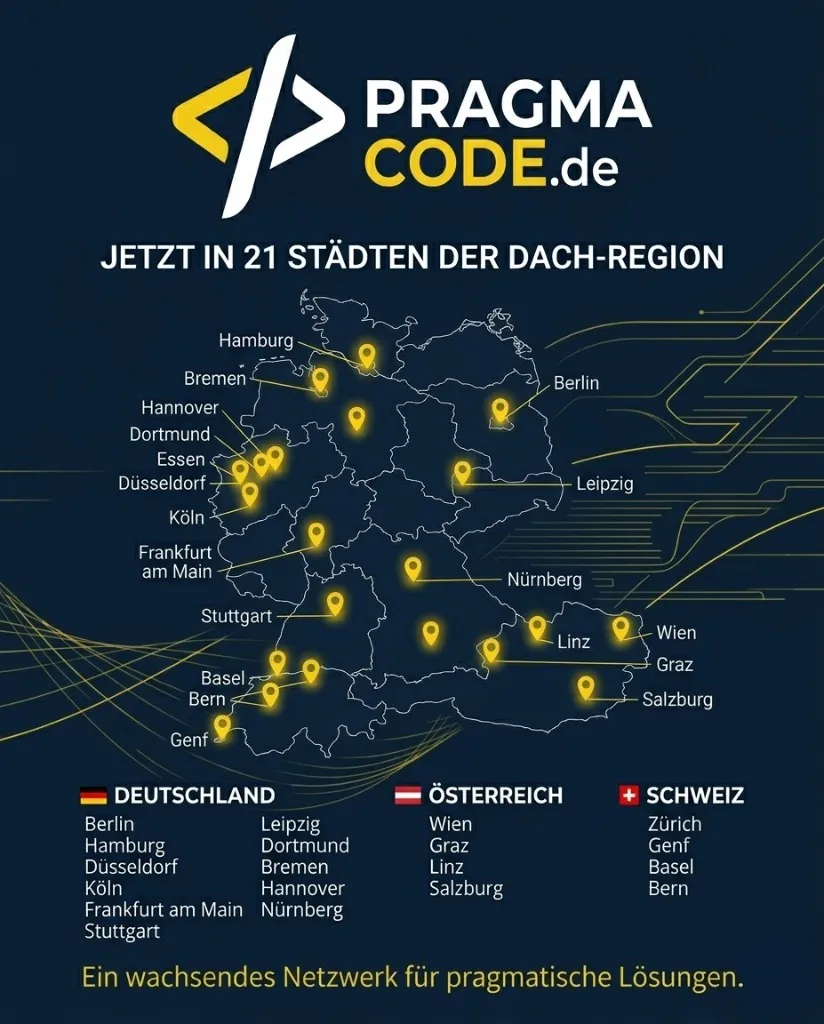
Our Regional Expertise
We are your digital partner – regionally anchored and successfully scaling across borders.
Questions about AI Act Compliance?
Pragma-Code safely guides you through the jungle of the new AI regulation. Let us audit your systems.
Schedule a Free ConsultationExtended Specialized Glossary
EU AI Act
The EU Artificial Intelligence Act (Regulation EU 2024/1689) is the world’s first comprehensive binding legal framework for AI, categorizing systems into risk tiers.
High-Risk AI
High-Risk AI systems under Annex III of the EU AI Act are subject to strict legal obligations including risk management, data governance, continuous logging, and human oversight.
GPAI (General Purpose AI)
General-purpose AI foundation models capable of performing a wide range of tasks, regulated under Articles 51+ of the EU AI Act with transparency and copyright requirements.
AI Literacy
The statutory obligation under Article 4 of the EU AI Act requiring employers to ensure staff possess sufficient competency in safe, compliant AI handling.
Human-in-the-Loop
A core oversight principle under Article 14 of the EU AI Act requiring human supervisors to monitor, verify, override, or halt automated AI decisions.
ISO/IEC 42001
The international standard for Artificial Intelligence Management Systems (AIMS), providing an auditable framework for AI governance and regulatory alignment.