


Answer engines and AI search assistants are fundamentally transforming web discovery: Discover how Generative Engine Optimization (GEO) replaces traditional SEO.
This article is an in-depth expert contribution from our content cluster. Discover the complete overview on our main page:GEO Search Engines →
The Era of Answer Engines and Citation Share
The way B2B decision-makers and technical leaders find solutions online has fundamentally changed. Classic search engines that present a list of ten blue links are rapidly being replaced by intelligent Answer Engines and Agentic AI systems. This deep dive shows you how to leverage Generative Engine Optimization (GEO) to become the cited authority in Perplexity, SearchGPT, and Google AI Overviews.
- Click-Through Rate Collapse & Zero-Click: Due to direct answer synthesis in AI Overviews, Perplexity, and ChatGPT Search, B2B websites are experiencing an average drop of 34% in organic click-through rates (CTR) in 2026. More than 65% of all business searches now conclude without a click to an external website.
- The New Core Currency "Citation Share": Success is no longer measured in Page 1 rankings, but in the percentage of times your brand or domain is cited as the primary source in the footnotes and attribution links of generative AI answers.
- Generative Engine Optimization (GEO): To appear in Large Language Models, content must be structured entirely differently. Entity Salience, E-E-A-T 2.0, machine-extractable semantic schema graphs, and data hardening replace traditional keyword density.
- Introduction: The Silent Death of Blue Links
- 1. The Shift to Citation Share: The New Search Currency
- 2. Generative Engine Optimization (GEO): Definition & Origins
- 3. The 4 Pillars of a Modern GEO Architecture
- 4. Optimizing for Perplexity: The Academic Crawler
- 5. Optimizing for SearchGPT & OpenAI Search
- 6. Technical Implementation: Deep JSON-LD and Semantic HTML
- 7. The GEO Roadmap for Enterprises in 2026
- Conclusion: Becoming the Cited Authority
Introduction: The Silent Death of Blue Links
For over 25 years, digital customer acquisition worked on a very simple and reliable premise: a user experiences a technical challenge, enters relevant search terms into Google, compares the ten blue links on Page 1, clicks on the most promising result, and lands directly on the vendor's website. But this decades-old search behavior is eroding at an unprecedented speed. In 2026, the reality of web search has fundamentally shifted. The 34% average drop in organic click-through rates (CTR) is not a temporary algorithm test—it is the direct consequence of an irreversible paradigm shift.
Instead of digging through countless, often ad-heavy, fluff-filled blogs, B2B decision-makers, engineers, and buyers are increasingly turning to AI Overviews, Perplexity, and ChatGPT Search. These platforms aggregate the web's collective intelligence in milliseconds, evaluate hundreds of documents concurrently, draft a tailor-made, highly structured summary, and list sources only as subtle footnotes or attribution references. If your brand isn't cited as a verified primary source in these synthesized answers, your company simply ceases to exist for prospective clients.
For B2B enterprises, SaaS organizations, and mid-sized market leaders, this marks a structural turning point: Traditional SEO, focusing exclusively on keyword densities, title tags, and superficial backlink quantities, falls completely short. To safeguard your visibility, brand authority, and enterprise pipeline in the era of autonomous AI agents, you must understand the core mechanics of Generative Engine Optimization (GEO) and systematically implement them across your digital architecture.
1. The Shift to Citation Share: The New Search Currency
Classic SEO KPIs such as keyword rankings, search console impressions, and raw website clicks are rapidly losing their operational value. When more than 65% of all commercial searches are resolved within Answer Engines as Zero-Click Search experiences—without the user ever leaving the conversational interface—we must fundamentally redefine how we evaluate online success. The primary currency in 2026 is Citation Share.
Citation Share measures the exact percentage of times your domain or brand is cited as an authoritative source in AI-generated answers for a defined set of domain-specific buyer queries. For example, if Perplexity answers 100 enterprise questions regarding "B2B E-Commerce Architecture" and cites your technical whitepapers or case studies 42 times as a primary source in its footnotes, your Citation Share in that niche is 42%. That is the new objective of modern digital strategy: optimizing not for fleeting clicks, but for authoritative, indispensable citations.
Comparison: Traditional SEO vs. Generative Engine Optimization (GEO)
- Primary Metric: Page 1 rankings, clicks, organic impressions
- Keyword Focus: Exact search volumes, semantic keyword density (WDF*IDF)
- Content Style: Long, emotional copy with promotional filler phrases
- Backlinks: Link power (PageRank) and raw volume of referring domains
- Crawler Target: Googlebot (classic HTML rendering & indexation)
- Primary Metric: Citation Share, Entity Salience, brand mentions in LLMs
- Information Focus: Conceptual entities, fact extraction, deep schema graphs
- Content Style: Data-driven analyses, HTML tables, hardened definitions
- Citations: True E-E-A-T signals, co-occurrence of brand and technical domain
- Crawler Target: PerplexityBot, OAI-SearchBot, Google-Extended, ClaudeBot
To enjoy high citation volumes, businesses must realize that Answer Engine crawlers like OAI-SearchBot or PerplexityBot prioritize completely different evaluation criteria compared to the classic Googlebot. Large Language Models (LLMs) search for verifiable facts, logical relationships, explicit source attributions, and authoritative author profiles. Every promotional marketing buzzword and fluff sentence introduces "token noise", reducing the mathematical probability of your text being selected as an answer citation. We must write for machine information extractors.
2. Generative Engine Optimization (GEO): Definition & Origins
Where does the concept of Generative Engine Optimization originate? The term was coined by a groundbreaking academic study authored by researchers from premier institutions, including Princeton University, Georgia Tech, the Allen Institute for AI, and IIT Delhi. In their empirical study, the researchers systematically analyzed which content structures, formatting techniques, and semantic optimizations cause Large Language Models (LLMs) to preferentially select and cite specific web pages in generative answers.
"Generative Engine Optimization (GEO) is the methodical structuring, enrichment, and technical formatting of web content with the goal of maximizing visibility, credibility, and citation rates within the synthetic answers generated by conversational search systems."
The researchers demonstrated that traditional ranking factors lose substantial influence in generative search environments. Instead, factors such as comprehensibility for neural networks, the statistical validity of claims, quotation readiness of individual paragraphs, and information density dominate. To understand why GEO is so powerful, one must examine the three-stage Retrieval-Augmented Generation (RAG) pipeline executed by modern Answer Engines during every query:
In the first phase (Retrieval), the search engine scans the web for documents semantically relevant to the user query. In the second phase (Re-Ranking & Fact Extraction), documents are chunked into concise text blocks. Embedding models filter out the chunks exhibiting the highest information density and fact clarity. In the third phase (Generative Synthesis), the LLM crafts the synthesized response and places source attributions directly next to the extracted facts, metrics, or definitions. GEO systematically optimizes content for all three phases of this pipeline.
3. The 4 Pillars of a Modern GEO Architecture
To establish a resilient GEO strategy in your B2B enterprise, you must align your content creation and IT architecture with four fundamental pillars. These pillars reflect the evaluation criteria generative models use to filter, weigh, and attribute knowledge.
1. Entity Salience & Graph Mapping
Precise definition of terms, products, and brands in semantic context. The AI must understand exactly which entity is associated with which attribute, preventing model hallucinations and misattributions.
2. E-E-A-T 2.0 & Authorship
Verifiable expertise, experience, authority, and trust. Machine-readable author profiles linked to Wikidata, LinkedIn, and peer-reviewed industry publications validate authentic subject-matter authorship.
3. Machine Extractability
Flawless HTML5 semantics, structured table data, and complete Schema.org JSON-LD markup. Facts must be readable for LLM parsers without any room for ambiguous interpretation.
4. Topical Authority & Clusters
Build true thematic niche dominance. Answer Engines preferentially cite highly specialized topical authorities over broad generalists. Cluster your domain expertise in structured topic hubs and glossaries.
The overarching discipline connecting all four pillars is Content Hardening (Information Density Optimization). This involves ruthlessly eliminating marketing fluff, generic introductions, and empty promotional slogans. Instead of writing: "We deliver revolutionary, world-class cloud architectures for unmatched client satisfaction", you write GEO-optimized: "Our cloud infrastructure operates on AWS Graviton4 instances, delivering a documented 99.99% uptime SLA with an average API latency of 45ms." LLMs prioritize specific metrics, benchmarks, technology specifications, and concrete figures—empty marketing claims are filtered out as semantic noise.
4. Optimizing for Perplexity: The Academic Crawler
Perplexity has established itself as the premier Answer Engine for complex research in technical and B2B sectors. The system is renowned for its granular source attributions and scientific citation logic. Perplexity uses a combination of proprietary crawlers (primarily PerplexityBot) and interfaces to large search indexes to identify the most authoritative web pages in real-time, which are then analyzed and synthesized by reasoning-optimized models (such as Sonar or Perplexity Pro).
Expert Tip for Perplexity Citations
Perplexity favors scientifically structured, fact-dense content. Place concise definition sentences directly at the start of each section, validate your assertions with primary research references, and format comparative metrics in clean HTML tables. PerplexityBot preferentially extracts tabular structures to resolve multi-criteria evaluation queries.
Another pivotal ranking factor for Perplexity is building high Co-Citation strength. When your brand name is frequently mentioned online in close semantic proximity to your core competencies (e.g., "Pragma-Code" alongside "Astro Web Development", "High-Performance E-Commerce", or "Generative Engine Optimization"), the underlying neural network encodes this relationship. Perplexity will naturally select your brand as an authoritative reference for related queries, even if a specific sub-page does not currently possess the highest classic backlink count.
5. Optimizing for SearchGPT & OpenAI Search
With SearchGPT and the native web search integration in ChatGPT, OpenAI has transformed information retrieval on a global scale. In contrast to Perplexity, which emphasizes academic research formatting, OpenAI focuses on delivering smooth, actionable, decision-ready answers. The proprietary crawler OAI-SearchBot indexes web pages at high velocity, seeking fresh, highly authoritative, and semantically flawless content.
1. Ensure AI Crawler Access in robots.txt
Confirm that your robots.txt file explicitly permits access for OAI-SearchBot, PerplexityBot, and Google-Extended. Blocking AI crawlers out of misplaced caution results in total invisibility across modern B2B discovery channels.
2. Implement Direct Answer Blocks (Inverted Pyramid)
Structure your paragraphs according to the inverted pyramid principle: The direct core answer leads the paragraph, followed by justification, statistics, and proofs. These blocks can be directly quoted by ChatGPT Search as answer snippets.
3. Structured Entity Linking via sameAs
Connect your articles and authors to external trust anchors using the sameAs attribute in your JSON-LD schema, mapping directly to verified LinkedIn profiles, Wikidata entries, and official company registers.
4. Authoritative Bylines & E-E-A-T Proof
OpenAI places tremendous weight on individual brand authority and verifiable expertise. When an established industry expert is linked as the author with verified publication records, the model's confidence in the factual accuracy spikes dramatically.
Furthermore, OpenAI strictly filters out low-quality AI mass content and anonymous AI spam. Organizations attempting to flood the web with programmatic, unverified content are systematically de-indexed by Answer Engine quality classifiers. Only deep original research, genuine enterprise case studies, and proven practical expertise survive in LLM citation feeds.
6. Technical Implementation: Deep JSON-LD and Semantic HTML
Without a modern, clean technical architecture, even the most thorough GEO content strategy will fail. AI parsers and headless retrieval bots read source code sequentially. When nested layout containers, heavy client-side JavaScript hydration delays, and malformed markup obstruct main content extraction, the crawler terminates the parsing routine. Modern web frameworks like Astro or Next.js (SSG) are ideal, delivering static, zero-JS HTML5 for instantaneous crawler processing.
The foundation of technical optimization for LLMs is structured JSON-LD (JavaScript Object Notation for Linked Data) markup. We deploy four interconnected schema types to provide AI search bots with an unambiguous, machine-readable relationship map:
BlogPosting
BlogPosting Schema
Declares the text as an editorial article with author, publication timestamp, abstract, and image assets.
BreadcrumbList
Breadcrumb Schema
Clarifies the exact hierarchical position of the article within the overall site architecture.
FAQPage
FAQPage Schema
Maps glossary items and core definitions directly as structured Q&A pairs for direct answer extraction.
HowTo / Step
HowTo Schema
Structures roadmaps and workflow phases into chronologically ordered actionable instructions.
Below is a practical code example illustrating an enhanced Schema.org JSON-LD block explicitly detailing entities via about and mentions for LLM indexing:
{
  "@context": "https://schema.org",
  "@type": "BlogPosting",
  "headline": "34% Drop in CTR: Why Traditional SEO Fails in 2026",
  "description": "The shift to Citation Share: How to optimize your B2B content for Answer Engines.",
  "about": [
    {
      "@type": "Thing",
      "name": "Generative Engine Optimization",
      "sameAs": "https://en.wikipedia.org/wiki/Generative_engine_optimization"
    },
    {
      "@type": "Thing",
      "name": "Artificial Intelligence Search",
      "sameAs": "https://en.wikipedia.org/wiki/Perplexity_AI"
    }
  ],
  "author": {
    "@type": "Person",
    "name": "Alexander Ohl",
    "url": "https://www.pragma-code.de/alexander-ohl",
    "sameAs": [
      "https://www.linkedin.com/in/alexander-ohl-b7b51b17b/"
    ]
  },
  "publisher": {
    "@type": "Organization",
    "name": "Pragma-Code",
    "url": "https://www.pragma-code.de"
  }
}
7. The GEO Roadmap for Enterprises in 2026
Migrating from traditional SEO to a comprehensive GEO architecture is not an overnight task accomplished by adding meta tags. It requires a systematic approach unifying content strategy, frontend engineering, and brand positioning. Here is our proven 6-month implementation roadmap for B2B enterprises:
Analyze your baseline status. Submit representative B2B queries regarding your products to Perplexity, ChatGPT Search, and Google AI Overviews. Are you currently cited? Are there outdated brand references or hallucinations? Check your robots.txt file.
Upgrade your HTML5 templates. Implement nested JSON-LD schema graphs across all core pages. Connect your company (Organization) and publishing experts (Person) to verified social profiles and authoritative hubs.
Revise your high-traffic pages. Replace generic marketing slogans with hard facts, verifiable metrics, and technical specifications. Add definition cards and comparative HTML tables to your pages.
Construct a comprehensive industry glossary (such as the Pragma-Code Glossary). Consistently link technical terms within blog posts to glossary detail pages to build an authoritative entity graph for AI crawlers.
Drive authoritative brand mentions across specialized industry publications. Focus not just on raw link equity, but on establishing strong semantic co-occurrence of your brand name with target technical concepts.
Establish automated Citation Monitoring. Continuously track your brand's Citation Share across all major conversational engines. Adapt your content roadmap based on LLM answer synthesis patterns.
Benefit of Successful Implementation
Becoming a GEO pioneer in your B2B niche establishes a powerful first-mover advantage.
Dominant Citation ShareYour brand becomes the default recommendation for AI-driven buyer queries.
Risk of Inaction
Relying solely on traditional keyword SEO isolates your business from modern decision-makers.
-34% to -60% Traffic LossHigh risk of complete invisibility in primary AI-driven search channels.
Conclusion: Becoming the Cited Authority
The 34% drop in organic click-through rates is not a cause for resignation, but an urgent strategic call to action. B2B decision-makers and technical leaders in 2026 demand immediate, trustworthy, and mathematically verified answers to their enterprise questions. Those who deliver these answers, and format them technically so that conversational search engines can extract them effortlessly, will emerge as the definitive winners of this search revolution.
Generative Engine Optimization (GEO) is the crucial mechanism to guarantee your digital authority for the coming decade. Pragma-Code is your strategic partner: We audit your existing assets, optimize your frontend architectures to meet stringent crawler criteria, and construct the deep JSON-LD bridges LLMs need to cite your enterprise as the leading authority.
-
1. Conduct Technical Crawler Audits
Analyze how effectively PerplexityBot, OAI-SearchBot, and Google-Extended can parse and process your digital assets.
-
2. Build E-E-A-T & Entity Networks
Structure your author profiles and programmatically connect your brand with your specific technical domains.
-
3. Execute Content Hardening & Schema Graphs
Transform your technical articles into extremely dense, citation-safe, and machine-readable knowledge sources.
Quick-Check: Your Path to GEO Sovereignty
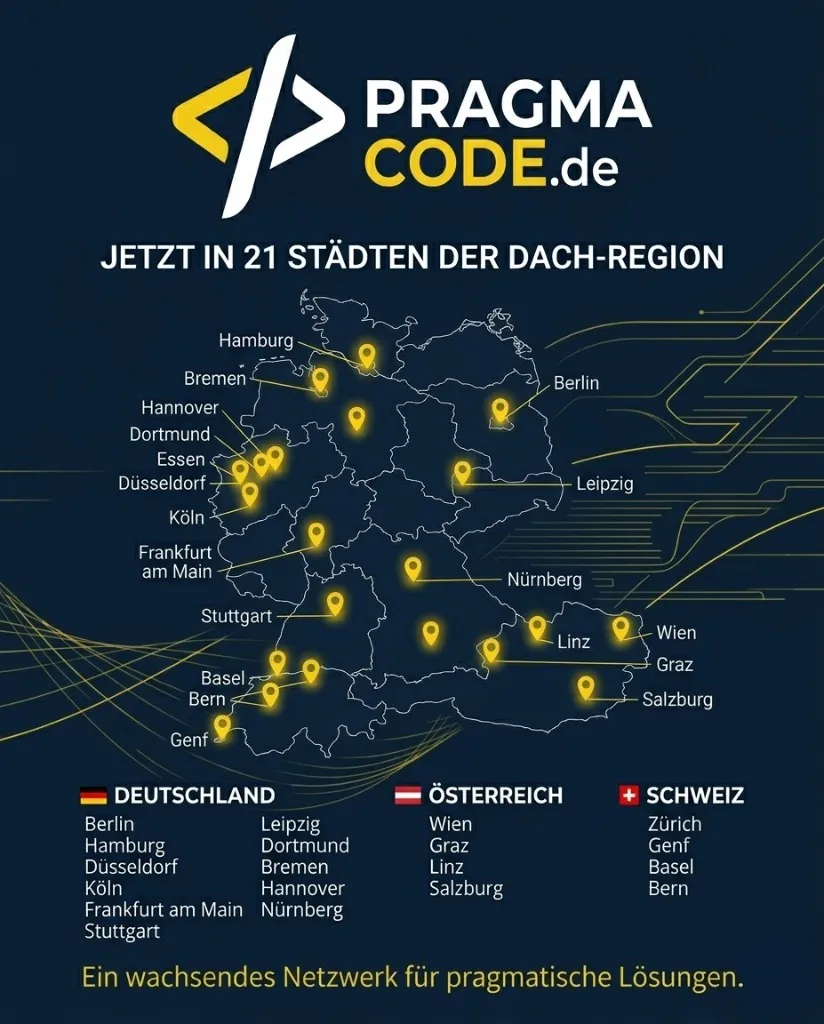
Our Regional Expertise
We are your digital partner – regionally anchored and successfully scaling across borders.
Have a vision?
Let's check together how we can make your idea take flight.
Book your free strategy call nowExtended Specialized Glossary
Citation Share
The core success metric in Answer Engines: The percentage of times your domain or brand is cited as a primary source in AI-generated answers.
Generative Engine Optimization (GEO)
The process of structuring and enriching web content so that LLMs preferentially extract, parse, and cite it in conversational search.
Entity Salience
The mathematical prominence and uniqueness of an entity within text, facilitating error-free fact attribution by AI models.
Co-Citation
The frequent joint occurrence of two entities (e.g., a brand name and a specific technical domain) across external web documents, enabling LLMs to learn their semantic relationship.
Zero-Click Search
Search queries where the user's intent is directly fulfilled by AI-generated summaries on the search result page without requiring a click to an external site.
JSON-LD
JavaScript Object Notation for Linked Data. The preferred format for search engines and LLMs to acquire clear semantic context.