

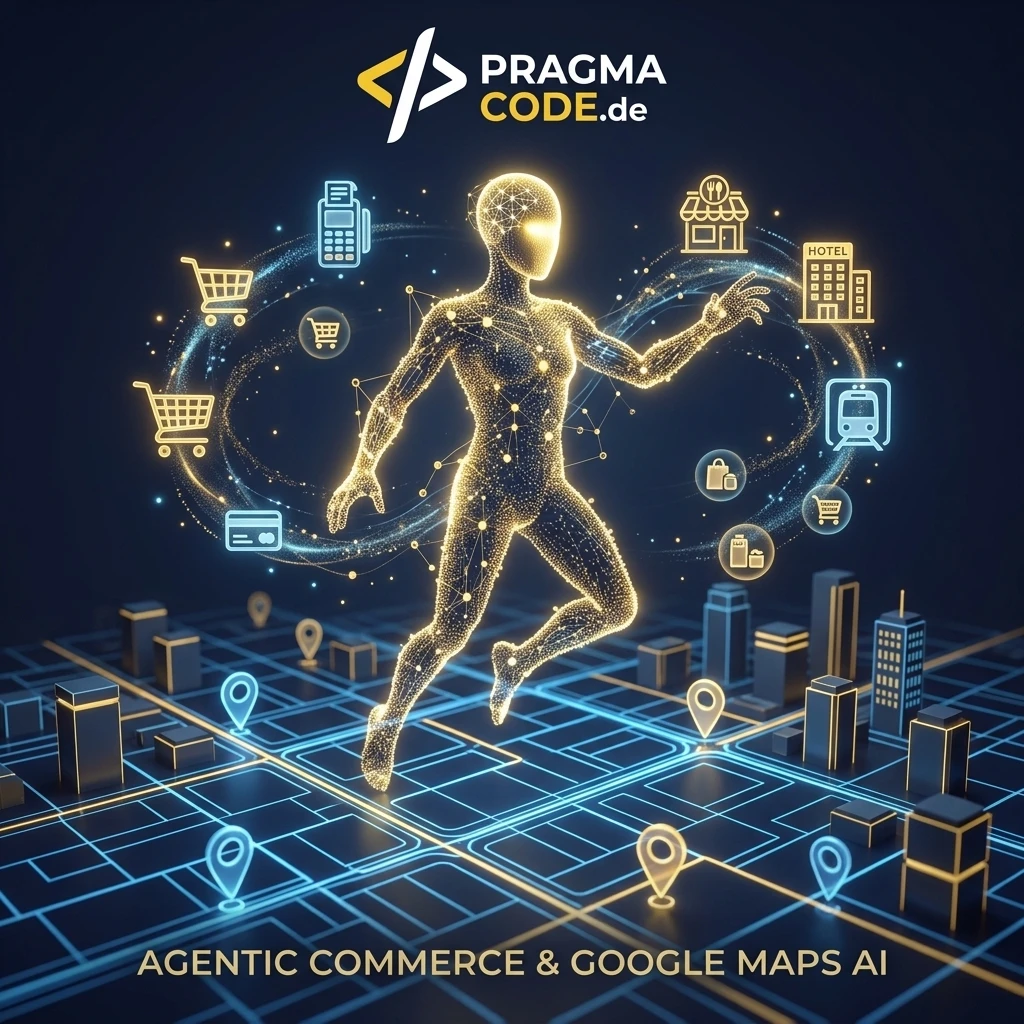
Since August 2026, Google Maps orders food, compares hotel prices, and knows your travel plans — all via AI agent. What sounds like a convenience feature for consumers is actually the starting gun for a fundamental shift in commerce: Agentic Commerce. This article shows SMEs what the Google Maps update concretely means and how to prepare your business right now.
This article is an in-depth expert contribution from our content cluster. Discover the complete overview on our main page:E-Commerce Solutions →
Google Maps now shops for you
On August 6, 2026, Google released an update for Ask Maps that definitively dissolves the boundary between map application and autonomous shopping assistant. Ordering food, comparing hotels, discovering events — all in natural language, all via AI agent. For SMEs in retail, hospitality, and services, this is not a comfort feature but a wake-up call: If you don't prepare your data for machine agents, you simply won't be found in the next generation of commerce.
- Paradigm shift in commerce: Google Maps now uses Gemini-based AI agents that autonomously order food, compare hotel prices, and incorporate travel plans from Gmail — the first mass-market proof point for Agentic Commerce in the consumer market.
- An open standard emerges: The new Universal Commerce Protocol (UCP) standardizes communication between AI agents and merchant systems — comparable to the role HTTP once played for the web.
- SMEs must act now: Structured data (Schema.org), open APIs, and GEO optimization determine whether your business gets recommended by AI agents — or remains invisible.
1. What Happened? Google Maps Becomes an AI Shopping Assistant
Google's announcement on August 6, 2026, sounds at first glance like a convenient comfort update for smartphone users: Ask Maps, the AI-powered conversational feature in Google Maps, can now autonomously order food, compare hotel prices, and even recommend events with ticket links. But behind the consumer feature lies a profound paradigm shift that affects the entire commercial landscape.
Agentic Food Ordering: The AI Agent as Purchaser
Users can now say in natural language: "Order me spicy pad kee mao with seafood for pickup on my way home." The AI then autonomously searches for open restaurants along the route, considers saved preferences and dietary requirements, places the desired dish directly in the cart, and presents the user with only the final confirmation. Partners like Square and Toast are already connected, with Uber Eats following soon.
The crucial point: The user no longer goes through a classic ordering funnel — no Google search, no restaurant website, no manual browsing through the menu. An AI agent takes over the entire process.
Hotel Discovery and Event Recommendations
The same pattern applies to hotels: "Find me a well-rated hotel with a gym within walking distance for next week's conference in downtown Miami, mid-range pricing." Ask Maps compares real-time prices, checks availability, and presents curated results. For events, the AI delivers concerts, comedy shows, and local happenings including ticket links — all in a conversational interface.
Personal Intelligence: Context from Gmail and Calendar
Perhaps the most revolutionary feature is the integration of Personal Intelligence: With user permission, Ask Maps connects to Gmail (and soon Calendar) and incorporates existing flight bookings, hotel reservations, and appointments into its recommendations. "Give me ideas for how to spend the hours near my hotel before my flight tomorrow" — the AI already knows the hotel and departure time and recommends activities including travel times to the airport.
Expert Tip: Why This Update Matters for SMEs
Google Maps has over 2 billion monthly active users. When this user base starts delegating purchasing decisions to an AI agent, an entirely new sales channel emerges — one where it's not a human visiting your shop but an algorithm evaluating your offering. SMEs that aren't machine-readable simply don't exist in this channel.
2. Agentic Commerce: When AI Shops for Your Customers
What Google Maps demonstrates here isn't an isolated case — it's the spearhead of a global trend we've already comprehensively analyzed in our deep dive on Agentic Commerce. The term describes a fundamental shift: It's not the human navigating through websites and apps, but an autonomous AI agent acting on the user's behalf.
The Classic Funnel Is Dying
In traditional e-commerce, a customer follows a linear path: Search → Compare → Select → Cart → Checkout. In Agentic Commerce, this entire funnel is traversed by an AI agent in seconds. The agent knows the preferences, understands the context (location, time, budget, dietary habits), and makes an autonomous pre-selection. The human is left with only the final confirmation.
For merchants, this means: Your website, your shop, your brand no longer needs to convince the human — it needs to convince the agent. And agents evaluate by different criteria than humans: structured data, API accessibility, machine-readable reviews, Schema.org markup, and verifiable facts.
The Ask Maps Update as Proof Point
What makes the Google Maps update so significant is its reach and concreteness. It's the first case where a product with over 2 billion users brings agentic commerce functionality into the mainstream. Until now, Agentic Commerce was a topic for tech visionaries and early adopters — now it becomes operational reality for every restaurant owner, hotelier, and retailer.
"The leap from classic e-commerce to agentic commerce is comparable to the paradigm shift from desktop to smartphone: It fundamentally changes how the medium is consumed."
3. Universal Commerce Protocol: The Open Standard
Google is developing the Universal Commerce Protocol (UCP) for Food together with partners — an open standard that unifies communication between AI agents and merchant systems. It standardizes the entire transaction process: product search, availability checks, cart population, pricing queries, and payment processing.
Why UCP Is a Game-Changer
Think of UCP as the HTTP of commerce. Before HTTP established the standard for web communication, every system spoke its own language. UCP does the same for machine-driven commerce: An AI agent that understands UCP can order from any connected merchant — regardless of whether they use Square, Toast, Shopify, or a proprietary system.
Consequences for SMEs
For SMEs in hospitality and retail, this means: Those who make their ordering and catalog data available through UCP-compatible interfaces will automatically be found and recommended by every AI agent that supports the standard. Those who don't will either depend on proprietary platforms — or won't be considered at all.
The comparison to the early days of the web is deliberate: In the 1990s, the mere existence of a website determined visibility. Today, the existence of machine-readable commerce interfaces determines visibility in AI-driven commerce. Anyone who has already read our article on E-Commerce Trends 2026 will recognize a recurring pattern: Every major trend — from Headless Commerce through Social Commerce to Zero-Click — points in the same direction: machine-optimized, context-aware, autonomous commerce.
4. Five Consequences for SMEs
The Google Maps update may sound like consumer tech at first glance. But the implications hit B2B commerce and SMEs with full force. Here are the five most important consequences:
Visibility in AI Assistants Becomes a Ranking Factor
When an AI agent decides which restaurant to recommend, Google Ads and SERP positions don't matter — machine-readable data, verified reviews, and structured product information do. The new discipline is called Generative Engine Optimization (GEO), and it doesn't replace SEO but adds a critical dimension. Our deep dive on GEO strategy shows the 34% decline in click-through rates for classic SEO — Agentic Commerce further accelerates this trend.
Structured Data and Schema.org Become Mandatory
AI agents can't interpret beautiful images or "feel" marketing copy. They need machine-readable facts: prices, availability, opening hours, menus, allergens, delivery radius. Schema.org markup (Restaurant, Product, Offer, Menu) transitions from an SEO nice-to-have to an operational requirement — because without this data, your offering simply doesn't exist for the agent.
API Readiness: Headless Commerce and Open Interfaces
Ask Maps doesn't order through a website interface — it communicates via APIs with Square's and Toast's systems. This means: Headless commerce architectures that separate frontend from backend and provide open interfaces for external systems become a fundamental prerequisite. Monolithic shop systems without API access are a dead end for AI agents.
Hyper-Personalization: Context Over Keywords
The Personal Intelligence feature shows where the journey leads: AI agents know the user's individual context — travel plans, dietary habits, budget range, location, time of day. Merchants who can serve personalized offers via APIs (dynamic pricing, context-based bundles, location-dependent availability) will be preferentially recommended.
Trust and Reputation as AI Decision Factors
Ask Maps explicitly considers reviews, saved places, and community contributions in its recommendations. For SMEs, this means: Online reputation management transitions from a marketing side project to a strategic success factor. Verified reviews, consistent NAP data (Name, Address, Phone), and active Google Business profiles are the trust signals that AI agents evaluate.
5. Roadmap: Becoming Agentic-Ready in 5 Steps
The good news: You don't have to implement everything at once. The following roadmap provides a practical plan that's achievable for SMEs of every size — from a single restaurant to a mid-sized online retailer.
-
Implement Schema.org and Structured Data
The most important first step: Ensure your Google Business Profile is complete and up-to-date. Then implement Schema.org markup on your website — at minimum
LocalBusiness,Restaurant, orProductwith all relevant attributes (prices, opening hours, menus, reviews). Use Google's Rich Results Test to validate your markup. Goal: Every factual piece of information about your business must be machine-readable. -
Build APIs and Headless Architecture
Check whether your current shop or POS system provides open APIs. If you use Square, Toast, Shopify, or WooCommerce, basic APIs are often already available. For proprietary systems: Plan the migration to a headless architecture or build an API gateway that makes your product data and ordering workflows accessible to external systems. Goal: An AI agent must be able to query your offering and trigger orders.
-
GEO Optimization for AI Visibility
Optimize your web content not just for Google rankings but also for citation in AI systems. This means: clear factual statements, Entity Salience (your brand must be clearly associated with a topic area), E-E-A-T signals (Expertise, Experience, Authoritativeness, Trustworthiness), and an
llms.txtfile that helps AI crawlers access structured information. Goal: Your business gets cited as a source by Perplexity, ChatGPT, and Google AI Overviews. -
Automation with n8n and AI Agents
Use workflow automation platforms like n8n to automate internal processes and prepare your systems for external AI agents. Examples: Automatic menu updates via Google Business API, real-time price synchronization between shop and delivery services, automated review responses. Goal: Your business data is always current, consistent, and synchronized across multiple channels.
-
Set Up AI Visibility Monitoring
Measure how often and in what context your brand is mentioned by AI systems. Classic SEO tools aren't sufficient for this — you need Citation Share monitoring that tracks how often your business is named as a source in AI-generated answers. Pragma Code offers specialized AI visibility monitoring for this purpose. Goal: Data-driven management of your agentic commerce strategy.
Expert Tip: Start with Step 1
Schema.org markup and a complete Google Business Profile are the quick wins with the highest ROI. In many cases, this can be implemented within a few days — and the impact on AI visibility is immediately measurable. Steps 2–5 build on this and can be implemented successively.
6. Classic E-Commerce vs. Agentic Commerce
To illustrate the magnitude of the shift, let's compare the two models side by side:
Comparison: Classic E-Commerce vs. Agentic Commerce
- Decision-maker: The human searches, compares, and buys themselves
- Discovery: Google Search, social media, paid ads
- Interface: Website, app, marketplace UI
- Optimization: SEO, UX design, conversion rate optimization
- Data format: HTML, images, marketing content
- Order process: Manual checkout in 5–7 steps
- Personalization: Cookie-based, retargeting, A/B testing
- Decision-maker: AI agent acts autonomously on the user's behalf
- Discovery: AI agents search APIs, structured data, knowledge graphs
- Interface: Natural language, conversational AI
- Optimization: GEO, Schema.org, API design, trust signals
- Data format: JSON-LD, APIs, machine-readable catalogs
- Order process: One sentence → agent handles everything → confirmation
- Personalization: Context-based (location, calendar, preferences, real-time data)
7. Real-Time Data and Community Intelligence
Two additional aspects of the Ask Maps update deserve special attention because they show where the development is heading:
Real-Time Transit Widget: Timeliness as a Quality Signal
Ask Maps now shows real-time delays for buses, trains, subways, and ferries — updated minute by minute, directly in the conversational interface. For SMEs, this is relevant because it highlights a central expectation of the AI era: timeliness. AI agents prefer data sources that are updated in real time. A restaurant with automatically synchronized opening hours, live availability, and daily-updated menus will be preferred over a competitor with static data.
Conversational Contributions: Crowdsourced Trust
Users can now report updates directly via voice or photo to Maps — new opening hours via storefront photo, insider tips like "more parking available behind the building." Over 500 million contributors keep Maps current. For SMEs, this means: Your customers actively shape your digital presence. Positive experiences shared by the community are stronger trust signals for AI agents than any advertising campaign.
Conclusion: Commerce Becomes Machine-Readable — or Invisible
The Google Maps update of August 2026 is more than a feature release — it's a starting signal. When a product with over 2 billion users begins delegating purchasing decisions to AI agents, it changes the rules for all of commerce. For SMEs, there are two options: Build the infrastructure for Agentic Commerce now — structured data, open APIs, GEO optimization, real-time synchronization — or watch as competitors occupy the new channel.
The roadmap is clear, the technologies are available, and the need for action is urgent. The shift to Agentic Commerce won't wait until every SME is ready. Businesses that act now secure a first-mover advantage in a market that is just beginning to emerge.
Quick Check: Is Your Business Agentic-Ready?
Have questions about Agentic Commerce?
Schedule a free consultationOur Regional Expertise
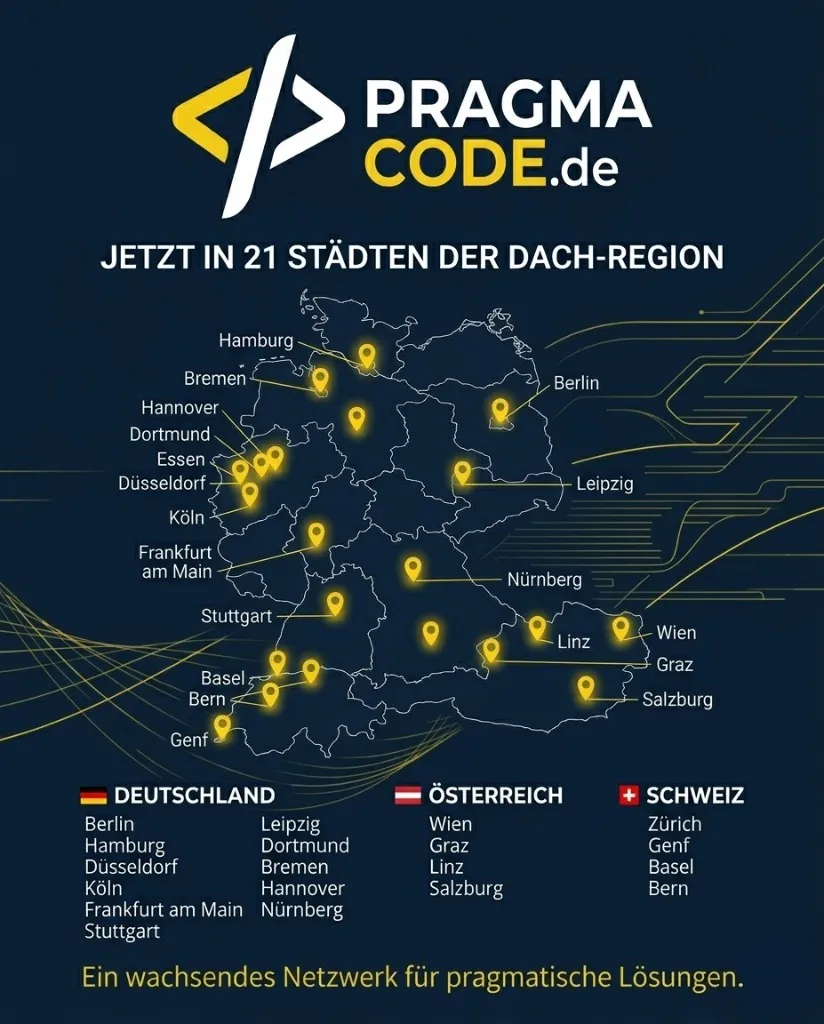
We are your digital partner – regionally anchored and successfully scaling across borders.
Have a vision?
Let's check together how we can make your idea take flight.
Book your free strategy call nowExtended Specialized Glossary
Agentic Commerce
A form of automated commerce where AI agents autonomously research, evaluate offers, and execute transactions on behalf of users — without the human having to make every single click themselves.
Universal Commerce Protocol (UCP)
An open industry standard that enables AI agents to communicate machine-readably with merchant systems — from product search through cart population to payment processing.
Ask Maps
The conversational AI feature in Google Maps, powered by the Gemini model, that answers natural language questions about places, routes, restaurants, hotels, and events with context-aware responses.
Personal Intelligence
Google's concept for context-aware AI assistants that, with user permission, access personal data like Gmail reservations to proactively deliver personalized recommendations.
Generative Engine Optimization (GEO)
The process of optimizing content so that it is optimally understood and recommended by generative AI search engines like Perplexity or ChatGPT.
Headless Commerce
An e-commerce architecture that separates the frontend from the backend, enabling seamless integration of AI agents through structured interfaces (APIs).