


How to scale hundreds of highly relevant landing pages using structured datasets, intelligent code templates, and Astro 6 – without violating Google's Scaled Content Abuse policy.
This article is an in-depth expert contribution from our content cluster. Discover the complete overview on our main page:SEO Landing Pages →
Scaled Landing Pages in the Era of Agentic SEO
Programmatic SEO has evolved from simple text templates into intelligent, data-driven content ecosystems. In 2026, Google demands more than mere sentence variations; it requires substantial data value and machine-readable entities. This guide demonstrates how to build hundreds of targeted long-tail pages using Astro 6, Next.js App Router, and modern AI agent workflows.
- Data × Template = Scale: pSEO combines structured databases (Airtable, PostgreSQL, Supabase) with flexible code templates for automated page generation.
- Preventing Scaled Content Abuse: Under Google's enhanced spam policies, pSEO pages must deliver genuine unique content, local stats, structured tables, or UGC.
- Modern Tech Stack: Maximum performance and crawl speed powered by Astro 6 SSG or Next.js App Router Incremental Static Regeneration (via
generateStaticParams()).
- What is Programmatic SEO (pSEO)?
- Who Benefits from Programmatic SEO?
- The pSEO Strategy: 6 Steps to Scale
- Technical Implementation: The Tech Stack
- Unique Content & Google Scaled Content Abuse
- Internal Linking: The Hub-and-Spoke Model
- Common pSEO Pitfalls to Avoid
- Implementation Roadmap
- pSEO & AI: Agentic Workflows in 2026
- Measuring Success: Key pSEO KPIs
What is Programmatic SEO (pSEO)?
Imagine being able to turn a single dataset and a smart template structure into not one, but 500 perfectly optimized SEO pages at once – each highly relevant for a specific search query. That is the promise of Programmatic SEO (pSEO), and large platforms like Tripadvisor, Airbnb, and Booking.com have been leveraging it for years to build massive organic reach.
What was once only realistic for tech giants with their own development teams is today achievable for small and medium-sized businesses thanks to modern frameworks like Astro 6, AI-powered content generation, and no-code databases. In this guide you will learn everything: what pSEO really is, which types of businesses benefit from it, how to build a solid strategy – and which mistakes you must avoid at all costs.
Programmatic SEO is a method for the automated creation of SEO-optimized web pages based on structured datasets and reusable templates. Instead of manually writing each page, you define a page structure once and populate it dynamically with varying data – such as cities, industries, product variants, or keywords.
The Core Formula: Data × Template = Scale
You combine a structured dataset (a database with entries like cities, categories, or attributes) with an HTML template that automatically populates SEO-relevant elements – title, meta description, H1, structured content – from the data. The result: a page for "Berlin + Tax Advisor" looks different from "Hamburg + Tax Advisor", even though both were generated from the same template.
Comparison: Traditional SEO vs. Programmatic SEO
- Creation: Manual writing of each individual page
- Speed: 1–5 pages / week
- Effort: High time investment, limited scalability
- Focus: Individual high-volume head terms
- Creation: Dataset + developed code template
- Speed: Hundreds of pages / day
- Effort: Low marginal cost, massive scaling
- Focus: Complete coverage of long-tail search volume
Who Benefits from Programmatic SEO?
Not every business benefits equally from pSEO. The key factor is whether your business model allows for a natural variation of content along one or more dimensions.
Local Services
Local Service Providers
An optimized landing page for each target city. Example: "Emergency Plumber Munich", "Tax Advisor Frankfurt".
E-Commerce
E-Commerce & Shops
Category & attribute combinations like "red sneakers size 42" as individual, indexable pages.
Comparisons
Comparison Portals
Price comparisons, review portals, and software head-to-heads (Tool A vs. Tool B).
B2B & IT
B2B & Industry IT
IT providers requiring tailored industry and solution pages for enterprise clients.
"Programmatic SEO is not a shortcut – it is a tool for businesses that truly understand their niche and want to systematically capture it."
The pSEO Strategy: 6 Steps to Scale
Before you start with the technical implementation, you need a clearly defined strategy. Many pSEO projects don't fail because of technology, but because keyword research and data structure are insufficiently thought through.
The heart of every pSEO strategy: Head Term × Modifier = Page Matrix. A head term is your main topic (e.g., "tax advisor"), a modifier is the varying dimension (e.g., 50 DACH cities). Result: 50 pages.
Every combination of head term and modifier must actually have search volume. Use Ahrefs, SEMrush, or DataForSEO to check volume and competitive strength.
Create a structured database (Airtable, Supabase, or PostgreSQL) with all modifier variations and unique data per entry: city descriptions, local statistics, regional specifics.
The template must generate unique title tags, H1s, and meta descriptions per page and provide enough unique content per page to avoid duplicate content issues.
Choose the right technical foundation: static pages (Astro 6 SSG, Next.js App Router with generateStaticParams()), or CMS-backed hybrid approaches.
Track each pSEO page individually in Google Search Console. Identify the top performers and continuously iterate on the template.
Technical Implementation: The Right Tech Stack
Your technical foundation determines crawlability, scalability, and long-term maintainability. Frameworks like Astro 6 or Next.js App Router allow you to generate hundreds of static HTML pages at build time from a data source – blazing fast, perfectly indexable, and serverless.
Astro 6 SSG
Astro 6 Content Collections
Ideal for content-focused pSEO. Zero JS by default, maximum Core Web Vitals. Leverages getStaticPaths() & JSON/Markdown.
Next.js App Router
Next.js App Router & ISR
Proven for dynamic enterprise projects. Uses generateStaticParams() and Incremental Static Regeneration for live updates.
No-Code / Headless
Webflow / Directus + Airtable
No-code & headless option for marketing teams. Generates landing pages via CMS APIs and Airtable without developer overhead.
WordPress CLI
WordPress + ACF & WP-CLI
For legacy WP sites: Advanced Custom Fields + WP-CLI enables bulk importing of pages from CSV datasets.
Here is a concise code example demonstrating dynamic route generation from a JSON database in Astro 6:
// src/pages/services/[city].astro
export async function getStaticPaths() {
  const cities = await fetchCitiesFromDatabase(); // e.g. Airtable / Supabase API

  return cities.map((city) => ({
    params: { city: city.slug },
    props: {
      cityName: city.name,
      population: city.population,
      localStats: city.statistics,
      seoTitle: `IT Services ${city.name} | Pragma-Code`,
    },
  }));
}

const { cityName, population, localStats, seoTitle } = Astro.props;
Unique Content & Google's Scaled Content Abuse Policy
The biggest challenge in pSEO is avoiding duplicate content and complying with Google's strict Scaled Content Abuse Policy. Google detects and penalizes pages that merely shuffle text blocks without delivering genuine value.
Google's Scaled Content Abuse Policy 2026
With recent core updates, Google scrutinizes automated websites more strictly than ever. Publishing hundreds of thin pages (<300 words) risks domain-wide deindexing. Every pSEO page requires unique context, structured data, and authentic value.
Geo Data
Location-Specific Data
Integrate district-specific statistics or regional economic metrics that truly differentiate "Munich" from "Hamburg".
UGC
User Generated Content
Authentic reviews and Q&As are inherently unique and strengthen the page's E-E-A-T signals.
AI & LLMs
AI-Assisted Variations
Use LLMs (Claude 3.7 Sonnet, GPT-4o) to generate unique, location-tailored intro paragraphs for each page.
Linking
Internal Entity Links
Each pSEO page must link to relevant pages (other cities, adjacent categories) and be linked internally.
Internal Linking: The Hub-and-Spoke Model
Without a well-thought-out internal linking concept, you risk your new pSEO pages never being crawled or indexed. Google discovers new pages primarily through internal links – not through the sitemap alone. Structure your pSEO pages using the Hub-and-Spoke model: a hub page (e.g., "All Cities") links to all individual spoke pages. Spokes link back to the hub and to related spokes.
Hub Page
Indexable Overview Hub
Create a central hub page (e.g. /tax-advisor/ → all cities) aggregating all spoke landing pages.
Schema.org
Breadcrumb Navigation
Implement breadcrumbs with complete Schema.org markup for explicit crawler hierarchy.
Context Links
Relational Cross-Links
Use relational links ("Also available in these cities") to guide crawlers and users dynamically.
Crawl Depth
Max 3 Click Depth
Ensure every pSEO landing page is reachable within a maximum of 3 clicks from the homepage.
Sitemap API
Dynamic XML Sitemap
A daily updated XML sitemap immediately feeds all new pSEO URLs to search engine crawlers.
The Most Common pSEO Mistakes
Mistake 1
Thin Content
Pages with insufficient unique content get deindexed. Provide a minimum of 300–500 words of unique content per page.
Mistake 2
Missing Canonical Tags
For similar pages (filter pages), canonical tags prevent pages from competing against each other in search results.
Mistake 3
Unvalidated Search Volume
Pages without search volume bring no traffic. Validate every keyword combination upfront in research tools.
Mistake 4
Poor Page Speed
Hundreds of slow pages damage the domain signal. SSG frameworks (Astro 6, Next.js) are the solution.
Implementation Roadmap
Define head terms and modifiers. Validate search volume and competition for all combinations. Create the database structure.
Develop the SEO template with unique title tags, H1s, meta descriptions. Integrate the data source (Airtable, Supabase, JSON API).
Deploy 20–50 pilot pages. Verify indexing via Google Search Console. Check Schema.org markup and internal linking.
Scale to all planned pages. Submit the sitemap. Trigger indexing requests for prioritized pages via Google Indexing API.
Track rankings and CTR per page. Identify top performers and continuously iterate the template.
pSEO and AI: Agentic Workflows in 2026
Large language models like Claude 3.7 Sonnet or GPT-4o have fundamentally changed the pSEO world. The intelligent combination of structured data and LLM-generated text blocks allows creating pages that feel like they were written manually – while maintaining pSEO scalability. Crucial note: AI-generated content is only valuable when it is based on real data and reviewed by human experts.
- Keyword Clustering: AI automatically groups thousands of keywords into thematic clusters for template planning
- Introductory Texts: LLMs generate unique, location-specific introductory paragraphs per page
- FAQ Generation: FAQs are automatically generated from the page topic and common search queries
- Quality Review: AI models review generated pages for quality and factual correctness before deployment
"Programmatic SEO with AI support is not the end of high-quality content – it is the beginning of scalable expertise."
Success Measurement: KPIs for pSEO Projects
pSEO projects require systematic tracking. Manual checks across hundreds of pages are impractical – automated dashboards and structured monitoring are mandatory.
Target: >90%
Indexing Rate
Share of your pSEO pages indexed by Google. Benchmark: over 90% of all generated URLs.
GSC Tracking
Average Position
Continuous ranking position tracking per individual page and aggregate via Google Search Console.
SERP Snippets
Click-Through Rate (CTR)
Measures how compelling your dynamic title tags and meta descriptions perform in organic search results.
Traffic Pool
Organic Traffic per Page
Identify top performers across your pSEO portfolio and continuously iterate underperforming templates.
Business ROI
Conversion Rate
The critical business KPI: pSEO traffic must ultimately convert into sales leads or purchases.
Quick-Check: Your pSEO Success Recipe 2026
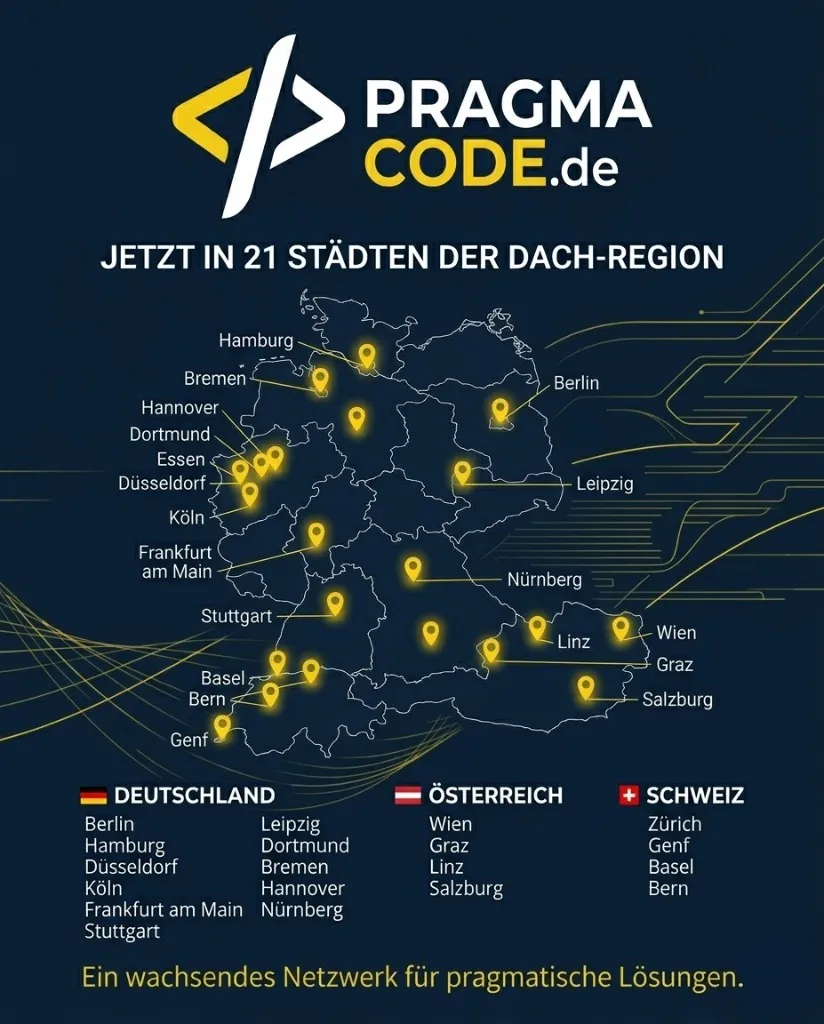
Our Regional Expertise
We are your digital partner – regionally anchored and successfully scaling across borders.
Have a vision?
Let's check together how we can make your idea take flight.
Book your free strategy call nowExtended Specialized Glossary
Programmatic SEO (pSEO)
A method for the automated creation of SEO pages from structured datasets and templates, enabling hundreds to thousands of pages to be created at scale.
Head Term
The central search topic in the pSEO formula (e.g., "tax advisor"), which is combined with a modifier to generate the page matrix.
Modifier
The varying dimension in the pSEO formula, e.g., city names, product categories, or industries, combined with the head term.
Thin Content
Pages with insufficient unique content. Google deindexes or penalizes such pages under the Scaled Content Abuse Policy.
generateStaticParams()
A Next.js App Router function (or getStaticPaths in Astro 6) that defines all dynamic routes at build time and generates static HTML pages.
Canonical Tag
HTML tag (rel="canonical") that tells Google which version of a page to treat as the "original" – essential in pSEO to prevent duplicate content conflicts.