


In 2026, market success is no longer dictated by mere keyword frequency, but by unshakeable trustworthiness: Large Language Models (LLMs), Google's AI Overviews, and autonomous AI agents ruthlessly filter out low-value AI spam. To be cited in modern Answer Engines, enterprises must embed E-E-A-T (Experience, Expertise, Authoritativeness, Trustworthiness) as an algorithmically readable architecture into their digital footprint.
This article is an in-depth expert contribution from our content cluster. Discover the complete overview on our main page:SEO & Content →
The Algorithmic Trust Anchor: Why LLMs Demand Human Expertise
The era of sequentially clicking on ten blue search result links has come to an end. In 2026, Retrieval-Augmented Generation (RAG) systems, Perplexity Pro, ChatGPT Search, and Google's AI Overviews aggregate web intelligence directly into synthesized answers. To eliminate hallucinations, AI crawlers evaluate unforgeable proof of real-world practical experience, deep technical authority, and institutional credibility rather than mere text volume. E-E-A-T has graduated from a qualitative rating guideline to the core currency of Generative Engine Optimization (GEO).
- From Keywords to Entities: AI models parse semantic relationships. Generic filler content is devalued by automated quality filters; what drives citation is building complete Topical Authority backed by proprietary first-party data.
- Machine-Readable Reputation Architecture: Using Schema Markup 2.0, connect author profiles, verified certificates, and organizations via JSON-LD directly to global knowledge graph entities (Wikidata, LinkedIn, scientific registries).
- Citation Share as the New Conversion Currency: Brands cited as primary sources in AI-generated answers achieve up to 45% higher click-through rates and capture pre-qualified B2B leads with shortened sales cycles.
- 1. The Paradigm Shift: How AI Search Engines Redefine Quality
- 2. The 4 Pillars of E-E-A-T: Algorithmic Decoding of Trust
- 3. System Comparison: Traditional Keyword SEO vs. E-E-A-T & GEO
- 4. Topical Authority & Entity Hubs: The Semantic Knowledge Network
- 5. Schema Markup 2.0: The Structured Data Pipeline for AI Agents
- 6. Visible Author Entities: Ending Anonymous Corporate Blogging
- 7. The 4 Cost Traps & Penalty Risks of Synthetic Mass Content
- 8. Measurability & ROI: How E-E-A-T Drives Citation Share and B2B Revenue
- 9. Step-by-Step Roadmap: 5 Phases to Unassailable Topical Authority
- 10. Quick-Check: Action Checklist for Decision-Makers and Marketing Teams
- 11. Conclusion: Trust as the Ultimate Moat in the AI Era
1. The Paradigm Shift: How AI Search Engines Redefine Quality
The global information landscape is experiencing its most seismic disruption since the commercialization of the internet. For over two decades, success in organic search engine marketing rested on two foundational pillars: exact keyword placement in headings and body text, and quantitative backlink acquisition to inflate domain authority scores. This mechanical playbook succeeded because legacy search engines evaluated documents primarily through index pattern matching and PageRank algorithms.
With the widespread adoption of frontier language models such as Google Gemini, OpenAI GPT-4o, Anthropic Claude, and specialized answer engines like Perplexity, this paradigm has irrevocably shifted. Search queries are no longer routed to static URL index lookups; instead, they are processed through multi-stage RAG pipelines. The language model converts user intent into high-dimensional semantic vectors, retrieves relevant context chunks from curated vector databases, and synthesizes a direct, comprehensive response inside the user interface.
In this workflow, model providers face an existential threat: the risk of hallucinations and the influx of low-grade synthetic content farms. When an AI provides incorrect compliance guidance to an enterprise executive or flawed engineering parameters to an architect, confidence in the entire platform disintegrates. Consequently, modern search and synthesis systems deploy rigorous multi-tiered quality filters rooted in Google's quality framework: E-E-A-T (Experience, Expertise, Authoritativeness, Trustworthiness).
For mid-sized and enterprise B2B organizations, engineering firms, consulting practices, and technology vendors, visibility alone is no longer the objective. To be cited and linked as an authoritative reference in AI summaries over the next decade, organizations must translate their genuine domain competence and project achievements into an unambiguous, machine-readable semantic web architecture.
2. The 4 Pillars of E-E-A-T: Algorithmic Decoding of Trust
Originally defined in Google's Search Quality Rater Guidelines to assist human evaluators, the four dimensions of E-E-A-T are now deeply integrated into the training, fine-tuning, and retrieval routines of modern LLMs. They form a multi-dimensional vector that quantifies document trustworthiness. To systematically optimize for these criteria, we must analyze how algorithms decode each pillar technically.
1. Experience (First-Hand)
Proof of direct, hands-on interaction with the subject matter. Did the author personally deploy the system? Was the software migration executed internally? Algorithms inspect texts for proprietary screenshots, performance benchmark logs, troubleshooting observations, and un-replicated case data.
2. Expertise (Credentials)
The formal theoretical and methodological mastery possessed by the author. Validated through academic degrees, recognized industry certifications (e.g., CISSP, AWS Solutions Architect), professional publications, and precise, consistent technical nomenclature.
3. Authoritativeness (Reputation)
The overarching reputation of the domain and organization within its industry vertical. Are your whitepapers cited by recognized trade journals, industry bodies, or universities? Are your executives invited to speak as keynote panelists at tier-1 conferences?
4. Trustworthiness (Integrity)
The central hub uniting all E-E-A-T dimensions. Incorporates technical infrastructure security (HTTPS, DNSSEC), transparent company disclosures (legal impressum, physical address), editorial integrity policies, conflict-of-interest disclosures, and reliable primary citations.
Google explicitly underscores in its documentation: Trustworthiness sits at the heart of the framework. Flawless expertise and first-hand experience carry zero weight if content exhibits factual ambiguities or introduces security risks for users. In Your Money or Your Life (YMYL) verticals—including healthcare, corporate finance, mission-critical cloud engineering, and cybersecurity compliance (EU AI Act, NIS2)—quality thresholds are enforced with uncompromising precision.
3. System Comparison: Traditional Keyword SEO vs. E-E-A-T & GEO
Successfully transitioning your digital marketing operations requires contrasting legacy SEO tactics with modern, trust-driven Generative Engine Optimization. Many processes established between 2018 and 2023 are not merely obsolete today—they actively expose your digital brand to algorithmic depreciation.
Comparison: Legacy SEO Playbook vs. Generative Engine Optimization (GEO) 2026
- Primary Goal: Maximizing blue-link clicks in position 1 to 3 of static search engine result pages.
- Optimization Vector: Keyword density formulas, WDF*IDF metrics, and repetitive target phrase placements.
- Content Generation: Mass outsourced content production via low-cost freelance mills without author attribution.
- Backlink Strategy: Quantitative link acquisition through generic guest posts, web directories, and blog networks.
- Technical Stack: Basic HTML with generic meta tags and standard OpenGraph social snippets.
- Core KPIs: Organic search impressions, rankings for short-tail queries, and third-party Domain Authority.
- Primary Goal: Dominating Citation Share in AI-generated synthesis blocks and conversational answer engines.
- Optimization Vector: Semantic entity coverage, information density, and verifiable E-E-A-T proof.
- Content Generation: Direct collaboration with internal Subject Matter Experts (SMEs) and proprietary research studies.
- Authority Building: Peer citations, industry body references, and contextual unlinked brand mentions.
- Technical Stack: Deeply nested Schema Markup 2.0 connecting Person, Organization, and Citation entities.
- Core KPIs: LLM Citation Share, Brand Sentiment score, qualified B2B pipeline velocity, and client retention.
The architectural distinction is clear: Legacy web crawlers read text strings; frontier LLMs parse semantic relationships between real-world entities. When your firm publishes a comprehensive guide on "High-Availability Kubernetes Architectures for Industrial IoT," an AI agent verifies whether your contributing engineers hold verifiable DevOps credentials on LinkedIn, whether your organization maintains active repositories on GitHub, and whether your case studies cite verified performance metrics.
4. Topical Authority & Entity Hubs: The Semantic Knowledge Network
Topical Authority represents the algorithmically quantified status of a domain as an indisputable reference hub for an entire knowledge vertical. Domains possessing comprehensive topical authority rank effortlessly even for fiercely competitive industry terms, whereas generalist platforms frequently stumble despite high legacy backlink metrics.
How AI Systems Compute Topical Authority
Modern AI search engines use vector embeddings and semantic Knowledge Graphs to evaluate domain completeness. If an enterprise software provider discusses "ERP Software Pricing" while ignoring fundamental architectural prerequisites like API integration layers, database transactional safety, GDPR-compliant data export routines, and migration risk management, the algorithm flags an incomplete knowledge graph. The site is categorized as purely transactional and loses its informational trust signals.
1. Pillar-and-Cluster Architecture (Thematic Silos)
Every core business domain is anchored by an exhaustive Pillar Page offering panoramic topic coverage. Nested beneath it are deep-dive cluster articles addressing technical specifics, interlinked in a strict hierarchical, bidirectional web.
2. Entity Mapping Over Keyword Research
Identify all sub-entities, compliance standards (e.g., ISO 27001, DIN EN 50128), and industry terminology. Ensure every entity is clearly defined, contextually grounded, and connected to parent concepts across your content ecosystem.
3. Establishing a First-Party Research Engine
Publish quarterly proprietary industry reports, customer benchmarking data, and operational case studies. Original data serves as the most potent citation magnet for AI search engines, being the world's sole primary source for those insights.
4. Rigorous Content Pruning (Quality Governance)
Outdated, shallow, or low-performing articles from previous years dilute your domain's trust score. Systematically upgrade legacy content to 2026 standards or prune outdated URLs using 301 redirects to the central pillar hub.
By establishing a robust Entity Hub, your company builds a digital fortress of expertise. When an AI agent formulates an answer to a complex user inquiry, it extracts data from your cluster because all cross-references, definitions, and technical proofs are logically and reliably contained on a single authoritative domain.
5. Schema Markup 2.0: The Structured Data Pipeline for AI Agents
While human readers process formatted copy, charts, and diagrams visually, AI crawlers and autonomous software agents depend on structured, machine-interpretable protocols. Standard HTML markup is often insufficient to represent complex organizational relationships unambiguously. This is the domain of Schema Markup 2.0 (Agentic SEO).
Schema Markup 2.0 represents the systematic, deeply nested deployment of Schema.org vocabularies formatted in JSON-LD. The objective is to serve web crawlers and AI ingest engines a complete, error-free knowledge graph embedded directly in the page source.
1. Person Schema with In-Depth Attribute Mapping
Link every author entity using hasOccupation, worksFor, alumniOf, and knowsAbout. The sameAs array references validated third-party profiles on LinkedIn, Google Scholar, ResearchGate, or GitHub.
2. Organization Knowledge Graph Embedding
Define your enterprise with complete corporate register numbers, founding history, executive leadership (founder, employee), ISO certifications, and verified sameAs links pointing to commercial registries and Wikidata entries.
3. Citation & Mentions Markup in Technical Articles
Every authoritative publication should reference scientific and primary sources using the citation attribute in BlogPosting markup. The about and mentions attributes connect discussed concepts directly to official Wikidata URIs.
4. Machine-Extractable FAQPage & HowTo Schemas
Answer engines like ChatGPT and Google AI Overviews leverage structured Q&A pairs and step-by-step instructions as direct feeds for quick summaries. Validated schema delivers bite-sized factual answers directly into the retrieval pipeline.
Expert Tip: Entity Disambiguation via Wikidata & sameAs
Always utilize unique Wikidata URIs (e.g., https://www.wikidata.org/wiki/Q11660 for Artificial Intelligence) in your about and sameAs schemas. This eliminates semantic ambiguity, allowing LLMs to seamlessly connect your content with the global machine knowledge base.
6. Visible Author Entities: Ending Anonymous Corporate Blogging
A widespread vulnerability in B2B enterprise websites is publishing critical technical content under anonymous aliases like "Admin", "Editorial Staff", or "Marketing Team". What originated as a convenience shortcut has transformed into a severe liability in the era of generative AI search.
Large Language Models are explicitly trained to trace information provenance back to accountable, verifiable individuals. An assertion regarding enterprise cybersecurity resilience carries weight for an AI only when authored by a demonstrably qualified security architect. Publishing anonymously signals to algorithms: "No qualified professional is willing to attach their reputation to the accuracy of this data."
The 6 Pillars of an Unassailable B2B Author Profile
Every contributing expert in your enterprise requires a dedicated, search-indexable author page (e.g., pragma-code.de/en/author/alexander-ohl). This hub must provide 6 essential trust anchors:
1. Authentic Photography
A high-resolution, professional portrait of the actual subject matter expert—never generic AI-generated avatars or stock placeholders.
2. Comprehensive Biography
Detailed documentation of professional milestones, focus areas, technological specializations, and real-world project achievements.
3. Verifiable Credentials
Formal academic degrees, accredited industry certifications, patents, and recorded keynote conference speaking appearances.
4. Digital Footprint & Social Proof
Direct links to active LinkedIn profiles, GitHub repositories, Google Scholar citations, and published technical books.
5. Curated Publication Archive
A comprehensive, structured index of all technical articles authored on the domain, proving continuous subject-matter dedication.
6. Person Schema Integration
Flawless JSON-LD semantic markup including interconnected sameAs references connecting to Wikidata and LinkedIn.
By empowering your internal Subject Matter Experts as visible thought leaders, your organization establishes an irreplaceable personal brand moat. These author entities are indexed by Google and AI agents as verified authorities, boosting your domain's aggregate trust score.
7. The 4 Cost Traps & Penalty Risks of Synthetic Mass Content
The temptation is clear: Modern language models enable organizations to generate hundreds of automated blog posts per week at near-zero incremental cost. Numerous businesses and generic marketing agencies embraced this illusion, saturating their domains with synthetic text. However, algorithmic countermeasures rolled out across 2025 and 2026 have resulted in severe commercial penalties.
1. The Helpful Content Classifier Trap
Domains publishing predominantly AI-summarized rehashes without proprietary research are classified domain-wide as unhelpful. Organic search visibility routinely collapses by 70% to 90% with minimal recovery prospects.
2. RAG Pipeline Exclusion (Citation Blacklisting)
AI search engines like Perplexity and Google AI Overviews maintain internal source reputation scores. Domains flagged for synthetic content scraping are purged from retrieval corpora and completely omitted from AI citations.
3. Compliance & Liability Risks from Hallucinations
Unvetted AI-generated copy frequently contains subtle inaccuracies or outdated legal frameworks. In B2B environments, publishing such errors triggers regulatory warnings, brand damage, and contractual liabilities.
4. Catastrophic Trust Loss Among B2B Buyers
Sophisticated enterprise buyers detect generic AI phrasing within seconds. A corporate blog filled with empty platitudes signals technical inadequacy, devastating conversion rates on high-value consulting and software contracts.
The core strategic directive for 2026 is unambiguous: Leverage AI for exploratory research, data structuring, and conceptual drafting—but entrust final editorial synthesis, original case analysis, and publication approval exclusively to human subject matter experts.
8. Measurability & ROI: How E-E-A-T Drives Citation Share and B2B Revenue
Investments in author profiles, proprietary research, and semantic schema architectures are frequently scrutinized by executive leadership for being less immediate than paid performance advertising (Google Ads, LinkedIn Ads). However, empirical data across enterprise B2B sectors demonstrates an extraordinary Return on Investment (ROI).
AI Overview Citation Rate
Google AI Overviews and Perplexity disproportionately favor verified E-E-A-T sources with structured semantic backends.
+45% Citation RateDomains with verified author entities are cited nearly three times as frequently in synthesized AI search answers.
B2B Lead Quality & Sales Velocity
Prospects converting through in-depth technical guides and validated case studies possess higher baseline trust.
+60% Faster Sales CyclesTransparent E-E-A-T signals dramatically reduce enterprise objection handling and accelerate procurement approval cycles.
Core Update Algorithm Resilience
While generic content sites experience severe volatility during search updates, verified authority domains remain impervious.
100% Core ResilienceInvesting in genuine domain expertise protects organic traffic assets and builds an enduring brand moat.
In the era of zero-click searches—where users receive syntheses directly on the engine page—the decisive benchmark metric has evolved: from simple raw traffic volume to Citation Share (the percentage of AI-generated answers recommending your enterprise as the authoritative solution). Dominating Citation Share captures the most valuable enterprise accounts.
9. Step-by-Step Roadmap: 5 Phases to Unassailable Topical Authority
Deploying a comprehensive E-E-A-T architecture is a structured transformation aligning digital marketing, software engineering, and core technical business units. The following battle-tested roadmap guides your enterprise to market leadership over the coming quarters.
-
Phase 1: Content Audit & SME Empowerment (Month 1)
Conduct a rigorous audit of all existing digital assets. Identify internal Subject Matter Experts (lead architects, senior engineers, consultants). Establish validated author profile hubs complete with professional photography, detailed bios, and verified social links.
-
Phase 2: Semantic Entity Mapping & Topic Silos (Month 2)
Define your organization's 3 to 5 foundational core competencies. Develop a granular entity map of all subtopics, standards, and technical interfaces. Structure comprehensive Pillar Pages and reallocate existing articles into strict semantic clusters.
-
Phase 3: Schema Markup 2.0 & Knowledge Graph Rollout (Month 3)
Deploy deeply nested JSON-LD schema across your entire digital property. Connect
Organization,Person,BlogPosting, andFAQPageschemas viasameAsandcitationproperties to global knowledge repositories (Wikidata, LinkedIn). -
Phase 4: Proprietary Research & First-Party Data Engine (Months 4–6)
Initiate the production of original research reports, technical benchmarks, and verified customer case studies. Establish a formal internal peer-review standard ("Technically reviewed by: Expert X") for all technical publications.
-
Phase 5: External Authority Amplification & Digital PR (Ongoing)
Expand author visibility beyond your proprietary domain: guest contributions in respected industry journals, appearances on prominent podcasts, and keynote conference sessions. These external citations finalize the AI's trust network.
10. Quick-Check: Action Checklist for Decision-Makers and Marketing Teams
Use the following checklist to evaluate your enterprise's current E-E-A-T maturity and identify immediate operational priorities for your team:
Quick-Check: Your Roadmap to Algorithmic Topical Authority
11. Conclusion: Trust as the Ultimate Moat in the AI Era
The digital marketing ecosystem is not facing the end of content marketing; it is witnessing its profound qualitative renaissance. In an era where artificial intelligence generates infinite volumes of synthesized text in milliseconds, shallow information carries zero economic value. What is radically scarce—and therefore immensely valuable—is authentic human experience, validated technical expertise, and institutional trustworthiness.
Enterprises that recognize early that modern search engines and AI agents seek verified evidence rather than superficial keywords are securing an insurmountable competitive moat. By embedding E-E-A-T not as a compliance checkbox but as a foundational architectural strategy, your organization captures the highest Citation Share in Perplexity, ChatGPT Search, and Google AI Overviews—winning the trust of high-value enterprise clients.
At Pragma-Code, we synthesize high-performance Web Development, rigorous Technical SEO, and cutting-edge Generative Engine Optimization (GEO) to turn your enterprise's technical excellence into lasting market dominance.
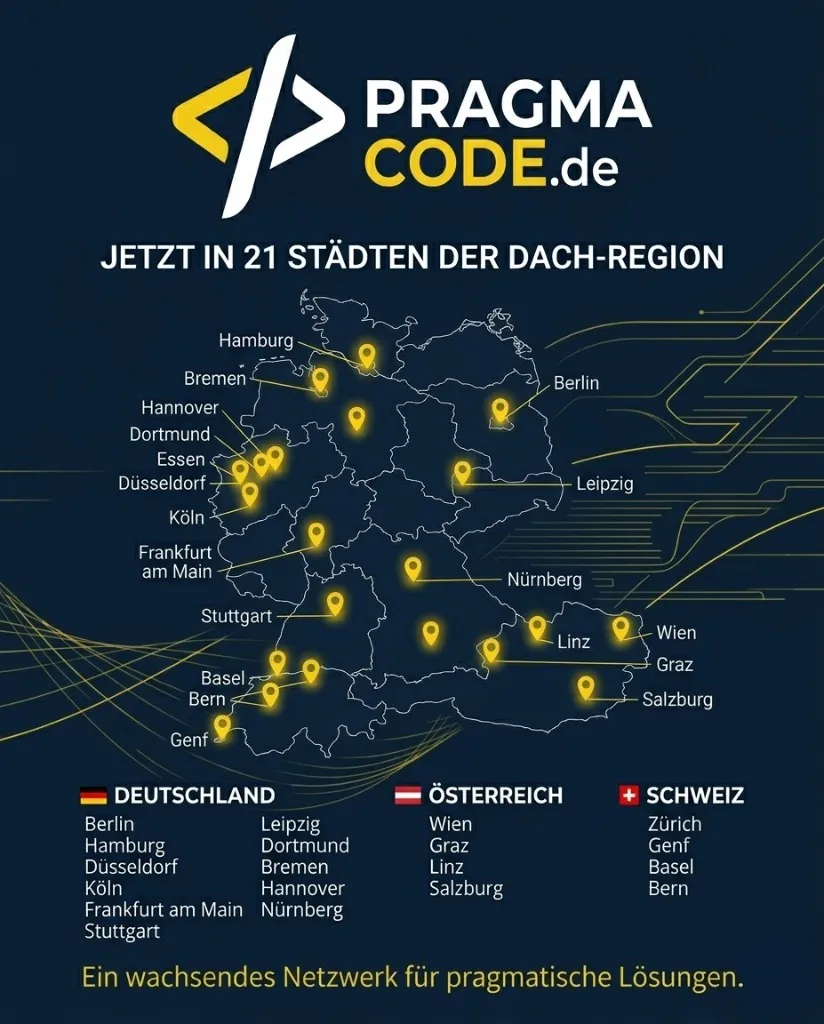
Our Regional Expertise
We are your digital partner – regionally anchored and successfully scaling across borders.
Ready to turn your brand into an undeniable AI reference?
We analyze your digital topical authority and deploy future-proof E-E-A-T and GEO architectures for measurable B2B success.
Book your free strategy call nowExtended Specialized Glossary
Generative Engine Optimization (GEO)
The practice of optimizing digital content specifically for generative language models and AI search engines (such as Perplexity, ChatGPT Search, or Google AI Overviews) to be cited as the primary, verified source in synthesized answers.
Topical Authority
The algorithmically measurable status of a domain or author as an authoritative reference in a specialized subject area, achieved through deep content coverage, semantic interlinking, and comprehensive topic mapping.
Schema Markup 2.0 (Agentic SEO)
The structured deployment of semantic JSON-LD vocabularies (Schema.org) to integrate entities, author profiles, academic citations, and relationships machine-readably into queryable knowledge graphs.
Retrieval-Augmented Generation (RAG)
A two-stage AI architecture where generative language models retrieve relevant factual data from verified external databases or web sources prior to answer generation to eliminate hallucinations.
Entity Hub
A semantic content architecture principle organizing information around real-world, unambiguously identifiable entities (persons, organizations, technologies, standards) rather than isolated keywords.