
GWT in 2026: Time to Act
For more than a decade, Google Web Toolkit (GWT) served enterprise teams well, enabling them to write complex web interfaces entirely in Java. In 2026, however, GWT has become a significant technical debt: compile times are sluggish, modern web APIs lack native support, and GWT talent is virtually non-existent. This guide outlines how CTOs and software architects can plan and execute a step-by-step modernization to Angular, React, or Vaadin Flow without downtime.
- The GWT Challenge: Extremely long compile cycles (Java-to-JS compilation), outdated dependency ecosystems, incompatibility with modern browser APIs, and high recruitment barriers make GWT a liability.
- Key Target Frameworks:
- Angular: Highly structured, TypeScript-based, features built-in dependency injection – ideal for Java teams.
- React + TypeScript: The global industry standard for maximal speed, component reuse, and ease of hiring.
- Vaadin Flow: Keep writing 100% of UI controller code in Java – perfect if your team wants to avoid JS/TS.
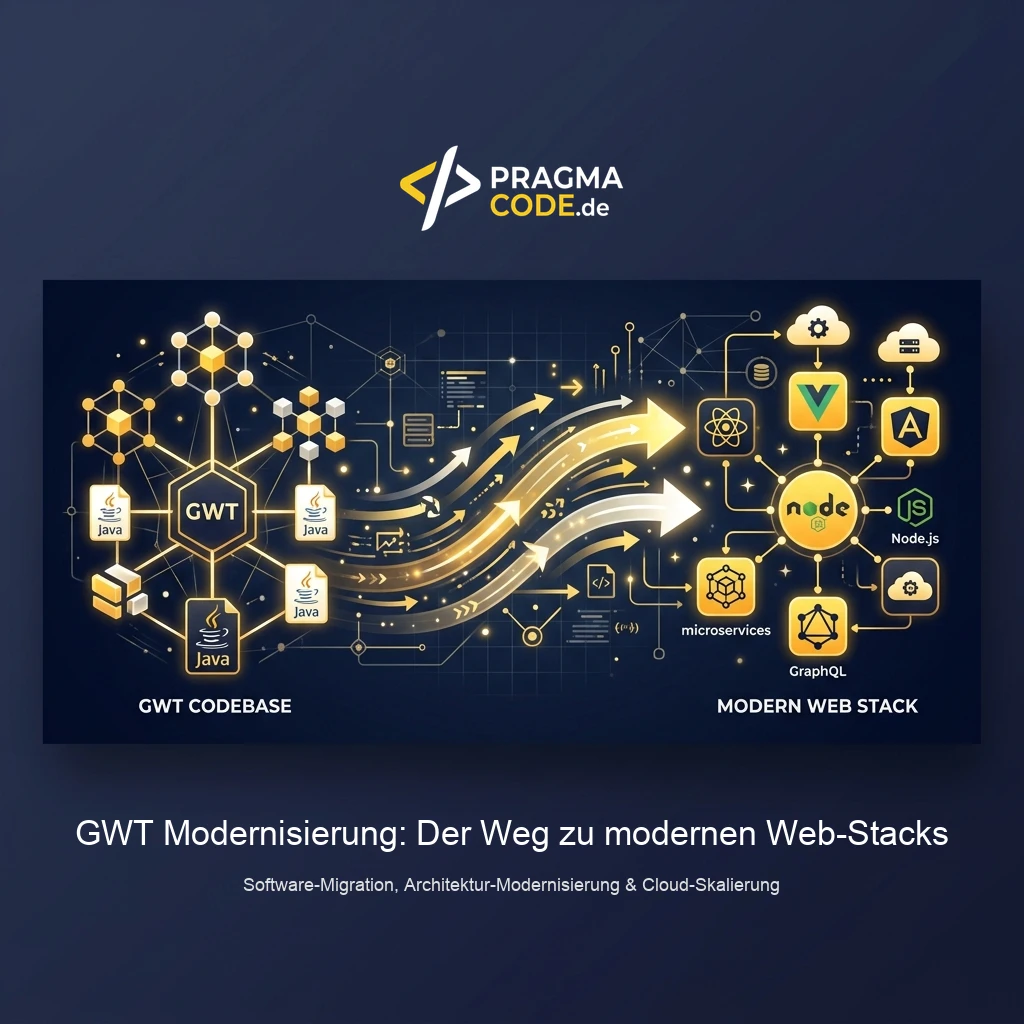
- Migration Strategy: Decouple the backend first (replace GWT-RPC with REST APIs) and execute an incremental transition using the Strangler Fig Pattern to mitigate risks.
- Introduction: The Decline of Google Web Toolkit
- 1. Why GWT Applications Pose an IT Risk in 2026
- 2. The Foundation: API Decoupling & Backend Modernization
- 3. Choosing the Right Target Stack (Angular, React, Vaadin)
- 4. The 6-Phase Migration Roadmap
- 5. Case Study: Modernizing a Large Logistics Portal
- Conclusion: Secure Future Viability Over Legacy Maintenance
Introduction: The Decline of Google Web Toolkit
When Google introduced GWT in 2006, it was a game-changer. For Java backend developers, it abstracted the browser away. You wrote client interfaces in Java, and GWT's compiler spit out optimized JavaScript. It resolved browser compatibility quirks, making complex Web 2.0 RIAs accessible without requiring javascript experts. It quickly became the default choice for banking, telecom, logistics, and internal ERP systems.
But web tech didn't stand still. Standardized HTML5 APIs, TypeScript, ES Modules, and modern browser engines eliminated the need for a heavy Java-to-JavaScript transpile process. In 2026, GWT is no longer an asset; it's a massive legacy burden. Tech leaders must now navigate the complexity of migrating these monolithic frontends to modern stacks to retain agility and system security.
Dieser Artikel ist ein vertiefender Fachbeitrag aus unserem Content-Cluster. Entdecken Sie die vollständige Übersicht auf unserer Hauptseite: GWT Modernization →
1. Why GWT Applications Pose an IT Risk in 2026
Continuing to host and maintain GWT frontend applications in 2026 creates significant security vulnerabilities and drags down operational efficiency. Software teams deal with three main risks:
Sluggish Compile Times
Because GWT compiles Java into separate JavaScript permutations for different browser types, building can take 15 to 45 minutes for medium-to-large projects. The lack of modern hot-reload capability severely hampers developer velocity.
Talent Pool Drought
New software engineers train in React, Angular, and Tailwind. GWT has not been taught in universities for nearly a decade. Hiring developers willing or able to work on legacy GWT code is highly difficult and expensive.
Vulnerable Dependencies
GWT web apps often rely on deprecated libraries and outdated JS wrappers. Since GWT's ecosystem has shrunk, many of these libraries no longer receive security patches, increasing vulnerability to client-side attacks.
Monolithic Backend Coupling (GWT-RPC)
GWT projects typically rely on GWT-RPC (Remote Procedure Call) for client-server communication. GWT-RPC serializes Java objects directly between client and server. This tightly binds the UI to the backend implementation. If you change a class in the backend, the entire GWT frontend must be recompiled. Furthermore, GWT-RPC is a closed protocol, preventing you from exposing the same backend logic to modern APIs, third-party integrations, or mobile apps.
2. The Foundation: API Decoupling & Backend Modernization
A GWT migration is not just a UI reskinning; it is an architectural modernization. The most important step is breaking the tight client-server coupling.
Before writing a single line of Angular or React code, migrate GWT-RPC endpoints to standardized JSON RESTful APIs or GraphQL. Documenting these endpoints with OpenAPI/Swagger creates a clean separation of concerns. Once the backend communicates via standard JSON, frontend teams can build the UI using standard JS mock data, speeding up development and preparing the architecture for microservices or native mobile client deployments.
3. Choosing the Right Target Stack (Angular, React, Vaadin)
When replacing GWT, three main alternatives fit best, depending on your team's skillset and product scope:
Option A: Angular (The Corporate Enterprise Standard)
For teams with a heavy background in Java, Spring Boot, or Jakarta EE, Angular is the default recommendation.
Why it fits: Angular is highly structured and opinionated. It relies on TypeScript and implements object-oriented design patterns, modules, services, and built-in Dependency Injection (DI) that mirror Java server-side architectures. Java developers transition to Angular much faster than to React, as the code organization feels instantly familiar.
Option B: React + TypeScript (Maximum Ecosystem & Hiring Ease)
If you are looking to hire frontend-native developers, scale the frontend fast, or need absolute performance, React is the global industry leader.
Why it fits: React has the largest UI library market share. Any dashboard, grid, chart, or form library you require is readily available as an NPM package. By pairing React with TypeScript, you retain the static type-safety necessary to refactor large projects without introducing runtime issues.
Option C: Vaadin Flow (Keep Your UI in Java)
What if your team consists entirely of backend Java developers with no interest in learning the modern JavaScript/npm/Vite build ecosystem? Vaadin Flow is the perfect answer.
Why it fits: Vaadin Flow lets you write all UI code directly in Java. Vaadin takes care of rendering web components in the browser and handling client-server synchronization automatically. This bypasses the need for client-side routing, REST controllers, and JavaScript compilation completely, keeping your code secure on the JVM.
Expert Tip: Internal Tools vs. Public Portals
Use Vaadin Flow for complex internal dashboards, ERPs, and toolings where your backend team needs to deliver rapid updates without UI overhead. For public portals, consumer-facing SaaS applications, or websites with strict SEO and initial page speed requirements, choose Angular or React to keep the frontend completely decoupled and lightweight.
Side-by-Side: GWT vs. Modern Frontend Architecture
- Tech Stack: Java compiled to JS (Legacy)
- Compile Speeds: 15+ minutes per build
- Communication: GWT-RPC (Java serialized)
- Talent Pool: Dwindling & hard to source
- UI Speed: Large monolithic bundles
- Tech Stack: TypeScript & ESM (Standard)
- Compile Speeds: Sub-second (Vite / ESBuild)
- Communication: REST JSON / GraphQL
- Talent Pool: Ubiquitous and easy to hire
- UI Speed: Code-splitting, lazy loading
4. The 6-Phase Migration Roadmap
Rebuilding a massive enterprise frontend in one go ("Big Bang Relaunch") is highly risky. We recommend a structured 6-phase approach to guarantee continuous operations.
Phase 1: UI Audit & Cleanup
Audit all active screens and user roles. We find that up to 25% of views in legacy software are deprecated. Clearing this clutter reduces your overall migration scope and saves budget.
Phase 2: API Relaunch & REST Migration
Begin exposing backend services through standard REST endpoints. Spring MVC or Jakarta RESTful Web Services are used to build JSON controllers that match the legacy GWT-RPC interfaces.
Phase 3: Component Design System
Establish a modern, accessible UI component library in the target framework (Angular or React). This ensures design consistency and simplifies developers' workflow.
Phase 4: Incremental Rollout (Strangler Fig Pattern)
Rather than a single launch, deploy GWT modules incrementally. By routing traffic through an API gateway, the new SPA components replace GWT pages block by block without the user noticing.
Phase 5: Session & State Sync
Ensure that active user sessions, permissions, and contexts transfer seamlessly between GWT and the new SPA pages using OAuth2 access tokens.
Phase 6: Deprecation & Decommissioning
Once all modules have migrated, remove GWT compile configurations from your CI/CD pipelines, decommission old GWT servlet paths, and clean the codebase.
5. Case Study: Modernizing a Large Logistics Portal
Below is a breakdown of a real-world modernization project executed by Pragma-Code:
Hansa Logistik Software GmbH
80 Employees | Old System: GWT v2.8 (Monolith on Tomcat)
The Challenge
- Compiler builds took over 22 minutes, slowing down agile updates.
- UI had no mobile responsiveness and looked dated (built in 2012).
- Struggled to hire new Java developers willing to maintain GWT templates.
- Tight coupling to legacy Java 8 libraries.
The Investment
Incremental UI migration to Angular 18 (TypeScript) & Spring Boot REST API
Results After 12 Months
Result: The new architecture enabled Hansa Logistik to launch a responsive mobile app within weeks and cut developer onboarding time from 3 months down to 2 weeks.
Is Your GWT App Ready for Migration?
Conclusion: Secure Future Viability Over Legacy Maintenance
Migrating from GWT is a major architectural endeavor, but it is necessary to future-proof your software assets in 2026. Sticking with GWT locks you out of the web ecosystem, blocks developer hiring, and limits your UI performance.
Whether you choose the structured OOP path of Angular, the flexible ecosystem of React, or the pure Java simplicity of Vaadin Flow, moving away from GWT ensures your app remains performant and maintainable. Pragma-Code provides the architectural planning, API design, and frontend implementation needed to deliver a risk-free modernization.
Frequently Asked Questions (Glossary)
GWT-RPC
Remote Procedure Call. GWT's serialization mechanism that allows exchanging Java objects directly between client and server.
Vaadin Flow
A Java framework that lets you build modern web UIs entirely in server-side Java. It takes care of rendering web components in the browser and handling client-server synchronization.
Strangler Fig Pattern
An architectural migration pattern that replaces legacy system modules with new microservices or SPA pages incrementally until the old system is completely decommissioned.
TypeScript
A typed superset of JavaScript that compiles to plain JavaScript, bringing structural type safety to large-scale frontend apps.
Unsere Expertise vor Ort
Wir sind Ihr digitaler Partner – regional verankert und überregional erfolgreich.