

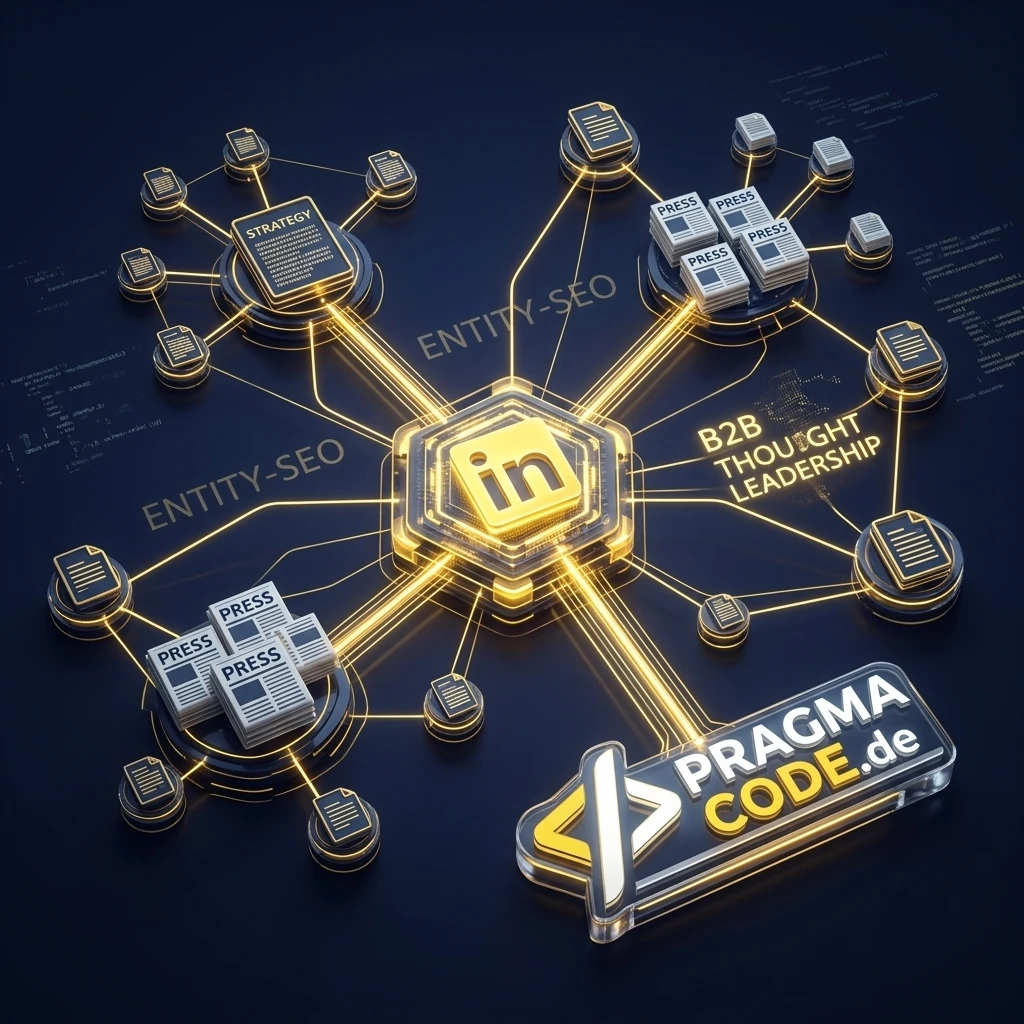
Leading strategy consultants and B2B executives continually publish groundbreaking market research and Tier-1 studies. Yet they often remain invisible to Google AI Overviews, Perplexity, and ChatGPT. Discover how to leverage the Hub-and-Spoke model, establish your LinkedIn profile as an algorithmic entity node, and sustainably multiply your machine-readable topical authority.
This article is an in-depth expert contribution from our content cluster. Discover the complete overview on our main page:SEO & Content Creation →
- The Semantic Gap: Many top consultants publish high-quality Tier-1 content on corporate websites, yet remain invisible to Google AI Overviews and AI engines (like Perplexity or ChatGPT Search) because the algorithmic link to their personal brand is missing.
- The Solution – LinkedIn as an Entity Hub: A LinkedIn profile acts as a central, verified entity node (Entity Hub) that semantically aggregates scattered external citations, studies, and media mentions within the Knowledge Graph.
- E-E-A-T in Practice: Optimization requires target-building five authority pillars – ranging from primary research data and commercial ROI proofs to linked structured data (JSON-LD SameAs Relation).
GEO and the Shift to Semantic Entity Search
In the era of Generative Engine Optimization (GEO) and the dominance of modern Large Language Models (LLMs), AI no longer looks for simple text strings. It evaluates validated relationships between concepts – so-called entities. If you want to be cited as a leading expert in responses from AI search engines like Perplexity, Google Gemini, or SearchGPT, you must build the "semantic bridge" connecting your personal profile with your distributed intellectual property across the web.
- Introduction: The Problem of Invisible Expertise
- 1. What is Entity SEO and Why Classic SEO Fails for Individuals?
- 2. The Hub-and-Spoke Model for Digital Identities
- 3. The Invisibility Trap: When Thought Leadership Vanishes
- 4. Case Study: The 5 E-E-A-T Pillars in an Anonymized Client Example
- 5. The 5 Pillars of Algorithmic Authority in Detail
- 6. Step-by-Step Guide: Establishing LinkedIn as an Entity Hub
- 7. Technical Leverage: JSON-LD and Schema.org for Personal Entities
- 8. Success Measurement: How to Query Your Reputation Score from AIs
- Conclusion and Outlook: Your Identity as a Strategic Asset
Introduction: The Problem of Invisible Expertise
Strategy consultants, partners of Tier-1 advisory firms (such as McKinsey, BCG, Bain, or Strategy&), and high-level B2B executives continuously publish groundbreaking analyses. They evaluate market developments in E-Commerce, predict the future of the consumer goods industry, or design complex IT security strategies. These analyses often sit on the highly authoritative corporate domains of their employers and register thousands of views from the target audience.
Yet, away from immediate human readers, something else happens algorithmically: Google, Perplexity, and ChatGPT treat these publications as impersonal products of the corporate brand. The actual author – the driving force behind the data – remains an empty string in the search engine index. When a potential client asks an AI search engine: “Who are the leading experts for eGrocery in Europe?”, the AI will name the firm's study, but fail to link the partner's name to it. There is a fundamental disconnect: Tier-1 Content, but Tier-3 Personal Visibility.
Why does this happen? The answer lies in the inner workings of modern semantic search systems. AIs and search engines no longer read texts as a simple collection of words (strings); they process information as interconnected entities (things). When a study is published on a website with only a static author name printed on it, search engines lack the unambiguous, machine-readable proof that this text string "Dr. John Doe" is identical to the person posting on LinkedIn, giving keynote speeches, and being cited in the trade press. The semantic bridge is missing. Without it, the consultant's digital authority remains scattered and fragmented across the web.
“Those who do not possess a machine-readable identity in the AI era surrender the control over their own expertise to the randomness of algorithmic hallucination.”
1. What is Entity SEO and Why Classic SEO Fails for Individuals?
To solve this problem, we must understand how Google and LLMs search for information today. For decades, classic SEO focused on keywords and backlinks. Pages were optimized for phrases like "management consulting London" or "E-Commerce consulting" and built backlinks to rank. This worked well as long as search engines did simple text comparisons.
Today, we navigate a completely new landscape: the era of Entity Based SEO. Google uses its Knowledge Graph to map billions of entities (people, places, organizations, concepts) and their relationships. When you search for a well-known public figure, Google shows a Knowledge Panel on the right with structured data (birth date, role, social profiles). This is the visual proof that Google understands the person as a distinct entity.
For B2B consultants and executives, this shift is massive. AI and search algorithms determine a person's Topical Authority by checking if the entity (the person) is linked via a relational edge to other highly authoritative entities (like a Tier-1 study or a leading business magazine). Classic SEO fails here because it does not view people as independent nodes of data. Entity SEO, on the other hand, optimizes the representation of a person directly within the Knowledge Graph.
From String to Thing
A name is just an unstructured text string to an AI until it is anchored as a unique entity (node) through structured data and verified profiles.
Relational Edges
Digital authority increases when relationships (edges) to other trusted entities (studies, leading media, institutions) are proven in a machine-readable format.
AI Knowledge Bases
Systems like Perplexity, Claude, and ChatGPT rely heavily on structured knowledge networks and highly linked hubs to identify subject matter experts.
2. The Hub-and-Spoke Model for Digital Identities
How do you double your digital authority online? The answer lies in establishing a clear architecture for your online presence: the Hub-and-Spoke Model.
Originally a logistics and content structure concept, when applied to personal branding and Entity SEO, it translates to:
The Hub
Single Source of Truth
Your central, optimized, and verified digital anchor. For B2B professionals, this is typically your LinkedIn profile (along with any personal websites). The hub must consolidate all signals and serve as Google's central point of reference for your entity.
The Spokes
Distributed Authority Signals
All external publications, studies on corporate websites, quotes in business media, podcast appearances, and academic papers. These spokes are scattered across the web but must systematically link back to your central hub.
When a consultant publishes a new study on their firm's domain (spoke), that page must not only mention their name as text, but should link directly to their LinkedIn profile (hub) or include structured markup. Conversely, the consultant must link the hub to the spoke on LinkedIn (e.g., through a detailed post, a link in the "Featured" section, or an update in the experience section). Through this bidirectional data flow, the search engine learns: “This study and this LinkedIn profile belong to the exact same entity.”
Comparison: Fragmented Presence vs. Hub-and-Spoke Model
- Missing Author Links: Studies are published without machine-readable personal attribution.
- Passive Resume: LinkedIn profile acts as a simple online CV without structured spokes.
- Raw Text Strings: Media quotes mention the name in isolation without entity backlinks.
- Isolated Data Points: Google cannot establish a semantic connection across sources.
- Algorithmic Noise: AI systems hallucinate facts or omit the consultant entirely.
- Active Hub Edges: All publications actively link back to the verified LinkedIn hub.
- Structured Schemas: JSON-LD SameAs properties link personal and corporate studies.
- Authoritative Quotes: Press mentions link directly to the verified social entity profile.
- Knowledge Graph Node: Clear entity established with measurable topical authority.
- Direct AI Citations: Perplexity and ChatGPT cite the person as the primary authority.
3. The Invisibility Trap: When Thought Leadership Vanishes
Many consulting firms invest six-figure budgets into rigorous market surveys, visual reports, and white paper campaigns. But when the semantic anchor is missing, the vast majority of this investment evaporates with zero personal brand equity for the author:
Loss of Personal Authorship
Without structured author schemas, the corporate domain absorbs 100% of the ranking signals. If the partner leaves the firm, all algorithmic topical authority stays behind with the previous employer.
Misallocation of PR Budgets
Press quotes in major business outlets without linked profile URLs offer brief ego-strokes, but fail to build machine-readable relational edges in Google's Knowledge Graph.
4. Case Study: The 5 E-E-A-T Pillars in an Anonymized Client Example
To demonstrate how this system operates in the real B2B world, we examine a typical starting profile from our project practice: a Director at a Tier-1 advisory firm in the Consumer Markets and Retail Advisory sector. All details are anonymized and condensed to what matters methodologically.
Examining the digital footprint of such a profile reveals a textbook pattern: a highly authoritative professional identity built on five distinct pillars. These pillars cover all dimensions of Google's E-E-A-T guidelines (Experience, Expertise, Authoritativeness, Trustworthiness), serving as proof of domain authority in online retail and consumer goods.
The following overview shows how these five pillars are distributed across the web, acting as spokes that support his digital authority:
As the author of a widely cited study on the European online grocery trade (eGrocery), the profile delivers deep primary data – a direct indicator of Core Expertise.
A second analysis explores how retailers can monetize their first-party customer data, anchoring the positioning as a strategic thought leader with commercial accountability.
Contributing to an annual consumer survey supplies empirical primary data on changing purchasing behaviour – a powerful quality signal, since Google weights original research above secondary reporting.
Involvement in a cross-industry specialist topic, documented in a comprehensive PDF report, proves the breadth of the consulting scope. Googlebot crawls and semantically analyses PDFs thoroughly.
External validation. In a prominent business-press article on delivery service regulation, the profile is quoted as the industry expert. This grants maximum social proof (Authoritativeness).
5. The 5 Pillars of Algorithmic Authority in Detail
Let us analyze these five pillars from the perspective of Entity SEO and algorithmic ingestion. Each of these publications broadcasts specific signals to search engines and AIs, forming a highly credible expert profile in the aggregate.
Pillar 1: The Core Study – The Foundation of Niche Dominance
The eGrocery market is highly volatile and characterized by complex supply chain logistics. A study analyzing the market's post-pandemic consolidation is, for Google, a "Core Expertise Signal". When the author's name is mentioned on that page and linked directly to the profile hub, the algorithm records the relationship: [Person] -> (Expertise in) -> [eGrocery].
Pillar 2: Customer Data ROI – Strategic Value Creation
In an era of high customer acquisition costs (CPA), maximizing the value of first-party data is crucial. A publication addressing the strategic challenge of how retailers can leverage customer analytics associates the person with business-critical B2B issues. For the algorithm, this expands the entity's semantic net to include concepts like "Data Monetization", "Customer Lifetime Value", and "Data-Driven Strategy".
Pillar 3: The Consumer Survey – Empirical Data as E-E-A-T Gold
Google values original, empirical research far more than secondary reports. An annual consumer survey offers exclusive insights into purchasing behavior. The expert interpreting these datasets profits directly from the domain authority of the publishing organisation: AI systems digest the survey, locate the name, and categorize the person as a primary source of consumer trends.
Pillar 4: The Adjacent Specialist Topic – Crossing Industry Borders
A study on integrating insurance products into the retail checkout (Embedded Insurance), documented in an accompanying PDF report, highlights the multidisciplinary nature of modern consulting. Googlebot crawls and semantically analyzes PDF documents thoroughly. Mentioning the author in a structured PDF hosted on a Tier-1 domain acts as a strong academic signal for personal authority.
Pillar 5: Media Quotes – Independent Third-Party Validation
This is the pinnacle of Entity SEO: when a prestigious, independent media outlet writes about delivery service regulations in Europe (such as the shutdown of dark stores in France) and quotes the person as the key expert, it sends the ultimate trust signal (Trustworthiness) to Google. A mention in a leading national business magazine proves to the algorithm that the entity's authority extends far beyond its employer's own channels.
Pro Tip: The Untapped Potential of Quotes
Most corporate PR departments are thrilled with press mentions, but forget the most important part: the link. When interviewed, politely ask journalists to link to your LinkedIn profile or corporate author page rather than just printing your name as plain text. For Entity SEO, a backlink from a high-authority publication like WirtschaftsWoche directly to your profile acts as a massive boost in the Knowledge Graph.
6. Step-by-Step Guide: Establishing LinkedIn as an Entity Hub
How can you apply this system to your own profile? Establishing an algorithmic Entity Hub requires a structured and consistent process. Follow this roadmap to link your profiles and publications:
Secure a clean, custom LinkedIn URL (e.g., linkedin.com/in/first-last). Write a compelling "About" section containing your exact niche keywords (e.g., "eGrocery", "B2B E-Commerce", "Consumer Markets"). This provides search engines with their first thematic anchors.
Add all your key studies, articles, and media mentions to your LinkedIn profile. Use the "Featured" section and input your studies under the "Projects" or "Publications" sections. Make sure every entry contains the exact title and a link to the original source.
Ensure that on the corporate pages hosting your studies, your author name is not just static text. It must be an active hyperlink pointing to your LinkedIn hub. Better yet, request your web team to implement structured data (Schema.org) on these author bio pages.
Publish regular updates on LinkedIn summarizing your studies to generate user interaction and index signals.
7. Technical Leverage: JSON-LD and Schema.org for Personal Entities
If you want full control over your digital identity, you cannot rely on LinkedIn's UI alone. You must speak the language of search engine crawlers. The most effective tool for this is structured data in JSON-LD format based on the Schema.org standard.
By embedding Person markup on your personal author site or your firm's team directory, you tell Googlebot exactly which web profiles and publications belong to you. This is how you define the semantic bridge mathematically.
Building the On-Page Bridge: Bi-directional Linking for Maximum E-E-A-T Impact
To achieve the maximum E-E-A-T effect, we must help Google actively confirm the connection. We do this via bi-directional linking on the page (On-Page). We add the publishingPrinciples (or alternatively award / credential) attribute to the Person schema on your own website or profile page, linking directly to the publication URL.
Here is a concrete example of an optimized JSON-LD markup for a personal entity, establishing the direct connection to a professional publication. This script should be added to the HTML header of the bio page:
{
  "@context": "https://schema.org",
  "@type": "Person",
  "name": "Dr. Jane Doe",
  "jobTitle": "Director Consumer Markets & E-Commerce",
  "worksFor": {
    "@type": "Organization",
    "name": "Example Consulting Ltd.",
    "url": "https://www.example.com/"
  },
  "url": "https://www.example.com/team/jane-doe",
  "sameAs": [
    "https://www.example.com/team/jane-doe",
    "https://www.linkedin.com/in/first-last/",
    "https://www.wikidata.org/wiki/Q12345678",
    "https://orcid.org/0000-0002-1825-0097"
  ],
  "knowsAbout": [
    "Consumer Markets",
    "eGrocery",
    "Customer Data ROI",
    "E-Commerce Strategy",
    "Embedded Insurance"
  ],
  "publishingPrinciples": [
    {
      "@type": "DigitalDocument",
      "name": "Title of the European eGrocery Market Study",
      "url": "https://www.example.com/publications/egrocery-study"
    }
  ]
}
The critical element in this markup is the "sameAs" attribute as well as the bi-directional linking via "publishingPrinciples". This is where you list the official profiles representing your identity and link them directly to your scientific contributions. When Googlebot reads this markup, it links the LinkedIn profile directly with the scientific contributions (via publishingPrinciples) instantly. This closes the semantic loop, merging authority from various domains into a single entity node.
In practice, exactly this setup is what we recommend: a dedicated entity page with Person schema consolidating all the spokes described here (profile hub, professional studies, scientific contributions) into a single, fully indexable node under the person's own control. One caveat matters: such a page belongs to the person it describes — it is only ever created and operated with their explicit consent, especially where employer compliance is involved.
8. Success Measurement: How to Query Your Reputation Score from AIs
How do you verify if your Entity SEO efforts are yielding results? Since AIs and semantic search engines do not offer traditional keyword ranking tables like Google SERPs, you must adopt new tracking methods.
The most direct way to measure your digital authority is by prompting LLMs and generative search engines (Perplexity, SearchGPT, Claude, Gemini) directly. Perform a quarterly audit by asking the models specific queries:
Entity Prompt
“Who is [Your Name]?”
Check if the AI provides a concise summary of your career, names your company, and associates you with your core topics (e.g., eGrocery).
Topic Prompt
“Who are the leading experts for [Topic]?”
Ask for a list of specialists in your niche. If your name appears, you have established high topical authority.
Also, analyze the citation sources in answers from Perplexity or Google AI Overviews. Are your LinkedIn posts or corporate studies used as footnotes? If so, the system has recognized your spokes as credible data sources. If the AI mentions your name but hallucinates facts, your entity lacks robust linking – in which case you must refine your sameAs markup and LinkedIn references. If you don't want to repeat this check manually, AI visibility monitoring can continuously track your entity across multiple AI search systems – including alerts when mentions or attributions shift.
Conclusion and Outlook: Your Identity as a Strategic Asset
The way B2B decision-makers and clients seek expertise has changed forever. No one clicks through twenty individual search results on page 3 anymore to evaluate a consultant. AIs summarize the global consensus – and this consensus is built on structured data.
For top consultants and executives, this means that digital identity (entity) is no longer a cosmetic option, but a business-critical asset. The Hub-and-Spoke Model offers the perfect blueprint to algorithmically unify scattered Tier-1 content, lifting personal visibility from Tier-3 to Tier-1. Those who start establishing their LinkedIn profile as an entity hub today and implement Schema markups will secure a leading position in tomorrow's search engines.
Do not wait for Google to discover your expertise on its own. Build the semantic bridge and double your digital authority.
Quick-Check: Your Path to Entity Success
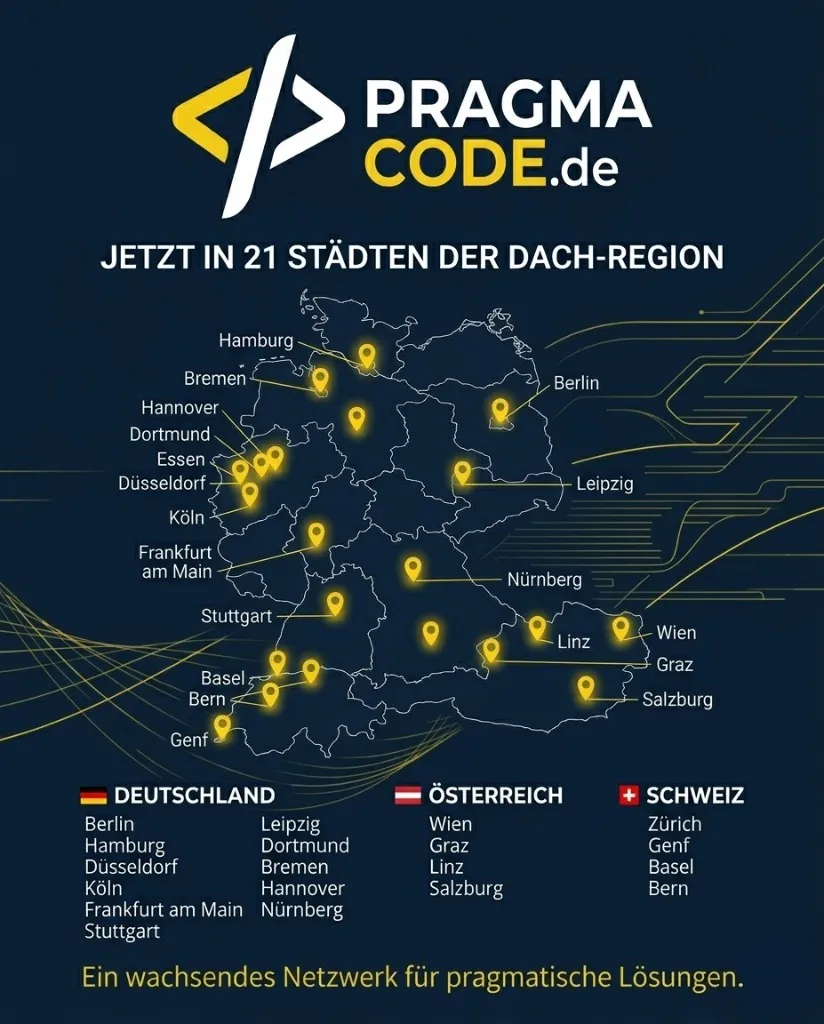
Our Regional Expertise
We are your digital partner – regionally anchored and successfully scaling across borders.
Have a vision?
Let's check together how we can make your idea take flight.
Book your free strategy call nowExtended Specialized Glossary
Entity Based SEO
A modern SEO approach that focuses not on keywords, but on entities (people, organizations, concepts) and their relationships in the Knowledge Graph.
E-E-A-T
A quality evaluation framework by Google standing for Experience, Expertise, Authoritativeness, and Trustworthiness.
Hub-and-Spoke Model
A structural model for aggregating scattered signals: a central node (hub, e.g., LinkedIn) collects and links to distributed content pieces (spokes).
Topical Authority
The algorithmic trust earned through consistent, high-quality content proving that an entity covers a specific topic exhaustively.
SameAs Relation
A Schema.org structured data property that explicitly tells search engines and AI systems that multiple URLs (e.g., a LinkedIn profile and a corporate bio) refer to the exact same real-world entity.