

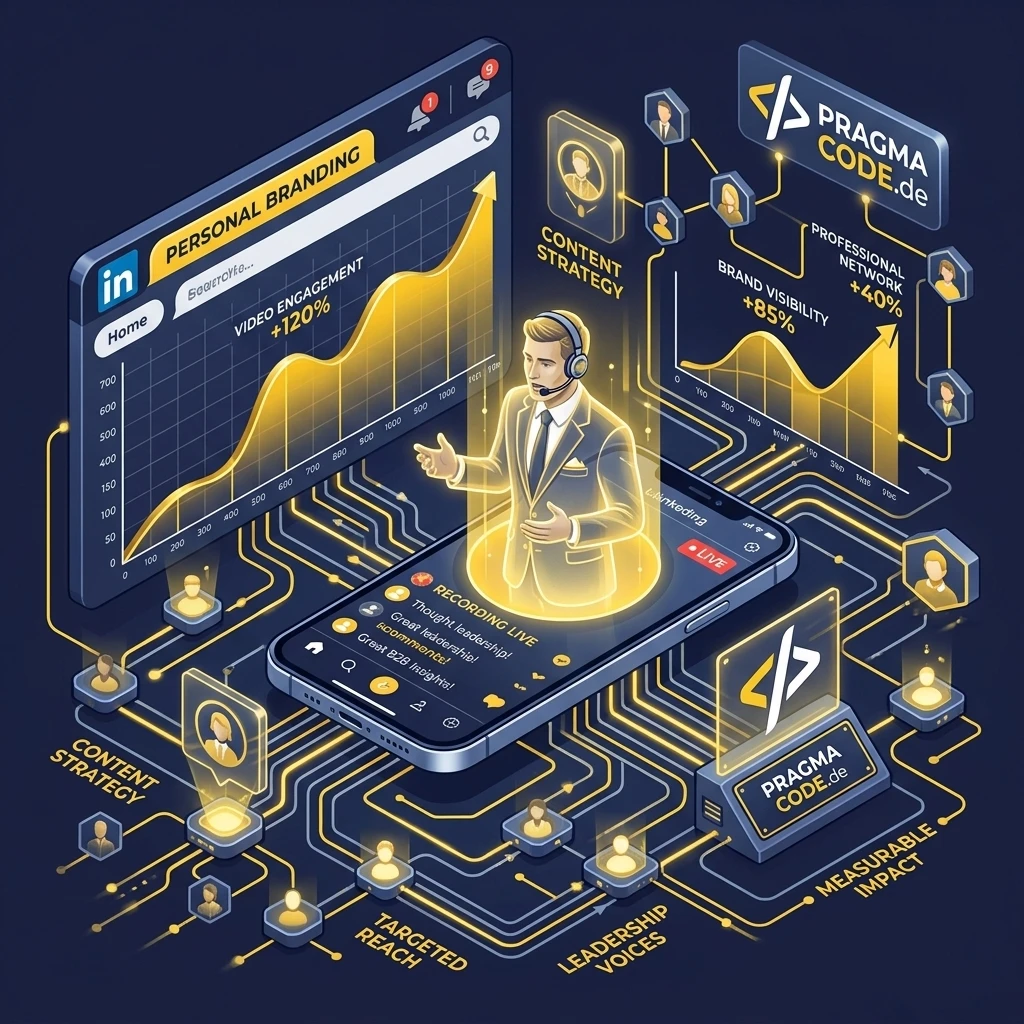
In 2026, high-ticket B2B software and IT contracts are won through digital trust in engineering leaders, not oversized advertising budgets. Discover how tech founders, CTOs, and solution architects leverage personal branding and unvarnished video marketing on LinkedIn to cut sales cycles in half and stand out from generic AI content.
This article is an in-depth expert contribution from our content cluster. Discover the complete overview on our main page:All Services at a Glance →
The Shift to H2H (Human-to-Human) Amidst AI Saturation
In 2026, enterprise B2B buyers do not purchase from faceless IT conglomerates or sterile AI-generated brochures – they buy from real experts whose competence they have observed over months. In a digital landscape overwhelmed by synthetic content, authentic Personal Branding combined with unvarnished Video Marketing is the most potent driver of qualified pipeline revenue.
- Risk Mitigation in High-Stakes Procurement: Enterprise software deals involve six- to eighteen-month sales cycles. Executive Thought Leadership substantially reduces perceived buyer risk at the C-level.
- Algorithmic Mechanics 2026: Personal founder and CTO profiles generate 8 to 15 times higher engagement rates than corporate pages. The LinkedIn Algorithm heavily rewards Dwell Time, multi-turn comment discussions, and native short-form videos.
- Streamlined Production Engine: By dedicating just 90 minutes weekly to batch video recording, engineering leaders transform their network into a self-sustaining inbound pipeline without cold outreach.
- 1. Why LinkedIn is Imperative for B2B Tech in 2026
- 2. The Psychology of the B2B Tech Buyer: Risk Mitigation & E-E-A-T
- 3. The 4 Pillars of Modern Tech Thought Leadership
- 4. Video Marketing as a Trust Accelerator: Demos & Teardowns
- 5. Studio Setup, Equipment & Tooling for Developers & CTOs
- 6. The LinkedIn Algorithm 2026: Dwell Time, Vertical Feeds & Anti-Spam
- 7. The 3 Dangerous Pitfalls of Corporate Ghostposting
- 8. The LinkedIn Content Funnel: From Visibility to Inbound Revenue
- 9. Case Study: 25k Views & 90% Inbound Meeting Rate in B2B SaaS
- 10. Step-by-Step Roadmap: Establishing a Visible Brand in 3 Months
- 11. Conclusion & Strategic Outlook for 2027
1. Why LinkedIn is Imperative for B2B Tech in 2026
The enterprise IT services, cloud architecture, and B2B software engineering landscape is characterized by high operational complexity and substantial transaction values. Whether navigating edge-native deployments, NIS2 regulatory compliance audits, microservice refactoring, or enterprise agentic AI workflows – contract sizes routinely scale into hundreds of thousands or millions of euros. Correspondingly, decision timelines are elongated: sales cycles of six to eighteen months are standard across European and global markets. Throughout this evaluation window, CIOs, CTOs, and VP-level stakeholders delegate critical budgets exclusively to partners whose engineering competence and operational integrity are indisputable.
In 2026, LinkedIn has permanently evolved beyond a passive resume board into the foundational clearinghouse for digital trust capital and Social Selling. However, algorithmic dynamics have shifted decisively: while years ago maintaining an institutional company page was considered adequate, static corporate channels today are rigorously deprioritized. Modern technical buyers disregard faceless promotional broadcasts; instead, they seek direct engagement with the architects and technologists behind the product.
Comparison: Company Page vs. Personal Brand Thought Leader
- Organic Reach: Avg. 1–2% engagement rate; algorithmic distribution is heavily restricted without ad spend.
- User Perception: Perceived as polished, corporate, and promotional; immediately triggers ad-fatigue defense mechanisms.
- Interaction Depth: One-way broadcast; sparse comment sections devoid of meaningful technical debates.
- Revenue Contribution: Minimal direct inbound conversion; primarily functional for legal press releases and job postings.
- Organic Reach: Avg. 8–15% engagement rate; achieves 8x to 15x higher organic reach within target buyer accounts.
- User Perception: Authentic, approachable, and technically authoritative; demonstrates real-world problem-solving capacity.
- Interaction Depth: Active peer-level discussions in comment threads; direct C-level relationship formation.
- Revenue Contribution: Robust inbound sales pipeline ("We saw your system teardown video and need this implemented in our infrastructure").
2. The Psychology of the B2B Tech Buyer: Risk Mitigation & E-E-A-T
Systematic B2B customer acquisition in the technology sector requires an intimate grasp of executive buyer psychology. Procuring custom software development, distributed database migrations, or cybersecurity consulting is fundamentally a high-risk purchase. If an IT executive commits to an unstable framework or an unproven vendor, their organization risks severe outages, security breaches, and contractual penalties – often jeopardizing the decision-maker's career. Consequently, B2B technology buyers do not optimize for the lowest initial price tag, but for maximum risk mitigation.
Digital risk mitigation is established through continuous proof of competence grounded in the E-E-A-T framework (Experience, Expertise, Authoritativeness, and Trustworthiness). When a CTO publicly deconstructs engineering trade-offs week after week, documents post-mortems of legacy migrations, and details how distributed deadlocks were resolved, potential clients develop unshakeable trust. Through this B2B "Zero Moment of Truth", prospective buyers become convinced of your team's capability long before an initial discovery call is scheduled.
3. The 4 Pillars of Modern Tech Thought Leadership
Many senior engineers and executives hesitate to build a presence on LinkedIn because they associate Personal Branding with self-aggrandizing hype or vacuous motivational slogans. In enterprise B2B tech, true authority is built on the exact opposite: rigorous, value-driven Thought Leadership. Successful engineering leaders anchor their content around four distinct operational pillars:
Architectural Teardowns
Deconstruct tangible architectural decisions: Why did your team migrate a legacy Node.js monolithic service into high-concurrency Rust microservices? What distributed caching strategy reduced p99 query latency by 70%? Clear architectural diagrams and code snippets establish immediate engineering credibility.
Failure Analysis & Recovery
Share failed deployments and the architectural safeguards engineered in response. Documenting "How a corrupted Redis cluster stalled production checkouts and how we built automatic failover" exhibits unmatched operational maturity.
Challenging Tech Hypes
Challenge mainstream vendor narratives with practical business realism: Why micro-frontends are an expensive anti-pattern for mid-market platforms, or why 80% of internal enterprise RAG initiatives fail due to poor data governance. Provocative, data-backed theses spark engaging C-level debates.
Team Philosophy & Standards
Provide transparent insight into automated CI/CD gating, code review benchmarks, and asynchronous remote engineering culture. This reinforces client confidence while simultaneously solving recruiting bottlenecks through organic employer branding.
4. Video Marketing as a Trust Accelerator: Demos & Teardowns
Modern software architecture, distributed streaming pipelines, and zero-trust security postures are inherently abstract concepts. One cannot physically handle a microservices orchestration topology. Video Marketing dissolves this barrier within seconds. A 60- to 90-second video featuring an architect sketching a cloud topology on a digital whiteboard or walking through a terminal live demo instantly eliminates cognitive friction for the viewer.
The LinkedIn Algorithm heavily favors native video formats. This is directly driven by the network's core engagement metric: Dwell Time. Videos halt mindless feed scrolling, maximizing active viewing seconds and signaling high editorial value to LinkedIn's ranking models. Crucially, video delivers the psychological halo effect: an executive's vocal clarity, posture, and technical passion directly elevate the perceived engineering caliber of their entire enterprise.
Format: Talking Head
Strategic Insights & Tech Policy
The executive addresses the camera directly to contextualize breaking tech developments, regulatory shifts (such as NIS2 or the EU AI Act), or common architectural mistakes. Cultivates authentic personal rapport and sharpens thought leadership.
Format: Screencast & Teardown
Live Code Audits & Dashboards
Live teardowns within code editors, cloud monitoring dashboards, or website performance benchmarks. Demonstrates step-by-step resolution of latency bottlenecks and CI/CD security hardening. Irrefutable empirical proof.
5. Studio Setup, Equipment & Tooling for Developers & CTOs
In enterprise B2B tech communication, over-stylized commercial advertising triggers defensive skepticism. However, maintaining technical baseline quality is an essential courtesy to executive viewers. Grainy video accompanied by echoing, tinny laptop microphone audio immediately degrades hard-earned technical authority.
1. Broadcast-Grade Audio Clarity (Top Priority)
Poor lighting is frequently forgiven; poor, echoey audio results in instant viewer abandonment. Deploy a dedicated dynamic broadcast microphone (such as the Shure SM7B or Rode PodMic USB) or a wireless dual-channel lavalier system (DJI Mic 2 or Rode Wireless PRO) featuring 32-bit float onboard recording.
2. Diffused Key Lighting Setup
Position a large, diffused key light (e.g., Elgato Key Light Air or Amaran 100d with softbox) at a 45-degree angle to your face. Adding a subtle, warm accent light in the background creates depth and separates the subject cleanly from the room.
3. 4K Mirrorless Camera with Fast Prime Lens
Modern flagship smartphones in cinematic video mode deliver remarkable quality. For an uncompromising corporate tier, upgrade to a mirrorless cinema-oriented body (Sony Alpha 6700 / FX30) paired with a 24mm or 35mm f/1.4 prime lens to yield smooth, natural background separation.
4. Permanent Single-Switch Studio Rig
Engineer your recording setup so that capturing video requires flipping a single master power switch. If recording demands repositioning tripods, recalibrating lights, and untangling cables every time, consistency will collapse within two weeks.
6. The LinkedIn Algorithm 2026: Dwell Time, Vertical Feeds & Anti-Spam
Achieving sustained organic reach in 2026 requires adapting to modern LinkedIn Algorithm heuristics. Cheap engagement hacks ("Comment 'YES' below to receive our PDF checklist") are systematically throttled. LinkedIn enforces sophisticated neural classifiers that analyze content for genuine topical authority and interaction depth:
The first two lines dictate visibility. Clicking "See more" is the initial algorithmic positive vote. The longer a user remains on the expanded post and scrolls through the text or video, the higher the algorithm scores content quality.
Monosyllabic replies ("Great post!") are discounted. The algorithm measures token volume and semantic density within comment conversations. Replying to comments with insightful follow-up questions keeps posts circulating in secondary feeds for 48 to 72 hours.
Automated, generic LLM outputs devoid of personal experience are downranked by platform classifiers. LinkedIn rewards first-party operational artifacts (custom architecture blueprints, actual customer metrics, terminal screencasts) that cannot be fabricated by generative text engines.
7. The 3 Dangerous Pitfalls of Corporate Ghostposting
Many enterprises delegate leadership communications to external copywriting agencies without rigorous technical oversight. This detached approach routinely produces negative outcomes:
Trap 1: Superficial Generic AI Copy
Agencies frequently feed generic prompts to standard LLMs. The resulting platitudes lack domain specificity and are instantly recognized as inauthentic by enterprise engineering leaders, eroding leadership credibility.
Trap 2: Chasing Vanity Metrics over Pipeline
Agencies often optimize for viral likes via broad motivational anecdotes. Thousands of superficial likes yield zero revenue if not a single qualified technical buyer is represented in the audience.
Trap 3: Detached Community Management
While an external ghostwriter might prepare a baseline post, they inevitably fail when CTOs ask technical architecture questions in the comments. Without the genuine expert's active engagement, relationship-building collapses at the most vital junction.
8. The LinkedIn Content Funnel: From Visibility to Inbound Revenue
Organic reach is meaningless unless systematically converted into enterprise sales pipeline. Effective Personal Branding structures content across a disciplined three-stage funnel:
Top of Funnel (TOFU) – Industry Visibility: Broad perspectives on high-level IT governance, engineering management paradoxes, and pragmatic analysis of emerging hype cycles. The goal is expanding first-degree reach and capturing C-level executive awareness.
Middle of Funnel (MOFU) – Architectural Authority: Highly granular technical breakdowns for senior engineers and enterprise architects. "Why we replaced standard Redis clusters with KeyDB", "Framework Benchmark: Astro vs. Next.js for high-concurrency B2B portals". These posts garner fewer viral likes, but generate immense bookmarking rates from actual budget holders.
Bottom of Funnel (BOFU) – Conversion & Social Proof: In-depth client case studies, verified ROI benchmarks, invitations to closed-door roundtable audits, or direct service calls-to-action. Leaders who have consistently delivered uncompromised MOFU value will observe strong conversion into qualified inbound meeting bookings.
9. Case Study: 25k Views & 90% Inbound Meeting Rate in B2B SaaS
Consider the real-world case of a technical founder leading a European B2B SaaS provider for automated warehouse and intralogistics robotics. The firm was competing against multi-billion-dollar legacy ERP providers and burning substantial monthly budgets on Google Ads with mediocre lead qualification.
Their pivot centered entirely on authentic Video Marketing on LinkedIn: Twice weekly, the CTO published 90-second uncut field videos directly from client warehouses. Pointing at conveyor scanners suffering latency spikes, he explained the asynchronous message queue handling in the codebase on his laptop, demonstrating how modern event brokers prevent data congestion. This was supplemented by weekly architectural cheat sheets formatted as PDF document carousels.
The eight-month outcome: Videos averaged 25,000 organic views among heads of logistics, plant managers, and supply chain directors. Outbound cold calling was completely phased out; 90% of qualified discovery calls began with: "We have watched your warehouse walkthrough videos for months – we are experiencing that exact latency bottleneck and want your team to audit our architecture."
10. Step-by-Step Roadmap: Establishing a Visible Brand in 3 Months
Establishing an authoritative industry reputation requires systematic execution and consistency. The following 3-month operational roadmap transitions tech executives from passive profiles to recognized industry authorities:
-
Month 1: Profile Transformation & Asset Architecture
Restructure your personal profile from a static CV into a high-converting landing page. Formulate a crisp value proposition across the header banner ("We help enterprise B2B platforms achieve sub-second latency"), a benefit-driven headline devoid of buzzwords, and a curated Featured section pointing directly to audits and whitepapers.
-
Month 2: Targeted Network Expansion & Active Engagement
Connect with 10 to 15 qualified C-level decision-makers daily using concise, non-promotional personalized notes. Add substantial technical commentary to posts by prominent industry voices to capture qualified peripheral visibility (piggybacking).
-
Month 3: Systematic Batch Production Engine
Establish a disciplined publication rhythm of 2 text/carousel posts and 1 native video post weekly. Consolidate all video recording into a dedicated 90-minute Friday afternoon batch window to prevent operational disruption during the workweek.
Topic Mining & Hook Engineering
Capture recurring technical hurdles from daily client consulting calls and architecture reviews. Draft provocative, curiosity-inducing opening hooks for each topic.
90-Minute Batch Recording Session
Record three 60- to 90-second technical videos in a single continuous session before the studio camera. Unvarnished, natural, and without robotic teleprompter delivery.
Post-Processing & Community Nurturing
Apply automated high-contrast subtitles and clean cover cards. Spend 20 minutes immediately following publication answering incoming comments to ignite algorithm distribution.
Pro-Tip: Capitalizing on the Golden Hour
The first 60 minutes following publication determine the ultimate reach multiplier of your post. Block this window in your schedule to immediately respond to every incoming comment with substantive questions. This demonstrates vibrant engagement to the algorithm, triggering broader distribution across secondary network feeds.
Quick-Check: Launching Your B2B Tech Brand
11. Conclusion & Strategic Outlook for 2027
We are witnessing a profound structural shift in B2B enterprise procurement. As generative AI makes generic textual copy and whitepapers universally commoditized, the economic value of authentic human credibility is experiencing exponential growth. Enterprise buyers demand to see the technologists behind the software, evaluate their engineering conviction, and observe their domain competence in live technical discourse.
Neglecting Personal Branding and Video Marketing is no longer an inconsequential marketing omission; it is an existential competitive disadvantage in the enterprise technology sector. Organizations that systematically develop their leadership into authoritative Corporate Influencers secure both predictable inbound deal flow and uncontested authority in the minds of their target buyers.
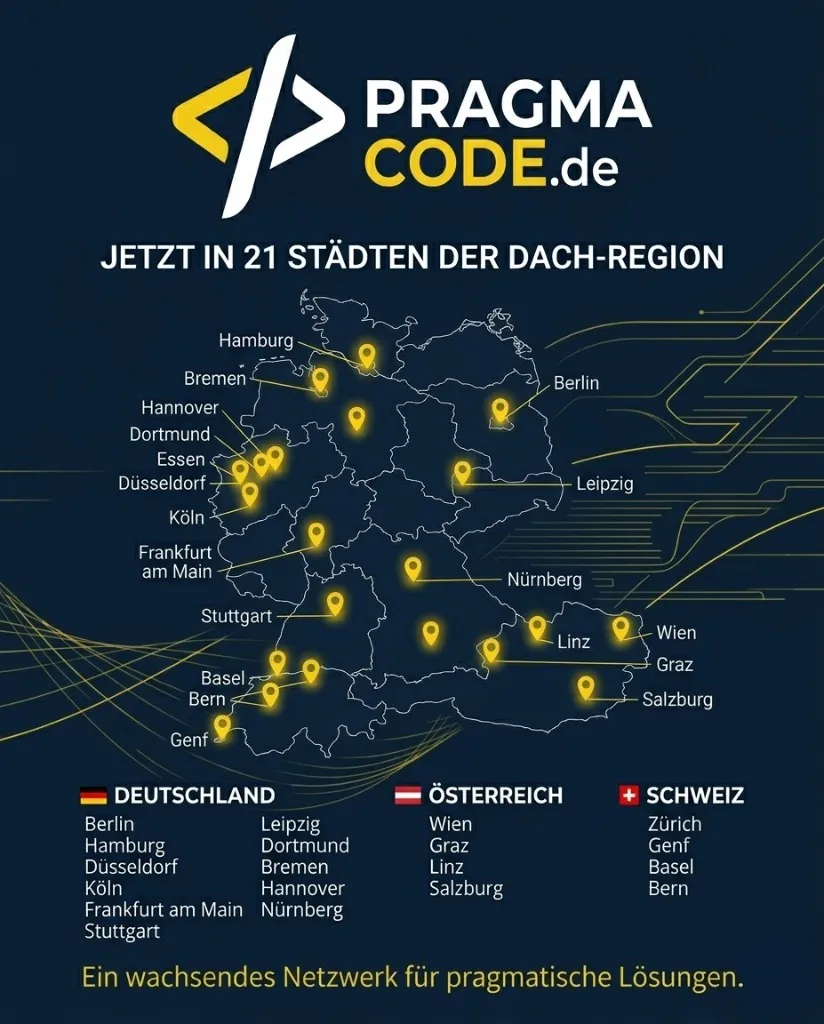
Our Regional Expertise
We are your digital partner – regionally anchored and successfully scaling across borders.
Have a vision?
Let's check together how we can make your idea take flight.
Book your free strategy call nowExtended Specialized Glossary
Personal Branding
The strategic positioning of an individual as an unmistakable expert brand. In B2B tech, it establishes authority, credibility, and differentiated market visibility.
Social Selling
The targeted utilization of professional networks like LinkedIn to identify qualified prospects, build C-level trust relationships, and shorten sales cycles through technical expertise.
Video Marketing
The integration of authentic video formats into B2B communications to make complex cloud architectures, codebases, and IT services visually tangible and engaging.
LinkedIn Algorithm
A machine learning system that ranks and distributes feed content based on dwell time, interaction velocity, topical authority, and comment depth.
Dwell Time
The duration a user spends viewing, reading, or watching a post. For LinkedIn's ranking algorithms, it serves as the primary metric of substantive content quality.
Thought Leadership
Establishing oneself as a pioneering industry authority by consistently sharing deep architectural insights, transparent post-mortems, and decisive technical viewpoints.
Corporate Influencer
Employees and tech executives who serve as authentic brand ambassadors on LinkedIn, communicating engineering excellence and corporate culture to prospective clients and talent.