

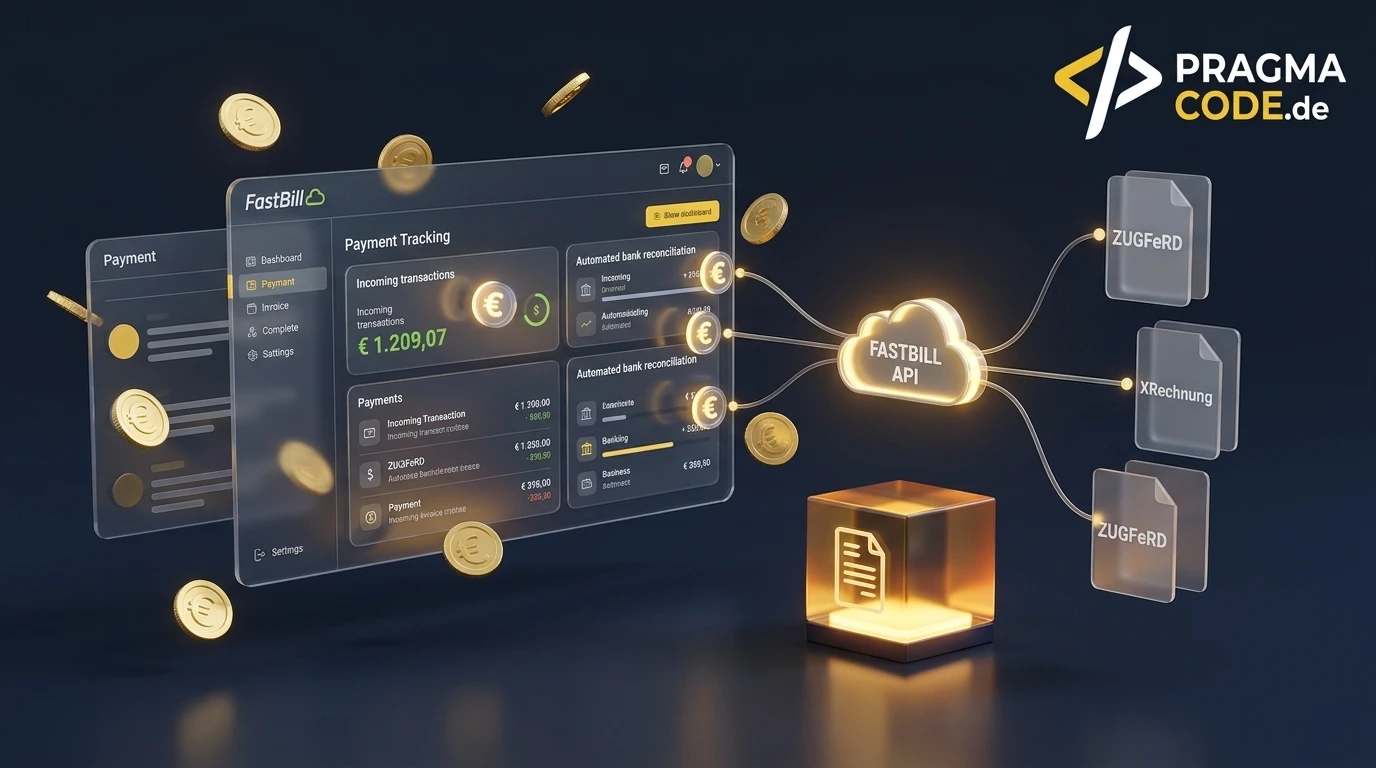
From an intuitive invoicing tool for service providers to an automated financial engine: FastBill merges streamlined billing, project time tracking, and automated bank reconciliation with an open REST API. In light of mandatory B2B e-invoicing for 2026/2027, deep n8n integrations, and modern FinTech connectors, we examine features, DATEV connectivity, developer workflows, and scaling boundaries for SMEs.
This article is an in-depth expert contribution from our content cluster. Discover the complete overview on our main page: AI Automation for Modern Businesses →
- Engineered for Service Agencies, Consultancies & SMEs: FastBill brings project management, time tracking, and professional billing together into a frictionless, unified workflow without manual data handoffs.
- Legally Compliant E-Invoicing (EN 16931): Native generation and parsing of hybrid ZUGFeRD and pure XRechnung electronic invoices fulfilling European and German statutory mandates.
- Real-Time Banking & Automated Matching: Automatic account synchronization via FinTS and PSD2 open banking reconciles incoming payments against outstanding invoices and automates reminders and payment triggers.
- Extensible REST API v2: Complete programmatic control over customer profiles, invoice items, and financial records with webhooks for headless commerce, CRM data pipelines, and n8n automation flows.
- Seamless Tax Advisor Collaboration: Direct transmission to DATEV Unternehmen online via certified DATEVconnect cloud interfaces and standard export archives.
Introduction: Transforming Invoicing into an Automated Growth Engine
In many small and mid-sized enterprises, digital agencies, and professional services firms, invoicing remains an irritating bottleneck. Logged hours must be exported from multiple project tracking tools, consolidated in spreadsheets, converted into PDF invoices manually, and matched line by line against bank transaction statements. At the end of the month, frantic searches ensue when the tax consultant requests missing receipts and documents.
Frankfurt-based FastBill GmbH – part of the international FreshBooks ecosystem since 2021 – was conceived specifically to dismantle this fragmented workflow. Rather than deploying rigid, heavyweight enterprise ERP software, FastBill delivers a nimble, service-driven infrastructure: from the moment an engineer or designer logs project hours to automated draft generation, immediate banking reconciliation, and one-click accountant exports.
With stringent European electronic invoicing mandates taking effect across 2025–2027, heightened audit requirements for GoBD compliance, and the accelerating integration of autonomous AI agents into enterprise finance, the platform serves as a pivotal bridge. In this comprehensive guide, we put FastBill 2026 to the test, explore the REST API v2 through production automation workflows, and show how growing organizations establish it as a centralized billing hub within modern IT architectures.
Core Capabilities: Billing, Multi-Banking, and Project Operations
FastBill positions itself as an end-to-end financial operations platform for knowledge workers, consultants, creative agencies, and digital service providers. The platform revolves around a complete financial loop: quotes, delivered billable hours, invoice generation, and liquidity tracking.
Quotes & Invoice Workflows
Create professional quotes and legally compliant invoices tailored to your corporate identity. Clients can accept quotes online via integrated digital signatures, instantly converting proposals into active invoices. Automated recurring billing (retainers and subscriptions) eliminates recurring manual invoicing routines.
Built-in Project Time Tracking
Team members track working hours directly against specific clients and projects via the desktop web app, browser extensions, or mobile applications. Logged hours automatically translate into detailed performance breakdowns and itemized customer invoices based on custom hourly rates.
Multi-Banking & Smart Reconciliation
Connect German and European commercial bank accounts, credit cards, and modern FinTech platforms (including Finom, bunq, Revolut, and PayPal). Incoming transactions sync automatically and match against open invoices via intelligent reconciliation algorithms.
Digital Receipt Inbox & OCR
Centralized inbound collection for supplier invoices via email forwarding, mobile camera scan, or drag-and-drop uploads. Machine-learning OCR extracts gross amounts, vendor names, invoice numbers, and VAT tax rates automatically to prevent manual data entry mistakes.
Contrasting FastBill with Traditional Accounting Monoliths
Whereas enterprise legacy software like SAP Business One or desktop DATEV packages approach finance through double-entry journal ledgers and rigid charts of accounts (such as SKR03 or SKR04), FastBill operates from the day-to-day operational reality of business managers. Project managers and consultants do not need to memorize accounting account numbers to issue an audit-proof, tax-compliant invoice with correct VAT treatment and EU reverse-charge clauses.
Simultaneously, native time tracking ensures that billable hours are never left stranded in disconnected silo apps like Clockify or Toggl. Instead, tracked hours move directly into billing drafts, noticeably increasing realization rates and eliminating unbilled client work.
Mandatory E-Invoicing 2026/2027: ZUGFeRD & XRechnung in FastBill
With the rollout of statutory e-invoicing legislation (such as the German Growth Opportunities Act and European e-invoicing mandates), issuing and accepting electronic invoices is legally binding for B2B transactions. Traditional flat PDF invoices no longer meet statutory standards; companies must exchange structured, machine-readable XML documents complying with the European EN 16931 specification.
Since January 1, 2025, businesses operating in Germany must be technically capable of receiving structured e-invoices in ZUGFeRD (version 2.0.1+) or XRechnung format. Outbound issuance transitions progressively through 2026 and 2027 based on corporate revenue thresholds. FastBill supports both electronic formats natively without extra modules.
1. ZUGFeRD: The Preferred Hybrid Architecture
FastBill leverages the ZUGFeRD standard (Comfort and Extended profiles). This hybrid framework embeds machine-readable XML data directly inside a standard visual PDF/A-3 container. This provides two distinct operational benefits:
- Human Readability: Clients, project managers, and finance officers can open, review, and print the document just like any regular PDF invoice.
- Machine Automation: Upstream ERP systems, accounting software, and banking gateways extract metadata, line items, VAT numbers, and banking details automatically without error-prone OCR guesswork.
2. XRechnung for Public Sector Procurement (B2G)
For public authorities, federal ministries, and municipalities, FastBill outputs pure XML XRechnung files (conforming to UBL or UN/CEFACT syntaxes). These documents incorporate mandatory routing IDs (Leitweg-ID), buyer reference numbers, and government procurement codes, enabling instant submission via national e-invoicing gateways like ZRE and OZG-RE.
2026 Pricing Plans & Tier Analysis
FastBill operates on a transparent SaaS subscription model structured around company size, seat counts, and integration requirements:
| Plan | Target Audience | Core Features | Banking & Interfaces |
|---|---|---|---|
| FastBill Solo | Freelancers & Solo Entrepreneurs | Unlimited quotes & invoices, ZUGFeRD generation, mobile receipt scanning app | 1 bank account, core CRM management, DATEV CSV export |
| FastBill Plus | Small Teams & Consultancies | Multi-user access, automated dunning routines, receipt approval workflows, recurring billing | Up to 3 bank accounts, Stripe & PayPal sync, REST API access |
| FastBill Pro | Growing Agencies & Scaling SMEs | Full project time tracking, granular role permissions, cost center management | Unlimited bank accounts, DATEVconnect online, Webhooks, premium developer API support |
Organizations aiming to orchestrate FastBill through workflow automation engines like n8n or custom client portals should choose at least the Plus plan, as it provides the dedicated API key and webhook event triggers required for automated programmatic integration.
Developer Architecture: FastBill REST API v2 & Webhooks
A key factor setting FastBill apart from closed legacy solutions is its open developer ecosystem. The FastBill REST API v2 allows engineering teams to weave invoicing, payment updates, and customer records directly into modern cloud architectures.
Authentication & API Fundamentals
Authentication relies on standard HTTP Basic Authentication using the account email address and your personal API key located in profile settings:
curl -s -X POST https://my.fastbill.com/api/1.0/api.php \
  -u "developer@yourcompany.com:YOUR_FASTBILL_API_KEY" \
  -H "Content-Type: application/json" \
  -d '{
    "SERVICE": "customer.get",
    "FILTER": {
      "CUSTOMER_NUMBER": "CUST-2026-0042"
    }
  }'
Essential API Automation Scenarios
E-Commerce & Checkout Synchronization
Whenever an order is placed on an e-commerce platform (such as Shopify, WooCommerce, or MedusaJS), an API webhook automatically registers the client in FastBill, generates a compliant ZUGFeRD invoice, and dispatches the download link to the customer.
CRM & Deal Closing Pipelines
When a sales deal is marked as "Closed-Won" in your CRM (HubSpot, Pipedrive, or Salesforce), the API instantly creates an itemized draft invoice with predefined payment terms and assigned project rates.
SaaS Metered & Subscription Billing
Cloud applications with consumption-based pricing send monthly compute units, API calls, or logged billable hours to FastBill, automating recurring customer invoicing and SEPA direct debit execution.
Production Blueprint: End-to-End Invoice Automation with n8n
Connecting FastBill with open-source workflow orchestration tools like n8n allows engineering teams to deploy bulletproof, automated billing pipelines. The following multi-stage workflow illustrates how companies eliminate manual touches from order to payment.
Event Trigger (Milestone or Time Log Completion)
The n8n workflow listens for webhooks emitted by project tracking tools (such as Linear, Jira, or GitHub) or time logs. Once an engagement milestone receives approval, the workflow extracts client identifiers, logged hours, and rate cards.
Customer Master Record Verification
Through the FastBill API endpoint customer.get, n8n verifies whether the customer record already exists. If missing, it creates the profile via customer.create, populating verified VAT IDs and billing addresses.
Automated ZUGFeRD Generation via API
The n8n pipeline invokes invoice.create, attaching itemized deliverables and requesting a ZUGFeRD-compliant PDF. The invoice is automatically emailed to the client and cataloged as open in FastBill.
Banking Webhook & Automatic Reconciliation
When the client settles the bill via bank transfer into your FinTech business account (e.g., Finom), FastBill reconciles the transaction. An outbound webhook triggers n8n to close open delivery tickets and notify team channels in Slack.
Tax Advisor Synergy: DATEV Integration Options
For German and European enterprises, frictionless integration with external tax advisors and accountants is a non-negotiable requirement. FastBill bridges this relationship via two complementary mechanisms:
- DATEVconnect online: For tax offices utilizing the DATEV cloud ecosystem, FastBill securely transmits digital receipt images, transaction metadata, and pre-assigned account codes directly into DATEV Unternehmen online. Tax accountants receive structured, verified records without any manual data re-entry.
- Standardized DATEV Format Export: For traditional tax practices, FastBill generates a monthly standardized DATEV posting batch (CSV formatted to official DATEV post-transfer standards) alongside a complete ZIP archive of source document scans.
This automated pipeline reduces monthly accounting preparation fees for clients, while eliminating reconciliation friction caused by missing receipts or ambiguous line items.
Security Architecture & Regulatory Compliance
Financial platforms are subject to rigorous regulatory frameworks. FastBill guarantees regulatory integrity through established security protocols:
German Data Center Hosting
All application databases and file repositories are hosted in ISO 27001-certified high-security facilities within Germany, complying fully with European GDPR data privacy statutes.
Tamper-Proof Audit Logging
Finalized invoices cannot be modified without trace. Every cancellation or correction generates a distinct audit-proof credit note with a transparent historical timeline fulfilling GoBD principles.
Mandatory Multi-Factor Authentication
To safeguard confidential business records and banking feeds, FastBill supports mandatory two-factor authentication (TOTP) across team and administrator accounts.
End-to-End Cryptography
All communication channels between client browsers, API consumers, banking servers, and DATEV cloud services use modern TLS 1.3 encryption with Perfect Forward Secrecy.
Limitations & Strategic Trade-Offs
Despite its strengths, FastBill is not a one-size-fits-all solution for every organizational profile. Decision-makers should evaluate several key limitations:
Architectural Boundaries of FastBill
- No Complete Double-Entry General Ledger: FastBill is an operational billing and pre-accounting platform, not a full general ledger accounting package capable of generating automated balance sheets and tax returns. Final annual accounts still require an accountant or specialized software like DATEV.
- Basic Inventory & Warehouse Tracking: Companies managing complex physical supply chains, multi-warehouse stock allocations, and bill-of-materials manufacturing will require a heavier ERP system such as Odoo or SAP.
- Enterprise Multi-Entity Consolidation: Large corporate groups requiring intercompany billing, multi-currency balance consolidation, and complex holding structures will exceed the platform's architectural sweet spot.
5-Step Implementation Roadmap for FastBill
Transitioning your billing operations to FastBill can be completed within a few business days when executed methodically. Follow this phased implementation plan:
-
1. Master Data Audit & Tax Configuration
Export customer, vendor, and product lists from legacy tools. Cleanse duplicate records, validate international VAT numbers, and establish default payment terms and discount structures.
-
2. Bank & Payment Gateway Integration
Connect your primary operating business bank accounts via FinTS/PSD2 open banking. Link Stripe, PayPal, or Finom accounts to enable automatic settlement and transaction notifications.
-
3. Branding & E-Invoicing Calibration
Upload your vector logos, custom typography, and corporate design stationary. Enable default ZUGFeRD-compliant PDF/A-3 output and configure routing identifiers (Leitweg-IDs) for public sector clients.
-
4. Accountant Alignment & DATEV Mapping
Coordinate with your tax consultant to determine the preferred data transfer route (DATEVconnect online or monthly batch exports). Configure standard charts of accounts (SKR03 or SKR04) and customer ledger ranges.
-
5. REST API & n8n Workflow Automation
Generate production API credentials and establish automated pipelines with your CRM, e-commerce stores, and time tracking platforms. Implement automated dunning cycles and monthly retainer workflows.
Conclusion: FastBill as the Agile Engine of Modern SME Finance
In our 2026 evaluation, FastBill demonstrates how modern billing and pre-accounting workflows should function: rapid, intuitive to use, legally compliant with European e-invoicing standards, and natively extensible through automated API pipelines.
For digital service providers, software consultancies, agencies, and e-commerce brands seeking to eliminate invoicing errors and accelerate cash flow through instant banking reconciliation, FastBill is a compelling platform. Paired with n8n or custom API integrations, it creates a flexible financial engine that scales smoothly with your business without the overhead of legacy ERP behemoths.
Frequently Asked Questions (FAQ)
Is FastBill ready for mandatory European and German e-invoicing?
Yes. FastBill natively generates and parses hybrid ZUGFeRD electronic invoices (PDF with embedded XML) and pure XRechnung XML documents conforming to the European EN 16931 specification without additional subscription fees.
How does FastBill differ from sevDesk and Lexware Office?
FastBill emphasizes project-driven businesses, agencies, and built-in time tracking. While Lexware Office and sevDesk provide deeper stand-alone ledger modules for revenue-surplus calculations (EÜR) and advance VAT filings, FastBill shines as an agile, API-extensible billing and preparation engine with smooth accountant handover.
Can FastBill be automated through n8n, Make, or Zapier?
Yes. FastBill provides a complete REST API v2 and webhook capabilities. Official nodes exist for Zapier and n8n, enabling event-driven synchronization of customers, invoices, payment statuses, and receipts across your tech stack.
Are company records securely hosted in Germany with automated backups?
Yes. All enterprise data is hosted in ISO 27001-certified data centers in Frankfurt am Main, Germany. Automated daily backups and strict GDPR compliance ensure enterprise-grade security and audit compliance.
Sources & Official References
- FastBill GmbH / FreshBooks Group: Official Platform and API Documentation (2026) – fastbill.com
- German Federal Ministry of Finance (BMF): Growth Opportunities Act & B2B E-Invoicing Regulations – bundesfinanzministerium.de
- Coordination Office for IT Standards (KoSIT): XRechnung Specification & European Standard EN 16931 – xoev.de
- Forum for Electronic Invoicing Germany (FeRD): ZUGFeRD 2.2 Standard & XML Profiles – ferd-net.de
- DATEV eG: Cloud Services and Accounting Interfaces for Upstream Systems (DATEVconnect online) – datev.de
Have a vision?
Let's check together how we can make your idea take flight.
Book your free strategy call nowExtended Specialized Glossary
FastBill
A cloud-based invoicing and accounting platform by Frankfurt-based FastBill GmbH for agencies, consultancies, and SMEs featuring project time tracking, banking sync, and a REST API.
ZUGFeRD
A hybrid electronic invoice format combining a visual PDF file with embedded, machine-readable XML data complying with the European EN 16931 standard.
DATEVconnect online
A cloud API interface by DATEV that allows third-party software systems to securely transfer digital receipts and booking records into DATEV Unternehmen online in real time.
n8n
An extensible open-source workflow automation platform for connecting APIs, enterprise data, and AI agents.