
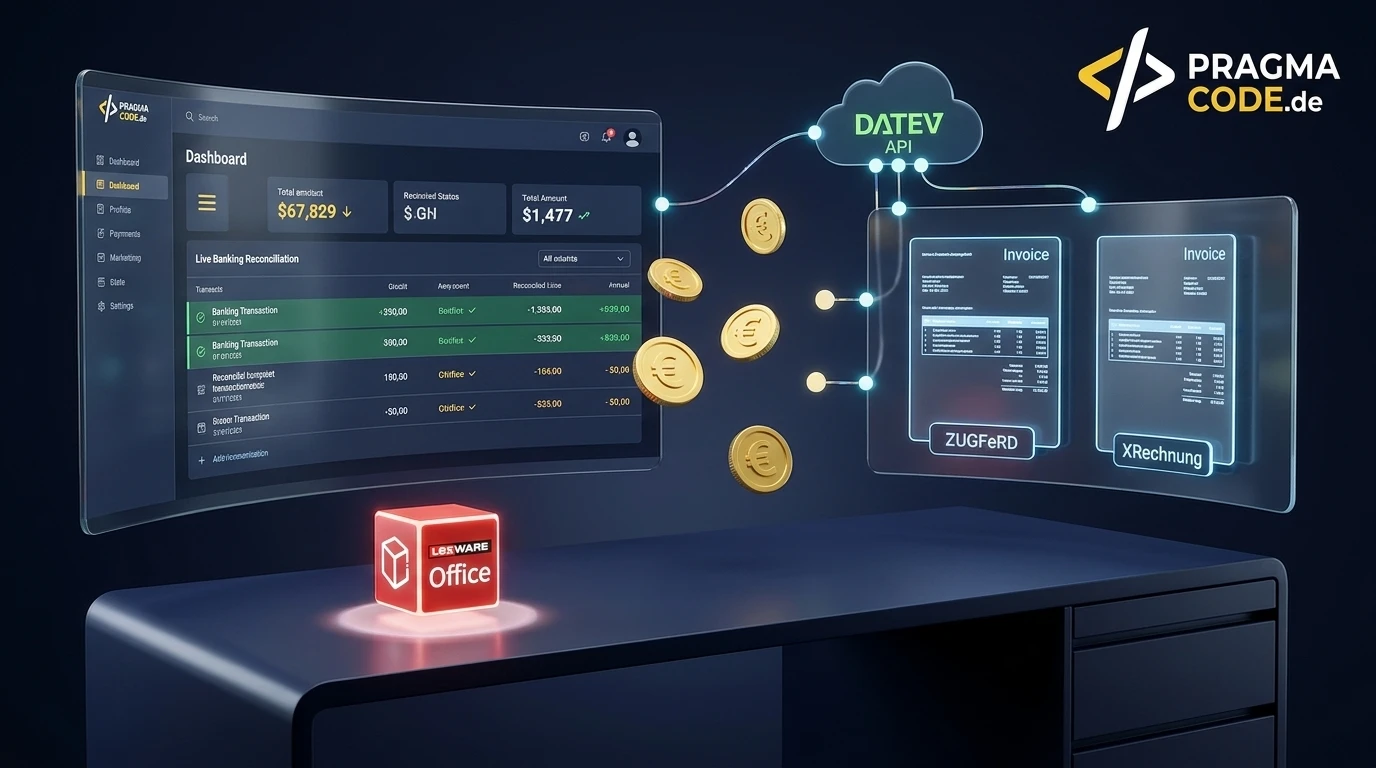
From a nimble receipt scanner app to a comprehensive business finance engine: With Lexware Office (formerly lexoffice), Haufe-Lexware has spearheaded cloud accounting for European SMEs, freelancers, and tax firms. Facing mandatory B2B e-invoicing for 2026/2027, automated DATEV data services, and an extensible REST API, we analyze architecture, workflows, pricing, and enterprise automation capabilities.
This article is an in-depth expert contribution from our content cluster. Discover the complete overview on our main page: AI Automation for Modern Businesses →
- Complete Cloud Unification: The former product lexoffice has been unified under the flagship brand Lexware Office, providing full browser-based bookkeeping, invoicing, and banking on modern cloud infrastructure.
- Mandatory E-Invoicing Readiness: Driven by European compliance and the German Growth Opportunities Act, the platform processes and generates structured ZUGFeRD and XRechnung XML documents without external converter tools.
- API-First Extensibility: Through its documented REST API (
api.lexoffice.io/v1), real-time webhooks, and direct integration with modern FinTech banking (e.g., Finom) and DATEV Rechnungsdatenservice 1.0, businesses eliminate manual CSV uploads to their tax advisors.
The Paradigm Shift in European Corporate Accounting
The era of manual paper binders, mechanical ledger re-typing, and convoluted Excel sheets has conclusively ended for European SMEs. Stricter statutory mandates regarding electronic invoicing alongside unyielding tax audit rules (GoBD) require seamless end-to-end digital pipelines. Lexware Office operates as an agile middleware layer linking bank accounts, operational e-commerce stores, and certified tax consultant backends.
- 1. Evolution: From lexoffice to the Unified Lexware Office Suite
- 2. Core Modules in Action: OCR Ingestion, Invoicing & PSD2 Banking
- 3. The 2026/2027 E-Invoicing Offensive: ZUGFeRD, XRechnung & EN 16931
- 4. Tax Advisor Collaboration via Automated DATEV Cloud Services
- 5. Developer Deep-Dive: REST API v1, Event Webhooks & FinTech Sync
- 6. Pricing Tiers, Licensing Models, and Total Cost of Ownership
- 7. Security, GoBD Audit Compliance, and Revision Safety
- 8. Verdict & Decision Matrix: Is Lexware Office Right for You?
- 9. Official Sources & Primary Documentation
1. Evolution: From lexoffice to the Unified Lexware Office Suite
For decades, small-business accounting across the DACH region was defined by rigid on-premise Windows applications. Haufe-Lexware in Freiburg built a market-dominant position with software packages like Lexware buchhaltung and Lexware warenwirtschaft. Despite their stability, these legacy setups created structural bottlenecks: local SQLite or Sybase databases required manual backup schedules, major feature updates necessitated annual software purchases, and remote tax collaboration relied on clunky VPN connections or manual CSV exports.
Recognizing the shift toward browser-first SaaS architectures, Haufe launched lexoffice as an agile, lightweight cloud alternative. What began as a user-friendly invoicing tool grew over a decade into an all-encompassing enterprise ecosystem. In 2023, Haufe consolidated its brand portfolio, phasing out the separate lexoffice moniker and positioning the solution as the corporation's future flagship: Lexware Office.
In 2026, Lexware Office operates as a high-availability multi-tenant cloud application. All client records reside strictly in German high-security data centers with ISO 27001 certification. Automated zero-downtime updates ensure that changes in tax rates, statutory reporting schemas, or electronic document standards take effect immediately without requiring user intervention. For fast-paced digital agencies, craft enterprises, and e-commerce merchants, this removes server maintenance burdens while guaranteeing continuous legal compliance.
1. 100% Cloud Native with Universal Cross-Platform Access
Fully functional in any modern browser on macOS, Windows, Linux, and mobile devices. Zero installation overhead, continuous background backups, and instant multi-device syncing.
2. Maximum GDPR & GoBD Compliance Hosted in Germany
Sovereign data storage within European jurisdiction, audit-proof document immutability, and cryptographically verified audit trails according to German tax law.
3. Bidirectional FinTech & ERP Interoperability
Direct connectivity to modern business banking accounts, payment processors, online marketplaces, and tax consultant frameworks without error-prone batch files.
2. Core Modules in Action: OCR Ingestion, Invoicing & PSD2 Banking
Daily administrative efficiency hinges on three core operational pillars: the speed of ingesting supplier receipts, the friction involved in converting sales proposals into invoices, and the automation level when reconciling bank movements. In benchmark tests, Lexware Office exhibits an intuitive user flow engineered to eliminate repetitive administrative toil.
Automated Receipt Ingestion with Machine Learning OCR
Incoming paper receipts or digital PDF vouchers can be uploaded via browser drag-and-drop, photographed using the iOS/Android companion app, or forwarded to a dedicated inbox email address. The optical character recognition engine analyzes incoming files in real time, extracting vendor identities, invoice dates, due dates, document numbers, gross sums, and segmented VAT rates (19%, 7%, tax-exempt). The neural classification engine remembers previous transactions: once an internet bill is assigned to account 4920 (Telecommunications in SKR03), subsequent invoices from the same supplier receive automated pre-booking proposals.
Sales Invoicing: From Quotation to Settlement
The sales module handles quotations, order confirmations, delivery notes, recurring invoices, and credit notes. The WYSIWYG layout editor allows full brand customization with company logos, custom typography, and personalized payment terms. Crucially, workflow progression is frictionless: when a client approves an estimate online, a single click converts the quote into a final invoice. If payments slip past their deadline, configurable multi-tier automated dunning triggers polite reminders, warning notices, or statutory interest calculations.
PSD2 Real-Time Banking & Live Reconciliation
Leveraging secure Open Banking (PSD2) gateways, Lexware Office connects with over 4,000 European banking institutions, credit cards, and digital FinTech accounts (such as Finom, PayPal, and Stripe). Account transactions are synchronized several times per day. The matching engine compares incoming bank entries against open receivables. When the transfer amount and invoice number match, the item is marked as settled automatically. Partial payments or early-payment cash discounts are identified and booked to dedicated differential accounts.
Comparison: Legacy Desktop Bookkeeping vs. Lexware Office Cloud Workflows
- Receipt Handling: Physical paper binders, manual scanning sessions at month-end, risk of document loss.
- Bank Reconciliation: Manual typing of statement rows or fragile CSV imports requiring manual sanitization.
- Tax Advisor Handoff: Paper courier folders or unorganized ZIP folders sent via insecure email.
- Collaboration: Single-seat workstation licenses, preventing simultaneous multi-user collaboration.
- Receipt Handling: Mobile photo uploads, instant machine-learning parsing, and automated voucher linkage.
- Bank Reconciliation: Automated PSD2 account syncing with predictive rule matching and discount handling.
- Tax Advisor Handoff: Direct cloud transmission via DATEV Rechnungsdatenservice 1.0.
- Collaboration: Role-based access control in the browser with live advisor co-working capabilities.
3. The 2026/2027 E-Invoicing Offensive: ZUGFeRD, XRechnung & EN 16931
The European Union's ViDA (VAT in the Digital Age) initiative and Germany's Growth Opportunities Act represent the most consequential shift in business transactions in decades. As of January 1, 2025, all domestic B2B enterprises must be technically capable of receiving structured electronic invoices. Standard visual PDFs sent via email no longer legally qualify as e-invoices because they lack structured, machine-parsable XML data compliant with European Standard EN 16931. Over the course of 2026 and 2027, mandatory e-invoice issuance rules phase in across the private sector.
Lexware Office was developed to make this massive regulatory shift effortless for non-technical business owners:
1. ZUGFeRD 2.2 / 2.3
Hybrid format pairing a human-readable PDF/A-3 document with an embedded XML schema. Allows immediate human inspection while facilitating automated parsing.
2. Pure XRechnung XML
The standard XML format for public administration tenders (B2G) and enterprise B2B. Lexware Office renders a clean visual print view directly from the raw XML tree.
3. Pre-Flight EN 16931 Validation
Automated syntax validation inspecting routing IDs (Leitweg-ID), VAT registrations, and unit codes prior to dispatch, preventing invoice rejections.
4. Automated XML Ingestion
Incoming structured electronic documents are ingested natively; line items, discounts, and payment terms flow directly into the review drawer.
5. Audit-Proof Cloud Archiving
Both raw XML payloads and rendered visual representations are preserved immutably for the statutory 10-year retention period in compliant cloud storage.
The greatest advantage for small businesses is operational simplicity. When an operator clicks "Finalize and Send Invoice" in tier XL, Lexware Office automatically bundles the ZUGFeRD XML layer into the generated PDF. If the recipient master profile contains a government routing code (Leitweg-ID), the software switches automatically to pure XRechnung output. Missing mandatory fields are flagged immediately in the editor, eliminating payment disputes caused by formal billing errors.
Expert Tip: Maintain Routing Codes in Master Records
Store your clients' Leitweg-ID and EU VAT identification numbers directly within their Lexware Office contact records. This enables the background engine to automatically detect public sector and enterprise contracts, selecting the correct syntax specification without manual switches.
4. Tax Advisor Collaboration via Automated DATEV Cloud Services
Historically, month-end and fiscal year-end closings generated massive friction between business owners and certified tax accountants. Receipts were mislaid, transaction records failed to match bank statements, and account classification errors required hours of manual clarification. Lexware Office solves this communication gap through its certified integration with modern DATEV cloud data pipelines.
1. Rechnungsdatenservice 1.0
Transmits structured sales and purchase records, tax codes, and metadata directly to DATEV Unternehmen online.
2. DATEV Belegbilderservice
Uploads digitized voucher graphics (PDF, JPEG) and permanently binds them to the corresponding ledger line in the DATEV data center.
3. Advisor Portal Access
Grants certified accountants free, role-restricted read or write access directly inside the client's live Lexware Office workspace.
4. DATEV Buchungsdatenservice
Synchronizes finalized ledger balances and closing journal entries back into the operational corporate cockpit.
Authentication is established securely using DATEV SmartLogin or SmartCard authentication. Once authorized, completing the monthly financial closing requires just one click to push all invoices, payments, and document images to the accounting firm. This frees accountants from manual data entry, enabling them to deliver high-value tax structuring and financial advisory services.
5. Developer Deep-Dive: REST API v1, Event Webhooks & FinTech Sync
For modern technology startups, scale-ups, and digital agencies, business software is only as robust as its API surface. An isolated software silo introduces operational friction and repetitive manual data maintenance. Lexware Office provides a fully documented REST API under api.lexoffice.io/v1, authenticated via bearer tokens.
Key Endpoints in the Lexware Office API
The API surface enables developers to programmatically create, query, and synchronize corporate data:
/v1/contacts (Master Contact Management)
Facilitates bidirectional synchronization with CRM platforms (HubSpot, Salesforce, Pipedrive). Updates made in the CRM update Lexware Office instantly.
/v1/invoices (Invoice Lifecycle Management)
Spawns finalized invoices or drafts directly from e-commerce stores (Shopify, WooCommerce, Shopware) or proprietary backends, handling tax calculation and PDF rendering.
/v1/vouchers & /v1/files (Receipt Ingestion)
Ingests supplier vouchers from automated scrapers (such as GetMyInvoices) or custom data pipelines, uploading corresponding PDF/image payloads.
/v1/event-subscriptions (Real-Time Webhooks)
Alerts external systems of status events including invoice.status.changed (e.g., when a client settles an account) and voucher.created.
Integrating Workflow Automation Pipelines with n8n
In modern enterprise IT environments, the open-source automation engine n8n frequently acts as business middleware. Utilizing the official or community Lexoffice node in n8n, teams build advanced end-to-end accounting automations without custom application code:
# Example: REST API call fetching open invoices via curl
curl -X GET "https://api.lexoffice.io/v1/invoices?voucherStatus=open" \
     -H "Authorization: Bearer <YOUR_API_TOKEN>" \
     -H "Accept: application/json"
A standard automated workflow functions seamlessly: When a B2B buyer executes an agreement on a custom Next.js storefront, Stripe dispatches a webhook event to n8n. The automation engine parses the customer data, invokes POST /v1/invoices in Lexware Office, and creates a GoBD-compliant ZUGFeRD invoice. Simultaneously, the resulting PDF is emailed to the client and archived into corporate cold storage—completely without human intervention.
The FinTech Connection: The Finom Integration Case Study
As showcased on modern digital banking platforms (such as Finom), Lexware Office's open architecture enables granular two-way integrations: Business account transactions stream continuously into Lexware Office (Lexware Office transactions), while digitized receipt attachments and outgoing sales invoices sync back (Lexware Office belege). This eliminates manual statement downloads forever.
6. Pricing Tiers, Licensing Models, and Total Cost of Ownership
Cost predictability is paramount for growing businesses. Lexware Office operates on a flexible monthly subscription model with no lock-in contracts, scaling alongside operational requirements:
Tier S (~€6.90 / month)
Core voucher management, mobile scanning, banking integration with transaction reconciliation, and tax advisor access. Ideal for solo contractors who bill externally.
Tier M (~€12.90 / month)
Adds professional invoicing, quotation workflows, customer contact management, and integrated online payment gateways (PayPal, Stripe).
Tier L (~€19.90 / month)
Adds cash register tracking, advanced multi-tier dunning, delivery notes, and flexible template layout engines for service providers.
Tier XL (~€29.90 / month)
Full suite functionality including ZUGFeRD & XRechnung generation, recurring billing, direct ELSTER VAT return filings, and full REST API access.
Cost Consideration: Payroll Add-On Expenses
The optional Payroll & Wages (Lohn & Gehalt) module is available starting at roughly €11.90 base plus €2.50 per processed employee per month. While this eliminates external payroll bureau fees, companies must ensure diligent internal maintenance of health insurance registrations and social security declarations.
Compared to legacy on-premise installations—which incurred four-figure upfront server investments, dedicated backup infrastructure, and pricey annual upgrade packages—the SaaS model of Lexware Office delivers outstanding TCO. In particular, Tier XL pays for itself within the first week of operation through automated e-invoicing and direct DATEV pipeline time savings.
7. Security, GoBD Audit Compliance, and Revision Safety
Under German fiscal law, accounting software must strictly prevent the post-hoc manipulation or undetected deletion of transaction logs. Any breach of GoBD principles can lead to the disqualification of business accounts during a tax audit, resulting in severe estimated tax penalties.
Immutable Document Locking
Once an outgoing invoice is dispatched or an expense voucher booked, Lexware Office immutably locks the record. Reversals must be executed as distinct credit notes or offsetting entries.
Certified Hosting in Germany
Production servers are situated in Frankfurt am Main and Karlsruhe. Strict compliance with GDPR provisions ensures zero exposure to non-EU data jurisdictional risks.
Automated GDPdU / GoBD Audit Exports
One-click compilation generates standardized tax auditor archives complete with index XML metadata, file hashes, and ledger journals conforming to official tax guidelines.
Two-Factor Authentication (2FA)
Workspace and advisor access are protected via Time-Based One-Time Passwords (TOTP), shielding sensitive commercial accounts from session hijacking.
Furthermore, Haufe-Lexware provides an exhaustive template for the statutory Process Documentation (Verfahrensdokumentation). This document allows businesses to formally demonstrate how digital documents are ingested, validated, stored, and protected against data corruption during tax audits.
8. Verdict & Decision Matrix: Is Lexware Office Right for You?
In 2026, Lexware Office stands as one of the most mature, intuitive, and reliable cloud accounting platforms across the DACH market. For small and medium-sized enterprises, trade contractors, digital agencies, and e-commerce merchants, it offers a complete operational package: statutory e-invoicing is handled frictionlessly, multi-bank reconciliation performs robustly, and DATEV cloud handoffs slash external tax consultant retainers.
System boundaries only emerge when dealing with heavy industrial complexity: Companies managing multi-stage manufacturing bills of materials (BOM), automated high-bay warehouse logistics, or multi-currency multinational holding structures will require an enterprise ERP like SAP S/4HANA or Odoo. For the vast majority of growing commercial businesses, Lexware Office represents one of the most scalable, cost-effective, and future-proof investments available.
Quick-Check: Is Lexware Office the Optimal Fit for Your Firm?
Looking to Automate Your Bookkeeping and API Workflows?
Schedule a Free Initial Consultation9. Official Sources & Primary Documentation
- Haufe-Lexware GmbH & Co. KG (2026): Official Lexware Office Product Suite & Release Notes – Comprehensive feature documentation, security infrastructure, and licensing plans.
- Lexware Office Developer Hub (2026): Official API Reference & Webhook Guides – REST endpoint specifications and payload definitions for v1.
- Federal Ministry of Finance (BMF Germany, 2024–2026): Implementation Circular on Mandatory B2B E-Invoicing – Legal foundations, transitional provisions, and standards under the Growth Opportunities Act.
- DATEV eG (2026): DATEV Cloud Data Services: Rechnungsdatenservice 1.0 & Belegbilderservice – Technical integration specifications for certified third-party software.
- Coordination Center for IT Standards (KoSIT, 2026): XRechnung Standard & European Norm EN 16931 Validation Suite – Semantic data modeling for electronic business transactions.
Have a vision?
Let's check together how we can make your idea take flight.
Book your free strategy call nowExtended Specialized Glossary
Lexware Office
The cloud business software by Haufe-Lexware for SMEs, freelancers, and tax consultants for GoBD-compliant invoicing, automated receipt processing, and direct DATEV integration.
DATEV Rechnungsdatenservice 1.0
A standardized cloud interface by DATEV that transmits structured invoice metadata and digital receipt images from upstream systems like Lexware Office directly into DATEV Unternehmen online.
ZUGFeRD
A hybrid electronic invoice format combining a visual PDF file with embedded, machine-readable XML data complying with the European EN 16931 standard.
GoBD
German principles for the proper management and storage of books, records, and documents in electronic form and for data access.