


For enterprises in Germany, Austria, and Switzerland, relying blindly on US-based cloud AI APIs creates unacceptable compliance, security, and operational risks. Discover how modern On-Premise LLMs leveraging quantized open-source architectures, vLLM, and local RAG ensure authentic data sovereignty, GDPR compliance, and drastically reduced TCO.
This article is an in-depth expert contribution from our content cluster. Discover the complete overview on our main page:AI Consulting & Integration →
The Bastion of Data Sovereignty: Physical Autonomy in the Age of Agentic AI
Why the era of naive cloud API consumption is over for core Central European industries and how enterprises achieve genuine technological independence through local open-source models, vLLM, and Zero-Trust gateways.
- Introduction: The AI Wave Meets European Reality
- Chapter 1: The Cloud AI Dilemma for European Mittelstand
- Chapter 2: The Modern On-Premise AI Tech Stack in 2026
- Chapter 3: Hybrid Architecture & Zero-Trust AI Gateways
- Chapter 4: Step-by-Step Implementation Roadmap & Pipeline
- Chapter 5: Concrete B2B Use Cases in the DACH Region
- Chapter 6: Total Cost of Ownership (TCO & ROI Analysis)
- Conclusion: Data Sovereignty as a Strategic Competitive Advantage
- Legal Certainty & GDPR Immunity: Operating On-Premise AI completely eliminates data transfers to foreign jurisdictions (Schrems II, US CLOUD Act) and safeguards against EU AI Act liability.
- Uncompromising IP Protection: CAD blueprints, software codebases, financial sheets, and patient records remain physically enclosed within corporate firewalls – zero risk of data leakage or third-party training ingestion.
- Predictable TCO & High Throughput: Through advanced Quantization (AWQ/GGUF 4-Bit) and inference engines like vLLM, local GPU clusters frequently break even against volatile cloud API token bills in under 6 months.
Introduction: The AI Wave Meets European Reality
Across Germany, Austria, and Switzerland (the DACH region), Artificial Intelligence has transitioned from an experimental innovation showcase into a mission-critical driver of enterprise value. Where basic conversational interfaces once handled isolated queries, sophisticated multi-agent orchestration systems and Agentic AI now coordinate intricate workflows across manufacturing lines, global supply chains, financial auditing, and applied engineering.
Simultaneously, executive boards and enterprise architects are confronting an urgent strategic reality: default reliance on proprietary cloud APIs from US hyperscalers (such as OpenAI, Microsoft Azure, Google Cloud, or Anthropic) introduces severe legal, operational, and financial exposures. Transmitting proprietary manufacturing tolerances, patent disclosures, or sensitive employee records across international cloud pipes exposes businesses to existential vulnerabilities.
The definitive answer to this challenge is On-Premise AI and sovereign European private cloud hosting. Spurred by exponential breakthroughs in open-weights models (including Llama 3.3, Mistral Large 2, and Qwen 2.5) paired with state-of-the-art inference engines such as vLLM, enterprises can now host Large Language Models (LLMs) directly on dedicated hardware – unlocking frontier reasoning capabilities, predictable operational budgets, and uncompromising Data Sovereignty.
Chapter 1: The Cloud AI Dilemma for European Mittelstand
The DACH region's economic backbone is anchored by specialized manufacturers, engineering powerhouses, and global "Hidden Champions." Decades of proprietary engineering know-how, specialized CAD designs, and unique process formulas constitute their core competitive moat. Feeding this intellectual property (IP) into opaque cloud APIs compromises that very foundation.
1. Compliance & Jurisdictional Liability (GDPR & Schrems II)
Transmitting personally identifiable customer records or HR files to US-based cloud servers breaches Articles 44 et seq. of the GDPR. Under the US CLOUD Act, federal agencies can compel US tech vendors to disclose data, regardless of physical datacenter locations in Frankfurt or Dublin.
2. IP Exfiltration & Corporate Espionage Risks
Proprietary CAD files, formulas, and balance sheets leave the corporate security perimeter during API calls. Even with contractual zero-retention agreements, risks of upstream server logging, man-in-the-middle exploits, and third-party credential breaches remain persistent.
3. Uncontrolled API Token Cost Escalation
While low-volume testing appears inexpensive, scaling enterprise-wide deployments with millions of daily RAG lookups and multi-step agent reasoning loops leads to volatile, exponentially rising OPEX line items.
4. Vendor Lock-In & Unannounced Model Deprecation
Proprietary cloud models undergo continuous backend alignment, safety filtering shifts, and deprecations without prior notice. Businesses hardwired to specific third-party APIs forfeit long-term architectural stability and resilience.
Additionally, the regulatory framework of the EU AI Act imposes strict transparency, reproducibility, and governance obligations. Proprietary cloud models remain opaque black boxes. In contrast, deploying open-weights models locally allows enterprises to maintain complete audit trails, deterministic inference parameters, and seamless adherence to Article 50 transparency requirements.
Chapter 2: The Modern On-Premise AI Tech Stack in 2026
Executing LLMs locally was once considered the exclusive domain of supercomputing clusters. In 2026, breakthroughs in open-source model design, 4-bit/8-bit quantization algorithms (AWQ, GPTQ, GGUF), and advanced memory-paged inference runtimes have democratized local frontier intelligence.
Hardware Sizing: Four Scalable Deployment Topologies
Hardware procurement should match target concurrency, token context lengths, and departmental isolation requirements. Four architectures have established themselves as industry standards:
1. Workstations & Apple Silicon Nodes
For specialized R&D teams and localized RAG experimentation, high-end workstations with NVIDIA RTX 4090 (24GB VRAM) or Apple Silicon hardware (Mac Studio M2/M3/M4 Ultra with up to 192GB Unified Memory) deliver quiet, cost-effective inference for 8B to 70B models.
2. Enterprise GPU Rack Servers
Dedicated 2U/4U rackmount servers equipped with NVIDIA L40S (48GB), RTX 6000 Ada, or NVIDIA H100/H200 NVL accelerators in on-premise server rooms. Serving as the primary enterprise AI core, they handle hundreds of concurrent queries using vLLM continuous batching.
3. European Dedicated GPU Bare-Metal
Bare-metal GPU instances hosted in certified European datacenters (e.g. Hetzner in Germany, OVHcloud in France, or Exoscale in Switzerland). Companies leverage cloud flexibility without hardware maintenance overhead while staying 100% compliant with EU data protection laws.
4. High-Density CPU Inference Clusters
Enterprise server CPUs (AMD EPYC 9004 or Intel Xeon with AMX matrix acceleration) running GGUF INT4 quantized models. An optimal solution for asynchronous overnight indexing, batch document parsing, and classification tasks without requiring dedicated GPUs.
Pro Tip: PagedAttention & Memory Bandwidth Efficiency
The primary bottleneck in enterprise LLM serving is rarely raw compute power – it is memory bandwidth and Key-Value cache (KV-cache) fragmentation. Utilizing vLLM with PagedAttention partitions GPU memory into non-contiguous virtual blocks, preventing memory wastage and boosting concurrent throughput by 3x to 5x on the exact same physical silicon.
Chapter 3: Hybrid Architecture & Zero-Trust AI Gateways
Enterprise IT strategies are rarely binary choices between 100% public cloud and 100% on-premise. The most resilient and cost-effective approach for DACH enterprises is a Sovereign Hybrid AI Model orchestrated through an on-premise Zero-Trust AI Gateway.
Comparison: Public Cloud AI vs. Sovereign Hybrid AI
- Data Ingress/Egress: Plaintext prompts leave the corporate perimeter into US clouds.
- Cost Dynamics: Unpredictable, volatile per-token billing (OPEX scaling penalty).
- Resilience: Vulnerable to API rate limits, third-party outages, and deprecations.
- Governance: Heavy administrative overhead for Data Protection Impact Assessments (DPIA).
- Data Sovereignty: 100% internal processing of confidential data within corporate boundaries.
- Cost Dynamics: Predictable fixed CAPEX investment with near-zero marginal cost per token.
- Resilience: Total ownership of model versions, weights, fine-tunes, and SLAs.
- Governance: Direct GDPR and EU AI Act compliance via automated Zero-Trust gating.
The foundation of this architecture is the localized Zero-Trust AI Gateway, acting as a secure mediator between core enterprise systems (ERP, CRM, DMS, and workflow automation suites like n8n) and underlying LLM runtimes.
1. Real-Time PII Masking & DLP
Every incoming prompt is evaluated for personally identifiable information (names, credit card numbers, IBANs) and internal credentials. Sensitive entities are scrubbed, masked, or pseudonymized before reaching inference workers.
2. Intelligent Content Routing
Public, non-sensitive tasks (such as general language translation or public marketing copy) can be dynamically routed to cost-efficient cloud endpoints. Whenever confidential data or proprietary documents are detected, routing to the local On-Premise LLM is strictly enforced.
3. Tamper-Proof Audit Logging
All prompt-response pairs and agent execution graphs are cryptographically hashed and logged to immutable local storage, ensuring frictionless compliance with ISO 27001, NIS2, and internal auditing frameworks.
4. RBAC & Air-Gapped Vector Segmentation
Integrated Role-Based Access Control guarantees that employees querying the local RAG knowledge base only receive information matching their active directory permissions.
Chapter 4: Step-by-Step Implementation Roadmap & Pipeline
Establishing an on-premise AI setup requires structured engineering execution to eliminate risk and ensure immediate operational ROI. Pragma Code implements this through a five-stage deployment methodology:
-
Phase 1: Data Audit, Governance & Use Case Scoping
Identify and prioritize high-impact enterprise workflows. Audit existing repositories (SharePoint, Confluence, ERP, file shares) for data hygiene, permission structures, and GDPR classification alongside Data Protection Officers.
-
Phase 2: Model Benchmarking & Hardware Sizing
Select the optimal open-source model families (e.g. Qwen 2.5 72B for code/tabular reasoning, Llama 3.3 70B for general reasoning, specialized SLMs for classification). Execute AWQ/GGUF quantization benchmarks and specify server hardware.
-
Phase 3: Building the Local Enterprise RAG Architecture
Deploy a self-hosted Vector Database (e.g. Qdrant or Milvus) utilizing hybrid search (Dense vector embeddings combined with BM25 sparse lexical search) and local reranking models (e.g. BAAI/bge-reranker-v2-m3) for hallucination-free retrieval.
-
Phase 4: Workflow Integration & Agentic Orchestration
Expose OpenAI-compatible REST endpoints to corporate portals and integrate automated pipelines via n8n. Connect proprietary enterprise software using Model Context Protocol (MCP) servers.
-
Phase 5: Monitoring, Continuous Evals & LoRA Fine-Tuning
Deploy automated evaluation suites measuring response quality, token throughput, and latency. Execute targeted LoRA/QLoRA parameter-efficient fine-tuning on domain-specific company terminology where necessary.
The Four Layers of the Production On-Premise Inference Pipeline
In production environments, four tightly integrated software layers guarantee sub-second latency and rock-solid availability under concurrent loads:
1. Quantization & Weight Optimization Layer
Converts floating-point weights into hardware-accelerated 4-bit representations (AWQ for NVIDIA GPUs or GGUF for edge/CPU). Compresses 70-billion-parameter models from 140GB down to under 40GB VRAM while retaining 99% baseline accuracy.
2. vLLM High-Throughput Serving Engine
Handles batch scheduling, PagedAttention memory orchestration, and prefix caching. Repetitive system instructions and multi-turn conversational contexts are cached in VRAM, eliminating redundant compute cycles.
3. Hybrid Vector Database & Retrieval Engine
Self-hosted vector storage with multi-tenancy and granular access filters. Chunks and embeds multi-format corporate documentation (PDFs, spreadsheets, technical manuals) in real time.
4. Zero-Trust API Gateway & Agent Interface
Central management proxy featuring API token validation, rate limiters, PII filters, and audit telemetry. Provides seamless plug-and-play endpoints for intranet portals, Microsoft Teams bots, and ERP integrations.
Chapter 5: Concrete B2B Use Cases in the DACH Region
On-Premise AI is actively delivering measurable operational advantages across demanding European industry sectors:
1. Industrial Engineering & Manufacturing: Confidential CAD & Field Service RAG
A precision machine manufacturer in Southern Germany maintains over 80,000 legacy CAD drawings, machine maintenance logs, and assembly guides spanning three decades. Previously, diagnosing field equipment breakdowns required days of manual archive research. By deploying an on-premise RAG pipeline on local GPU servers, field engineers now query historical maintenance cases and torque specifications in natural language. Not a single page leaves the internal network, safeguarding critical manufacturing IP.
2. Medical Technology & Pharmaceuticals: Audit-Proof Clinical Dossier Analysis (Switzerland)
A Swiss diagnostics manufacturer analyzes hundreds of clinical trial reports, laboratory sheets, and regulatory submission dossiers under strict FDA and MDR frameworks. Because these documents contain patient health identifiers and trade secrets, commercial cloud uploads are legally prohibited. A quantized Mistral Large model deployed on local server hardware automates preliminary compliance extraction directly within their air-gapped R&D facility.
3. Legal Services & Auditing: M&A Due Diligence Contract Parsing (Austria)
A prominent commercial law firm in Vienna processes thousands of pages of confidential shareholder agreements, asset filings, and employment contracts during corporate acquisitions. Operating a dedicated open-source LLM inside their air-gapped network enables automated clause extraction and risk analysis without compromising attorney-client privilege or data privacy laws.
4. Financial Institutions: Automated KYC & Loan File Verification
A regional European banking provider processes hundreds of commercial loan applications daily. The on-premise AI gateway parses financial statements, cross-references registry entries with internal core banking databases, and prepares structured credit assessment summaries for risk officers, bypassing the regulatory friction of cloud outsourcing audits.
Chapter 6: Total Cost of Ownership (TCO & ROI Analysis)
Beyond compliance and IP security, the financial rationale for On-Premise AI is compelling. While public cloud providers bill for every input, output, and cached context token, on-premise infrastructure reduces marginal query costs to basic server electricity.
TCO Financial Case Study: 500 Knowledge Workers with Active AI Usage
Scenario: An enterprise of 500 knowledge workers generating an average of 25 RAG queries daily per employee with 3,000 context tokens and 500 output tokens.
- Monthly Token Consumption: ~750 million tokens (including RAG context).
- Public Cloud API Invoicing (Commercial Frontier Model): ~€4,500 to €9,000 monthly (€54,000 to €108,000 annually).
- On-Premise Server Infrastructure (Pragma Code Stack): One-time hardware investment of ~€28,000 (Dual NVIDIA L40S 48GB Server, redundant PSUs, 3-year warranty) + ~€250 monthly power and facility costs.
- Break-Even & Financial ROI: The hardware investment achieves full break-even in 5 to 7 months. From the second year onward, the enterprise captures more than €50,000 in net annual OPEX savings.
Additionally, on-premise deployments eliminate unpredictable cloud pricing hikes, API concurrency throttles, and costly bandwidth egress fees associated with continuous cloud data streaming.
Quick Check: Is On-Premise AI the Right Choice for Your Organization?
Conclusion: Data Sovereignty as a Strategic Competitive Advantage
Transitioning to On-Premise AI and sovereign hybrid architectures is not a defensive retreat from innovation; it is the definitive strategy for technological autonomy. Modern open-source LLMs powered by vLLM, hybrid RAG, and high-density compute deliver state-of-the-art cognitive performance without compromising enterprise data security.
Organizations that invest in controlled, proprietary AI infrastructure today protect their most valuable commercial assets, satisfy European compliance mandates effortlessly, and secure a lasting structural cost advantage over competitors stranded in cloud API subscription traps.
Pragma Code provides end-to-end engineering support – from initial feasibility audits and hardware sizing to model quantization, vector retrieval architecture, and production integration into enterprise intranets and n8n automated workflows.
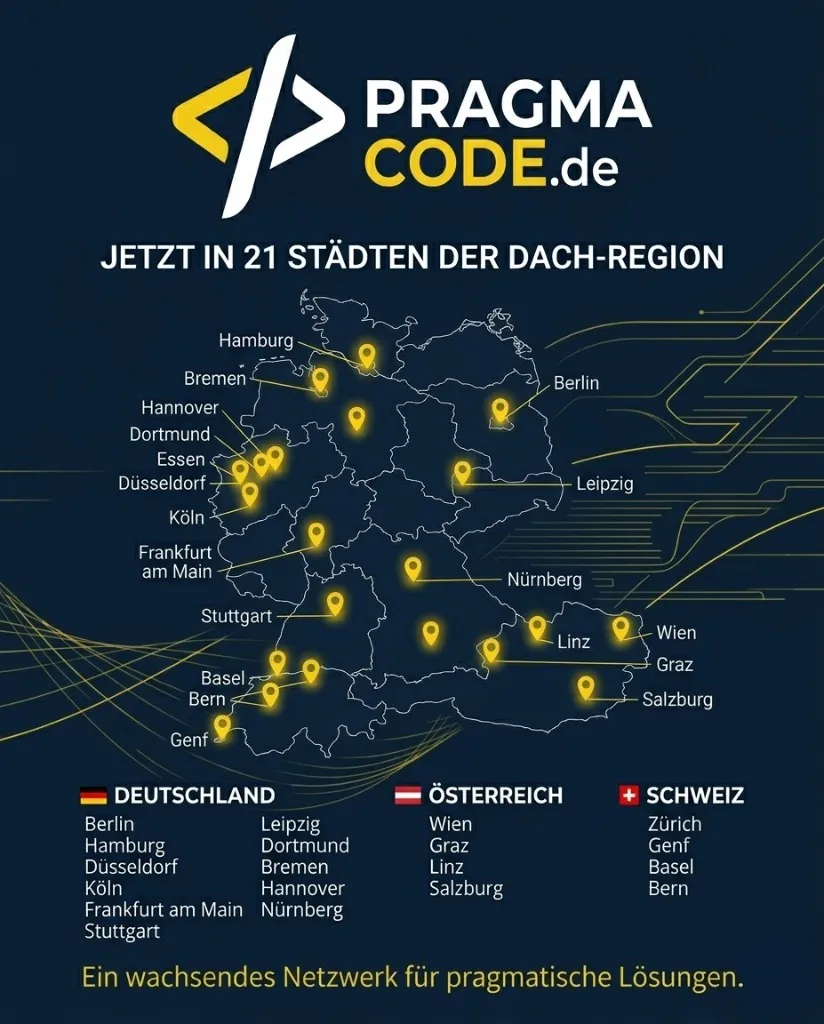
Our Regional Expertise
We are your digital partner – regionally anchored and successfully scaling across borders.
Planning a Local On-Premise AI Infrastructure?
We audit your hardware and data landscapes, quantize open-source models, and integrate high-throughput RAG pipelines into your corporate intranet.
Request Free AI Architecture ConsultationExtended Specialized Glossary
On-Premise AI
On-Premise AI refers to the local hosting and execution of Artificial Intelligence models on proprietary company-owned hardware or isolated private cloud environments. This guarantees absolute data control, protects IP, and eliminates GDPR compliance risks.
RAG (Retrieval-Augmented Generation)
Retrieval-Augmented Generation (RAG) is a design pattern that connects a Large Language Model to a local vector database. The system retrieves pertinent company documents in real-time to ground answers without requiring costly model retraining.
Quantization
A mathematical model compression technique (e.g. converting 16-bit float weights to 4-bit via AWQ or GGUF). It reduces VRAM memory demands by up to 70% with negligible loss in reasoning accuracy, enabling high-performance inference on standard hardware.
vLLM
A high-throughput open-source inference and serving engine for LLMs. Through PagedAttention, vLLM manages attention key-value memory with minimal fragmentation, maximizing throughput for concurrent enterprise queries.
Data Sovereignty
The unconstrained legal and technological authority of an organization to govern the storage, processing, security, and dissemination of its digital data without dependence on foreign state jurisdictions.