


Planning digital job management, shared scheduling or a connected quotation and invoicing process? Start by defining the operational project. This guide helps trade businesses in Germany prepare a useful description and ask the funding provider and financing bank the right questions before committing.
This article is an in-depth expert contribution from our content cluster. Discover the complete overview on our main page: Automating everyday business processes →
This article is a preparation guide for operational digitalization in the trades. Our companion article on BAFA advisory funding for AI and SEO focuses on strategic consulting. Here, the starting point is a business workflow and the documents needed to discuss it with a funding provider.
The immediate news comes from Baden-Württemberg: on 30.10.2026, L-Bank announced additional repayment subsidies within its Digitalisierungsfinanzierung programme. The offer applies only in Baden-Württemberg. For a business operating in Germany, the relevant location and the precise project therefore remain the starting points for checking possible support.
How to use this guide: The current funding rules and the responsible provider's decision take precedence. This article does not replace funding advice.
Digitalization funding for trade businesses Germany: define the project
Start with an operational problem that the people doing the work recognise. “We want new software” describes an intention to buy. “We want an approved job to reach scheduling without re-entering the details” describes a workflow and an outcome that can be checked. Write down where information originates, who uses it next and where clarification is currently needed. Use observations you can substantiate within your own business, rather than assumptions about the industry.
A useful project description connects the current situation with the intended future state. Explain what already works and should remain in place. If the accounting process is reliable, replacing it need not become part of the project simply because the business wants a new scheduling tool. Define a scope that a supplier can understand and an adviser can question. Funding eligibility then needs to be assessed against the relevant programme rules; fashionable terminology cannot establish it.
Digital job management
Describe how an enquiry becomes an approved job. Which details should carry forward, who confirms changes and how should completed work be reported back to the office? Specify the intended handover before selecting a product or accepting a supplier's proposed package.
Scheduling and dispatch
Record who allocates appointments and how the team should learn about changes. Describe information needed for a decision, such as skills or material availability. Discuss whether a shared schedule is sufficient or whether connecting it to job management would make the proposed workflow more useful.
Quotations and invoicing
Explain how agreed work and subsequent changes should be recorded. Decide who approves the completed work for invoicing. A traceable handover provides a clearer project objective than a broad ambition to remove paper from the office without describing the resulting working method.
Use a simple sketch to make these handovers visible. A workflow does not need to be an elaborate technical diagram at this stage. It needs to give the people reviewing your idea a shared understanding of the intended process. Our business process automation page and services for trade businesses offer implementation context.
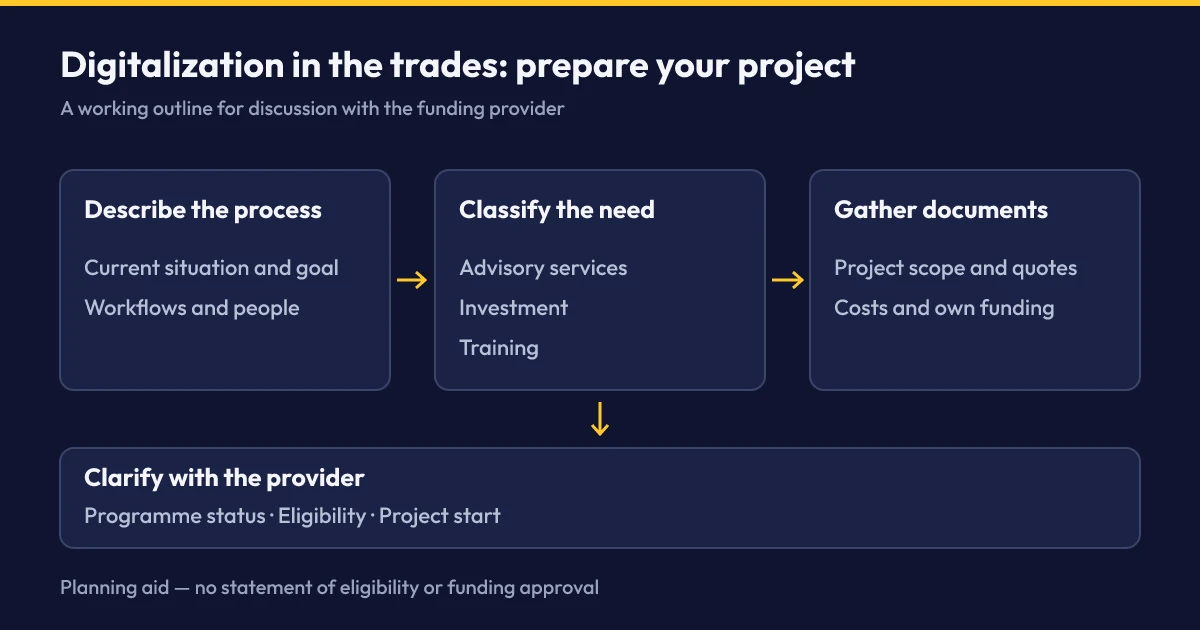
Separate advisory work, investment and training
Classify the planned services by their purpose before discussing financial support. The following categories are a working structure, not a list of costs that automatically qualify for funding. They help you explain whether the business needs a clearer decision, a technical implementation or the ability to operate the new process confidently. Avoid allowing these different purposes to disappear inside an undefined “digitalization package” on a quotation.
Advisory work: decide what to change
Use this category for examining the existing process and developing a suitable approach. A documented workflow and agreed decision criteria can be useful intended outputs. Ask the funding provider separately which advisory activities and requirements for advisers apply to the programme you are considering.
Investment: implement the process
Place the planned technical solution here. Ask the supplier to distinguish purchasing the solution from setting it up. Whether licences, adaptations or interfaces can be included must be checked explicitly against the selected programme, rather than inferred from the word “digitalization”.
Training: make it usable at work
Describe what employees should be able to do independently after introduction. Learning to approve a quotation has a different purpose from administering the application. Clarify which learning content and evidence the provider may require before treating training as part of an eligible project.
Also separate the service being purchased from the form of financing being discussed. Ask whether the proposal concerns a grant, a repayable loan or a repayment subsidy. Request an explanation of when money would become available and which obligations would accompany approval. Your budget decision should follow the payments the business would actually need to make. A promotional claim about possible support should not be entered into your financing plan as secured income.
Find federal and state programmes through official sources
Germany's federal funding database, Förderdatenbank, provides an overview of programmes from the federal government, the states and the European Union, with search and filtering options. Use it as a starting point. Search for the purpose of the project and the relevant region, then open the provider's original page.
For each possible match, record what remains unclear. Check whether the offer relates to your operating location and the services you intend to purchase. Do not read a programme heading as confirmation that everything in the supplier's proposal will qualify. Keep the link to the applicable rules beside the project description, so everyone involved in the discussion refers to the same version rather than remembering different summaries.
You can also ask the local Handwerkskammer, or chamber of skilled crafts, about innovation and technology advice. The German Confederation of Skilled Crafts, ZDH, describes BIT advisers as supporting businesses with new technologies and innovation projects. Bring your workflow sketch and ask which organisation would be responsible for the particular application.
For a state-level offer, continue the research with the relevant state development bank or administering body. The only programme presented here as a checked example is L-Bank's Digitalisierungsfinanzierung, discussed below. If your business operates outside Baden-Württemberg, start a location-specific search rather than transferring the conditions of this regional example to another German state.
Ask what you may do next
A useful initial discussion ends with a concrete next action: which document is missing, who should receive it and what you may do afterwards. Request a written response when the current rules leave a question unresolved. Keep that response with the project documents so the purchasing decision can refer to it.
Prepare the project description, supplier quotes and own funds
Prepare a working document that makes sense without a sales presentation. Describe the operational benefit in a way you can later check yourself. “The approved record of completed work is available for invoicing” is a practical acceptance criterion. A claimed time saving without a basis in your own records is not a sound substitute. Leave outcome figures out until there is evidence to support them.
Project scope
State the current situation and the intended outcome. Explain which handover will change and which activities remain outside the project. Identify someone within the business who can answer operational questions and coordinate decisions without relying entirely on the supplier's interpretation.
Clear supplier quotes
Ask suppliers to define the boundaries of their work. Request an explanation of what setup includes and where ongoing support begins. Ask the funding provider which quotation format and comparisons are required for your application, without assuming a universal minimum number of quotations.
Financing and cash availability
Compare the expected payments with the own funds available to the business. Prepare for the possibility that support is refused. Discuss the treatment of taxes and recurring costs with your tax adviser and, where appropriate, the bank financing the project.
Introduction into daily work
Set aside internal time for coordination and testing. Identify who will review existing data and approve the new working method. Ask which implementation and completion records would be expected later, so you can plan the administrative work alongside the technical introduction.
Illustrative example: connecting a job report to invoicing
The following example is fictional and serves only to illustrate preparation. A trade business wants its office to receive a completed on-site work report linked to the relevant job. Notes are currently transferred afterwards. The proposed objective is a digital handover with operational approval before invoicing. This defines a specific workflow without asserting a saving or suggesting that the project has been found eligible for funding.
When requesting a quotation, the business describes the information the report should contain. It asks how amendments remain visible and how a report attached to the wrong job can be corrected. The proposed training focuses on recording and approving reports. The responsible provider would then need to assess whether these activities fit a programme.
Consider technical acceptance independently of the funding application. Can existing information be transferred into the solution and exported later? Who should help if the handover stops working? Record these questions in the service description. Our article on process automation in production provides further context for thinking about operational flows. A technically attractive proposal also needs to fit the capacity and working practices of the people who will use it.
Keep a shared version for follow-up questions
Give the project description a clear revision status and record unresolved decisions in it. If a supplier changes the scope, reconcile the description with the revised quotation. Otherwise, the adviser may be discussing a different service from the one you eventually intend to order. Mark unanswered questions as open instead of filling the gaps with assumptions.
Review the draft with office staff and the people working on site. Ask them to walk through a typical job using the proposed handover. Where is information missing? Who notices an error, and who decides the job can move forward? Use sanitised sample data and record the operational answers as requirements.
Also state what you do not yet want to decide. Connecting the work report might be the immediate priority, while replacing inventory management remains outside the intended scope. A clear boundary helps you discuss comparable supplier proposals. It also avoids allowing an apparently attractive funding opportunity to expand the technical requirement after the event. Let the operational purpose guide the project.
At the end of the preparation discussion, allocate unanswered questions to the appropriate party: operational questions to the business, service questions to the supplier and funding questions to the responsible provider. Record the answers in the shared working document. Before commissioning, check again that the project description and supplier quotation still describe the same scope.
Clarify the permitted start before making a commitment
Treat an order or contract acceptance as a point requiring clarification whenever the permitted project start remains unresolved. Ask the responsible provider before taking a binding action. The ability to submit an application is not an automatic instruction to begin. The appropriate sequence needs to follow the rules of the programme actually selected, with any uncertainty resolved before the business commits to delivery.
Specifically, the L-Bank programme leaflet dated 01.11.2026 requires a written application to the financing bank before the project starts. Implementation may begin after a complete, timely application there; starting before approval remains at the business's own risk. The first legally binding commitment, such as placing an order, also counts as a start. An application submitted afterwards therefore cannot simply be assumed to protect a project already underway.
Do not transfer this specific rule to other funding arrangements. Ask whether an application is sufficient for your selected programme or whether a further authorisation must be awaited. If something has already been signed or work has begun, disclose the actual sequence. Do not change dates to create the appearance of a project that has not yet started.
L-Bank: interpret the regional announcement correctly
The announcement dated 30.10.2026 expands repayment subsidies financed from L-Bank's own resources, including support for entry-level investment. It concerns businesses in Baden-Württemberg.
The current Digitalisierungsfinanzierung product page describes applications through a financing bank, the Hausbank; no application suspension was indicated there when checked. The product is a development loan. The state's Digitalisierungsprämie and L-Bank's repayment subsidy cannot be combined with each other. Review the current conditions with your bank rather than deriving an individual funding amount from the announcement.
For project preparation, give the bank a clear description and discuss the appropriate financing route. Ask which documents are currently required before ordering implementation. A regional news item is useful when it leads to a focused check of a relevant opportunity.
Frequently asked questions about project preparation
Does my preferred software automatically qualify?
A product name is not enough for an assessment. Describe the operational purpose and the planned services. Ask the responsible provider to check whether the project and its costs fit the current programme conditions.
How can I describe the benefit without inventing savings?
Identify a concrete workflow improvement, such as a traceable handover from job management to invoicing. Describe how the team will recognise a working future state. Leave outcome figures out unless there is a reliable basis for them.
What should I clarify before placing a binding order?
Clarify the permitted project start for the selected programme. Ask explicitly which action counts as a start and which confirmation is needed before ordering. Keep the response with your project documents.
What if I cannot find a suitable programme?
Assess the operational benefit and financing without an expected subsidy. Consider narrowing the project to a scope that can be meaningfully accepted. Use a sound quotation and the funds available to decide whether and when to proceed.
Bring a workable project proposal to the discussion
Prepare a working document that makes the proposal understandable. Discuss it internally with the people who will use the process after introduction. Then assess supplier proposals and funding conditions separately. This keeps the intended purchase clear while establishing which financing is actually available, rather than allowing an uncertain subsidy to determine the whole project.
Before your next discussion
If you need to narrow the technical scope, start with the workflow discussion on our automation page. Preparation is still useful if the appropriate outcome turns out to be a project financed from your own resources, or a decision to postpone implementation until the business is ready.
Official sources and primary documentation
Federal funding database: home page and programme search — starting point for federal, state and EU funding research. Stand: 03.11.2026 (checked on this date).
ZDH: innovation and technology advisers — the role of BIT advisory support. Stand: 03.11.2026 (checked on this date).
L-Bank: additional repayment subsidies, announcement dated 30.10.2026 — the regional news context. Stand: 03.11.2026 (checked on this date).
L-Bank: Digitalisierungsfinanzierung — current product, application route and links to conditions. Stand: 03.11.2026 (checked on this date).
L-Bank: Digitalisierungsfinanzierung leaflet dated 01.11.2026 — particularly application documents and the permitted project start. Stand: 03.11.2026 (checked on this date).
Process automation for your business?
I deliver this for small and mid-sized businesses: at a fixed price agreed upfront, working directly with the person who builds it. Process, scope and pricing are on the service page.
See service & pricing Or request a free intro callExtended Specialized Glossary
Workflow
An organised sequence of tasks, responsibilities and handovers. Project preparation compares the current workflow with the intended future workflow.
Project description
A clear account of the current situation, intended outcome, scope and implementation approach. The responsible funding provider determines the specific requirements.
Own funds
The business's own financial resources intended for the project. Their availability belongs in the company's financing plan.