

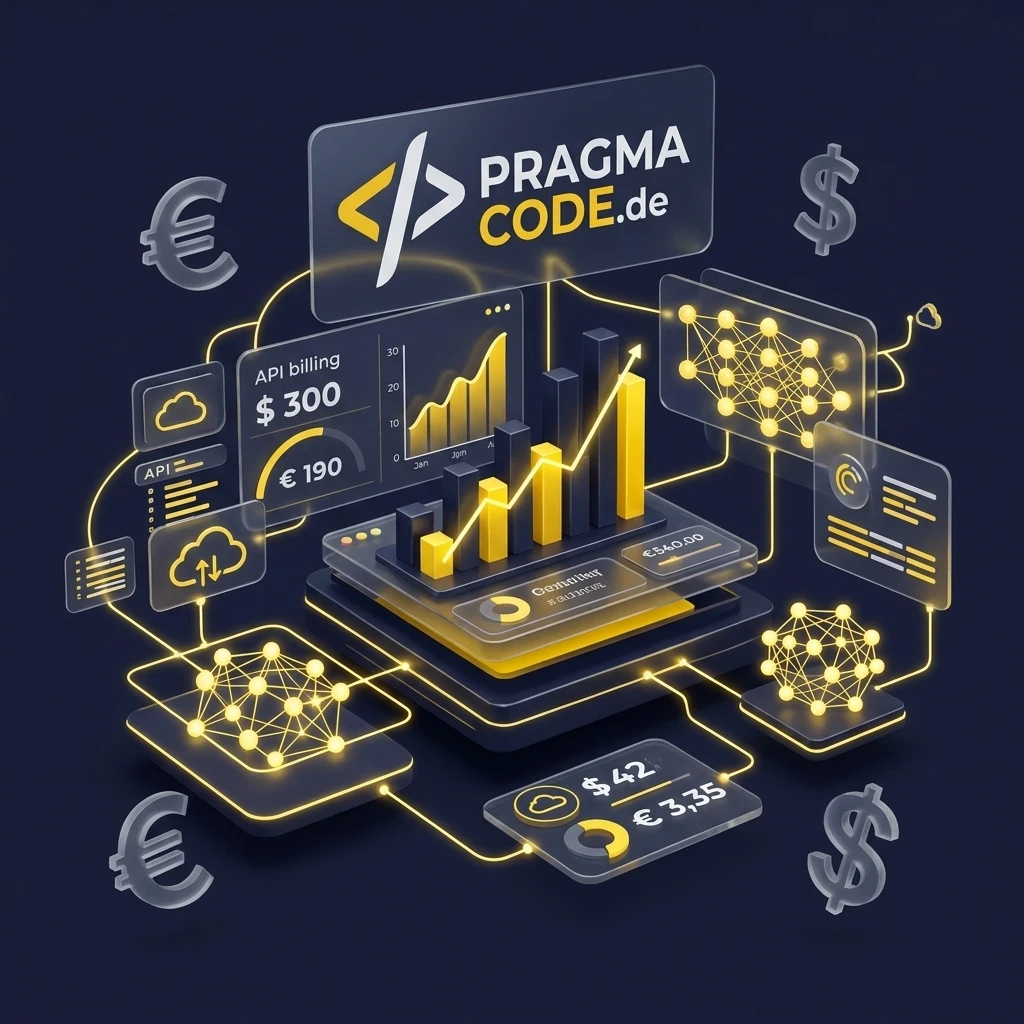
Hidden multipliers, autonomous agent loops, and unmonitored token flows frequently turn monthly AI invoices into painful budget surprises. Learn how European SMEs cut AI operational costs by 60–80% using FinOps principles, smart model routing, prompt caching, and batch APIs — with zero loss in output quality.
This article is an in-depth expert contribution from our content cluster. Discover the complete overview on our main page: AI Automation & Intelligent Agents →
The End of the Flat-Rate Illusion
In the summer of 2026, Anthropic announced separate billing for automated AI usage — sparking an industry-wide debate. The message for businesses: The era of uncontrolled AI costs is over. Companies that don't actively manage their API spending risk budget surprises that can derail entire AI initiatives.
- New billing models: Anthropic and other providers are increasingly separating interactive chat usage from automated agentic workflows — with massive implications for SME cost structures.
- Cost optimization as imperative: Through model routing, prompt caching, and dynamic context management, AI costs can be reduced by 60–80% without sacrificing output quality.
- Hybrid as the golden path: Combining cloud APIs for peak loads with local open-source LLMs for standard tasks offers maximum control at minimal ongoing costs.
- Introduction: The Hidden Cost Traps of AI Automation
- The New Reality of AI Billing
- Strategies for Cost Optimization
- Hybrid Approaches: Balancing Cloud and On-Premise
- Budgeting and Financial Planning for AI Projects
- Checklist: Total Cost of Ownership for AI
- Conclusion: Costs Under Control — Success Secured
Introduction: The Hidden Cost Traps of AI Automation
In May 2026, Anthropic sent shockwaves through the entire tech industry: The Claude developer announced that starting June 15, billing for automated AI usage — including the Agent SDK, programmatic claude -p commands, and third-party apps — would be separated from regular chat usage. The reasoning was as simple as it was explosive: Automated agentic workflows were consuming up to 175 times more compute than flat-rate subscriptions could sustain. Although Anthropic paused the plan shortly before the deadline, the message to the industry was unmistakable: The era of token flat rates for AI automation is drawing to a close.
For SMEs in the DACH region that are increasingly relying on Agentic AI systems, this development is a wake-up call. While the performance capabilities of Large Language Models (LLMs) continue to grow exponentially and base per-token prices are dropping, total expenditures are exploding due to the sheer complexity of modern AI workflows. A single user request to an autonomous agent can trigger dozens of invisible model calls, tool calls, and retry loops — turning the month-end invoice into a nasty surprise.
This article shows you how to regain control over your AI costs. We analyze the new billing models from major providers, present proven cost optimization strategies, and deliver a practical checklist for calculating the Total Cost of Ownership (TCO) of your AI initiatives. Because one thing is certain: Companies that don't actively manage AI costs will sooner or later be overwhelmed by them.
The New Reality of AI Billing: What Businesses Need to Know
The days when a flat monthly subscription covered an entire company's AI needs are definitively over. The leading providers — Anthropic, OpenAI, Google, and Microsoft — have fundamentally restructured their pricing models over the past 18 months. For decision-makers at SMEs, understanding the mechanics behind these models is essential for making informed budget decisions.
Overview: The Three Dominant Billing Models
Token-Based Billing
The standard model for API usage: You pay per million processed tokens — separately for input (your request) and output (the AI's response). Prices vary significantly: from ~$0.15/M tokens for mini models to $15/M tokens for flagship models like Claude Sonnet 4.6.
Feature-Based Tiers
SaaS platforms like Microsoft Copilot or Salesforce Einstein bundle AI features into license packages with fixed monthly fees per user ($20–$50/user/month). AI usage is capped, but the limits are often opaque.
Automation Tiers (NEW)
The model Anthropic sought to establish: Separate billing pools for human interaction and machine automation. Programmatic API calls are priced and limited separately — a trend that other providers will follow.
Why "Invisible Costs" Are So Dangerous
The real challenge isn't the published list prices — those are transparent. The problem is the hidden multipliers that emerge in modern AI architectures. When you instruct an AI agent to autonomously execute a task, far more happens behind the scenes than a simple API call would suggest:
Agentic Loop Costs
An autonomous agent executes planning, execution, and reflection steps in recursive loops. A single user request can quietly trigger 10–50 LLM calls — each with the full context window.
Reasoning- & Thinking-Tokens
Modern reasoning models (o1/o3, Extended Thinking) generate hundreds of internal chain-of-thought steps. These thinking tokens are billed as full output tokens and can multiply single-request costs tenfold.
Context Window Inflation
Each step in the agent loop resends the entire accumulated conversation history. With a 128k-token window, billable input tokens multiply exponentially with every iteration.
Shadow AI / Unmonitored Use
Employees often deploy AI tools without centralized oversight. Fragmented API keys and unmetered accounts aggregate into an invisible expenditure block that only surfaces on the month-end invoice.
Asymmetric Token Pricing
Output tokens are 3–5x more expensive than input tokens across leading providers. If your agent generates verbose documentation, code blocks, or tabular data, output expenses surge disproportionately.
Missing Hard-Caps & Timeouts
Without strict loop thresholds, execution timeouts, and hard monthly spending limits configured in your API gateway, buggy agent logic or recursive tool retries can incur runaway costs overnight.
The Anthropic Debate: Impact on Your Budget
Anthropic's decision to pause its separate automation billing plan should lull no one into a false sense of security. The analysis that led to the announcement was unequivocal: Individual users with agentic workflows were extracting value equivalent to 175x their subscription cost. This is not a sustainable business model in the long term — neither for the provider nor for enterprises that depend on planning certainty.
The takeaway for SMEs: Prepare for usage-based billing for automation to become the new standard. Companies that implement robust cost monitoring today will navigate the transition without shock. Those who wait for the bill to arrive will feel the impact twice as hard.
Strategies for Cost Optimization in AI Automation
The good news: You're not helplessly at the mercy of rising costs. With the right strategies, AI automation spending can be reduced by 60–80% — without sacrificing output quality. The key lies in combining intelligent architecture, data-driven monitoring, and deliberate model selection.
Strategy 1: Monitoring & Transparency — FinOps for AI
You can only optimize what you measure. The principle of FinOps — Financial Operations — has proven itself in traditional cloud computing and is now the foundation for any serious AI cost strategy. The first step is establishing granular monitoring that captures AI spending not just at the invoice level but at the request and workflow level.
Establish Request-Level Tracking
Every API call must be tagged with metadata: Which workflow triggered it? Which user? Which model? How many tokens? Use logging middleware or specialized tools like LangSmith, Helicone, or a self-hosted observability dashboard.
Calculate Cost per Task
Aggregate token costs not just per month but per business transaction. What does processing a single customer inquiry cost? What does generating a report cost? Only then can you assess the ROI of individual AI applications.
Set Budget Alerts and Hard Limits
Define daily limits and weekly budgets per team or use case. Implement automatic alerts at 80% utilization and hard stops at 100%. An AI gateway like TrueFoundry or a custom n8n workflow can manage this control centrally.
Introduce Chargeback Models
Allocate AI costs to the departments or projects that incur them. Once teams see that their experiments cost money, they optimize intuitively. Transparency is the most powerful lever for behavioral change.
Strategy 2: Efficient Model Usage — The Right Model for Every Task
The single greatest lever for cost reduction is deliberate model selection. Not every task requires the most powerful (and expensive) model. The principle of Model Routing — also known as a "Tiered Model Strategy" — automatically assigns each task to the most cost-effective model.
Flagship Models
Claude Opus 4.8 / 3.7 Extended Thinking, GPT-5 / o3
$15–$60 / M Output TokensReserved for complex reasoning tasks, multi-step planning, and strategic decisions. A maximum of 5–10% of your total API volume should be routed here.
Workhorses
Claude Sonnet 3.7 / 4.6, GPT-4o
$10–$15 / M Output TokensThe bread-and-butter models for production workloads: document analysis, RAG pipelines, code generation. This is where most of your value creation happens — and where the greatest optimization potential lies.
Nano & Flash Models
GPT-4o-mini, Claude Haiku, Gemini 2.0 / 3.6 Flash
$0.15–$0.80 / M Output TokensIdeal for classification, data extraction, routing decisions, and straightforward summarization. These models should handle 60–80% of your total volume.
Local Open-Source Models
Llama 3.3 / Llama 4, Mistral Small / Large, Qwen 3
$0 API costs (hardware only)For high-volume, low-complexity tasks: pre-classification, embeddings, simple Q&A. After the initial hardware investment, no variable costs remain.
Expert Tip: The 80/20 Rule of Model Selection
In practice, approximately 80% of all AI tasks at an SME can be handled by nano models or local LLMs — and only 20% require a flagship model. Implement an intelligent router (e.g., via n8n or an AI gateway) that classifies incoming requests by complexity and automatically assigns them to the appropriate model. This step alone reduces API costs by an average of 50–70%.
Strategy 3: Prompt Caching, Batch APIs, and Context Management
Prompt caching and asynchronous processing are currently the most effective levers for reducing costs in repetitive workflows. The technique leverages the fact that in most enterprise AI applications, a large portion of the context is identical with every request and background workloads rarely require millisecond latency.
Exact-Match Caching
Identical requests are served straight from cache without contacting the provider API. Ideal for internal knowledge bases and support bots. Saves 100% of API fees on repeated prompts.
Provider-Side Prompt Caching
Anthropic, OpenAI, and Google offer native context caching: Cached input tokens at Anthropic cost only 10% of the standard input price (-90% discount). A massive lever for rich RAG contexts.
Asynchronous Batch APIs (-50% Discount)
Workloads without instant real-time requirements (e.g., overnight document indexing, weekly reporting analytics, data enrichment) can be submitted via batch endpoints with a 24-hour SLA at a guaranteed 50% price reduction at OpenAI and Anthropic.
Dynamic Context Management & Reasoning Limits
In autonomous agent loops, set strict thinking token limits (max_thinking_tokens) and condense conversational history after each completed subtask. This prevents runaway loops and cuts input/output volume by 40–60% per execution.
Strategy 4: Avoiding Vendor Lock-in and Exit Strategies
Vendor lock-in is particularly treacherous in the AI space. Once you've tailored your prompts, fine-tuning data, and integrations to a single provider, switching becomes a project requiring months of migration effort. The following principles protect your flexibility:
Never communicate directly with the provider API. Use an abstraction layer (e.g., LiteLLM, LangChain, or a custom API wrapper) that lets you swap providers with a configuration change — without touching your application code.
Distribute your workloads across at least two providers. Use OpenAI for Task A and Anthropic for Task B. If one provider goes down or raises prices, you can redirect workflows.
Operate a local open-source model (e.g., Llama 4, Mistral) as an emergency fallback in parallel. Even if it doesn't deliver the same quality, it secures your operations and strengthens your negotiating position with commercial providers.
Keep all system prompts, evaluation metrics, and fine-tuning datasets in a provider-neutral format. This way, you can migrate to a new provider within days, not months, if needed.
Hybrid Approaches: Balancing Cloud and On-Premise
Any serious discussion about cost optimization must address hybrid infrastructure. As we detailed in our article on On-Premise AI in the DACH Region, local AI models offer advantages not only for data privacy and compliance — they're also a powerful tool for cost control.
Comparison: Pure Cloud AI vs. Hybrid Approach
- Variable costs: Every API call has a cost — as volume increases, costs grow linearly or exponentially
- Dependency: Provider price increases hit you directly and without negotiating power
- Data risk: Sensitive company data leaves the corporate network with every call
- Latency: Network roundtrips to external APIs add 200–500 ms to response times
- Predictable baseline: Local models handle 60–80% of volume → fixed hardware costs (CAPEX) instead of variable API fees
- Negotiating power: A functioning on-premise fallback gives you genuine alternatives during price negotiations
- GDPR-compliant: Sensitive data stays within your network — only non-critical tasks go to cloud APIs
- Low latency: Local inference at 20–80 ms for real-time applications like voice agents or chatbots
When Does the Hybrid Approach Make Sense?
The decision of whether a hybrid model makes economic sense depends on a few key factors. As a rule of thumb: Once you're spending more than €5,000/month on cloud AI APIs, a hybrid analysis is worthwhile. The initial hardware costs for a capable GPU server (e.g., with NVIDIA L40S or A6000) typically pay for themselves within 6–12 months given a consistent workload.
For a detailed analysis of the technical implementation, we recommend our guide on Mini Datacenters and Local LLMs. There you'll learn how to build your own AI infrastructure on a manageable budget — one that can serve both as a primary platform and a strategic fallback.
Budgeting and Financial Planning for AI Projects
AI projects rarely fail due to technology — they fail due to a missing financial plan. The biggest trap: Companies calculate only the obvious API costs and forget the numerous indirect cost items. Realistic budgeting must reflect the Total Cost of Ownership.
ROI Calculation: The Complete Picture
ROI calculation for AI projects differs fundamentally from traditional IT investments. For a process mining initiative or an automation project, you must weigh both direct savings (personnel costs, throughput times) and indirect costs (engineering time, training, monitoring).
Direct API costs: Token consumption × model price. Plan with a 30% safety buffer above test values, as production loads typically run higher.
Engineering costs: Development time for prompts, integrations, and monitoring. Budget for 2–4 person-months for initial setup and 20–30% ongoing for maintenance and optimization.
Infrastructure: Costs for AI gateway, monitoring tools, caching infrastructure, and potentially local hardware. These "side costs" often account for 15–25% of total expenditure.
Opportunity costs: What do you miss out on if you don't pursue the AI initiative? Competitors leveraging AI automation are continuously lowering their per-transaction costs — every month of delay widens the gap.
Long-Term Cost Projections and Adaptation Strategies
A key advantage in the current market environment: Base per-token costs are continuously declining. Since 2024, prices for high-performance models have dropped by 60–80% — driven by competition among the major providers and increasing pressure from open-source alternatives like Llama 4 and Mistral. For your long-term planning, this means:
Conservative Scenarios
Plan for annual cost reductions of 30–40% at constant model quality. Review your contracts and API rates quarterly to ensure you're paying current market prices — not 2024 rates.
Volume Effects
While unit costs decrease, usage volume will typically increase as successful pilot projects expand to additional departments. Plan for an annual volume increase of 100–200%.
Model Generation Switches
Every 6–12 months, new models appear that are often better and cheaper. Build your architecture so that a model switch is a configuration change — not a redevelopment.
Premium Checklist: Total Cost of Ownership for AI Projects
The following checklist helps you realistically calculate the total costs of an AI project. Use it as a template for your internal budget planning.
1. API & Token Costs
Capture token consumption per workflow (input + output) × model price × expected monthly volume. Account for the agentic loop factor (multiplier of 10–50x per user request).
2. Personnel Costs
Prompt engineering, integration work, ongoing optimization, and monitoring. Budget for a dedicated AI engineer (part-time) or allocate hours from an external partner.
3. Infrastructure Costs
AI gateway, monitoring/observability stack, caching layer, potentially GPU hardware for local models. Don't forget electricity, cooling, and network costs for on-premise setups.
4. Compliance & Security
GDPR conformity review, Data Processing Agreements with AI providers, potential auditing under the EU AI Act. These costs are often forgotten but are mandatory for B2B companies in the DACH region.
5. Training & Change Management
Onboarding of business units, documentation, internal communication. Don't underestimate the human factor: The best AI solution fails if employees don't use it or use it incorrectly.
6. Scaling Costs
Plan for costs of expanding to additional use cases. Successful AI projects generate internal demand — budget a 50% buffer for organic growth in the first year after launch.
Expert Tip: Strict Cost Monitoring from Day 1
Implement strict cost monitoring for every AI application from the very beginning to avoid surprises. The key metrics: Cost per task (not just total costs), Cost per user (identifies "power users" and shadow AI), and Cost per quality point (ensures savings don't come at the expense of output quality). Tracking these three KPIs from the start provides a solid data foundation for all subsequent optimization decisions.
Conclusion: Costs Under Control — Securing the Long-Term Success of Your AI Initiatives
Anthropic's announcement was not an isolated event but a signal for the entire industry: The golden era of undifferentiated AI flat rates is coming to an end. For SMEs in the DACH region, this is not a threat — it's an opportunity. Companies that build the right structures today will not only reduce costs but also operate a more robust, resilient AI infrastructure.
The core messages of this article can be distilled into three principles:
Quick-Check: Your AI Cost Strategy
Do you have questions about AI cost optimization?
Schedule a free consultationOur Regional Expertise
We are your digital partner – regionally anchored and successfully scaling across borders.
Have a vision?
Let's check together how we can make your idea take flight.
Book your free strategy call nowExtended Specialized Glossary
Token (AI)
The smallest billing unit when using Large Language Models. One token corresponds to approximately 4 characters or 0.75 words in Western languages. Costs are calculated per million processed input and output tokens.
FinOps
Financial Operations (FinOps) is an operational framework for managing and optimizing cloud and AI spending. It connects engineering, finance, and business in a data-driven approach to cost optimization.
Vendor Lock-in
The dependency on a single technology provider that makes switching to alternatives economically or technically difficult. In the AI context, lock-in arises from proprietary APIs, fine-tuning data, and platform-specific integrations.
Total Cost of Ownership (TCO)
The total operating cost of an investment over its entire lifecycle. In the AI context, TCO includes not only API fees but also engineering time, infrastructure, monitoring, training, and opportunity costs.
Prompt Caching
An optimization technique where frequently repeated system prompts or context windows are cached to avoid redundant token processing. Prompt caching can reduce input costs by up to 90%.
Model Routing
An architectural strategy where requests are automatically routed to the most cost-effective AI model — simple tasks to small models, complex tasks to powerful models.