

Say goodbye to soaring SaaS subscription costs and rigid data silos: Learn how mid-sized businesses build robust, scalable automation pipelines with self-hosted n8n, native AI orchestration, and MCP integration with 100% data sovereignty.
This article is an in-depth expert contribution from our content cluster. Discover the complete overview on our main page: n8n Automation →
- 100% Data Sovereignty & GDPR Compliance: Self-hosted n8n guarantees deployment on European servers or on-premise without uncontrolled data leakage into US clouds.
- Up to 90% TCO Savings: Unlike pay-per-operation models (Zapier, Make), n8n scales with unlimited workflow executions at predictable, fixed server costs.
- Native AI Agents & MCP Integration: Integrated LangChain nodes, local LLM connectivity (Ollama, DeepSeek), and Model Context Protocol (MCP) transform rigid pipelines into intelligent, self-healing systems.
- 1. Shrinking the Efficiency Gap in Mid-Sized Businesses
- 2. What is n8n? Architecture, Fair-Code & Low-Code Power
- 3. Hosting Strategies & TCO Comparison: Cloud vs. Self-Hosted
- 4. The B2B Comparison: n8n vs. Zapier vs. Make
- 5. AI Agents, LangChain & MCP in n8n
- 6. Enterprise Architecture: Queue Mode, Redis & Scaling
- 7. Advanced Workflow Design & Error Handling
- 8. Real-World Case Studies from European SMEs
- 9. Security, GDPR Compliance & EU AI Act
- 10. 5-Step Roadmap to Successful Implementation
- 11. Maintenance, Monitoring & Operational Reliability
- 12. Conclusion & Strategic Outlook for 2026+
From Rigid Data Shuttles to Intelligent Agent Ecosystems
Simply copying data fields from point A to point B is obsolete in 2026. Modern enterprise automation combines event-driven webhooks with autonomous AI agents, Model Context Protocol (MCP) tooling, and strict PII filtering prior to any model inference.
1. Shrinking the Efficiency Gap in Mid-Sized Businesses
In today’s competitive economy, time is the most rapidly depleting asset. While multinational corporations maintain dedicated departments for "Digital Transformation" and "Process Excellence", small and medium-sized enterprises (SMEs) often struggle with a patchwork of legacy systems: isolated ERP databases, separate CRM software, ad-hoc spreadsheets, and error-prone manual data entry.
This creates the dreaded efficiency gap: the vast discrepancy between what is technologically possible (fully synchronized, event-driven data flows) and daily office reality (valuable specialists wasting hours re-typing PDF invoices, manually updating inventory counts, or copying status messages).
Modern process automation is no longer an optional luxury—it is an existential imperative. With the rise of advanced AI reasoning models, the rules of automation have changed forever: it is no longer just about rigid "If-This-Then-That" triggers, but about understanding and processing unstructured enterprise data. In this landscape, n8n has emerged as the premier Swiss Army knife for forward-thinking organizations requiring maximum flexibility, complete data sovereignty, and unlimited scalability.
2. What is n8n? Architecture, Fair-Code & Low-Code Power
n8n (pronounced "n-eight-n") is an open-source workflow automation platform built upon a node-based, visual graph model. Unlike rigid no-code tools or cumbersome custom scripts, n8n marries the visual clarity of a modern drag-and-drop canvas with the unbounded power of professional code.
Node-Based Logic Meets Pro-Code Extensibility
Every node in n8n encapsulates a specific function or a standardized connection to an external API. The architecture is categorized into three fundamental node types:
Trigger Nodes
Initiate workflow execution based on specific events: incoming webhooks, incoming emails, scheduled cron jobs, database mutations, or API polling events.
Transformation & Logic Nodes
Filter, aggregate, and manipulate data streams. The code node enables native execution of JavaScript or Python for advanced computations in JSON format.
Action & Integration Nodes
Communicate bi-directionally with over 400 external platforms (HubSpot, Salesforce, SAP, SevDesk, Datev, PostgreSQL, Slack) via authenticated REST and GraphQL endpoints.
The core architectural benefit: where pure no-code platforms hit a brick wall when edge-case business logic is required, n8n’s Code Node allows engineers to write native JavaScript (Node.js) or Python directly inside the flow. Teams can import standard packages, process binary attachments, calculate cryptographic signatures, and reshape complex payloads seamlessly.
Expert Tip: The Fair-Code Licensing Model
n8n operates under a Sustainable Use Fair-Code license. The source code is publicly accessible on GitHub and completely free for internal company self-hosting. Commercial license fees only apply for enterprise governance features like multi-user RBAC, LDAP/SSO, and compliance audit logs. You maintain 100% independence from proprietary platform lock-in.
3. Hosting Strategies & TCO Comparison: Cloud vs. Self-Hosted
Choosing where to host your automation engine is the single most critical strategic decision. While traditional iPaaS platforms force clients into proprietary US cloud subscriptions, n8n offers absolute deployment freedom.
Cost Pitfalls of Proprietary SaaS Platforms
The SaaS Cost Explosion on Zapier & Make
SaaS platforms charge per "task" or "operation". A single workflow with 10 steps executing 5,000 times a day generates 1.5 million tasks per month—costing between $1,500 and $4,000 monthly. With self-hosted n8n, your infrastructure cost remains flat regardless of transaction volume.
Data Privacy & Vendor Lock-In Risks
Routing sensitive customer data (PII), payroll details, or engineering specs through multi-tenant US cloud servers introduces critical GDPR non-compliance risks and leaves your business vulnerable to sudden pricing hikes.
TCO Comparison over 24 Months (1,000,000 Tasks / Month)
At medium to high transaction volumes, a professionally managed n8n instance pays for itself within weeks:
Zapier Enterprise SaaS
Approx. $2,600 – $4,000 monthly ($62,400+ over 2 years). Execution time limits per step, no direct local database connectivity without complex SSH tunneling.
Make Pro / Enterprise
Approx. $900 – $1,800 monthly ($32,400+ over 2 years). Data transfer caps and aggressive operation multipliers on looped arrays.
Managed n8n by Pragma-Code
Predictable server hosting from approx. $130 monthly on dedicated high-performance servers in Germany, including automated backups, secret management, and SLA.
4. The B2B Comparison: n8n vs. Zapier vs. Make
To help you select the optimal automation foundation, we evaluated the three industry leaders across decisive enterprise benchmarks:
Comparative Analysis: n8n vs. Zapier vs. Make (Integromat)
- Data Sovereignty: 100% GDPR-compliant on dedicated European or on-premise servers.
- Cost Model: Fixed server cost—unlimited workflow executions and data transfers.
- Programmability: Unrestricted pro-code freedom via JavaScript, Python, and npm libraries.
- AI Architecture: Native LangChain nodes, MCP tooling, and local LLM execution (Ollama).
- Network Reach: Direct internal access to on-premise SQL, SAP systems, and network shares.
- Data Sovereignty: Multi-tenant US cloud infrastructure with third-party data transit.
- Cost Model: Exponential pricing curves tied directly to task consumption and loop runs.
- Programmability: Restricted execution time limits and tightly constrained sandboxes.
- AI Architecture: Primarily basic wrappers around external cloud APIs (OpenAI/Anthropic).
- Network Reach: Requires opening public firewall ports or maintaining brittle VPN relays.
5. AI Agents, LangChain & MCP in n8n
The defining competitive edge of n8n in 2026 is its native convergence of classical workflow automation with autonomous artificial intelligence. n8n was the first enterprise tool to integrate LangChain directly into its visual workflow builder.
Four Core Pillars of Autonomous Workflows
1. Reasoning & AI Agents
The AI Agent node acts as a cognitive controller. Given explicit system instructions and operational goals, it dynamically decides which tools and sequential actions are required.
2. Model Context Protocol (MCP) Tools
Through standardized MCP servers, AI agents safely query CRM data, inspect file repositories, and execute validated SQL queries with full type safety.
3. Vector Stores & RAG (Retrieval-Augmented Generation)
Connect company knowledge via Qdrant, Pinecone, or pgvector. AI agents answer customer inquiries grounded strictly on authenticated internal documentation.
4. Local LLMs with Zero Cloud Data Egress
Seamlessly integrate Ollama, LocalAI, or vLLM to run frontier open-weight models (like DeepSeek-R1 or Llama 3.3) directly on your own private GPU infrastructure.
A typical 2026 production workflow: A customer submits a complex warranty claim via email with an attached invoice PDF. n8n parses the document, redacts personal information via a PII anonymization node, instructs a local reasoning agent to check the warranty terms in the ERP via MCP, and automatically creates a draft credit note in the accounting software—without transmitting a single byte to external US servers.
6. Enterprise Architecture: Queue Mode, Redis & Scaling
A frequent pitfall during early n8n experimentation is running production workloads on default SQLite storage in single-process mode. For high-volume enterprise operations, Pragma-Code deploys a resilient distributed architecture:
The 4 Pillars of Resilient Enterprise Infrastructure
PostgreSQL with Connection Pooling
Replaces SQLite for ACID-compliant execution state storage, complete workflow execution histories, and point-in-time database backups.
Queue Mode with Redis & Multi-Worker
Decouples incoming webhook ingestion from task execution. Webhooks are queued in Redis, allowing horizontally scaled worker clusters to process surges without latency.
External Secrets Management
Zero plaintext credentials: integration with HashiCorp Vault, AWS Secrets Manager, or Infisical for automatic API key rotation and fine-grained access control.
Reverse Proxy with TLS 1.3 & WAF
Protects public webhook endpoints using Caddy or Traefik with automated SSL certificate renewal, DDoS mitigation, and IP whitelisting.
7. Advanced Workflow Design & Error Handling
A professional workflow is engineered for continuous resilience. At Pragma-Code, we enforce strict software engineering practices:
1. Dedicated Error Triggers & Exponential Backoff
Every mission-critical pipeline is connected to a global Error Trigger workflow. When an external API endpoint fails due to network degradation or rate limiting, the error handler captures the payload, initiates an exponential retry sequence, and dispatches an incident ticket to Slack or Microsoft Teams if thresholds are exceeded.
2. Modular Sub-Workflows
Rather than designing monolithic "spaghetti" diagrams, repetitive operations—such as token refreshes, PII sanitization, or tax calculations—are encapsulated in isolated Sub-Workflows. This keeps main workflows clean, maintainable, and easily unit-testable.
3. Idempotency & Webhook Deduplication
Network retries frequently cause duplicate webhook deliveries. By caching unique transaction identifiers (e.g., Stripe Event IDs or Shopify Order IDs) in high-speed Redis or SQL tables, workflows verify whether an event has already been processed, preventing disastrous double-billing or redundant inventory decrements.
8. Real-World Case Studies from European SMEs
3 Proven Implementation Scenarios
HVAC & Field Services: 24/7 Emergency Dispatch Automation
Challenge: An HVAC maintenance provider struggled with overwhelming night-shift emergency calls that strained on-call technicians.
n8n Solution: Audio transcripts from the VoIP phone system trigger an n8n webhook. A local LLM extracts customer ID, issue severity, and location. n8n cross-references route schedules in the ERP, assigns the optimal on-call technician, and sends the customer an SMS confirmation with an estimated arrival time—in under 45 seconds.
B2B Wholesale: Multi-Channel Inventory & Price Synchronization
Challenge: Stock discrepancies and overselling across Shopware, Amazon Business, and eBay.
n8n Solution: An event-driven n8n queue workflow instantly broadcasts ERP inventory changes to all sales channels in real time. Dynamic wholesale prices are recalculated on the fly, and completed orders are automatically formatted for DATEV accounting export.
IT Consulting: Automated RFP Specification Analysis
Challenge: Manually reviewing complex tender questionnaires consumed over 20 consulting hours per week.
n8n Solution: Tender PDFs are ingested by n8n, split into semantic chunks, and evaluated against the firm’s past project knowledge base using pgvector. The sales team receives an automated feasibility matrix and customized draft proposal within 3 minutes.
9. Security, GDPR Compliance & EU AI Act
Automation pipelines serve as the central nervous system for corporate data flows, demanding uncompromised security standards:
4 Pillars for Legally Compliant Automation Pipelines
Strict GDPR Compliance
End-to-end data processing confined entirely to the EEA without cross-border transfers (Art. 44 GDPR). Third-party Data Processing Agreements (DPAs) are fully eliminated with on-premise hosting.
EU AI Act Governance
Transparent logging of automated AI decisions, comprehensive audit logs, and mandatory Human-in-the-Loop review gates for sensitive business workflows.
RBAC & Least-Privilege Access
Role-based access control guarantees that operational teams only see relevant workflows while sensitive HR and financial pipelines remain strictly partitioned.
Git-Backed Audit Trails
Workflows are version-controlled as declarative JSON files in private Git repositories. Every modification is peer-reviewed, audited, and instantly revertible.
10. 5-Step Roadmap to Successful Implementation
To guarantee that automation initiatives deliver tangible business value on schedule, Pragma-Code employs a battle-tested rollout methodology:
-
1. Process Audit & ROI Opportunity Assessment
Identify repetitive manual tasks, calculate return on investment, and prioritize high-impact workflows.
-
2. Architecture Provisioning & Security Hardening
Deploy isolated Docker/Kubernetes environments on dedicated European infrastructure, configure PostgreSQL, Redis queue mode, and secure secrets vaults.
-
3. Iterative Workflow Modeling & AI Integration
Visually build automation pipelines in n8n, connect API credentials, implement payload transformations, and integrate AI agent nodes and RAG vector stores.
-
4. End-to-End Testing & Edge-Case Validation
Execute rigorous sandbox testing with production-like data, simulate API outages, and fine-tune automated error notification handlers.
-
5. Production Rollout, Monitoring & Team Enablement
Go-live with 24/7 telemetry, train internal key users on maintaining workflows, and establish continuous iteration cycles.
11. Maintenance, Monitoring & Operational Reliability
A production n8n instance is mission-critical infrastructure. To ensure 99.9% uptime, we establish the following operational safeguards:
3 Essential Operational Safeguards for Maximum Availability
Centralized Telemetry & Logging
Forward all execution logs to observability suites like Grafana Loki or OpenSearch for real-time proactive anomaly and failure detection.
Automated Credential Monitoring
Event-driven workflows continuously verify OAuth token expiration dates and alert system administrators 14 days before token invalidation to prevent unexpected downtime.
Routine Patching & Staging Pipelines
Monthly staging validation of new n8n engine releases and custom node packages in an isolated environment to patch security vulnerabilities without business disruption.
Quick-Check: Is Your Company Ready for n8n?
12. Conclusion & Strategic Outlook for 2026+
Process automation with n8n is far more than replacing manual tasks: it serves as the digital backbone for agile, future-proof organizations. Companies that modularize their data infrastructure today, embrace open standards, and enrich workflows with autonomous AI intelligence build an insurmountable competitive moat.
With the right combination of self-hosting, enterprise queue clustering, and battle-tested orchestration, n8n transforms fragmented software ecosystems into high-velocity value creation engines. Start your automation journey today with Alexander Ohl and the engineering team at Pragma-Code.
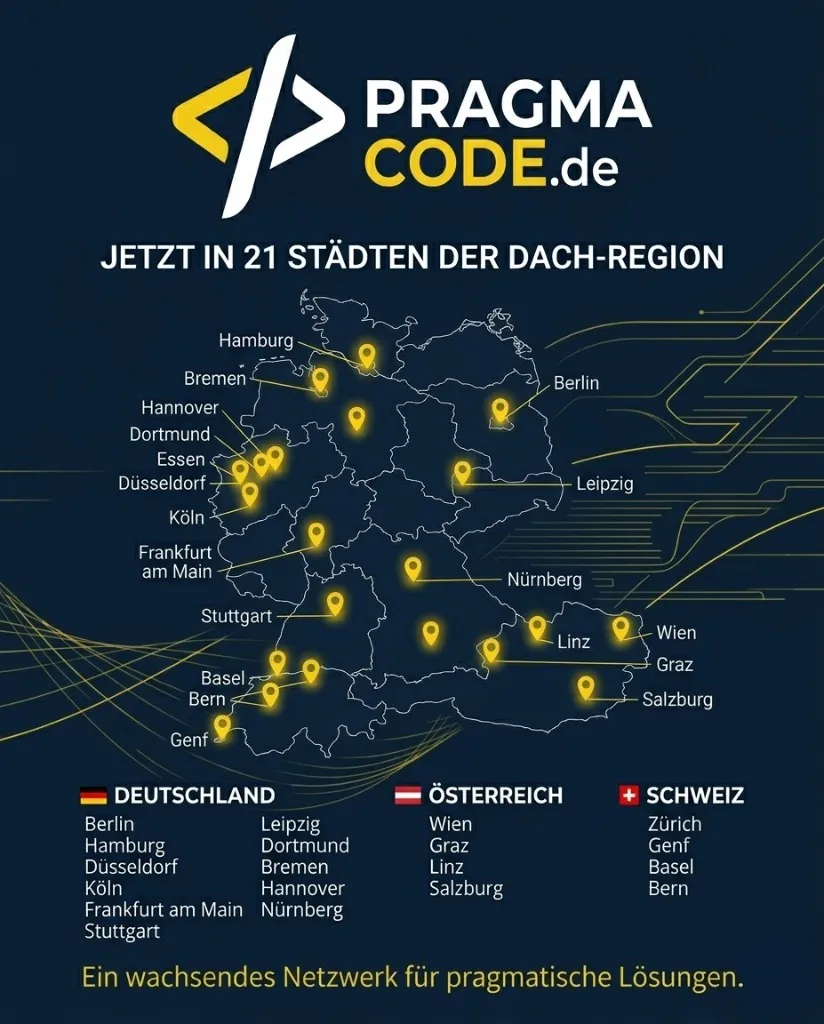
Our Regional Expertise
We are your digital partner – regionally anchored and successfully scaling across borders.
n8n automation for your business?
I deliver this for small and mid-sized businesses: at a fixed price agreed upfront, working directly with the person who builds it. Process, scope and pricing are on the service page.
See service & pricing Or request a free intro callExtended Specialized Glossary
Workflow
The entire logical chain of triggers, operations, and data transformations automating a business task.
Node
A single functional building block in n8n that executes a specific API action, AI computation, or data processing step.
Webhook
An HTTP endpoint that receives real-time events from third-party systems and triggers workflows instantaneously.
API (Interface)
The standardized interface through which n8n exchanges data with ERP, CRM, store, or database systems.
JSON
The universal, structured data format (JavaScript Object Notation) in which information is transferred between n8n nodes.
Low-Code
A visual development environment providing standard logic via drag-and-drop while allowing custom pro-code extensions (JavaScript/Python).
Self-Hosting
Operating the n8n instance on private or dedicated server infrastructure in Europe for maximum GDPR compliance and unlimited tasks.
LangChain
A modular orchestration framework for large language models integrated into n8n as a native node family for memory, tools, and agents.
Model Context Protocol (MCP)
An open standard for seamlessly providing enterprise context and tools to autonomous AI agents in automation pipelines.