

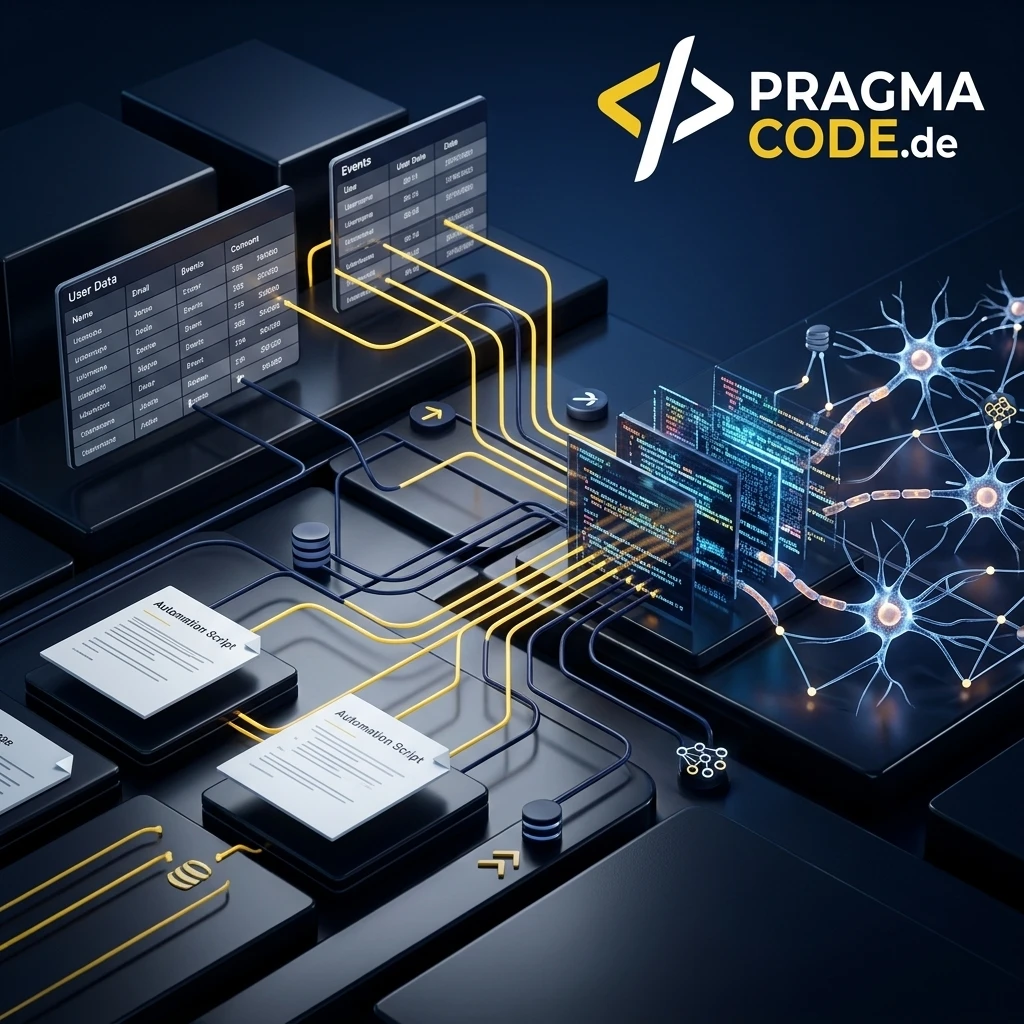
For small and medium-sized enterprises, manually entering and analyzing unstructured data is a major efficiency bottleneck. Whether client feedback, supplier documents, or support tickets: manual processing wastes valuable working hours and is highly error-prone. In this guide, you will learn how to fully automate and secure your text and document processes in a GDPR-compliant manner using the SeaTable no-code database and integrated Artificial Intelligence on German servers.
This article is an in-depth expert contribution from our content cluster. Discover the complete overview on our main page: AI & Automation →
The Breakthrough for Unstructured SME Data
While traditional relational database systems fail at unstructured PDFs, long free texts, and customer emails, the combination of no-code databases and modern Large Language Models (LLMs) bridges the gap. Data is semantically parsed, validated, and linked directly inside the table cell – 100% GDPR-compliant on German servers without custom software development.
- Breaking Data Silos: SeaTable combines the intuitive interface of a spreadsheet with the relational data integrity of an SQL database and native AI column types.
- Autonomous Document Processing: Multimodal AI models extract invoices, delivery notes, and contracts directly from file attachments and populate columns accurately.
- GDPR & EU AI Act Compliance: Operating on ISO 27001-certified German servers with configurable Human-in-the-Loop (HITL) validation ensures sensitive corporate data remains fully protected.
- The Manual Struggle with Unstructured Data
- Understanding SeaTable: More than a Spreadsheet, a No-Code Database
- AI Integration in SeaTable: Revolutionizing Text & Document Processes
- Benefits for SMEs: Efficiency, Accessibility, and Data Sovereignty
- Blueprint: Step-by-Step Guide for Automated Customer Feedback Analysis
- Practical Tips: Getting Started with AI Automation in SeaTable
- Conclusion
The Manual Struggle with Unstructured Data
In almost every mid-sized business, the same manual routine repeats every single workday: staff members copy invoice figures from PDF files into ERP systems, inspect incoming customer emails to triage urgency, or transcribe handwritten service logs into spreadsheets. Industry benchmarks indicate that up to 80% of all corporate operational data exists in unstructured form. It is scattered across email inboxes, vendor agreements, customer inquiries, and paper scans. Manually processing this flood of raw data drains valuable staff capacity, delays invoice settlement, and introduces avoidable data entry errors.
15–20 Mins Processing Time per Document
Manually transcribing line items, tax IDs, and totals ties qualified specialists to tedious repetitive data entry tasks.
4–7% Error Rate in Manual Transcription
Typographical slips, overlooked cash discounts, or incorrect master data matches trigger expensive accounting reconciliation loops.
Scaling Bottleneck as Invoice Volumes Grow
Expanding document volumes force linear headcount growth instead of running high-throughput processes autonomously with degression.
For years, automating these manual bottlenecks was an exclusive luxury for large corporations with specialized software engineering teams and six-figure integration budgets. Mid-sized companies remained stuck with isolated legacy software, as developing custom OCR and AI pipelines proved too complex and expensive to maintain. However, with the maturation of modern No-Code platforms and accessible Large Language Models (LLMs), the equation has flipped. Modern platforms like SeaTable build the vital bridge: they combine relational database capabilities with generative AI – configured entirely within the browser without writing code.
Understanding SeaTable: More than a Spreadsheet, a No-Code Database
Upon initial launch, SeaTable feels delightfully familiar, reminding users of everyday spreadsheet applications like Microsoft Excel or Google Sheets. The user interface is clean, and columns and rows can be operated intuitively. Yet beneath the surface, the architecture differs fundamentally from flat spreadsheet tools.
From a Spreadsheet Alternative to a Relational Database
Traditional spreadsheets quickly break down when handling complex data relationships. Sheets exist in isolation; connecting rows across sheets relies on brittle formulas like VLOOKUP or XLOOKUP, which easily fail whenever column headers shift. In contrast, SeaTable is a full-fledged relational database. Tables can be logically connected via 1:N and N:M relationships – such as connecting clients to contracts, vendors to incoming bills, or projects to team deliverables. Redundancies are eliminated, and referential data integrity remains protected at all times.
Furthermore, unlike conventional spreadsheets, SeaTable enforces strict typed data fields. Columns store rich object types rather than loose strings: file attachments (such as multi-page PDF invoices), formatted Markdown text, checkboxes, team member assignments, geolocation data, and relational links. This strict schema definition allows AI models to parse documents systematically and map extracted values cleanly into designated target fields.
The Power of Relational Connections
By establishing cross-table relational links, SeaTable creates an exact logical model of your business operations. An AI model can analyze not only a single row, but pull contextual information from linked tables (such as vendor payment terms, historical tickets, or approved discounts) directly into its extraction prompt.
Flexible Views, App Designer, and Event-Driven Automations
A standout feature of SeaTable is the clean separation between database storage and visual presentation. The same dataset can be visualized across multiple views: standard grids, agile Kanban boards, interactive scheduling calendars, image galleries, or Gantt timelines. With the integrated App Designer, businesses can build tailored internal departmental portals where operators only see and edit the specific fields relevant to their role.
Through integrated automation rules, the system reacts to events in real time: uploading a document, updating a row status, or receiving an incoming webhook triggers automated pipelines within milliseconds. This is exactly where AI-driven data enrichment excels.
Multimodal File Storage
Store and process PDFs, scans, and contracts directly inside the row – analyzed by modern vision LLMs.
Relational 1:N & N:M Links
Cross-table relations break data silos and enrich AI queries with comprehensive organizational context.
Native AI Columns & Automations
Event-driven triggers execute prompts autonomously upon row changes or document uploads.
AI Integration in SeaTable: Revolutionizing Text & Document Processes
SeaTable unfolds its full power when paired with Artificial Intelligence. Featuring native integrations and dedicated AI column types, the platform connects with leading frontier models (such as Claude 3.5 Sonnet, Gemini Flash, or local open-source LLMs). The language model acts like an invisible digital assistant monitoring database rows, understanding document context semantically, and returning structured data back into predefined fields.
In mid-sized enterprise operations, automation focuses on four mission-critical process areas:
1. Automated Text Analysis
Incoming customer feedback, tickets, and reviews are analyzed in real time for sentiment, urgency, and underlying intent. Negative feedback triggers immediate automated escalation alerts.
2. Intelligent Document Extraction
Multimodal models read unstructured PDFs, invoices, and receipts. Invoice numbers, IBANs, net, tax, and gross totals flow directly into structured database columns.
3. Autonomous Classification
Inbound messages from web forms and support emails are categorized semantically and assigned to departments (sales, support, billing) with priority tags.
4. Synthesis & Reply Drafts
Generates concise summaries of long contract agreements and produces personalized email response drafts based on historical ticket resolutions.
1. Automated Text Analysis (Sentiment & Keyword Extraction)
Businesses continuously collect feedback through web forms, emails, and review platforms. To gauge customer sentiment, staff historically had to read each entry manually. In SeaTable, the integrated AI handles this: the moment a comment arrives, the system evaluates the tone (positive, neutral, negative) and tags core keywords. When critical dissatisfaction is flagged, automated threshold alerts notify service leadership instantly.
2. Intelligent Document Processing (IDP)
Intelligent Document Processing (IDP) liberates enterprises from fragile OCR templates. In SeaTable, users simply upload a PDF invoice into an attachment column. A multimodal vision model parses the document geometry, locates vendor names, invoice IDs, issue dates, and line item amounts, and populates the database fields automatically. Manual labor shrinks to a brief verification glance.
3. Semantic Classification and Triage
Incoming tickets require prompt assignment. The AI classifies free text semantically rather than relying on rigid keyword matchers: a request stating "Our branch needs three additional user licenses" is routed autonomously as a sales inquiry, whereas "Login crashes with error 500" receives priority technical support routing. This significantly accelerates customer response times.
4. Text Summarization and Draft Generation
Dense technical scopes of work or extensive email threads can be condensed into three actionable bullet points by the model. Furthermore, SeaTable drafts personalized responses: accessing the client's name, previous correspondence, and specific technical notes, the AI formulates a polite email and saves it directly in a formatted Markdown field as a reviewable draft.
Pro Tip: Prompt Engineering in the Table
Apply rigorous Prompt Engineering within SeaTable's automation settings. Instruct the AI model to return structured JSON objects strictly (such as {"amount": 1250.00, "tax_rate": 19}). This enables deterministic mapping into numerical columns without unexpected text tokens breaking downstream formulas.
Benefits for SMEs: Efficiency, Accessibility, and Data Sovereignty
Why should mid-sized organizations leverage SeaTable and no-code AI rather than licensing monolithic enterprise suites or writing custom in-house software? The strategic advantage rests on three pillars:
Rapid Implementation and Citizen Development
Traditional document automation projects typically span months and consume large consulting budgets. With SeaTable, a production-ready prototype can be deployed within an afternoon. Because no software programming is required, business units (accounting, operations, HR) can iterate on their own table schemas. This citizen development model eases the load on internal IT teams while ensuring real-world operational agility with minimal time-to-value.
GDPR Sovereignty and German Cloud Hosting
Data privacy is a strict compliance mandate for enterprises in the European Union. Many US-based SaaS platforms violate European privacy standards by storing data overseas or leveraging customer information for model training. SeaTable guarantees legal certainty: its cloud service runs on ISO 27001-certified infrastructure in German data centers. Alternatively, companies can self-host an on-premise instance within their private network.
EU AI Act: Risk Mitigation via Human-in-the-Loop
Under the European Union Artificial Intelligence Act (EU AI Act), automated document processing and classification tasks in business environments generally fall under the minimal or transparency risk tiers. Implementing explicit verification checkpoints (Human-in-the-Loop) ensures human operators retain ultimate decision control. Financial and legal liability risks are therefore systematically governed.
While advanced workflow engines like n8n Process Automation excel as integration backbones across complex multi-system setups, SeaTable provides the ideal synergy of an intuitive tabular interface and direct AI-powered document extraction.
Comparison: Traditional Spreadsheets vs. Relational No-Code Database (SeaTable)
- Flat Architecture: No true relational links without brittle, error-prone formulas.
- Manual Entry: PDFs and documents must be opened, read, and transcribed by hand.
- Security Deficits: Lack of row-level permissions leads to accidental formula overwriting.
- No Native AI: Connecting language models requires custom scripts or complex add-ons.
- Relational Integrity: Real 1:N and N:M links provide clean, non-redundant data storage.
- Autonomous Extraction: Multimodal AI reads PDFs and scans in the background to fill fields.
- Granular Permissions: Restrict specific tables, columns, and views from unauthorized edits.
- Native AI Nodes: Visual configuration of prompts directly within column settings.
Blueprint: Step-by-Step Guide for Automated Customer Feedback Analysis
To put principles into practice, this blueprint guides you through configuring an automated customer feedback and triage pipeline in SeaTable. The workflow captures raw submissions, determines sentiment and categorization, and generates a personalized email draft.
The Automated Workflow at a Glance
Database Table Structure Specification
Create a new base in SeaTable with the following column definitions:
1. Feedback_Text (Type: Long Text)
Captures the unedited customer submission (e.g., via Typeform webhook or inbound email import).
2. Sentiment (Type: Single Select)
Options: 🟢 Positive, 🟡 Neutral, 🔴 Negative. Populated autonomously by the AI automation.
3. Category (Type: Single Select)
Options: Support, Billing, Partnership, Spam. Manages automated routing to the responsible team.
4. Email_Draft (Type: Formatted Text / Markdown)
Stores the drafted response for human review and final approval prior to dispatch.
AI Automation Rule Configuration
In SeaTable, navigate to Add Automation and pick the trigger event "When a row is added". Add the action "Execute AI Model":
-
1. Model Selection & GDPR Endpoint
Choose an enterprise model hosted within European data centers (such as German Azure endpoints or European Mistral instances) to ensure complete data compliance.
-
2. Structured Prompt for Sentiment & Category
Define an exact system prompt enforcing strict JSON output for deterministic automated processing:
Analyze the following customer feedback: "{row.Feedback_Text}". Return the result strictly as a JSON object in this format: { "sentiment": "Positive" | "Neutral" | "Negative", "category": "Support" | "Billing" | "Partnership" | "Spam" } -
3. Deterministic JSON Parsing
Use SeaTable's column mapping or a lightweight JavaScript snippet to parse the JSON properties directly into the Sentiment and Category single-select columns.
-
4. Context-Aware Email Drafting
Generate personalized draft responses directly inside a formatted Markdown column:
Draft a professional, friendly email response to this feedback: "{row.Feedback_Text}".
The sentiment has been classified as {row.Sentiment} and the category is {row.Category}.
Keep it concise, offer concrete next steps, and use a polite closing.
Practical Tips: Getting Started with AI Automation in SeaTable
Adopting automated document processing should follow a focused, incremental path. Avoid trying to tackle multi-tier, highly intricate processes on day one. Instead, launch with a well-scoped pilot initiative.
1. Data Quality and Input Optimization
The accuracy of any language model correlates directly with the quality of its inputs. When digitizing physical documents, maintain a resolution of at least 300 DPI to give OCR (Optical Character Recognition) and vision LLMs optimal character clarity. On web forms, input restrictions and required fields prevent invalid entries at the source.
2. Hybrid Workflows (Human-in-the-Loop)
Particularly when dealing with client-facing communications or financial disbursements, never allow AI to operate unmonitored. Embed the Human-in-the-Loop (HITL) paradigm: the AI populates fields and drafts replies, but a dedicated check column labeled "Approved (Yes/No)" determines when data syncs to the ERP or emails are sent. SeaTable triggers outbound actions only after a team member clicks confirmation.
3. Seamless Integration with Existing IT Environments
SeaTable provides its greatest return on investment when acting as a smart staging hub within a modern software ecosystem. Utilizing its documented REST API and webhooks, the platform connects easily with ERP, DMS, and CRM systems. Data flows in automatically, is enriched by AI, and is synchronized back via API Integration.
Data Encryption
Ensure that all data transfers via API are secured with TLS 1.3 transport encryption and scoped API tokens.
Role-Based Access
Strictly enforce the principle of least privilege for API integrations to eliminate the risk of unauthorized data exposure.
Conclusion
Manual transcription and routine document verification no longer need to constrain growing enterprises. The synergy of relational no-code databases and artificial intelligence democratizes enterprise-grade process automation for mid-sized businesses. Companies in the DACH region and across Europe benefit from rapid deployment, lower operational costs, and dependable GDPR compliance on German infrastructure.
Today, the pressing question is no longer whether to automate document workflows, but how quickly your organization unlocks the latent value in unstructured data. SeaTable offers the ideal launchpad.
Quick-Check: Your Path to No-Code Automation
Ready to automate your workflows with SeaTable & AI?
Schedule a Free Initial ConsultationOur Regional Expertise
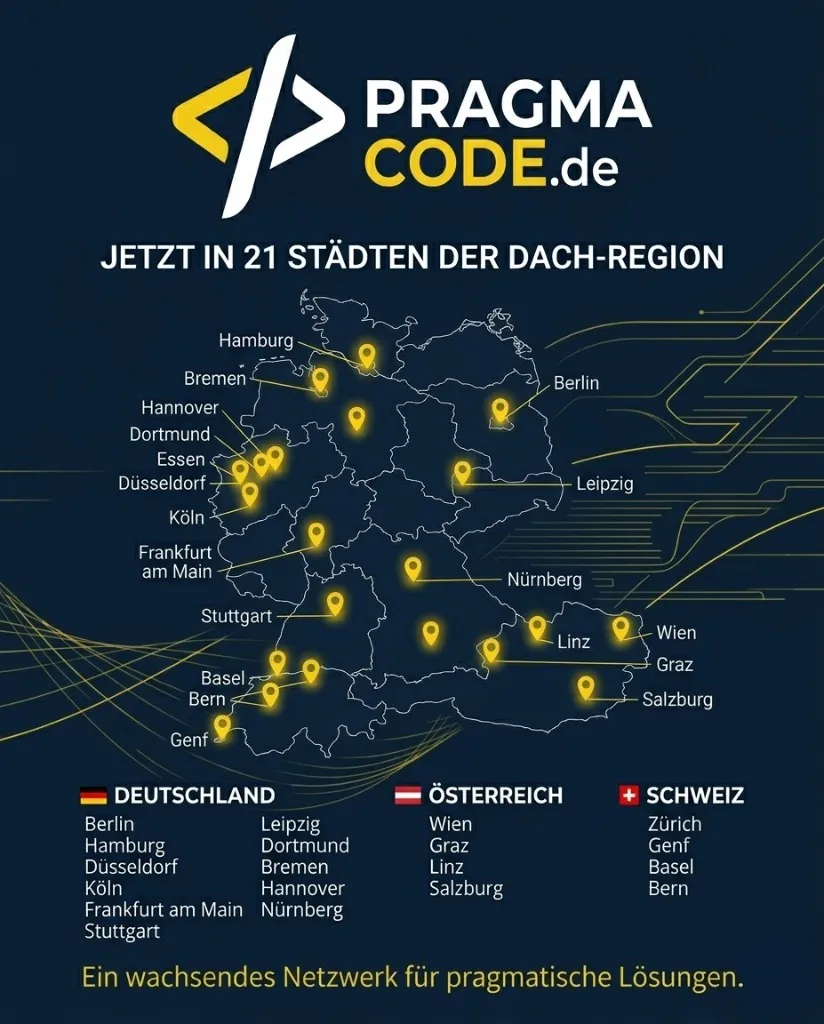
We are your digital partner – regionally anchored and successfully scaling across borders.
AI automation for your business?
I deliver this for small and mid-sized businesses: at a fixed price agreed upfront, working directly with the person who builds it. Process, scope and pricing are on the service page.
See service & pricing Or request a free intro callExtended Specialized Glossary
SeaTable
A powerful, flexible no-code platform and relational database designed like a spreadsheet that supports complex data structures and automated workflows.
No-Code
An approach to software development and process automation where applications and workflows are created using visual user interfaces without manual coding.
Intelligent Document Processing (IDP)
The automated extraction, classification, and analysis of structured and unstructured data from documents (such as invoices or contracts) using artificial intelligence.