

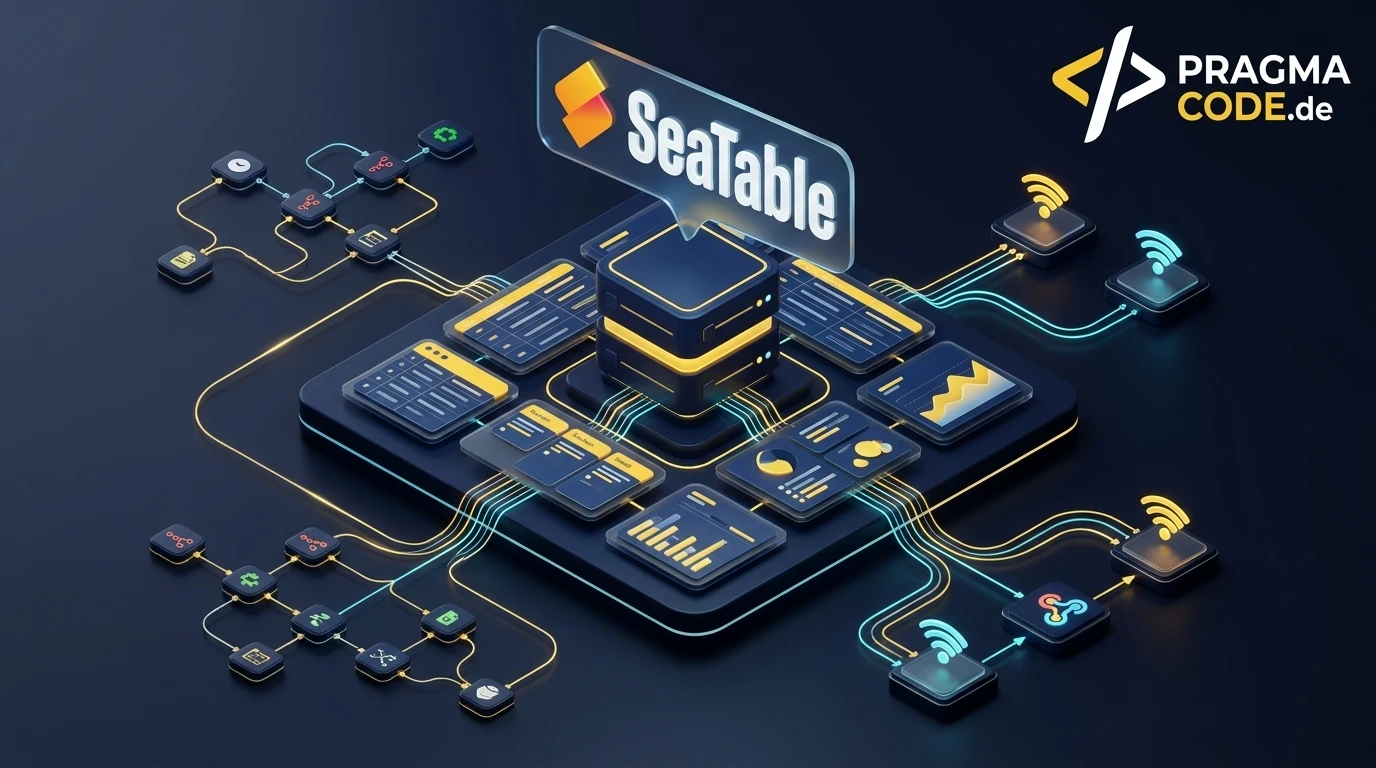
Outdated Excel spreadsheets, conflicting file versions, and manual copy-paste routines cost small and medium-sized enterprises dozens of productive work hours every week. An experienced SeaTable specialist transforms this unstructured data chaos into a high-performance relational low-code database. Learn why SeaTable is conquering European SMEs as a GDPR-compliant alternative to Airtable, how n8n and AI pipeline integration works, and what criteria matter most when hiring an external consultant.
This article is an in-depth expert contribution from our content cluster. Discover the complete overview on our main page: AI Automation & Intelligent Agents →
- Overcoming Spreadsheet Limits: Conventional spreadsheets break down during collaborative operations; SeaTable's relational database architecture enforces referential integrity and eliminates fragmented file versions.
- 100% GDPR Sovereignty: Engineered in Germany with ISO 27001 cloud hosting in Frankfurt/Switzerland and an on-premise Docker edition, SeaTable eliminates extraterritorial US CLOUD Act exposure.
- Holistic Workflow Automation: A certified SeaTable specialist connects tables via webhooks to n8n and self-hosted AI models, constructs custom portals, and achieves full ROI break-even in 3 to 5 months.
From Spreadsheet Chaos to a Scalable Process Platform
In most small and medium-sized enterprises (SMEs), historically grown spreadsheets form the unofficial backbone of daily operational business. What once started as a pragmatic workaround inevitably turns into a severe bottleneck as employee headcount grows: duplicate files scattered across network drives, accidentally overwritten formulas, and missing linkages cause silent data loss and operational frustration. With the release of SeaTable 6.2, the platform developed in Mainz, Germany, has established itself as the premier European standard for relational low-code operations. A certified SeaTable specialist bridges the gap between commercial line-of-business departments and modern software engineering: structuring core processes, creating intuitive employee apps, and automating third-party APIs via n8n — without the exorbitant overhead of traditional custom ERP projects.
- 1. Why Excel Hits Its Limits and SMEs Need Relational Databases
- 2. What Does a SeaTable Specialist Do Inside an Enterprise?
- 3. Typical High-Impact Use Cases for SeaTable in European SMEs
- 4. Orchestrating SeaTable with AI Automations and n8n Pipelines
- 5. Why SeaTable Is the GDPR-Compliant Alternative to US Airtable
- 6. How to Find and Hire the Right Specialist: Roadmap & ROI
- 7. Frequently Asked Questions (FAQ)
- 8. Conclusion: Operational Data Mastery as a Competitive Edge
1. Why Excel Hits Its Limits and SMEs Need Relational Databases
Spreadsheet software such as Microsoft Excel or Google Sheets remains an exceptional toolkit for ad-hoc financial modeling, personalized calculations, and individual notes. However, the moment multiple employees are required to collaborate simultaneously on central operational processes — such as order fulfillment, recruiting pipelines, or project management —, the historic strengths of Excel rapidly morph into severe business risks.
The root problem of conventional spreadsheets lies in their flat two-dimensional paradigm: rows and columns exist in operational isolation. Real-world business operations, by contrast, are fundamentally governed by relational dependencies. A single customer corresponds to multiple points of contact, issues dozens of separate purchase orders, which in turn reference specific delivery notes, invoices, and warranty claims. When teams attempt to force this operational reality into Excel, they produce duplicate data fields, volatile VLOOKUP or XLOOKUP formulas, and bloated workbooks that freeze computers during opening.
Architecture Comparison: Spreadsheets vs. SeaTable Relational Low-Code
- No Relational Integrity: No true 1:n or n:m foreign-key linkages between separate sheets
- Fragile Calculations: Critical business formulas can be accidentally overwritten by end users
- Governance Deficit: No granular role-based security per column, row, or functional view
- Isolated Silo: Total lack of native webhook and API architectures for automated integrations
- Version Fragmentation: Files scattered on local network drives (“Orders_final_v2_edit.xlsx”)
- True Relational Links: Full relational integrity across multi-table operational databases
- Enforced Data Types: Rigid schema controls (Text, Number, Formula, File, User, Foreign Link)
- Role-Based Access: Granular permissions per table, view, column, and Universal App portal
- API-First Engine: Native webhooks, REST APIs, and event-driven automation triggers built-in
- Single Source of Truth: Centralized database hosted in certified European ISO 27001 facilities
Security and governance amplify this challenge: in a traditional Excel file, any team member with read access automatically sees every sensitive data point contained within — including confidential gross profit margins, executive compensation, or proprietary vendor discounts. Masking columns with sheet protection is notoriously insecure and easily bypassed. Relational low-code databases like SeaTable strictly decouple raw database records, permission scopes, and end-user presentation interfaces.
2. What Does a SeaTable Specialist Do Inside an Enterprise?
SeaTable features an exceptionally intuitive, spreadsheet-like interface. Many business owners initially experiment by creating basic personal tables. However, bridging the chasm between a rudimentary digital notepad and a robust, resilient enterprise-grade operating system demands specialized architectural discipline. This is precisely where an internal or external SeaTable specialist delivers exponential value.
A qualified SeaTable consultant integrates the strategic acumen of a management consultant, the rigor of a database architect, and the practical implementation skills of an integration engineer. Rather than merely configuring table headers, they analyze the overarching operational flow from lead generation through production to invoicing.
1. Relational Data Architecture
Developing normalized data models. Architecting clean 1:n and n:m relationships between master records (Accounts, Products) and transactional data (Orders, Tickets, Time Logs) to eliminate redundancy completely.
2. Governance & Permissions
Designing fine-grained access rules. Configuring row-level and column-level permissions ensuring external suppliers, sales reps, and executive directors access strictly the exact records necessary for their duties.
3. Universal App Builder Portals
Building dedicated business applications via the SeaTable App Builder. Delivering role-tailored frontend interfaces for field staff, warehouse workers, or executives without exposing raw database tables.
4. Custom Scripting & Automation
Writing custom Python and JavaScript scripts for complex mathematical computations, data transformations, and validation rules that exceed built-in spreadsheet formula capabilities.
5. API & n8n System Pipelines
Integrating SeaTable seamlessly with existing enterprise software ecosystems via REST APIs and webhooks. Connecting legacy ERPs, e-commerce storefronts, CRMs, and self-hosted AI engines.
With the milestone release of SeaTable 6.2, the specialist's role becomes even more pivotal: newly introduced features such as dedicated HTML pages within the Universal App Builder, enhanced inline record editing, and advanced string/date calculation functions unlock custom enterprise web portals that historically required six-figure software development contracts.
Expert Field Tip: The "Flat Table" Antipattern
The single most frequent mistake during unassisted DIY migrations is importing legacy Excel workbooks 1:1 as giant monolithic tables. This traps businesses in old paradigms and discards 80% of SeaTable's capabilities. A true specialist decomposes monolithic sheets into discrete relational entities (e.g., Companies, Contacts, Engagements, Milestones) and connects them via foreign keys. Only then can organizations unlock automated rollups, cross-departmental aggregations, and error-free reporting.
3. Typical High-Impact Use Cases for SeaTable in European SMEs
Owing to its structural flexibility, SeaTable adapts to almost every operational business function. For European small and medium-sized enterprises with 10 to 500 team members, four operational domains consistently deliver the highest return on investment when migrating from Excel:
1. B2B Pipeline & Opportunity Hub
Legacy CRM suites like Salesforce or HubSpot are frequently over-engineered, rigid, and prohibitively expensive for growing mid-market companies. A SeaTable specialist designs an agile pipeline with visual Kanban deal stages, automated follow-up reminders, and quote tracking.
2. Order Fulfillment & Project Tracking
Coordinate multi-stakeholder client orders across multiple subcontractors, vendors, and milestone deadlines inside a unified data foundation with interactive Gantt timelines, asset storage, and cost tracking.
3. Complaint & Warranty Ticket Management
Prevent valuable customer support requests and product complaints from disappearing inside crowded inboxes: responsive public web forms capture defects, SLA timers alert staff, and tickets are automatically dispatched.
4. Applicant Tracking & GDPR Records
Structured recruitment pipeline from resume intake to signing, complete with automated GDPR Article 17 erasure routines after the 6-month statutory window and streamlined digital absence approval workflows.
4. Orchestrating SeaTable with AI Automations and n8n Pipelines
The ultimate power of a low-code database unfolds when it ceases to operate as an isolated data silo and instead becomes the central nervous system of your entire corporate IT landscape. While SeaTable provides native automation triggers for localized tasks (included in Free and Plus tiers since SeaTable 6.1), a SeaTable specialist orchestrates complex cross-system pipelines using the open-source automation engine n8n.
Unlike proprietary US cloud automation services such as Zapier or Make, n8n can be hosted entirely on your own European infrastructure. Paired with SeaTable, this creates a sovereign, enterprise-grade automation stack that maintains full European jurisdictional control over every transaction.
Event Trigger in SeaTable
An employee updates a row status (e.g., “Client Approved”) or an external customer submits a SeaTable web form. An instantaneous webhook dispatches the record payload to the listening n8n automation engine.
Pipeline Processing & AI Extraction
n8n validates the schema and passes unstructured payload data (such as attached PDF supplier invoices or email body text) to a self-hosted AI model for automated classification and key-value extraction.
Enterprise System Synchronization
n8n simultaneously generates the corresponding sales order in the corporate ERP, archives generated PDF receipts, and notifies the assigned project lead inside Microsoft Teams or Slack.
Database Two-Way Sync
The newly generated ERP reference number, secure storage URI, and audit timestamp are written back into the designated SeaTable columns, establishing an unbroken audit trail.
To dive deeper into automated text extraction, explore our companion analysis SeaTable & AI: Text & Document Processes No-Code, which demonstrates semantic text processing directly within table cells. A certified specialist guarantees that schema architectures, REST requests, and cryptographic keys harmonize perfectly.
5. Why SeaTable Is the GDPR-Compliant Alternative to US Airtable
Airtable is internationally recognized as the pioneer of spreadsheet-database hybrids. However, European organizations face significant regulatory hurdles: because Airtable is headquartered in the United States, it falls under the purview of the US CLOUD Act and FISA Section 702. Even when US SaaS providers offer EU data residency, corporate data protection officers face substantial legal ambiguity regarding extraterritorial data access requests.
SeaTable is developed by SeaTable GmbH, based in Mainz, Germany. For mid-market European enterprises, this provides three crucial compliance, security, and governance advantages:
Data Privacy & Sovereignty: SeaTable vs. US SaaS Competitors
- US Jurisdiction: CLOUD Act and FISA 702 permit foreign agency subpoenas on corporate data
- No Self-Hosting: No fully self-hosted on-premise Docker deployment option available
- Currency & Price Risk: Steep recurring per-user monthly subscription fees invoiced in US Dollars
- Rate Limitations: Strict API rate throttling on large-scale automated data extraction
- Legal Complexity: Complex Data Protection Impact Assessments (DPIA) vulnerable to scrutiny
- 100% GDPR-Compliant: Headquartered in Mainz, governed under German law and European courts
- Sovereign Cloud: Enterprise hosting in ISO 27001 facilities (Exoscale Frankfurt & Switzerland)
- Self-Hosted Docker: Full Enterprise Edition deployable directly on your own internal servers
- Predictable TCO: Transparent European pricing at €7/user (Plus) and €14/user (Enterprise)
- Instant DPA: Legally binding Data Processing Agreement under EU GDPR Article 28 available
For strictly regulated industries across Germany, Austria, and Switzerland — including healthcare providers, tax advisory firms, financial institutions, and critical infrastructure suppliers (NIS-2) —, SeaTable's on-premise capability is an indispensable prerequisite. A SeaTable specialist deploys, secures, and maintains the Docker cluster on your private Linux nodes, ensuring that zero sensitive business data ever leaves your internal firewall unmonitored.
6. How to Find and Hire the Right Specialist: Roadmap & ROI
Embarking on a process modernization initiative understandably raises critical executive questions: What does an implementation look like in practice? What internal resources will be required? And how rapidly will the financial investment break even?
A professional SeaTable consultant avoids chaotic trial-and-error setups, relying instead on a structured, four-phase delivery methodology designed to de-risk adoption and foster enthusiastic organizational buy-in:
-
Phase 1: Process Discovery & Data Modeling (Weeks 1–2)
In-depth audit of legacy Excel sheets, paper routing slips, and manual handoffs. Identifying data silos, operational frictions, and compliance gaps. Mapping out the normalized relational database schema collaboratively.
-
Phase 2: MVP Prototyping & Pipeline Integration (Weeks 3–4)
Configuring core SeaTable bases, data validation rules, and preliminary Universal App Builder dashboards for pilot users. Setting up n8n webhooks to automate critical cross-platform notifications and ERP syncs.
-
Phase 3: Legacy Data Migration & Role Governance (Weeks 5–6)
Scrubbing and standardizing legacy Excel and CSV records. Executing automated migration scripts into relational tables. Configuring granular role-, view-, and column-level security policies and completing DPA paperwork.
-
Phase 4: Staff Enablement & Production Go-Live (Weeks 7–8)
Conducting role-specific user training workshops. Distributing custom video tutorials and documentation. Transitioning to full production with dedicated hypercare support from your implementation specialist.
Financial Business Case: Replacing Excel with SeaTable & Automation
Baseline Situation (Manual Spreadsheet Overhead): 3 employees spend 1 hour each day on manual data entry, file reconciliations, and search routines = 15 lost hours per business week. Across 44 operational weeks, 660 hours are lost. At a burdened rate of €65/hour, this amounts to €42,900 in annual opportunity cost.
Modernized Architecture (SeaTable & n8n): One-time discovery, relational schema architecture, and workflow engineering: approx. €8,500 to €14,000. Software licenses for 10 power users: approx. €840 to €1,680 annually. Routine time reduction: over 75% saved (~495 hours). Net annualized capacity recovered in year one: exceeding €32,000. Payback horizon (Break-Even): attained in 3 to 5 months.
Relational Discipline
Understands normalization, foreign keys, and relational schema architecture instead of shallow spreadsheet clones.
Custom Code (Python / JS)
Writes custom automation scripts for advanced data transformations, validation routines, and mathematical algorithms.
System Integration (n8n / APIs)
Integrates SeaTable as an operational hub connecting ERPs, CRMs, financial ledgers, and local AI reasoning pipelines.
GDPR & Compliance Mastery
Designs bulletproof role-based permissions, automated Article 17 retention purges, and enforceable EU DPAs.
7. Frequently Asked Questions (FAQ)
What fundamentally sets SeaTable apart from Airtable?
While both products utilize a spreadsheet-database hybrid paradigm, SeaTable differs in three vital ways: First, SeaTable is engineered and owned in Germany (SeaTable GmbH, Mainz), guaranteeing EU hosting and zero exposure to the US CLOUD Act. Second, SeaTable offers a production-grade, self-hosted Enterprise Docker edition that runs on internal bare-metal servers. Third, its pricing structure at €7 and €14 per user/month is significantly more cost-effective for mid-sized organizations compared to dollar-denominated US competitors.
Can SeaTable truly replace traditional SQL databases like PostgreSQL or MySQL?
For line-of-business applications, internal dashboards, CRM pipelines, project tracking, and approval workflows: yes, unconditionally. It liberates departments from long development cycles. For massive transaction-heavy computing (such as an e-commerce checkout handling thousands of payments per second), a low-level SQL database remains essential. A skilled specialist unites both: SeaTable operates as the human-facing operational control panel while backend databases sync seamlessly via scheduled API jobs.
How long does a typical implementation project take with a specialist?
Department-level workflows (such as an applicant tracking system or a customer ticketing portal) are routinely brought to production in 5 to 10 working days. Comprehensive company-wide implementations replacing deeply embedded legacy spreadsheet webs and connecting via n8n to ERPs and email infrastructure typically require 4 to 8 weeks, inclusive of conceptual design, data migration, and team training.
What prerequisite technical skills do employees need for daily operations?
None. Anyone familiar with basic spreadsheets like Excel can operate SeaTable effortlessly within minutes. Furthermore, the specialist builds custom web application frontends via the Universal App Builder, providing clean forms with enforced input rules, intuitive dropdowns, and calendar views that systematically prevent user entry errors before they happen.
8. Conclusion: Operational Data Mastery as a Competitive Edge
The long-term resilience of European small and medium-sized enterprises will not be determined by abstract strategy decks, but by the agility and precision of their daily execution. Organizations that continue forcing skilled knowledge workers to manually juggle fragmented Excel spreadsheets burn money daily and court crippling compliance liabilities.
SeaTable offers the European economy a mature, GDPR-compliant software foundation that merges spreadsheet intuitiveness with the structural rigor of a relational database. Guided by a certified SeaTable specialist, migrations proceed rapidly, safely, and with quantifiable efficiency dividends from day one. When combined with n8n workflow automation and artificial intelligence, you establish a resilient operational operating system primed for scalable growth.
Quick-Check: Your Roadmap to a Relational Low-Code Platform
Do you have questions about SeaTable deployment or n8n workflow automation?
Schedule Free ConsultationOfficial Sources & Primary Documentation
- SeaTable GmbH (July 2026): "Release Notes SeaTable 6.2" – HTML Pages in Universal App Builder, Single Record View & Formula Enhancements.
- SeaTable GmbH (March 2026): "Release Notes SeaTable 6.1" – Native Automations in Free and Plus Subscription Tiers.
- SeaTable GmbH (2026): "Official Pricing Model 2026" – Free, Plus (from €7/user/month), Enterprise (€14/user/month) & Self-Hosted Docker.
- German Federal Office for Information Security (BSI): "IT-Grundschutz Standards" – Baseline security guidelines for relational database deployments.
- European Union: "GDPR Article 28 Processor Requirements" – Statutory standards governing external service providers and DPAs.
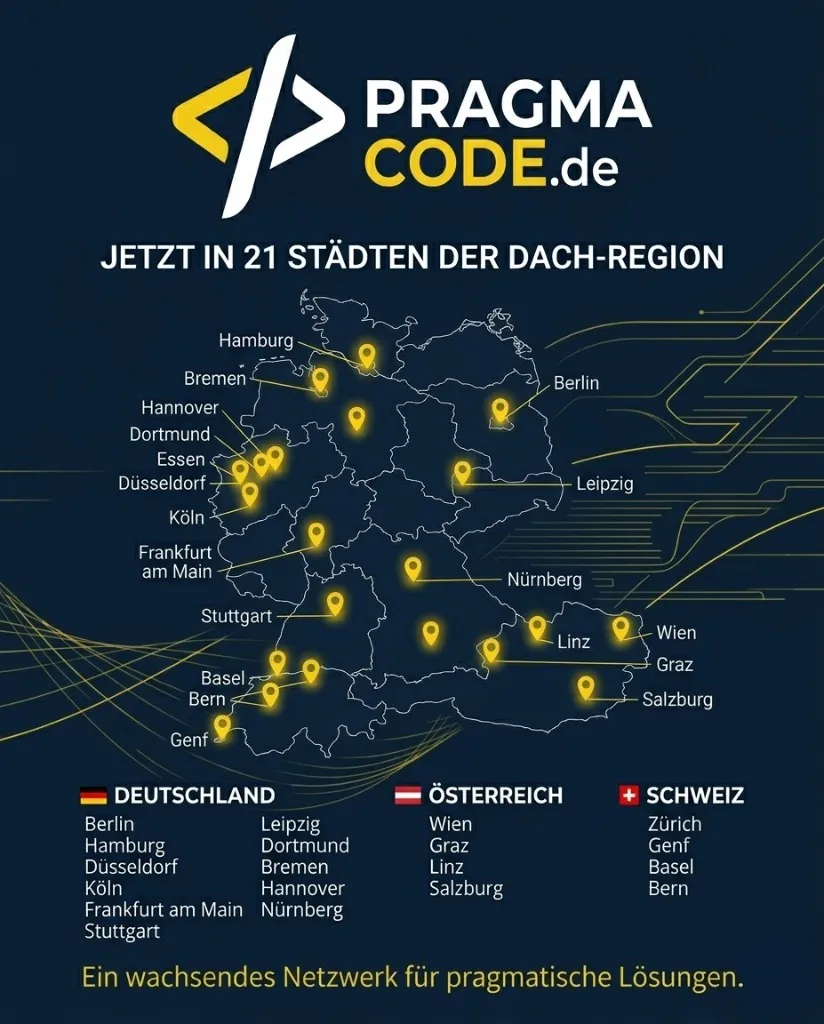
Our Regional Expertise
We are your digital partner – regionally anchored and successfully scaling across borders.
Have a vision?
Let's check together how we can make your idea take flight.
Book your free strategy call nowExtended Specialized Glossary
SeaTable
A no-code and low-code database platform developed in Germany, combining the intuitive user interface of a spreadsheet with the power of a relational database.
Low-Code
A modern approach to software and database development combining visual interfaces with custom scripting (such as Python or JavaScript) for maximum flexibility.
n8n
An open-source and GDPR-compliant self-hostable workflow automation platform designed to seamlessly connect APIs, databases, and AI services.