


Low-code and iPaaS platforms like n8n increasingly govern the crown jewels of modern enterprises: ERP systems, CRM databases, payment streams, and AI agents. Yet while developers build workflows in record time, a massive blind spot emerges in enterprise cybersecurity. This comprehensive guide outlines how IT directors and DevOps teams implement an uncompromising Zero-Trust architecture for n8n.
This article is an in-depth expert contribution from our content cluster. Discover the complete overview on our main page: n8n Automatisierung & Implementierung →
The Invisible Highway into Your Core Systems
Low-code workflow engines like n8n have evolved from simple productivity utilities into the central nervous system for enterprise ERP, CRM, and financial data flows. Operating these integration pipelines without an uncompromising Zero-Trust foundation creates the single most dangerous entry vector for lateral cyber attacks across modern business infrastructures.
- Low-Code as the Premier Threat Vector: Because n8n servers consolidate high-privilege read and write permissions to relational databases, ERPs (SAP, Salesforce), and AI models, unsecured webhooks and HTTP request nodes represent prime targets for SSRF and data exfiltration.
- The Three Pillars of Zero-Trust in n8n: Hardening relies on separating the control plane from the execution plane (worker sandboxing via Docker/Kubernetes), dynamic external secrets management (HashiCorp Vault / Infisical instead of plaintext environment variables), and cryptographic HMAC validation for every ingress event.
- Pragma Code Hardening Standard: By integrating enterprise features such as Single Sign-On (OIDC/SAML), granular RBAC workspace segregation, automated credential rotation, and real-time SIEM log streaming, Pragma Code transforms volatile pipelines into audit-ready security strongholds.
- 1. The Blind Spot: Why Low-Code Is the New Prime Target for Cybercriminals
- 2. Threat Anatomy: How Unhardened n8n Servers Get Compromised
- 3. Applying Zero-Trust to n8n: The 3 Core Architectural Principles
- 4. The 5 Technical Hardening Pillars for Enterprise n8n Deployments
- 5. Security Checklist & Decision Matrix: SME vs. Enterprise Grade
- 6. Real-Time Monitoring, Audit Logging & SIEM Integration
- 7. 5-Stage Implementation Roadmap for Engineering Leaders
- 8. Conclusion: Maximum Automation Velocity with Uncompromised Security
1. The Blind Spot: Why Low-Code Is the New Prime Target for Cybercriminals
Digital agility in enterprise engineering is defined by speed. To eliminate manual bottlenecks, streamline mission-critical business processes, and synchronize legacy relational databases with modern cloud applications, organizations globally have embraced workflow automation platforms. Among them, the fair-code engine n8n has emerged as the premier solution, empowering cross-functional teams to visually build complex, real-time data pipelines connecting hundreds of endpoints.
However, as the operational power of these integration engines expands, an acute architectural vulnerability emerges in the shadows. A production n8n server is never an isolated island. To parse invoices, qualify high-value sales leads, trigger financial reconciliations, or orchestrate autonomous AI agents, n8n requires unrestricted, privileged credentials to the most valuable systems across the enterprise stack:
Relational SQL Databases
Direct read and write connections to internal core database clusters (PostgreSQL, MySQL, MS SQL, Oracle).
CRM & ERP Service Tokens
Administrative service tokens for CRM and ERP backends (Salesforce, HubSpot, SAP S/4HANA, Dynamics 365).
Financial & Payment APIs
Elevated API keys for banking rails, payment gateways (Stripe, PayPal), and financial ledger APIs.
AI Models & Agentic Memory
Full execution and memory context credentials for Large Language Models (LLMs) and agentic tool protocols.
When an integration engine of this magnitude is breached, attackers do not merely compromise a single microservice—they gain keys to the kingdom. A hijacked n8n server acts as the ultimate launchpad for lateral movement. While traditional application servers are shielded behind multi-layered firewalls, Web Application Firewalls (WAFs), and demilitarized zones (DMZs), low-code instances frequently operate as unmonitored shadow IT on cloud VPS hosts with default passwords, root privileges, and unrestricted egress networking.
Mid-Market Security Assessment
In over 70% of enterprise security audits conducted by Pragma Code, n8n instances were found running with root privileges on the host OS, storing production API keys as plaintext environment variables in unencrypted .env files, and exposing unauthenticated webhook endpoints to the public internet. This common oversight completely nullifies enterprise perimeter firewalls.
2. Threat Anatomy: How Unhardened n8n Servers Get Compromised
Building an airtight defense requires understanding the exact attack mechanics targeting low-code pipelines. In 2026, cyber adversaries leverage automated reconnaissance agents and AI vulnerability scanners to systematically probe integration endpoints:
Server-Side Request Forgery (SSRF)
Exploiting HTTP Request Nodes to map internal corporate networks.
Catastrophic Blast RadiusIf workflows accept unsanitized destination URLs from external webhooks, attackers can force n8n to harvest cloud metadata endpoints (169.254.169.254) or query internal database ports.
Code Injection via Script Nodes
Malicious payloads executed inside JavaScript and Python nodes.
Remote Code Execution (RCE)When user-supplied input is dynamically evaluated inside code nodes without strict sandboxing, attackers can hijack the Node.js runtime and execute arbitrary shell commands on the host server.
2.1 Unauthenticated Webhook Ingress & Replay Vulnerabilities
The entry point of an automation workflow is typically a webhook node listening for events emitted by third-party systems (such as e-commerce checkouts, email triggers, or web forms). Operating these webhooks without cryptographic message authentication (HMAC) or strict IP allowlisting allows any malicious actor to inject forged payloads into the pipeline.
Consequences range from unauthorized inventory manipulation and database poisoning to triggering automated phishing dispatches to high-profile clients. Even more insidious are replay attacks, where an attacker intercepts a legitimate, signed webhook payload and re-transmits it repeatedly, triggering duplicate refund payouts or corrupting transactional records.
2.2 Supply Chain Exposure via Community Extensions
The n8n ecosystem features a thriving directory of community-contributed nodes distributed via npm. Similar to the broader open-source ecosystem, this introduces inherent supply-chain risks, including dependency confusion, typosquatting, and compromised maintainer accounts. If an engineer installs an unverified community node, that code runs with the full system permissions of the n8n host process, granting direct access to all stored environment secrets and database credentials.
3. Applying Zero-Trust to n8n: The 3 Core Architectural Principles
Traditional perimeter-based security—the belief that everything inside the corporate VPN or local network is inherently safe—has collapsed in the modern era of distributed cloud ecosystems. The mandatory architectural framework to combat this reality is the Zero Trust Architecture (ZTA) specified by NIST SP 800-207.
When mapped onto n8n automation pipelines, Zero-Trust dictates that no workflow, incoming webhook, outbound API request, or internal service account is granted implicit trust. Every single transaction must be explicitly validated, micro-segmented, and continuously monitored:
Every ingress webhook, outbound API dispatch, and user session must be cryptographically authenticated and authorized based on real-time context, irrespective of network origin. Integrity, authenticity, and temporal validity must be mathematically proven before processing.
Workflows and service credentials must be restricted to the bare minimum permissions required for their specific execution step. A lead enrichment workflow must never hold administrator privileges across the wider CRM or database cluster.
The system architecture is engineered under the assumption that individual execution nodes or external endpoints will inevitably be compromised. The blast radius is strictly contained through micro-segmentation, read-only file systems, and ephemeral runtimes.
Architectural Comparison: Default n8n Setup vs. Zero-Trust Enterprise Hardening
- Monolithic Container: Web UI, editor, webhooks, and workflow execution run in a single shared process.
- Plaintext Credentials: API keys and database credentials reside in unencrypted
.envfiles or SQLite databases. - Flat Network Topology: The instance has unrestricted access to all internal LAN ports and IP ranges.
- Open Webhooks: Ingress endpoints accept raw POST requests without cryptographic signature checks.
- Static Credentials: Master API tokens remain valid indefinitely without automated rotation.
- Queue Mode with Isolated Workers: Strict segregation of webhook receiver, main management console, and sandboxed execution workers.
- Dynamic Secrets Management: Integration with HashiCorp Vault or AWS Secrets Manager with automated key rotation.
- Network Micro-Segmentation: Execution in isolated Docker networks with egress firewalls preventing SSRF.
- HMAC & mTLS Validation: Cryptographic payload signatures and mutual TLS on all ingress routes.
- Granular RBAC & SSO: OIDC/SAML authentication with hardware MFA and just-in-time permissions.
4. The 5 Technical Hardening Pillars for Enterprise n8n Deployments
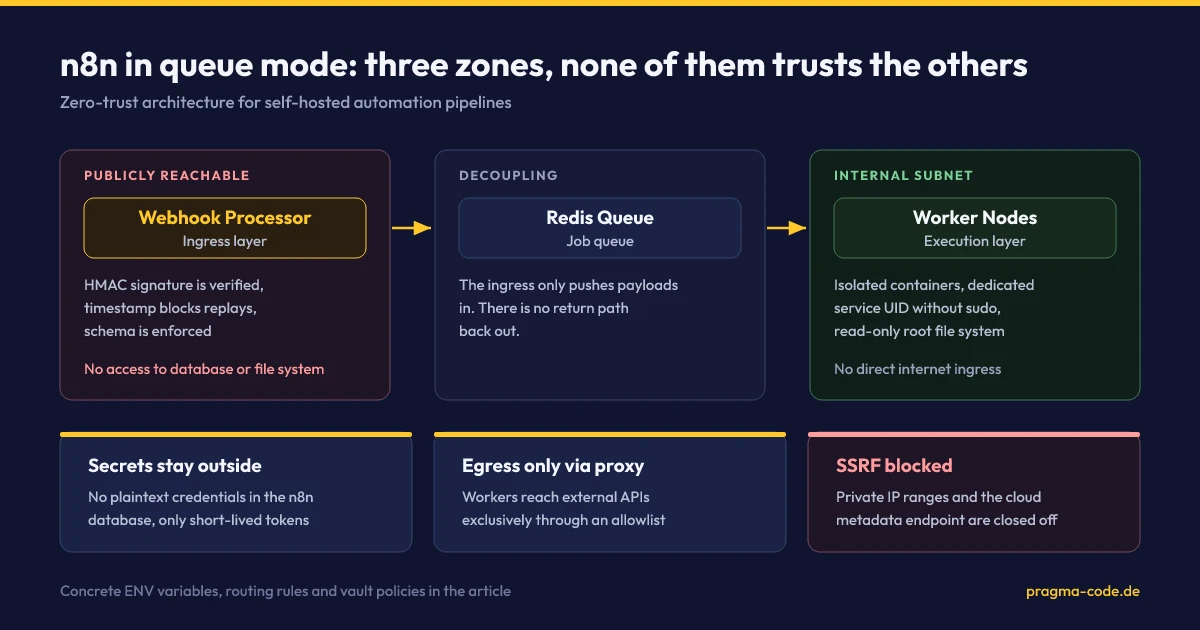
To elevate an n8n deployment to enterprise-grade resilience capable of withstanding advanced persistent threats, Pragma Code implements a rigorous five-pillar hardening framework:
Pillar 1: Network Micro-Segmentation, Worker Isolation & SSRF Mitigation
In standard single-instance deployments, n8n executes workflow tasks within the main application process. For enterprise operations, running in Queue Mode backed by Redis and dedicated worker containers is mandatory. This decouples the architecture into three isolated tiers:
-
Webhook Processor (Ingress Tier)
A lightweight, publicly exposed n8n process that does nothing except receive webhooks, validate cryptographic signatures, and push jobs onto the Redis queue. It possesses no access to internal databases, file storage, or management APIs.
-
Main Service & Visual Editor (Management Tier)
The central orchestration hub for workflow authoring. It is entirely shielded behind an internal corporate VPN or an Identity-Aware Proxy (e.g., Cloudflare Zero Trust / WireGuard) with enforced FIDO2 hardware authentication.
-
Task Runners & Worker Nodes (Execution Tier)
Isolated Docker containers that pull tasks from Redis. They operate inside private subnets without direct internet ingress and can only initiate outbound traffic through an inspected, allowlisted forward proxy.
Mitigating SSRF (Server-Side Request Forgery): Using environment flags such as N8N_ENFORCE_SETTINGS_FILE_PERMISSIONS=true and kernel-level firewall rules (iptables / cloud security groups), all outbound requests to private RFC 1918 subnets (10.0.0.0/8, 172.16.0.0/12, 192.168.0.0/16) and cloud metadata endpoints (169.254.169.254) are blocked by default for HTTP Request nodes. Any legitimate internal connectivity must be explicitly allowlisted via secure DNS routing.
Pillar 2: Centralized Secrets Management & Dynamic Token Rotation
Hardcoded credentials in configuration files represent an unacceptable risk. In a Zero-Trust topology, n8n never stores raw credentials on its internal storage layer. Instead, it delegates credential resolution to an external enterprise Secrets Management engine (such as HashiCorp Vault, Infisical, or AWS Secrets Manager):
Encryption at Rest
All credentials stored in n8n are encrypted using AES-256-GCM backed by a high-entropy master key (N8N_ENCRYPTION_KEY) injected securely at startup.
Dynamic Ephemeral Credentials
Instead of static passwords, n8n requests short-lived database tokens valid for just 15 minutes from HashiCorp Vault, expiring automatically after workflow completion.
Automated Key Rotation
Third-party API keys are rotated automatically on regular schedules (e.g., every 30 days) via DevOps pipelines without manual workflow reconfigurations.
Pillar 3: Cryptographic Webhook Validation (HMAC) & Schema Enforcement
Every externally accessible webhook endpoint must enforce rigorous validation before passing payloads to downstream nodes. Pragma Code implements a three-tier ingress defense:
Cryptographic HMAC-SHA256 Verification
The emitting service (e.g., Stripe, Shopify, GitHub) signs the request body using a shared secret key (transmitted in headers such as X-Hub-Signature-256). A reverse-proxy gateway or validation node computes the HMAC hash of the raw body and immediately returns 401 Unauthorized if signatures do not match perfectly.
Strict JSON Schema Filtering
Incoming payloads are validated against rigid JSON schemas. Unexpected fields, anomalous string lengths, or potentially malicious SQL/HTML script fragments are sanitized before reaching backend databases.
Timestamp & Nonce Validation against Replay Attacks
Webhook headers must include a recent timestamp. Requests drifting by more than 300 seconds from UTC are rejected, neutralizing intercepted replay packets.
Pillar 4: Code Node Sandboxing & Disabling Dangerous System Modules
n8n Code Nodes allow executing custom JavaScript (Node.js) and Python logic. Without strict sandboxing, arbitrary code can invoke system binaries and compromise the file system. In hardened deployments, we enforce the following restrictions:
Setting NODE_FUNCTION_ALLOW_BUILTIN= (empty string) prohibits workflows from importing sensitive Node.js modules like fs, child_process, net, http, or crypto.
When specific npm packages are required for business logic (e.g., lodash or dayjs), they must be explicitly declared via NODE_FUNCTION_ALLOW_EXTERNAL=lodash,dayjs.
Containers run strictly under non-root service accounts (node:node, UID 1000) with a read-only root filesystem (read_only: true) and ephemeral tmpfs mounts.
Pillar 5: Identity Governance, Granular RBAC & Enterprise SSO
Under Zero-Trust, user identity is the primary control boundary. For enterprise n8n instances, access governance is governed by:
Centralized SSO via Entra ID, Okta or Keycloak
Local username/password authentication is disabled in favor of OpenID Connect (OIDC) or SAML 2.0 with enforced hardware MFA (FIDO2).
Role-Based Access Control (RBAC)
Teams are segmented into isolated workspaces. Business units cannot inspect production financial workflows or access enterprise ERP credentials.
Environment Promotion Pipelines (Dev / Staging / Prod)
Workflow development never occurs directly on production instances. Changes are version-controlled in Git and deployed via automated CI/CD after peer review and automated security linting.
5. Security Checklist & Decision Matrix: SME vs. Enterprise Grade
Organizations have distinct threat models and compliance requirements. The following decision matrix provides IT leaders with clear guidance on required controls across organizational maturity levels:
6. Real-Time Monitoring, Audit Logging & SIEM Integration
A defining principle of Zero-Trust is continuous observability: „Never trust, always verify, continuously monitor.“ When unauthorized actors probe automation pipelines, they leave forensic indicators across execution metrics.
For enterprises subject to NIS2, ISO 27001, SOC 2, or GDPR compliance, Pragma Code deploys an integrated observability stack:
Real-Time SIEM Streaming
All administrative audit logs (user logins, workflow edits, credential modifications) and detailed execution metrics are streamed formatted in structured JSON to centralized SIEM platforms (Grafana Loki, Datadog, Elastic Stack, or Splunk).
AI-Driven Anomaly Detection
Automated behavioral baselines immediately trigger high-priority alerts on statistical anomalies: such as a 500% surge in outbound data volume, connections to unrecognized external IP blocks, or sudden spikes in failed webhook HMAC verifications.
Strict Data Minimization in Execution Records
To preserve GDPR compliance, n8n is configured (EXECUTIONS_DATA_SAVE_ON_SUCCESS=none or selective node scrubbing) to purge sensitive personally identifiable information (PII), customer records, and credentials from the execution database immediately upon successful workflow completion.
7. 5-Stage Implementation Roadmap for Engineering Leaders
Transitioning legacy automation workflows into a hardened Zero-Trust architecture requires a structured phased approach to avoid operational downtime. Pragma Code guides enterprises through this five-stage migration roadmap:
-
1. Inventory Assessment & Credential Audit
Catalog all deployed n8n instances, active workflows, and associated credentials. Classify processed data categories (financials, PII, intellectual property) and audit community-contributed nodes for security vulnerabilities.
-
2. Architecture Design & Container Hardening
Deploy a hardened target environment operating in Queue Mode. Configure non-root execution containers, read-only file systems, disabled native Node.js modules, and strict subnet-level egress filtering.
-
3. Secrets Management & Enterprise IAM Integration
Migrate static environment variables to HashiCorp Vault or Infisical. Implement OIDC/SAML Single Sign-On and enforce workspace-level RBAC following the Least-Privilege principle.
-
4. Webhook Hardening & Ingress Schema Enforcement
Transition all public ingress webhooks to cryptographic HMAC signature validation and implement strict JSON schema validation to neutralize injection and replay attacks.
-
5. SIEM Integration, Penetration Testing & Production Go-Live
Connect log streams to corporate SIEM platforms. Execute controlled automated penetration tests (simulating SSRF, RCE, and credential theft) before the final production cutover.
8. Conclusion: Maximum Automation Velocity with Uncompromised Security
Low-code workflow automation with n8n is one of the most transformative efficiency drivers available to modern enterprises. Visually composing systems empowers cross-functional teams to build in days what custom software engineering used to take months to deliver. However, velocity without architectural security represents an existential enterprise risk.
In 2026, technology leaders can no longer afford to operate automation pipelines as blind, unhardened black boxes. Adopting a comprehensive Zero-Trust architecture for n8n ensures you unlock the full agility of modern low-code technologies while keeping your core ERP data, customer databases, and mission-critical assets cryptographically secured and audit-compliant.
As a specialized engineering consultancy for n8n Automation and enterprise IT Security, Pragma Code designs, hardens, and operates mission-critical automation infrastructure tailored to high-compliance enterprise environments.
Quick-Check: Is Your n8n Infrastructure Zero-Trust Ready?
fs, child_process) blocked in code nodes?
Ready to secure your n8n pipelines with Zero-Trust standards?
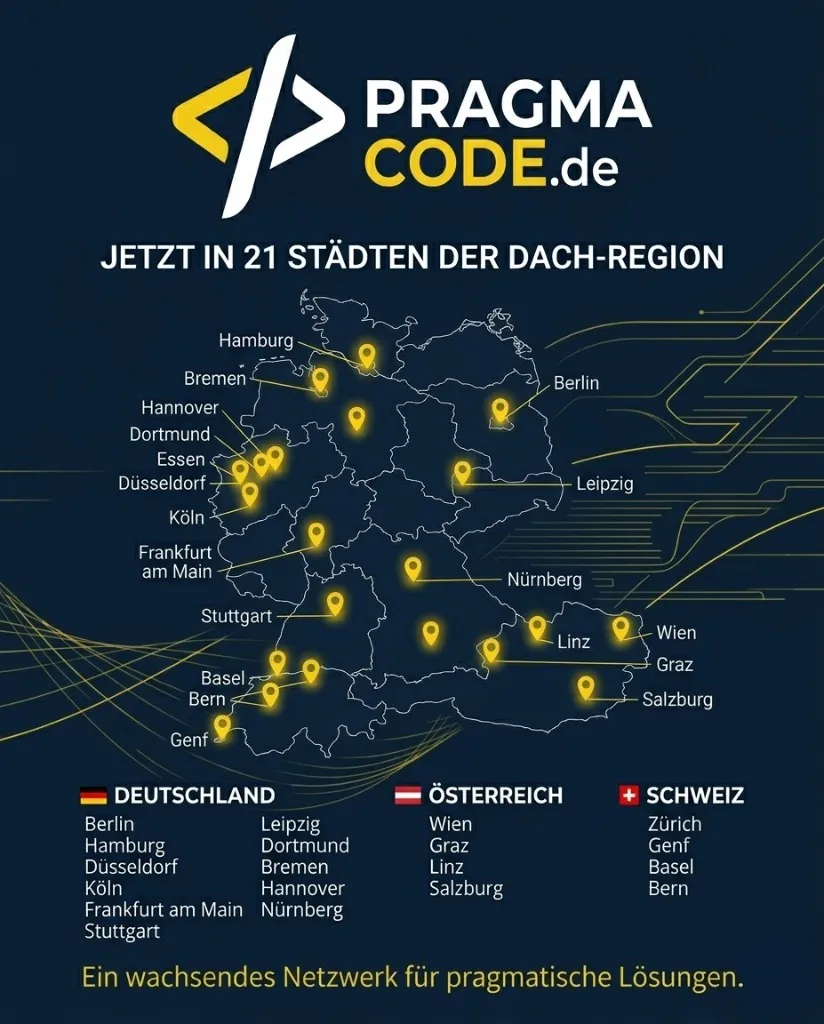
Schedule a Free Security AssessmentOur Regional Expertise
We are your digital partner – regionally anchored and successfully scaling across borders.
Have a vision?
Let's check together how we can make your idea take flight.
Book your free strategy call nowExtended Specialized Glossary
Zero Trust Architecture (ZTA)
A strict cybersecurity model ('never trust, always verify') that utilizes micro-segmentation, assumes every endpoint, user, and network is inherently untrusted, and continuously validates every transaction.
SSRF (Server-Side Request Forgery)
A vulnerability where an attacker abuses a backend server to forge unauthorized HTTP requests against internal network resources or cloud metadata endpoints.
HMAC (Hash-based Message Authentication Code)
A cryptographic authentication mechanism combining a secret key with a cryptographic hash function to verify data integrity and payload authenticity for webhook events.
Least Privilege
The essential security paradigm ensuring that identities, APIs, and background processes receive only the absolute minimum permissions necessary to perform their defined function.
Secrets Management
The centralized, encrypted, and auditable management of sensitive credentials such as API tokens, private keys, and passwords using dedicated vault services instead of static configuration files.