


In over 75 percent of small and medium-sized enterprises, employees use generative AI tools on private accounts daily. Discover how IT leaders uncover this shadow AI usage and transform it into secure, auditable business workflows via a centralized Enterprise AI Gateway with n8n, SSO, and Zero Data Retention.
This article is an in-depth expert contribution from our content cluster. Discover the complete overview on our main page: IT Security & Compliance →
- The SME Reality: Outright bans on generative AI fail consistently. Employees routinely use personal ChatGPT, Claude, or DeepSeek accounts on work laptops, causing sensitive corporate secrets and personal data to leak unchecked into third-party cloud infrastructure.
- The Architectural Solution: A centralized, self-hosted Enterprise LLM Gateway powered by n8n or API proxies, integrated with Microsoft Entra ID (SSO), shields company data through automated PII masking and enforceable Zero Data Retention (ZDR).
- Compliance & Competitive Edge: Rather than stifling innovation, business units gain access to high-performance, privacy-compliant AI assistants that fulfill all mandates under the GDPR, EU AI Act (Article 4 AI Literacy), and Trade Secrets Protection Act.
- 1. The Status Quo: Shadow AI as an Uncalculated Enterprise Risk
- 2. Detection & Audit: Uncovering Shadow AI in the Corporate Network
- 3. Why Bans Fail: How "Block & Ban" Compromises Security
- 4. Architectural Blueprint: The Secure Enterprise AI Gateway with n8n & SSO
- 5. Data Loss Prevention & In-Flight PII Masking
- 6. 5-Stage Roadmap: From Shadow AI to a Governed Productivity Hub
- 7. Quick-Check & Strategic Takeaways for IT Leaders
1. The Status Quo: Shadow AI as an Uncalculated Enterprise Risk
Generative language models have permeated daily business operations across European SMEs at unprecedented velocity. Whether in marketing for copywriting, sales for synthesizing complex tender documents (RFPs), software engineering for code acceleration, or finance for formula optimization: knowledge workers rely heavily on the productivity gains of modern LLMs. Yet while large enterprises deploy dedicated enterprise tenants with multi-million-dollar budgets, medium-sized businesses frequently operate in a governance vacuum.
This dynamic gives rise to Shadow AI. Employees autonomously set up accounts with providers like OpenAI, Anthropic, or DeepSeek using private email addresses or corporate inboxes without authorization from IT leadership, without data protection officer (DPO) validation, and without a signed Data Processing Agreement (DPA).
1. Uncontrolled IP Exposure
- Consumer AI account terms allow vendors to store and leverage input prompts for model training.
- Proprietary source code, customer databases, and financial models enter third-party neural weights.
2. Severe GDPR Penalties
- Employees transmit customer records and HR files to overseas servers without a signed DPA.
- Breach of third-country transfer rules without enforceable Standard Contractual Clauses (SCCs).
3. Trade Secret Invalidation
- Legal remedies require businesses to demonstrate "reasonable steps" to maintain confidentiality.
- Pasting confidential data into public consumer chatbots legally voids protected trade secret status.
4. AI Governance Non-Compliance
- Mandatory requirement for enterprises to guarantee workplace AI literacy for all personnel.
- Lack of centralized registration and risk classification for shadow AI utilities across teams.
For IT directors, the crucial realization is that Shadow AI is almost never driven by malice. It is a direct reaction to an urgent demand for modern productivity tooling. Ignoring this demand or attempting to suppress it with rudimentary firewall blocks merely forces staff onto unmonitored smartphones, 5G hotspots, and home-office bypasses.
2. Detection & Audit: Uncovering Shadow AI in the Corporate Network
Before implementing governance frameworks, IT security teams require an evidence-based operational overview. Shadow AI generates distinct digital footprints across network telemetry, client endpoints, and authentication directories. Through systematic inspection, IT leaders can quantify usage volumes and identify the most exposed business units.
1. Network & DNS Traffic Telemetry
Analyzing corporate DNS queries, proxy logs, and Next-Generation Firewall (NGFW) Layer-7 telemetry for connections to endpoints like api.openai.com, chatgpt.com, claude.ai, anthropic.com, poe.com, perplexity.ai, and v0.dev. Sustained outbound payload spikes frequently indicate bulk uploads of PDF binders or code repositories.
2. Browser Extension & Endpoint Audits
Auditing installed browser add-ons via Mobile Device Management (MDM) and Endpoint Detection & Response (EDR). Unsanctioned AI sidebars, automated writing assistants, and machine translation plugins regularly capture DOM elements and form inputs in the background.
3. SaaS & Single Sign-On Consent Anomalies
Reviewing OAuth enterprise application grants inside Microsoft Entra ID or Google Workspace. Employees frequently grant third-party AI utilities "Sign in with Microsoft/Google" permissions, granting read access to email inboxes, calendar feeds, and shared OneDrive folders.
4. Non-Punitive Departmental Discovery
Hosting collaborative discovery workshops with team leads in Sales, Marketing, Software Engineering, and HR to map operational bottlenecks: Which repetitive tasks consume excessive time, and which prompts do employees construct to accelerate their workflows?
Executing these discovery checks forms an integral part of an overarching EU AI Act compliance audit for AI workflows. Once usage patterns become transparent, it becomes clear that teams are simply striving to deliver better work in less time.
3. Why Bans Fail: How "Block & Ban" Compromises Security
The default reflex of traditional IT departments facing emerging attack surfaces is total restriction. URLs are placed on firewall blacklists, direct connections are terminated, and disciplinary memorandums are issued. In the domain of generative AI, this strategy invariably degrades organizational security.
Comparison: Restrictive AI Ban vs. Governed Enterprise AI Gateway
- Staff Behavior: Continued usage via personal smartphones, cellular tethering, and unmonitored home devices.
- Visibility: Complete blind spot for IT; zero telemetry on transmitted data volumes and sensitive assets.
- GDPR Compliance: Ongoing, undetected data protection breaches across unmanaged devices lacking a DPA.
- Competitiveness: Severe loss of operational velocity compared to agile, AI-enabled market competitors.
- Cost Control: Chaotic expense claims for fragmented consumer subscriptions ($20/month per user).
- Staff Behavior: Enthusiastic adoption of the official, faster, and integrated corporate AI hub.
- Visibility: 100% audit logging, granular token quotas, and centralized usage analytics.
- GDPR Compliance: Total regulatory compliance through contractual Zero Data Retention and real-time PII filtering.
- Competitiveness: Maximized efficiency via pre-built prompt templates and direct integrations with ERP & CRM.
- Cost Control: Up to 70% cost reduction via wholesale API tiers and semantic caching versus individual seat licenses.
True cybersecurity is achieved not by suppressing necessary tools, but by providing superior, compliant alternatives. Supplying employees with rapid, GDPR-compliant access to frontier models eradicates the underlying incentives for Shadow AI.
4. Architectural Blueprint: The Secure Enterprise AI Gateway with n8n & SSO
To safely channel shadow AI into compliant business operations, SMEs require an architecture that remains modular, cost-effective, and fully within their administrative perimeter. A premier foundation is a self-hosted Enterprise LLM Gateway engineered with the open-source automation platform n8n, combined with a reverse proxy and unified Identity and Access Management (IAM).
As explored in our technical treatise on Zero-Trust security with n8n, hardening automated integration layers is paramount. For AI governance, n8n functions as an intelligent intermediary orchestrating all communication between employees, internal systems, and external frontier model APIs.
1. IAM & Single Sign-On (SSO)
Integration with existing enterprise identity providers via Microsoft Entra ID, Google Workspace, or Okta through OIDC/SAML. Enforcing role-based access control (RBAC): Defining exactly which departmental groups have access to specific frontier models (such as Claude 3.5 Sonnet, GPT-4o, or Mistral Large).
2. Zero Data Retention (ZDR) APIs
Connecting commercial LLM providers exclusively through enterprise API tiers (OpenAI API, Anthropic Commercial API, Azure OpenAI, or Google Vertex AI) backed by signed Data Processing Agreements (DPA). Contractually barring model training and enforcing immediate memory purging upon request completion.
3. PII Masking & AI Guardrails
Automated real-time inspection within the n8n pipeline prior to dispatching prompts to external LLMs. Detecting and redacting IBANs, credit cards, email addresses, names, and proprietary project codenames using regex and local Named Entity Recognition (e.g. Microsoft Presidio).
4. Audit Logging & Token Budgeting
Granular telemetry recording of metadata (timestamp, department, user ID, model, latency, token count) without persisting cleartext prompt payloads. Enforcing monthly financial spending caps per cost center to prevent runaway API expenditures.
This architecture transforms n8n into a unified control plane for enterprise AI. Employees interact with the system via intuitive web interfaces (such as LibreChat or OpenWebUI connected via SSO) or through custom n8n bot automations in Slack, Microsoft Teams, and internal portal extensions.
5. Data Loss Prevention & In-Flight PII Masking
A primary architectural advantage of the gateway paradigm over direct model interaction is the ability to execute programmatic security guardrails in real time. When a sales executive submits a confidential tender document or customer service transcripts for summarization, the raw text frequently contains names, phone numbers, and contractual amounts.
Within the Enterprise AI Gateway, a middleware node intercepts the prompt, executes entity recognition, and substitutes sensitive tokens with standardized placeholders (such as [PERSON_1] or [IBAN_1]). The cloud model operates purely on the sanitized content. Upon receiving the generation, the gateway can re-inject the original entities locally before rendering the output, ensuring private assets never leave the internal perimeter.
1. Presidio PII Anonymization Engine
Deploying self-hosted data protection engines (such as Microsoft Presidio or localized spaCy transformers) within internal Docker containers to scan prompts in sub-millisecond cycles.
2. Prompt Injection & Jailbreak Defenses
Sanitizing inbound prompts to thwart indirect prompt injections and adversarial system prompt extraction techniques attempting to bypass corporate policies.
3. Zero-Knowledge Audit Trails
Storing cryptographic hashes and telemetry metrics in an internal PostgreSQL database for security incident verification while purging prompt content immediately upon delivery.
4. Hybrid Multi-Model Routing Logic
Intelligent classification: Highly sensitive financial data is automatically routed to on-premise open-source models (such as Llama 3 or Mistral), whereas standard public copywriting tasks utilize ZDR commercial cloud APIs.
Expert Tip: Augmenting Gateways with Local Enterprise RAG
To eliminate manual copy-pasting of confidential internal PDFs into chat windows, combine your gateway with a local Enterprise RAG architecture. This enables employees to query company wikis, manuals, and ERP repositories securely within your sovereign network.
6. 5-Stage Roadmap: From Shadow AI to a Governed Productivity Hub
Transitioning an organization from unmonitored shadow AI to an enterprise-grade AI infrastructure succeeds best through a structured, staged implementation plan. This approach balances technical rigor with user adoption across departments.
-
Phase 1: Telemetry Discovery & Stakeholder Alignment (Weeks 1–2)
Conducting DNS and firewall audits to establish baseline usage metrics. Engaging executive leadership, the works council, and data protection officers around a positive mandate: "We are not banning AI; we are providing an enterprise-grade foundation."
-
Phase 2: Corporate AI Policy & Data Classification (Weeks 3–4)
Formulating a clear traffic-light data policy: Green (public marketing data / unrestricted), Yellow (internal operational assets / enterprise gateway with ZDR mandatory), Red (confidential PII and secrets / automated masking or local LLM execution mandatory).
-
Phase 3: Gateway Deployment & SSO Integration (Weeks 5–6)
Deploying containerized gateway infrastructure (n8n, LiteLLM proxy, PostgreSQL) on sovereign infrastructure. Securing enterprise API agreements (OpenAI, Anthropic) under Zero Data Retention terms and connecting Microsoft Entra ID via SSO.
-
Phase 4: Targeted Power-User Pilot (Weeks 7–8)
Rolling out the platform to pilot groups (Marketing, Technical Sales, Customer Support). Providing tailored workflow templates, monitoring response latencies, and gathering user feedback to optimize usability.
-
Phase 5: Enterprise Rollout & AI Literacy Training (Weeks 9–10)
Expanding platform access company-wide supported by hands-on AI literacy workshops complying with EU AI Act Article 4. Activating token budgeting dashboards and gracefully phasing out consumer chatbot endpoints.
This structured progression ensures high employee satisfaction while immunizing the organization against compliance audits and catastrophic intellectual property leaks.
7. Quick-Check & Strategic Takeaways for IT Leaders
Shadow AI is not a symptom of employee indiscipline; it is tangible evidence of massive innovative drive inside your business units. IT leaders who seize the initiative to illuminate unregulated AI and channel it into a governed gateway architecture achieve two decisive outcomes: Ironclad data sovereignty and a major leap in enterprise productivity.
Quick-Check: Action Items for Enterprise AI Sovereignty
Pragma Code partners with European SMEs to design, secure, and deploy sovereign Enterprise AI Gateways, custom n8n automation pipelines, and GDPR-compliant RAG systems. Connect with our security architects to evaluate your infrastructure requirements.
Ready to secure and empower AI workflows across your enterprise?
Schedule a Free IT Security ConsultationOur Regional Expertise
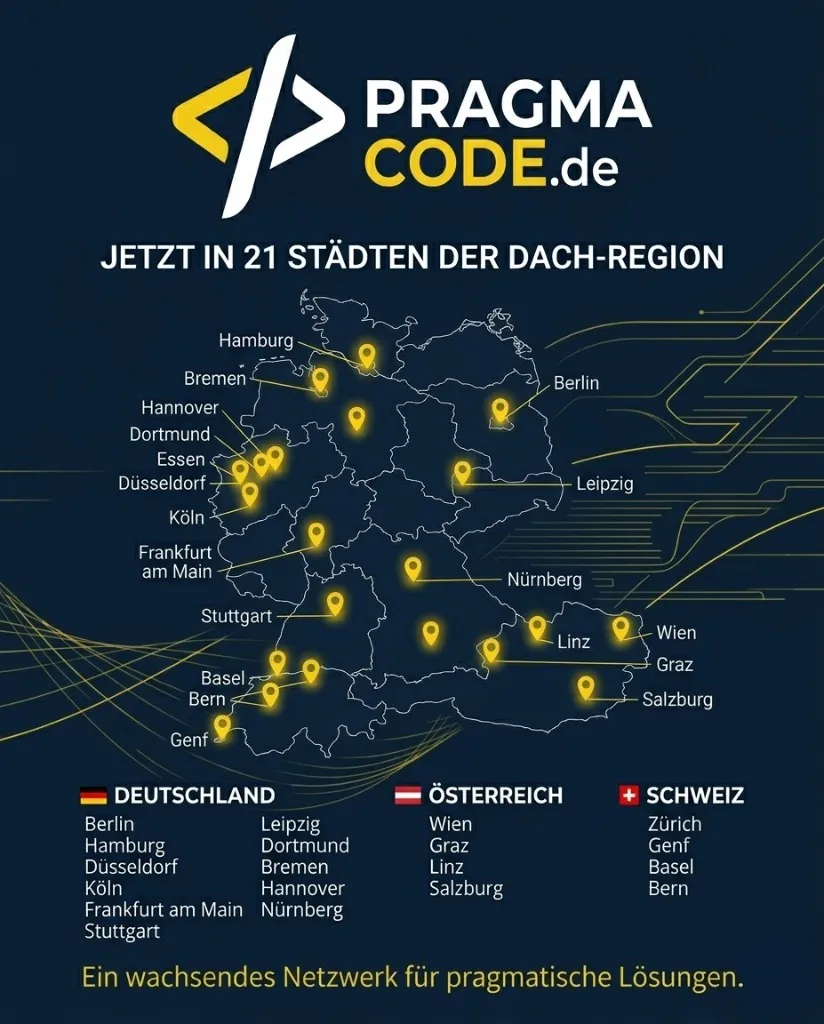
We are your digital partner – regionally anchored and successfully scaling across borders.
Have a vision?
Let's check together how we can make your idea take flight.
Book your free strategy call nowExtended Specialized Glossary
Shadow AI
The unsanctioned and unregulated use of generative AI tools by employees on corporate devices without IT approval.
Zero Data Retention (ZDR)
A contractual and technical guarantee by AI providers ensuring that submitted prompts are not stored and not used for model training.
Data Loss Prevention (DLP)
Automated security mechanisms and inspection filters designed to detect, mask, or block sensitive corporate data in transit.
Enterprise LLM Gateway
A centralized proxy and orchestration server aggregating company-wide AI traffic, enforcing SSO, and logging compliance audits.