


In 2026, the grace period for Artificial Intelligence in European SMEs has officially come to an end: The EU AI Act is now actively enforced by market surveillance authorities. But how do IT leaders and developers audit existing n8n pipelines, OpenAI/Claude APIs, RAG systems, and internal chatbots in daily operations? This technical guide provides a battle-tested 5-step audit protocol, an interactive compliance risk grid, and concrete code patterns for audit-proof hardening.
This article is an in-depth expert contribution from our content cluster. Discover the complete overview on our main page: IT Security & Compliance →
From Prompt Experimentation to Regulatory Stress Tests
While 2024 and 2025 were characterized by rapid experimentation with generative AI, internal hackathons, and quickly assembled n8n workflows, 2026 has ushered in a new reality: The transition periods of the EU AI Act have expired. European market surveillance authorities are actively inspecting deployments, demanding verifiable proof of risk classifications, data flows, and control mechanisms. This technical guide provides the operational playbook for IT leaders.
- Operational Execution over Legal Theory: High-level legal opinions are no longer sufficient in 2026. IT directors and lead engineers must be able to audit every individual API call, n8n pipeline, and vector database against the AI Act's risk tiers and Article 50 obligations.
- The 5-Step Technical Audit Protocol: From discovering unsanctioned Shadow AI and conducting risk triage to embedding programmatic Human-in-the-Loop gateways and tamper-proof audit logging, SMEs can establish comprehensive compliance in five phases.
- Automated Governance & C2PA Provenance: Synthetic media and public-facing chatbot interactions must now carry machine-readable provenance metadata (C2PA / SynthID) and accessible frontend transparency badges meeting WCAG AAA standards.
- Eliminating Executive Liability: By maintaining a documented audit checklist and an active risk management system, executives fulfill their fiduciary duty of care and protect their organization from fines reaching up to €35 million or 7% of global annual turnover.
- 1. The Operational Scope: Which SME AI Workflows Must Be Audited Now
- 2. The Compliance Risk Grid: Traffic-Light System for Enterprise AI
- 3. The 5-Step Technical Audit Protocol for Engineers & IT Leaders
- 4. Production Code & Architecture Patterns (n8n, API Wrappers & Frontend)
- 5. The CTO, Executive & Compliance Officer Audit Checklist
- 6. Maximizing Synergies: Aligning AI Act with NIS2, GDPR, and ISO 27001
- 7. Conclusion & Strategic Roadmap: Compliance as an Operational Moat
1. The Operational Scope: Which SME AI Workflows Must Be Audited Now
The most widespread misconception among mid-market companies remains: "We don't train foundational frontier models like OpenAI or Google—therefore, the EU AI Act does not apply to us." This is a dangerous fallacy with severe liability implications. European AI regulation strictly distinguishes between Providers and Deployers. Almost every modern SME utilizing AI-powered SaaS solutions, API integrations, or automated workflow pipelines qualifies legally as a deployer.
Over the past 24 months, organizations have integrated AI capabilities into core operations at unprecedented speed. Often, this occurred decentralized within marketing, sales, or HR—bypassing central security review. An effective technical audit must rigorously examine four architectural tiers:
1. LLM API Gateways & Wrappers
Direct REST or SDK connections to OpenAI (GPT-4o, o3), Anthropic (Claude 3.5/3.7), Google Vertex AI, or Mistral. Crucial audit factors include what data (especially personally identifiable information or proprietary trade secrets) is transmitted in prompts and whether vendor data retention flags are configured correctly.
2. Low-Code Pipelines (n8n / Make)
Visual workflow automations that parse incoming emails, classify invoices via OCR, enrich CRM records, or generate automated quotes. These pipelines frequently lack programmatic Human-in-the-Loop validation gates before triggering external actions (Human-in-the-Loop).
3. Local RAG & Vector Databases
Retrieval-Augmented Generation architectures (e.g., powered by PostgreSQL pgvector, Qdrant, or Pinecone) indexing internal wikis, Confluence workspaces, PDF technical manuals, and customer support histories. Audits must ensure document-level access permissions are strictly enforced.
4. Autonomous Voice & Chat Agents
Customer-facing systems deployed on websites, WhatsApp Business API, or telephony centers. Under Article 50 of the AI Act, these interfaces are subject to strict mandatory transparency and disclosure rules from the first moment of interaction.
Without a structured audit protocol, IT leaders cannot identify where unsanctioned Shadow AI persists, which sensitive data flows leave the European perimeter, and which automated workflows inadvertently trigger the stringent obligations of Annex III High-Risk AI.
2. The Compliance Risk Grid: Traffic-Light System for Enterprise AI
The EU AI Act adopts a risk-based regulatory philosophy: It regulates specific use cases rather than the underlying algorithms. To provide clear operational clarity for engineering teams and management, Pragma-Code created the Compliance Risk Grid, categorizing common mid-market use cases into the four legal tiers:
Unacceptable Risk
- Emotion recognition of employees in the workplace or hiring calls
- Real-time remote biometric identification in publicly accessible spaces
- Social scoring and behavioral evaluation leading to detrimental treatment
- Subliminal manipulative techniques altering human behavior to cause harm
High-Risk Systems
- Automated screening, ranking, and CV scoring in recruitment pipelines
- AI-assisted creditworthiness assessments and risk scoring for clients
- Critical process automation in energy, water, or healthcare infrastructure
- Access evaluations for educational or vocational training admissions
Transparency Obligations
- AI chatbots on corporate websites (clear disclosure upon initial contact)
- Voice agents in telephony centers (auditory disclosure: "You are speaking with an AI assistant")
- Synthetic marketing assets, generated imagery (Flux, Midjourney), and deepfakes
- AI-generated editorial articles published without substantive human editorial review
Minimal & No Risk
- AI-assisted code completion (GitHub Copilot, Cursor) for software engineers
- Spam, malware, and phishing detection filters in email gateways
- Internal operational data aggregation & visualization without personal profiling
- Grammar checking, translation (DeepL), and drafting with mandatory human review
Beware of the Automated Recruiting Trap!
Many SMEs have recently adopted tools that parse incoming applicant resumes with LLMs, generate applicant summaries, and output an automated "Fit Score (1–100)". If this score influences automated rejections or candidate filtering, the AI Act automatically classifies the tool as an Annex III High-Risk AI System. Deploying such systems without an audited risk management framework represents a direct regulatory breach.
3. The 5-Step Technical Audit Protocol for Engineers & IT Leaders
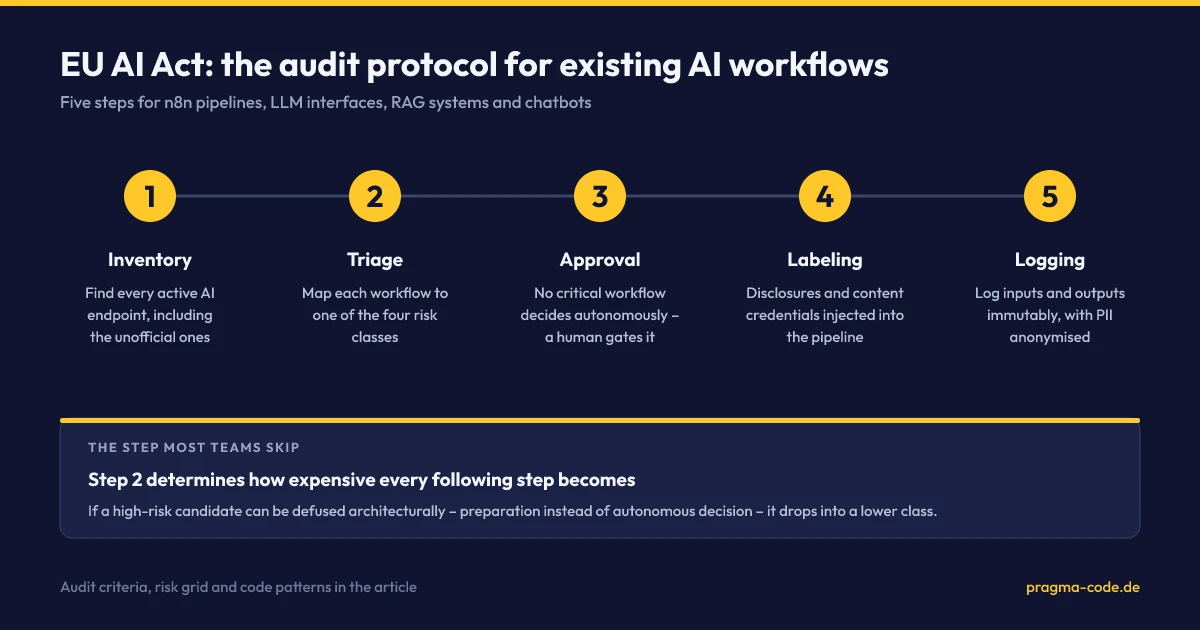
To bring an organization into full AI Act compliance within a matter of weeks, engineering and compliance teams require a structured, repeatable technical review process. Pragma-Code's 5-Step Audit Protocol guides IT departments systematically through discovery, classification, and architectural remediation:
Conduct a comprehensive scan of all AI endpoints across the organization. Inspect DNS query logs, cloud billing statements, GitHub/GitLab repositories, n8n workflow databases, and browser extension policies. Output a central AI Asset Inventory detailing providers, model versions, processed data tiers, and hosting jurisdictions.
Systematically evaluate each inventoried pipeline against the AI Act's four risk tiers. Determine whether workflows fall under Annex III (High Risk) or Article 50 (Transparency). For borderline high-risk candidates, evaluate architectural refactoring (e.g., converting automated decisioning into human decision-support) to downgrade regulatory exposure.
Engineer programmatic approval gates into automation pipelines. Critical workflows must not execute autonomous write operations on production databases. Implement approval nodes in n8n, Slack interactive webhook gates, or dual-custody verification modals in internal dashboards to ensure ultimate authority remains with trained human staff.
Implement mandatory disclosures and content credentials. For chatbots and telephony voice agents, embed accessible disclosures upon session initiation. For AI-generated marketing imagery and video assets, inject cryptographic C2PA manifests and invisible digital watermarks (SynthID) directly into automated rendering pipelines.
Establish centralized prompt and transaction governance. Log all mission-critical AI inputs and outputs into immutable, queryable audit tables while enforcing automated PII anonymization to maintain GDPR compliance. Establish incident response runbooks for model drift, severe hallucinations, or security bypasses.
Executing these five phases not only shields the organization from regulatory penalties but substantially elevates system reliability, data hygiene, and operational resilience.
4. Production Code & Architecture Patterns (n8n, API Wrappers & Frontend)
To help development teams implement these audit requirements immediately, here are three production-tested code patterns commonly integrated during our engineering audits.
4.1. n8n Architecture: Human-in-the-Loop Approval Node
In low-code pipelines, an LLM agent should never trigger direct commercial or customer-facing actions without intermediate approval. The following node structure implements an asynchronous Wait-for-Approval pattern:
{
  "nodes": [
    {
      "name": "Webhook Inbound Lead",
      "type": "n8n-nodes-base.webhook",
      "position": [100, 300]
    },
    {
      "name": "AI Draft Generator (LLM)",
      "type": "@n8n/n8n-nodes-langchain.agent",
      "position": [320, 300]
    },
    {
      "name": "Slack Approval Request",
      "type": "n8n-nodes-base.slack",
      "parameters": {
        "channel": "#ai-approvals",
        "text": "🚨 New AI Draft Ready for Review: \n*Client:* {{ $json.customerName }}\n*Proposal:* {{ $json.aiProposal }}\n\nPlease review and approve in dashboard."
      },
      "position": [540, 300]
    },
    {
      "name": "Wait For Webhook Approval",
      "type": "n8n-nodes-base.wait",
      "parameters": {
        "resume": "webhook",
        "webhookId": "approval-hook-xyz"
      },
      "position": [760, 300]
    },
    {
      "name": "Execute Final Action",
      "type": "n8n-nodes-base.httpRequest",
      "position": [980, 300]
    }
  ]
}
4.2. TypeScript / Node.js: Compliant Audit-Logging API Wrapper
To ensure all outbound model interactions are logged for regulatory auditing while preventing sensitive PII from leaking to third-party model providers, wrap API calls with a proxy handler:
import { OpenAI } from 'openai';
import { maskPII } from './security/pii-masker';
import { db } from './database/audit-logger';

const openai = new OpenAI({ apiKey: process.env.OPENAI_API_KEY });

export async function executeCompliantAiCall(params: {
  userId: string;
  workflowId: string;
  systemPrompt: string;
  userPrompt: string;
  model: string;
}) {
  const startTime = Date.now();

  // 1. GDPR Protection: Redact PII (names, emails, bank accounts) before transmission
  const sanitizedPrompt = maskPII(params.userPrompt);

  try {
    // 2. Outbound request to model provider
    const response = await openai.chat.completions.create({
      model: params.model,
      messages: [
        { role: 'system', content: params.systemPrompt },
        { role: 'user', content: sanitizedPrompt }
      ],
      temperature: 0.2
    });

    const outputText = response.choices[0]?.message?.content || '';
    const latencyMs = Date.now() - startTime;

    // 3. Immutable audit logging (EU AI Act Art. 12 & Art. 50)
    await db.aiAuditLogs.insert({
      userId: params.userId,
      workflowId: params.workflowId,
      modelUsed: params.model,
      tokenCount: response.usage?.total_tokens ?? 0,
      latencyMs: latencyMs,
      timestamp: new Date().toISOString(),
      complianceStatus: 'COMPLIANT_HUMAN_IN_THE_LOOP_PENDING'
    });

    return {
      success: true,
      data: outputText,
      auditLogged: true
    };
  } catch (error) {
    // Incident logging for API failures, safety triggers, or rate-limit blocks
    await db.aiIncidentLogs.insert({
      workflowId: params.workflowId,
      error: (error as Error).message,
      timestamp: new Date().toISOString()
    });
    throw error;
  }
}
4.3. Frontend: WCAG AAA Compliant AI Transparency Badge
When presenting AI-generated summaries, recommendations, or customer support responses in user portals, Article 50 mandates clear visual disclosure. Here is how the live component renders in the browser:
Developers can embed the following accessible HTML snippet directly into their frontend components:
<!-- WCAG AAA Accessible AI Transparency Banner -->
<div class="ai-generated-banner" role="status" aria-live="polite">
<span class="ai-badge-icon" aria-hidden="true">🤖</span>
<span class="ai-badge-text">
<strong>AI-Generated Summary:</strong> This content was generated by an AI assistant and verified by human staff.
</span>
<a href="/en/privacy-policy#ai-transparency" class="ai-badge-link">
Transparency Details <span aria-hidden="true">→</span>
</a>
</div>5. The CTO, Executive & Compliance Officer Audit Checklist
Corporate directors bear personal responsibility for ensuring statutory compliance across enterprise IT. Use this structured checklist to benchmark your organization's readiness:
Does a complete inventory exist listing all AI tools, SaaS assistants, and API credentials used across every department? Have all teams been screened for unsanctioned Shadow AI accounts?
Have all automated use cases been formally classified? Is it confirmed that no prohibited systems (emotion tracking) or unregulated high-risk deployments (automated resume filtering) are active?
Are technical approval gates embedded into all mission-critical workflows to guarantee human sign-off prior to execution?
Do web chatbots, voice assistants, and synthetic marketing assets clearly inform users of their artificial nature upon initial engagement?
Are executed Data Processing Agreements (DPAs) in place with all AI vendors (OpenAI, Anthropic, Google, Microsoft) with zero-retention flags activated to prevent data training?
Are employees systematically trained in the safe, lawful use of AI systems (mandated under Article 4)? Has an internal AI Usage Policy been acknowledged in writing?
6. Maximizing Synergies: Aligning AI Act with NIS2, GDPR, and ISO 27001
A common concern among business leaders is regulatory overload. However, when approached strategically, the EU AI Act should not be treated in isolation. It integrates seamlessly into existing cybersecurity and governance frameworks:
GDPR (Privacy by Design)
GDPR safeguards personal data against unauthorized processing. Implementing automated prompt sanitization and PII masking during your AI audit directly satisfies GDPR Articles 25 and 32 (Privacy by Design and Security of Processing).
NIS2 Directive
NIS2 requires organizations to manage cybersecurity risks throughout their digital supply chain. Because third-party LLMs operate via cloud APIs, your AI Act audit simultaneously covers required third-party vendor risk assessments.
ISO 27001 / TISAX
Audit logging, access control policies, and incident response procedures required for AI Act compliance can be mapped directly into your existing Information Security Management System (ISMS) under ISO/IEC 27001.
SME Grants & Subsidies
Investments in securing and auditing AI infrastructure often qualify for substantial public subsidies and innovation grants across European jurisdictions, offsetting advisory costs by up to 50%.
7. Conclusion & Strategic Roadmap: Compliance as an Operational Moat
The EU AI Act in 2026 is not an obstacle to innovation—it separates undisciplined experimenters from reliable market leaders. Organizations that audit their AI infrastructure now, remediate architectural gaps, and demonstrate transparent compliance will secure the most valuable asset in the digital economy: customer trust and verifiable enterprise readiness.
Enterprise buyers and public procurement bodies already require proof of compliant AI governance from their supply chains. Having an audited AI Act verification protocol secures lucrative B2B contracts while unprepared competitors face exclusion or costly legal injunctions.
"In AI systems, security and compliance are not emergency brakes—they are the anti-lock braking system (ABS) that enables enterprises to automate at full speed with complete confidence."
Next Steps with Pragma-Code
Are you looking to ensure that your n8n pipelines, API integrations, and internal AI assistants fully comply with the EU AI Act 2026? The engineering team at Pragma-Code conducts rigorous technical audits, delivers audit-proof documentation, and hardens your automation architecture for production excellence.
And who keeps this current in day-to-day operation?
Logging, human oversight and a documented model and version state are not a one-off task — they go stale with every model change and every silent fallback. The Agent Operations product line takes exactly that over on an ongoing basis: monitoring, a monthly quality sample against a fixed set of test cases and, in the "Operations & Evidence" tier, the AI-Act-relevant documentation. From €390 per month, cancel monthly.
Our Regional Expertise
We are your digital partner – regionally anchored and successfully scaling across borders.
Are your AI workflows ready for regulatory inspection?
Pragma-Code conducts comprehensive technical AI Act audits for your APIs, n8n automation pipelines, and RAG architectures—complete with audit-proof documentation.
Request Technical AI Act AuditExtended Specialized Glossary
AI Act Audit Protocol
A structured technical auditing process designed to systematically discover, classify, and secure all AI workflows, API integrations, and data pipelines across an organization.
Human-in-the-Loop Gateway
A programmatic checkpoint within an automation chain (e.g., in n8n or backend microservices) that pauses autonomous execution until an authorized human specialist explicitly approves the action.
Annex III (High-Risk AI)
The annex of the EU AI Act listing specific high-risk use cases—including HR recruiting/resume screening, credit scoring, access to essential services, and critical infrastructure management.
Prompt Governance
The programmatic enforcement of data protection policies on outbound LLM API requests—including automatic PII redaction, token rate limiting, and version-controlled system prompts.
Shadow AI
The unsanctioned use of generative AI tools and private API keys by employees or departments without governance, monitoring, or security auditing by the central IT team.