

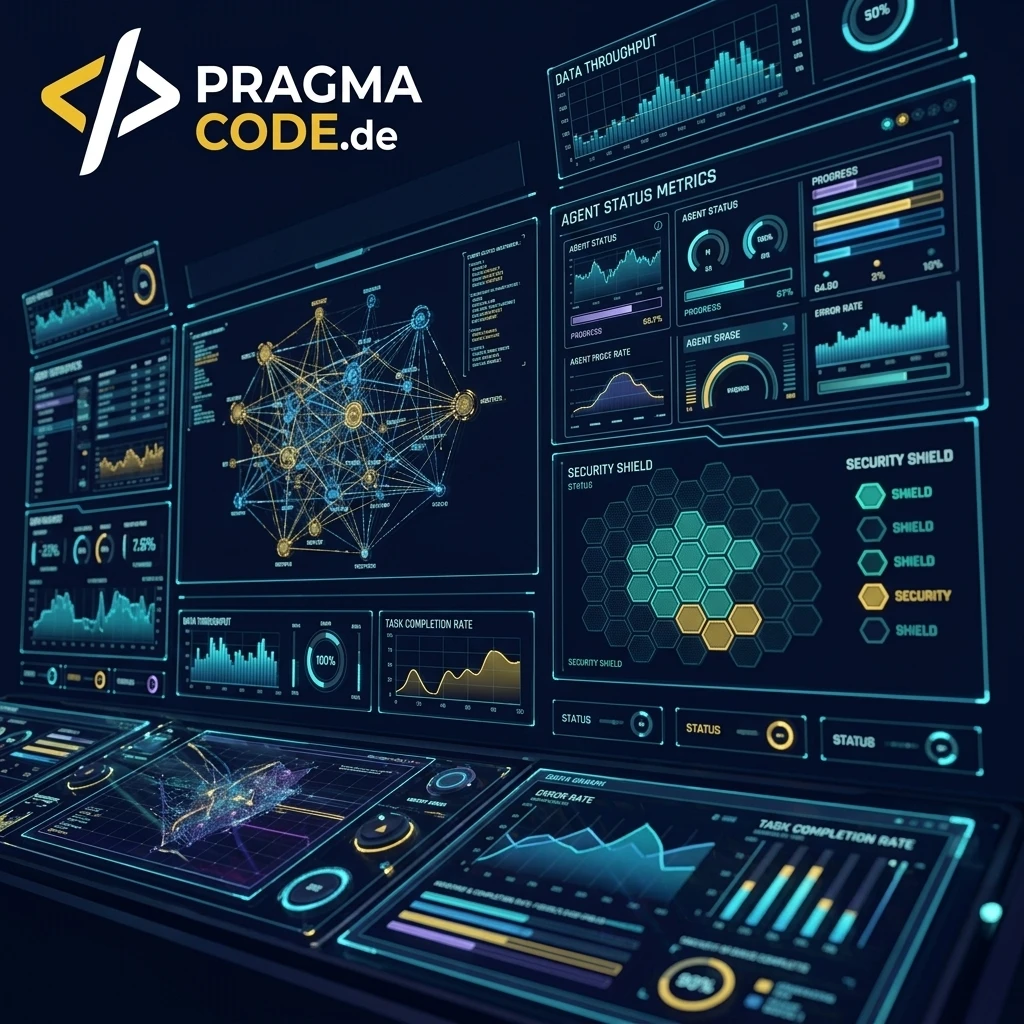
Multi-agent systems transform SMEs into highly productive engines. Yet without a central AI Control Tower, shadow agents, runaway token costs, and EU AI Act compliance violations loom. Learn how medium-sized enterprises govern AI agents securely and efficiently.
This article is an in-depth expert contribution from our content cluster. Discover the complete overview on our main page:AI & Automation Solutions →
The Anchor of Digital Sovereignty
In 2026, competitive advantages stem no longer from isolated prompts, but from orchestrated multi-agent systems. Any enterprise deploying dozens of autonomous agents requires a central AI Control Tower to guarantee transparency, security, and maximum return on investment.
- The Scaling Dilemma: Transitioning from basic chatbots to autonomous multi-agent networks creates immense productivity gains. However, without centralized governance, it invites shadow agents, sensitive data leaks, and runaway API expenses.
- The AI Control Tower as an Operating System: It unifies five key pillars: LLM Observability, Agentic Audit Trails for the EU AI Act, dynamic Token Cost Control, granular MCP access management, and automated circuit breakers.
- SME Success Factor: Medium-sized enterprises can build enterprise-grade governance using modern open-source foundations (such as LiteLLM, Langfuse, n8n, and LangGraph) while retaining complete sovereignty over their data and workflows.
- 1. The Shift from Chatbots to Agent Swarms
- 2. Why SMEs Need an AI Control Tower
- 3. The 5 Pillars of a Modern AI Control Tower
- 4. Comparison: Uncontrolled Chaos vs. Governed Control Tower
- 5. Architecture, MCP Tooling & FinOps Economics
- 6. Practical SME Use Cases
- 7. EU AI Act Compliance Deep Dive: 4 Core Pillars
- 8. Incident Response Playbook: 4-Step Emergency Plan
- 9. Roadmap: 5 Steps to Governed Agent Operations
- 10. Conclusion & Outlook
1. The Shift from Chatbots to Agent Swarms
The evolution of Artificial Intelligence within enterprise environments crossed a historic threshold in 2026. While 2023 and 2024 were dominated by standalone Large Language Models (LLMs) like ChatGPT or basic support chatbots, modern value creation in medium-sized enterprises is driven primarily by autonomous, collaborative multi-agent swarms.
A single AI agent is no longer tasked merely with drafting an email. Instead, specialized agent teams collaborate in closed execution loops: A research agent discovers customer requests in the ticketing system, a data agent queries ERP records, a domain agent calculates custom quotations via standardized interfaces powered by the Model Context Protocol (MCP), and a compliance agent validates statutory obligations before any database transaction is finalized. This coordinated form of multi-agent orchestration slashes business processing times from days to milliseconds.
However, as autonomous actors proliferate across the enterprise IT landscape, operational risks expand exponentially. When dozens of agents independently invoke APIs, execute database writes, and initiate multi-step inference chains across frontier foundation models (such as Claude 3.7 Sonnet, OpenAI o3, or Gemini 2.5), traditional IT monitoring collapses without specialized command centers. In the absence of structured guardrails, rogue shadow agents emerge, causing unbudgeted token consumption and critical security vulnerabilities.
Expert Tip: The Principle of Least Privilege (PoLP) for AI Agents
Never grant AI agents broad administrative credentials or unrestricted database write tokens. Every agent must operate under an isolated service account with strictly scoped, time-bound read, write, and execution privileges dynamically verified by the AI Control Tower.
2. Why SMEs Need an AI Control Tower
Small and medium-sized enterprises (SMEs) face a triple challenge when deploying multi-agent systems: stringent statutory regulations, constrained operational budgets, and rising cyber resilience requirements. While large corporations can establish entire AI governance departments, SMEs require automated, lean architectural solutions.
An AI Control Tower acts as the central command center for all active AI assistants and workflow agents across the enterprise. It monitors data flows, enforces security policies, and delivers real-time governance metrics. Without such an instance, three critical failure modes inevitably emerge in practice:
Cost Explosion from Uncontrolled Agent Loops
If two agents enter recursive execution loops or execute uncapped retry routines, thousands of dollars in API charges can accumulate within hours.
Non-Compliance with the EU AI Act
European AI regulations mandate transparency, risk management, and complete auditability for mission-critical AI deployments. Operating without audit trails exposes executive leadership to severe liability.
Prompt Injection & Data Exfiltration
Agents with direct access to sensitive corporate databases can be manipulated via indirect prompt injections within supplier files, leaking proprietary records to external endpoints.
3. The 5 Pillars of a Modern AI Control Tower
An enterprise-grade AI Control Tower for SMEs rests on five integrated functional pillars designed to integrate seamlessly into modern IT architectures:
1. LLM Observability & Telemetry
Comprehensive visibility into token consumption, latency benchmarks, task success rates, and hallucination scores across all connected inference backends – from hyperscaler APIs (Anthropic, OpenAI, Google) to local private inference.
2. Agentic Audit Trail & Compliance
Immutable, cryptographically verifiable logging of all reasoning paths, prompt templates, tool execution parameters, and model outputs to ensure strict compliance with GDPR accountability and EU AI Act standards.
3. Dynamic Token Cost Control & Multi-LLM Routing
Automated workload routing that delegates simple extraction tasks to cost-effective Small Language Models (SLMs) while reserving expensive frontier models for high-level reasoning, backed by enforced monthly budget caps.
4. Identity & Tool Governance (IAM & MCP Shield)
Granular access control determining which agents can invoke specific MCP servers, databases, or third-party webhooks – complete with Zero-Trust authentication and automated credential rotation.
5. Circuit Breaker & Incident Management
Automated kill switches that detect anomalous token surges, erratic execution patterns, or unauthorized tool parameters, instantly quarantining compromised agents and notifying security engineers.
"AI Governance is not an administrative brake pedal – it is the foundation of operational velocity: Only enterprises with total visibility and control over their autonomous agents can scale them fearlessly across core business processes."
4. Comparison: Uncontrolled Chaos vs. Governed Control Tower
The operational gap between unmanaged shadow AI scripts and a centrally governed multi-agent architecture is immediately apparent in day-to-day enterprise execution:
Comparison: Uncontrolled Chaos vs. Governed AI Control Tower
- API Keys: Hardcoded in local scripts or scattered untracked across workstations.
- Cost Control: Discovered retrospectively when monthly hyperscaler invoices arrive.
- Security: Zero upstream filtering for indirect prompt injections or unauthorized data leaks.
- Compliance: No audit logging; immediate legal exposure for managing directors under the EU AI Act.
- Debugging: Frantic log hunting across disparate containers during unexpected agent failures.
- API Keys: Centralized vault with automatic key shielding, token quotas, and rotation.
- Cost Control: Real-time telemetry dashboards, departmental budget ceilings, and dynamic model routing.
- Security: Bidirectional guardrails filtering malicious payloads and redacting sensitive PII.
- Compliance: Immutable Agentic Audit Trail fully aligned with EU AI Act standards.
- Debugging: Deep visual trace graphs capturing every decision node in real time via OpenTelemetry.
5. Architecture, MCP Tooling & FinOps Economics
A persistent myth among SMEs is that deploying an AI Control Tower necessitates seven-figure enterprise software contracts. In practice, a resilient, modular governance architecture can be engineered efficiently using proven open-source components and open standards:
1. LiteLLM Proxy & AI Gateway
Acts as the unified point of entry for all corporate agents. Coordinates dynamic load balancing, automatic provider failover, prompt caching, and global rate limiting across dozens of inference backends.
2. Langfuse & OpenTelemetry
Provides deep tracing into complex multi-agent graphs. Measures execution latencies, attributes token costs precisely by business unit, and captures immutable trace records for compliance audits.
3. NeMo Guardrails & Tool Governance
Active safety layer evaluating agent prompts and tool outputs in real time for jailbreaks, PII leaks, and hallucinations. Shields MCP servers and internal APIs from unauthorized command execution.
4. Hybrid: n8n & LangGraph
Pairs deterministic visual workflow automation via n8n for enterprise tool integration with cyclic stateful graph engines via LangGraph for complex, autonomous reasoning chains.
FinOps Governance & Dynamic Multi-LLM Routing
To keep API expenditures mathematically governed across multi-agent pipelines, the AI Control Tower introduces precise FinOps telemetry. Because multi-agent networks continuously pass intermediate reasoning chains between nodes, total inference expenditure follows the core FinOps equation:
The FinOps Cost Formula for Multi-Agent Networks
Cost = Σ [ (Tokens_In × Price_In + Tokens_Out × Price_Out) × (1 − Cache_Rate) ]
Where Tokens_In and Tokens_Out reflect the volume processed at node i, Price represents the specific pricing tier of the assigned model, and Cache_Rate quantifies the efficiency gain achieved through server-side prompt caching (e.g., for system prompts and tool schemas). By automatically downgrading routine classification tasks from expensive frontier models (~$15.00/M tokens) to self-hosted Small Language Models (~$0.20/M tokens), the Control Tower delivers cost reductions between 60% and 85%.
The operational impact of an enterprise AI Control Tower on monthly cloud expenditures and mean time to resolution (MTTR) is illustrated in the interactive benchmark below:
6. Practical SME Use Cases
The operational value of an AI Control Tower becomes most evident in traditional medium-sized industrial and wholesale environments:
Use Case A: Industrial Machinery Manufacturer (450 Employees, Custom Valve Engineering)
A specialized valve manufacturer deployed autonomous multi-agent pipelines to process global procurement tenders (RFPs) and client inquiries. Originally, agents operated independently with direct database access.
Following the integration of a centralized AI Control Tower, all operations funnel through the LiteLLM Gateway under rigid architectural boundaries:
Agents cross-reference technical specifications independently; however, commercial discounts above 5% require mandatory human approval from a sales engineer.
Standard lead-time requests are routed to local SLMs. Monthly API expenditures dropped sharply from €4,200 to under €680.
Every decision step is logged into an immutable Agentic Audit Trail, providing audit-proof quality documentation during client compliance reviews.
Use Case B: B2B Electronics Distributor (180 Employees)
An electronics distributor operates automated agent workflows for processing incoming freight invoices and customs documentation. Through an indirect prompt injection concealed within a PDF metadata payload, external attackers attempted to divert invoice remittances to unauthorized accounts.
The Control Tower’s embedded guardrail layer flagged the malicious instruction payload before it reached the foundation model. The circuit breaker instantly severed the affected pipeline from the accounting API and alerted the security operations team. The attack was repelled with zero financial or operational damage.
7. EU AI Act Compliance Deep Dive: 4 Core Pillars
With the full enforcement of the EU AI Act, enterprises utilizing autonomous AI agents in core business operations face binding statutory mandates. An AI Control Tower delivers the technical foundation for four critical articles of the regulation:
1. Article 12: Automatic Event Logging
Mandates continuous, tamper-resistant event logging throughout the lifecycle of an AI system. The Control Tower records every prompt, tool execution, and model output with cryptographic timestamps in an immutable audit store.
2. Article 14: Human Oversight
Requires technical mechanisms that enable human operators to supervise automated decisions, intervene, or halt execution pipelines instantly via emergency kill switches.
3. Article 15: Accuracy & Cyber Resilience
Prescribes robust safeguards against data poisoning, adversarial jailbreaks, and system manipulation. Bidirectional safety guardrails actively intercept prompt injections and protect system integrity.
4. Article 50: Transparency Obligations for Agent Interactions
Mandates that interactions between autonomous systems and external parties must be clearly identified as AI-generated. The Control Tower enforces standardized transparency headers across all communication channels.
8. Incident Response Playbook: 4-Step Emergency Plan
Operational anomalies in multi-agent environments require automated, deterministic intervention. When telemetry monitors detect security triggers (such as sudden token spikes or anomalous tool parameters), the 4-step emergency playbook activates automatically:
Automated Isolation & Quarantine
The circuit breaker revokes API tokens and database credentials for the suspect agent immediately, freezing execution graphs across all active worker threads.
Forensic Snapshot Preservation
Pipeline states, vector memory indices, and comprehensive telemetry traces are captured and committed to immutable storage for root-cause forensic analysis.
Human-in-the-Loop Alerting
The designated IT security team receives an immediate high-priority alert via webhook integrations (such as Teams, Slack, or PagerDuty) detailing the anomaly vector.
Patching & Controlled Rollback
Following prompt remediation or guardrail rule updates, the agent is validated inside an isolated staging sandbox prior to phased re-enablement in production.
9. Roadmap: 5 Steps to Governed Agent Operations
Implementing an AI Control Tower should follow a phased adoption plan to ensure operational continuity. The roadmap below outlines the proven deployment path for SMEs:
Identify all active AI tools, custom scripts, API keys, and browser extensions across the company. Map data flows and uncover unmanaged compliance exposures.
Deploy a LiteLLM Proxy gateway. Deprecate hardcoded API keys and transition all applications to centralized, quota-managed service accounts.
Connect Langfuse and OpenTelemetry collectors. Log all agent prompts, tool executions, and API expenditures in real time to fulfill EU AI Act obligations.
Establish automated safety filters: prompt injection scanners, PII redaction prior to model submission, and hard stop-loss financial triggers.
Optimize model selection: Automatically route routine agent queries to low-cost open-source models while reserving premier foundation models for complex logic.
10. Conclusion & Outlook
Building an AI Control Tower is the foundational prerequisite for forward-thinking SMEs seeking to scale Artificial Intelligence safely, compliantly, and profitably. Establishing robust governance infrastructure today eliminates liability exposure and unpredictable token costs while unlocking sustainable competitive advantages in the agentic era.
At Pragma-Code, we partner with medium-sized enterprises to design, architect, and deliver tailor-made AI Control Towers – GDPR-compliant, vendor-independent, and seamlessly aligned with your existing IT ecosystem.
Quick Check: Is Your Business Ready for Agent Governance?
Continuous Operations & Verification
Logging, human oversight, and a documented model versioning state are not one-off tasks — they erode with every model upgrade and silent fallback. The Agent Operations service line handles this continuously: monitoring, monthly benchmark sampling against standardized test suites, and audit-ready documentation under the EU AI Act. Starting from €390/month, cancelable monthly.
Ready to scale your AI agents securely and efficiently?
Schedule a Free Initial ConsultationOur Regional Expertise
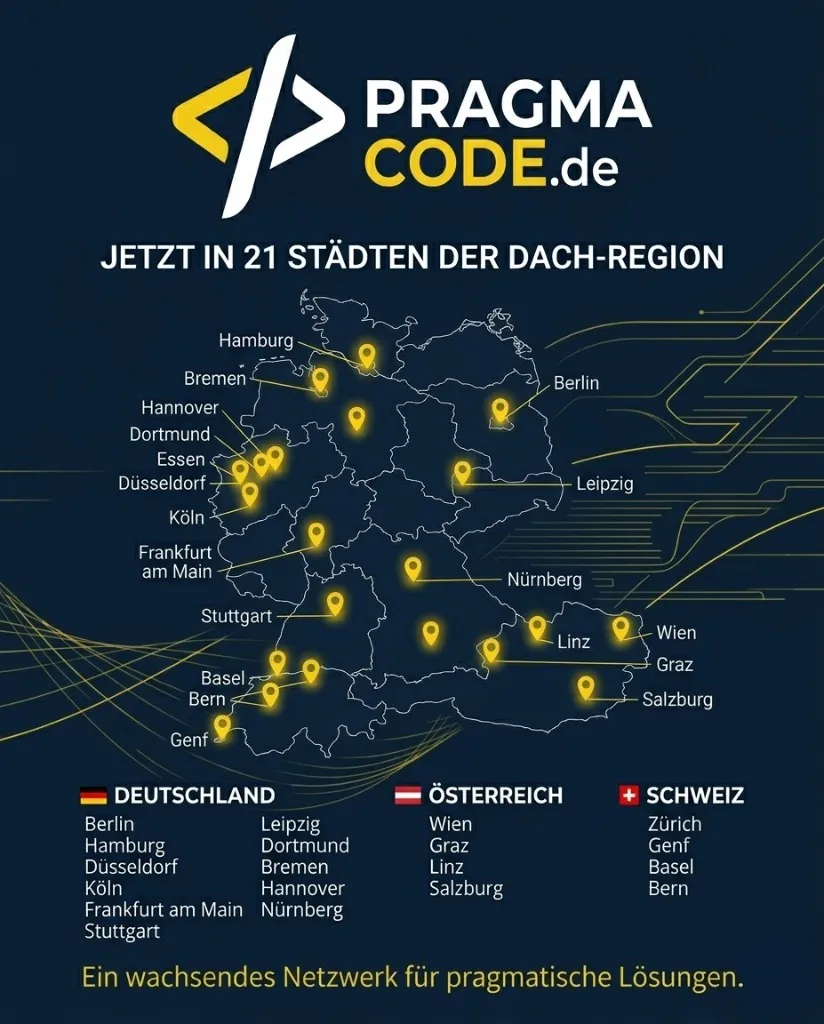
We are your digital partner – regionally anchored and successfully scaling across borders.
Have a vision?
Let's check together how we can make your idea take flight.
Book your free strategy call nowExtended Specialized Glossary
AI Control Tower
A central management and governance platform for real-time monitoring, permission management, cost control, and security enforcement across distributed AI agent systems.
Agentic Audit Trail
A comprehensive, immutable log of all decisions, tool executions, prompts, and model outputs of autonomous AI agents for compliance and auditing purposes.
LLM Observability
The continuous measurement of latency, token usage, task success rates, hallucination scores, and API costs across large language models.
Token Cost Control
Strategies and technical mechanisms (such as dynamic prompt caching, multi-LLM routing, and hard token budgets) to prevent runaway API fees.