

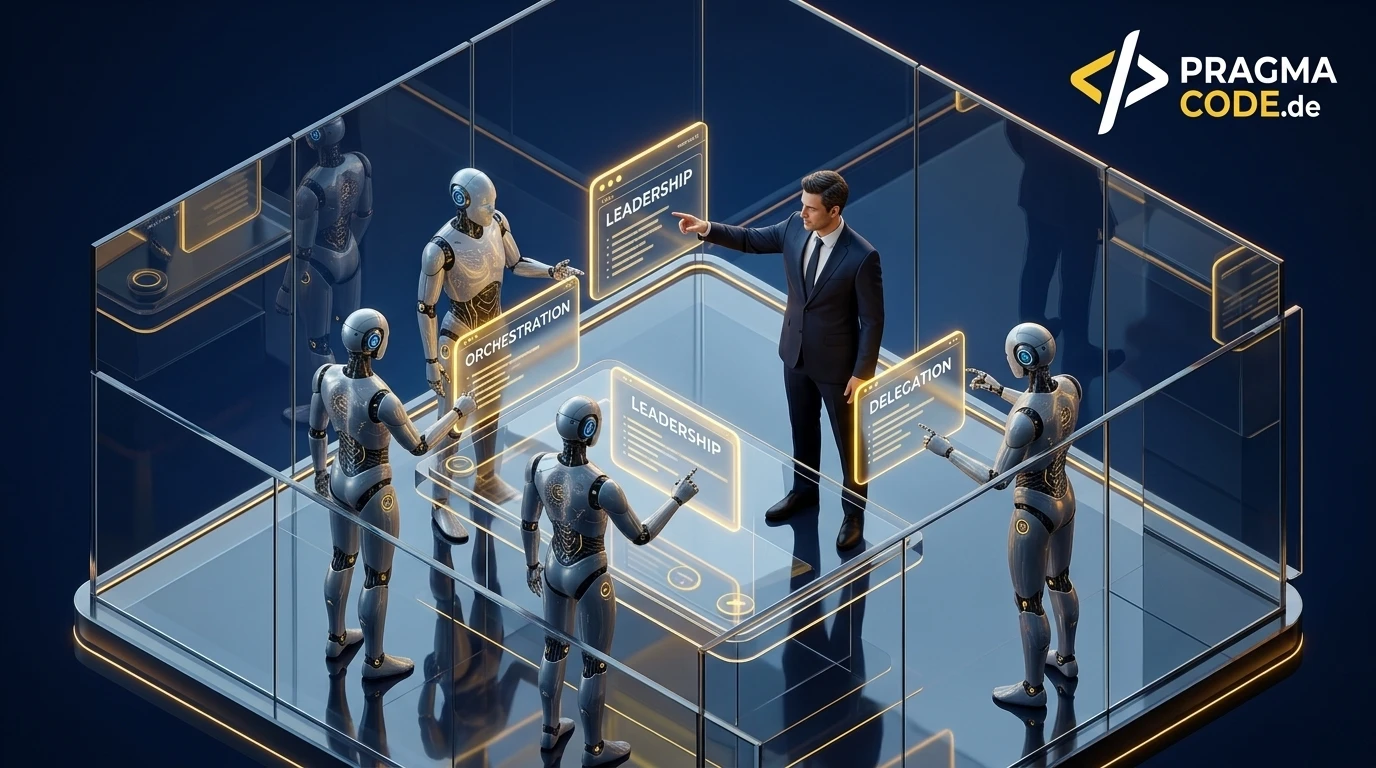
The era of trivial chatbot prompt tricks is over. If mid-sized enterprises want to deploy autonomous AI agents productively, they must stop trying to program them and start leading them. Why large language models must be understood as 'Alien Intelligence', why the Harvard Kennedy School identified leadership skills as the primary AI lever, and how hybrid organizations of humans and algorithms operate in real production environments.
This article is an in-depth expert contribution from our content cluster. Discover the complete overview on our main page: AI & Automation →
- Paradigm shift to „Alien Intelligence“: Modern frontier models and autonomous agents are neither conventional deterministic IT programs nor biological minds. They operate as non-linear, associative pattern processors. Those who attempt to program them deterministically fail; those who lead them like human team members scale operational output exponentially.
- Harvard Kennedy proof: Prompting is leadership work: Empirical management research proves that experienced leaders consistently achieve superior results with AI compared to technical specialists. Delegation, context definition, explicit boundary setting, and psychological safety steer AI agents far more reliably than syntactic prompt engineering tricks.
- Orchestration beats isolated silos (Span of Control): Trailblazing companies such as Leaders of AI demonstrate how 10 human professionals orchestrate 50 autonomous agents to drive enterprise growth. The decisive factors for mid-market SMEs are disciplined adherence to a span of control of 6 to 8 agents per orchestrator, standardized SOPs, and sovereign orchestration platforms such as n8n.
From prompt instruction recipient to autonomous coworker
As the hype surrounding isolated chatbot widgets subsides, real production-grade agentic architecture is taking root in competitive enterprises: Autonomous digital units conduct research, qualify inbound leads, deliver Tier-1 customer support, and reconcile ERP records. The bottleneck is no longer raw model inference speed, but the human capability to orchestrate multi-agent fleets strategically and error-free.
- 1. The Illusion of the Software Metaphor: Why We Are Dealing with Alien Intelligence
- 2. The Harvard Parallel: Why Great People Leaders Make the Best AI Conductors
- 3. Real-World Practice: A 60-Person Organization with 10 Humans and 50 AI Agents
- 4. Span of Control & Management Theory: No Agent Swarms Without Managerial Limits
- 5. The 5-Pillar Framework: Institutionalizing Agentic Leadership in the Enterprise
- 6. The 4-Stage Implementation Roadmap: From Isolated Tasks to a Sovereign Fleet
- 7. Conclusion: The Emerging Human Role as Conductor of Algorithmic Teams
1. The Illusion of the Software Metaphor: Why We Are Dealing with Alien Intelligence
Since the dawn of business computing, organizations have treated information technology through a deterministic cause-and-effect lens. A software engineer writes code in Python, Java, or C++, a compiler translates instructions into binary bytecode, and the processor executes each statement without deviation: Given input A, output B is guaranteed. Whenever anomalies occur, an engineer identifies a reproducible bug in the source code and eliminates it through debugging and unit tests.
With the widespread enterprise adoption of frontier LLMs from Anthropic, OpenAI, and Google, as well as specialized open-weight models, this mechanical paradigm has permanently unraveled. Yet, executive suites and IT managers across mid-sized businesses continue to commit a fundamental category error: They attempt to implement generative AI agents as if they were configuring a relational database or a monolithic ERP suite. They demand rigid deterministic responses, expect linear code execution, and experience immediate frustration when a model nuances an answer or hallucinates under ambiguous instructions.
Pro-Tip: The Alien Intelligence Paradox
Operating a generative language model like a legacy database squanders over 90 percent of its cognitive leverage. Treat modern frontier LLMs not as calculating engines, but as exceptionally well-read, rapid, yet context-dependent digital coworkers. Organizational triumph stems not from micro-syntactic scripting, but from institutional delegation and leadership.
In an in-depth conversation on the widely followed podcast ungeskriptet (YouTube), AI pioneer and founder of Leaders of AI, Dominic von Proeck, highlighted this cognitive shift: Frontier AI is fundamentally an Alien Intelligence. It is a non-biological, high-dimensional associative entity trained on trillions of tokens of human communication and behavioral data. While it possesses no biological consciousness, it simulates deductive reasoning, strategic argumentation, and lateral problem-solving with nuance that resembles an intelligent conversational partner far more than a spreadsheet.
Anyone managing such systems quickly discovers that language models mirror human conversational dynamics. They react to tone, clarity of context, and structured guidance. When a corporate executive casually remarks to an intern: „Quickly draft a market report on Product X“, the resulting deliverable is predictable: shallow, fragmented, and devoid of actionable substance. If the same manager submits an identical vague prompt to an AI model, the output is similarly disappointing. Yet, while everyone recognizes that the intern suffered from poor leadership, the executive instinctively blames the AI tool as immature or broken.
Comparison: Traditional Software Usage vs. Agentic Leadership
- Operator mindset: Submitting one-off prompts; searching for elusive „magic prompt“ hacks.
- Interaction flow: Manual, synchronous; constant copy-pasting across browser windows.
- Instruction quality: Ambiguous queries („Write an article on topic Y“) lacking context.
- Failure handling: Immediate frustration upon hallucinations; premature abandonment of the tool.
- Scalability: Linear; every task requires direct human presence and screen time.
- Operator mindset: Executive conductor and author of robust Standard Operating Procedures.
- Interaction flow: Autonomous, asynchronous; multi-agent fleets communicating over shared state.
- Instruction quality: Explicit role definition, ground-truth knowledge bases, and verifiable KPIs.
- Failure handling: Systematic debugging of SOP guidelines, schema guardrails, and automated checks.
- Scalability: Exponential; autonomous agents execute workflows 24/7 across business units.
The imperative for forward-looking leadership is clear: We must stop treating autonomous agents as static software scripts. We must learn to manage and direct them as a distinct, alien workforce. This requires a profound evolution in executive capabilities – an evolution now substantiated by empirical management science.
2. The Harvard Parallel: Why Great People Leaders Make the Best AI Conductors
For several years, enterprise recruitment fixated on „Prompt Engineers“ – individuals purporting to hold specialized linguistic formulas capable of unlocking extraordinary outputs from language models. Tech blogs and recruitment agencies promised lucrative salaries for this narrow specialty. However, as frontier models grew increasingly robust against ambiguous phrasing, the illusion of syntactic prompt tricks dissolved.
Replacing technical prompt tricks is foundational management excellence. A landmark empirical study conducted by the Harvard Kennedy School alongside leading research bodies revealed a striking correlation: Professionals with proven, superior delegation and leadership skills when managing human teams consistently extract far higher performance from AI agents than pure software engineers or technical specialists.
The inverse finding is equally consequential: Employees who master directing autonomous AI agents with precision, clarity, structured feedback, and psychological safety develop the exact leadership competencies required for senior executive mandates. Managing autonomous AI pipelines has quietly become the premier training ground for next-generation corporate leaders.
Why does traditional leadership prowess correlate so directly with agentic success? The answer lies in the essential mechanics of effective delegation:
1. Comprehensive Strategic Contextualization
Ineffective managers delegate isolated tasks without explaining overarching corporate objectives. Exceptional leaders frame the entire mission: Who is the target audience? What tone is expected? What constraints exist? Autonomous agents require precisely this contextual grounding in their system prompts. When background knowledge is missing, stochastic generation fills the vacuum with generic platitudes.
2. Establishing Guardrails and Escalation Boundaries
True leadership is neither blind trust nor suffocating micromanagement. Seasoned leaders set clear operating boundaries: Under what conditions may the agent execute autonomous transactions? At what sentiment threshold must a distressed customer be transferred to a senior human specialist? An agent lacking escalation rules is an organizational liability; an agent bounded by strict governance is an enterprise multiplier.
3. Iterative Feedback and Root-Cause Refinement
When an employee delivers a substandard briefing, an adept executive analyzes the breakdown: Was the instruction ambiguous? Was reference data omitted? How must team protocols be updated to prevent recurrence? The same principle applies to autonomous agents: When an agent produces an inaccurate draft, the root issue is rarely model failure, but an unrefined Standard Operating Procedure (SOP).
This insight represents a profound strategic advantage for mid-market businesses. SMEs do not need to hire dozens of niche prompt engineers. Instead, they must empower experienced department heads, sales executives, and operations managers to translate their real-world expertise into standardized agent operating manuals. This philosophy underpins our advisory work at Pragma-Code, as explored in our guide on AI in the Job Market: Opportunity or Wave of Layoffs for SMEs?.
3. Real-World Practice: A 60-Person Organization with 10 Humans and 50 AI Agents
The operational validity of this model is demonstrated by trailblazers like Dominic von Proeck at Leaders of AI. Today, the organization operates with an active workforce of approximately 60 „collaborators“ – of whom only 10 are biological human beings. The remaining 50 contributors are specialized, autonomous AI agents seamlessly woven into day-to-day operations.
Such an operating model often triggers skepticism among traditional executive boards: How can a lean team of ten individuals manage fifty autonomous software agents without descending into operational paralysis? The answer lies in breaking complex business processes down into granular, highly specialized role profiles. Rather than attempting to build a brittle, monolithic „omni-agent“ that handles everything from accounting to outbound marketing, high-performing teams deploy specialized swarms of focused sub-agents.
Consider the architecture of an end-to-end B2B sales and onboarding customer journey within such a hybrid organization:
When an enterprise prospect registers for an industry briefing, an inbound agent inspects the company domain, extracts revenue figures, employee headcount, and existing software infrastructure via verified public databases and LinkedIn APIs, generating an executive one-page briefing for the sales director.
Once a calendar invitation is confirmed, the preparation agent synthesizes historical interaction logs, generates targeted diagnostic questions for the consultation call, and syncs the customized dossier directly into the account executive CRM record.
The core strategic dialogue is conducted exclusively by an experienced human executive. Empathy, emotional intelligence, strategic alignment, and interpersonal trust remain uniquely human faculties that no algorithmic model can replicate.
Following the call, the sales representative records a 45-second voice memo: „Client agreed to Package Tier B, 30-day payment term, kick-off on the first of next month.“ The contract agent generates the legally vetted proposal, triggers electronic signatures, and monitors completion deadlines.
Upon contract execution, the onboarding agent provisions client portal access, initiates security credentials, sends structured welcome guides, and monitors initial platform telemetry, automatically escalating anomalies to human engineers.
This workflow highlights the extraordinary economic leverage: Human professionals are relieved of repetitive clerical overhead, manual CRM maintenance, and routine follow-up tasks. They dedicate their energy entirely to high-impact strategic initiatives, creative architecture, and client relationships. Simultaneously, this setup exposes a critical operational hazard that von Proeck underscored: The Emergence of Agent Silos.
When autonomous agents are built in isolation without a unified communication fabric, organizations replicate the worst dysfunctions of corporate bureaucracy: Departmental silos. In one candid retrospective, von Proeck shared how a dedicated content creation agent named „Jürgen“ produced outstanding technical articles for weeks – yet because the agent was disconnected from real-time sales discussions, its editorial output completely diverged from the products the commercial team was actively selling. The fix was integrating all agents into shared team messaging channels (such as Slack or Mattermost), allowing them to read public operational updates and maintain real-time strategic alignment.
4. Span of Control & Management Theory: No Agent Swarms Without Managerial Limits
Why do so many ambitious enterprise AI initiatives falter when attempting to scale multi-agent fleets? The failure rarely stems from the cognitive limitations of Claude 3.5 Sonnet, GPT-4o, or Gemini 1.5 Pro. It stems from violating classic organizational design principles.
In management science, the principle of Span of Control (AI) has governed enterprise structures for decades. It dictates that an executive can effectively supervise, mentor, and evaluate no more than 6 to 8 direct reports without experiencing a collapse in oversight quality. Beyond this threshold, feedback loops deteriorate, communication latency explodes, and managerial drift sets in.
The exact same mathematical and cognitive constraint applies to managing autonomous AI systems. Assigning an individual human employee to oversee 25 independent autonomous agents invites operational failure. The human supervisor is overwhelmed by token streams and notifications, critical warning signs are overlooked, and subtle agent drift (the gradual divergence of an autonomous system from its intended goals) goes undetected until costly errors occur.
1. Human AI Manager & Lead Architect
The human leader establishes strategic business objectives, budgetary limits, security boundaries, and regulatory compliance. Instead of overseeing 50 disparate worker agents, the executive directly manages only 3 to 5 Tier-1 supervisor agents.
2. Supervisor & Orchestrator Agents
High-level coordination agents (e.g., a „Head of Marketing Orchestrator“ or „Sales Operations Lead“). They receive executive instructions, break them into structured milestones, and delegate them across specialized subordinate agents.
3. Specialized Worker Agents
Granular functional units operating within tightly constrained boundaries: Web scrapers, SQL query agents, data formatting pipelines, and translators. They possess zero autonomous strategic discretion, operating strictly per SOP.
4. Independent Validation & Auditor Agents
A decoupled verification layer that evaluates outputs before release. This agent checks factual veracity, validates compliance against GDPR standards, and prevents personally identifiable information (PII) leakage.
By implementing this multi-tier hierarchy, the managerial span of control remains disciplined at every level. A human AI Manager directs a focused cohort of orchestrators, who each oversee a manageable cluster of functional workers. To explore the architecture and financial considerations of deploying such systems, review our analysis on Buying, Renting, or Building an AI Agent.
5. The 5-Pillar Framework: Institutionalizing Agentic Leadership in the Enterprise
To transform abstract leadership principles into an operational system, Pragma-Code implements the 5-Pillar Framework for Agentic Leadership across client organizations. This methodology ensures enterprise AI deployment does not rely on ad-hoc individual experimentation, but becomes an institutionalized core competency.
1. Enterprise Context Architecture
An autonomous agent is only as capable as the ground-truth data it accesses. Rather than copy-pasting documents into ad-hoc prompt windows, enterprises require a unified context layer combining Enterprise RAG and Model Context Protocol (MCP) servers with live product catalogs and ERP databases.
2. SOPs as Structured System Prompts
Standard Operating Procedures are formalized into structured formats (e.g., Markdown with XML tags) serving as immutable system instructions. Every SOP defines role scope, objectives, input parameters, step-by-step procedures, negative constraints, and schema outputs.
3. Human-in-the-Loop Safeguards
Unchecked autonomy in mission-critical workflows is unacceptable. For agreements exceeding defined financial thresholds, contract cancellations, or customer disputes, systems must enforce mandatory human review. The agent prepares the deliverable; the human validates or revises.
4. Continuous Automated Evaluations
Like human teams, autonomous systems require objective performance metrics. Automated evaluation benchmarks (Evals) assess agent accuracy and latency weekly. If a third-party model update alters reasoning behavior, automated monitoring triggers instant administrative alerts.
5. Sovereign Integration Infrastructure
Enterprise agents must not reside inside proprietary cloud black boxes. By leveraging open-source orchestration layers such as n8n, self-hosted vector stores, and European API gateways, mid-market businesses preserve full data sovereignty and GDPR compliance.
The fifth pillar – sovereign integration infrastructure – is frequently neglected. In his interview, Dominic von Proeck stressed the necessity of anchoring agentic workflows on European or open-source orchestration engines like n8n. While high-level reasoning can utilize frontier LLMs (such as Claude or Gemini), business logic, customer credentials, and database rights remain strictly under internal enterprise governance. For a deeper technical examination of secure corporate tool integration, consult our guide on MCP Servers for Enterprise Data.
6. The 4-Stage Implementation Roadmap: From Isolated Tasks to a Sovereign Fleet
How can mid-sized companies adopt this agentic paradigm without risking operational disruption or misallocating significant capital? Based on extensive enterprise deployments, we recommend a disciplined, four-phase rollout:
-
Phase 1: Identify Repetitive Cross-System Workflows
Avoid starting with the most complex corporate challenge. Identify 2 or 3 high-volume processes with clearly defined structured inputs: e.g., weekly executive sales reporting, inbound ticket triage, or vendor invoice reconciliations.
-
Phase 2: Formalize Standard Operating Procedures (SOPs)
Before writing code or configuring agent pipelines, experienced domain specialists must document the workflow in unambiguous written detail. If a qualified human cannot execute the task flawlessly from the documentation, an autonomous AI system will inevitably fail.
-
Phase 3: Prototyping with n8n & Hermes Agents
Deploy a sandbox environment utilizing open-source orchestration engines like n8n paired with Hermes Agent architectures or frontier models, bounded by strict human-in-the-loop approvals. The agent generates structured drafts; human operators review and authorize.
-
Phase 4: Multi-Agent Scaling & AI Manager Transition
Once baseline accuracy is established, close automated feedback loops. Train team members into AI Managers equipped with telemetry dashboards and delegation tools. The organization scales operational capacity significantly without linear headcount growth.
7. Conclusion: The Emerging Human Role as Conductor of Algorithmic Teams
The operational experience of pioneers like Dominic von Proeck and the rigorous findings of the Harvard Kennedy School illuminate a singular trajectory: The dystopian fear that artificial intelligence will eliminate human enterprise is unfounded. Equally mistaken is the passive assumption that AI can be relegated to an optional desktop chatbot.
The genuine transformation is that every knowledge worker and executive must evolve into a manager of autonomous digital collaborators. Leaders who recognize the associative nature of „Alien Intelligence“, who author rigorous Standard Operating Procedures, and who architect agent networks with disciplined spans of control will unlock unprecedented organizational agility and competitive dominance.
The European mid-market holds a distinct structural advantage: With deep domain expertise, exacting quality standards, and disciplined operational processes, mid-sized enterprises possess the ideal foundation to author world-class SOPs. The imperative now is translating that institutional excellence into the language of autonomous agentic systems.
Executive Quick-Check: Transitioning to Agentic Operations
Video Source & Interview Background
The core insights, quotes, and operational frameworks regarding hybrid AI team structures and the „Alien Intelligence“ thesis originate from the in-depth interview on the business podcast „ungeskriptet“ (Host: Ben) featuring guest Dominic von Proeck (Founder of Leaders of AI).
Episode: „What He Told Me About AI Was Shocking“
Watch full YouTube interview: https://www.youtube.com/watch?v=8RDnKQ-cTKg (YouTube: ungeskriptet Podcast).
Ready to deploy autonomous AI agent architectures in your enterprise?
Pragma-Code engineers bespoke, sovereign multi-agent networks and trains your team into high-performing AI Managers. Schedule a strategic consultation to discover high-leverage automation opportunities in your business.
Schedule Free ConsultationOur Regional Expertise
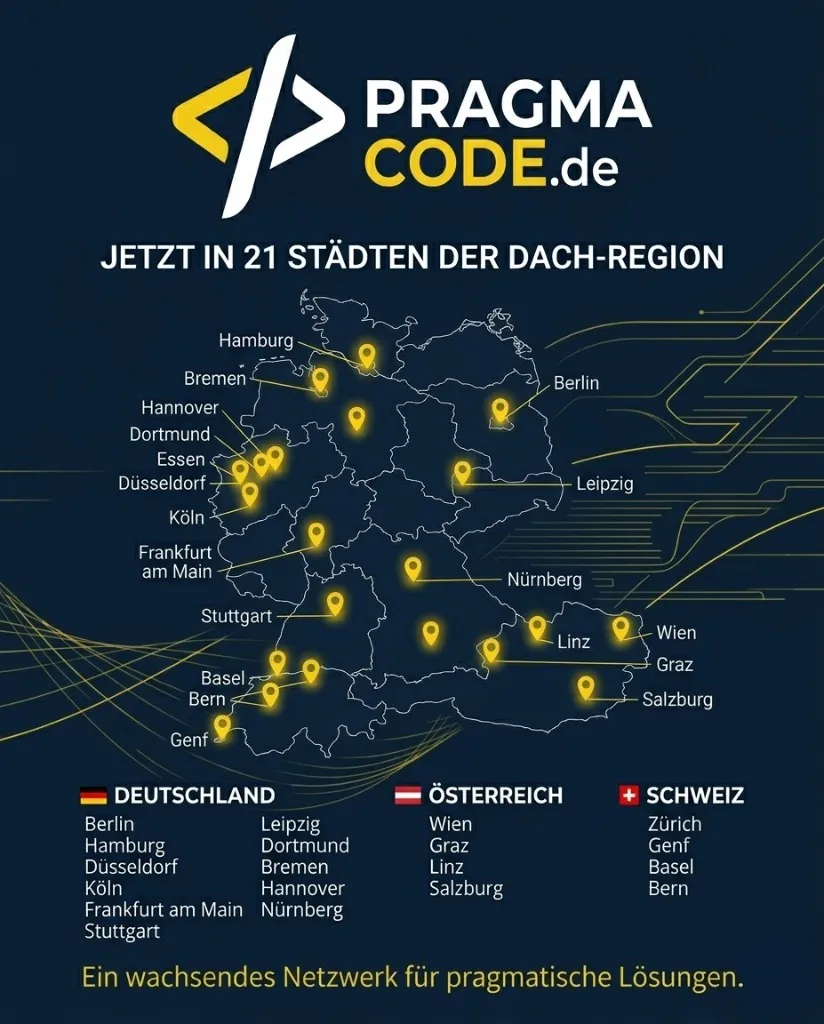
We are your digital partner – regionally anchored and successfully scaling across borders.
AI automation for your business?
I deliver this for small and mid-sized businesses: at a fixed price agreed upfront, working directly with the person who builds it. Process, scope and pricing are on the service page.
See service & pricing Or request a free intro callExtended Specialized Glossary
Alien Intelligence
A term describing large language models and autonomous agents as non-human, associative pattern processing engines that must be directed through leadership, delegation, and clear boundaries rather than treated like traditional software or human minds.
Agent Orchestration
The structured coordination, communication, and routing of multiple specialized autonomous AI agents via integration platforms (such as n8n or API gateways) to execute end-to-end business workflows without information silos.
Span of Control (AI)
The management principle adapted to AI systems, dictating that a human supervisor or orchestrator agent should directly oversee no more than 6 to 8 sub-agents to avoid context drift, hallucinations, and coordination failure.
AI Manager
An emerging leadership role focusing on managing hybrid human-AI teams, defining standard operating procedures (SOPs), supervising agent performance KPIs, and establishing organizational governance rather than writing low-level code.
Standard Operating Procedure (SOP)
Documented step-by-step operating guidelines that serve as the foundation for system prompts, agent roles, and escalation boundaries to ensure high-fidelity deterministic execution across autonomous multi-agent pipelines.