

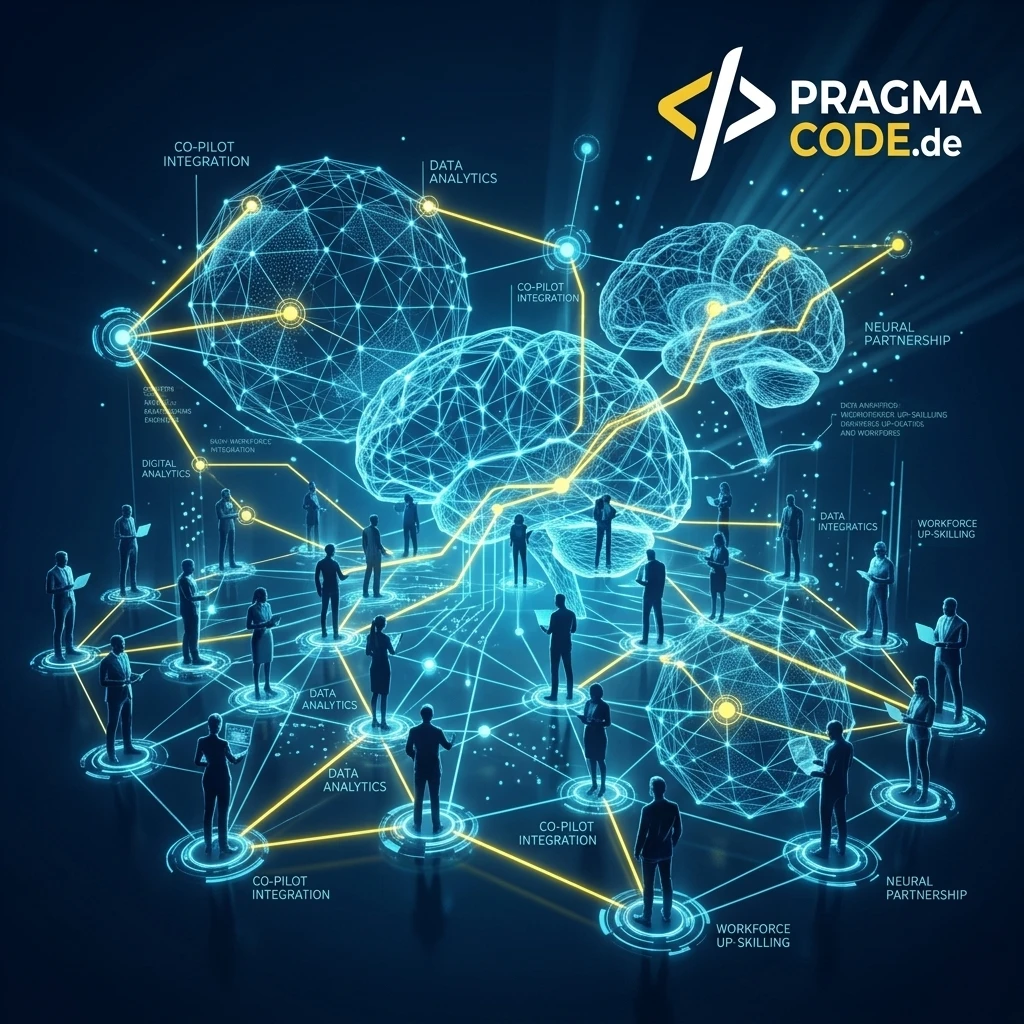
The debate surrounding Artificial Intelligence in the labor market oscillates between two extremes: on one hand, headlines about shrinking entry-level positions fuel fears of impending layoff waves. On the other hand, companies in key areas such as financial accounting report thousands of unfilled job openings. For small and medium-sized enterprises (SMEs) across Germany, Austria, and Switzerland (DACH), 2026 brings an urgent question: Does AI automation mean job cuts, or is it the saving grace against demographic labor shortages? In this comprehensive guide, we analyze the labor market paradox, map out the transformation of key job roles, document real DACH industry case studies, and deliver a battle-tested 4-step roadmap for strategic HR development in SMEs.
This article is an in-depth expert contribution from our content cluster. Discover the complete overview on our main page:AI Automation for Enterprises →
- The 2026 Paradox: AI automation reduces demand for traditional junior entry-level roles by roughly 16%, while over 4,900 vacancies remain open in financial accounting across DACH alone.
- Demographics Buffer Layoffs: Large-scale layoff waves fail to materialize in SMEs because demographic shifts (5.2 million Baby Boomers retiring by 2030 in Germany alone) absorb productivity gains completely.
- From Clerk to AI Orchestrator: The leverage for SMEs lies not in headcount reduction, but in systematic upskilling—transforming manual data processors into strategic AI Orchestrators backed by multi-agent architectures.
- 1. The 2026 Labor Market Paradox: Polarization over Mass Cuts
- 2. Role Transformation in Detail: What Disappears, What Emerges?
- 3. DACH Case Studies: Three Industry Verticals Evaluated
- 4. Why DACH SMEs Face No Layoff Wave
- 5. Roadmap: 4 Steps to SME Workforce Transformation
- 6. The 2026 Skill-Mapping Matrix for HR & Leaders
- 7. Ethical & Legal Guardrails: Works Councils, GDPR & EU AI Act
- 8. Quick-Check: Is Your Team AI-Ready?
From Simple Chatbots to Autonomous Multi-Agent Orchestration
While early artificial intelligence debates centered on reactive tools such as basic text generators, modern DACH enterprises in 2026 operate with autonomous multi-agent networks and deterministic agentic workflows. Human professionals are not displaced; instead, they steer, validate, and audit specialized agent pipelines as authoritative system orchestrators in real time.
1. The 2026 Labor Market Paradox: Polarization over Mass Cuts
Anyone analyzing labor market data across Germany, Austria, and Switzerland (DACH) in 2026 encounters two seemingly contradictory trends. On one side, recruiting platforms and industry federations report a measurable contraction in traditional junior and entry-level postings: across software engineering, content production, and administrative processing, job openings for pure routine roles fell by nearly 16 percent year-over-year. Tasks such as writing basic boilerplate code, generating generic product descriptions, or manually transcribing data between isolated software platforms are increasingly handled by autonomous cognitive agents.
On the other side, employer associations and national labor agencies continue to sound the alarm: according to the DIHK Labor Market Report 2026, more than half of all German medium-sized businesses identify the acute shortage of skilled workers as their single greatest operational risk. In financial accounting, controlling, and tax consulting alone, more than 4,900 vacancies for qualified professionals remained unfilled last quarter across the DACH region, despite widespread adoption of algorithmic automated invoice processing.
The Paradox Summarized
Artificial Intelligence in SMEs does not eliminate entire job categories; rather, it deconstructs occupations into granular tasks. Where repetitive routines disappear, demand for analytical reasoning, domain expertise, systems thinking, and human judgment increases dramatically.
Empirical research from the German Institute for Employment Research (IAB) validates this development under the thesis of Task-Shift rather than Job-Loss: technological breakthroughs rarely erase complete professions; instead, they fundamentally reshape the portfolio of tasks within existing roles. A professional who previously spent 70 percent of their working day aggregating spreadsheets and formatting tables now relies on automated AI pipelines as a preliminary filter, refocusing their energy on anomaly detection, strategic reasoning, and personalized client consultation.
Concurrently, enterprises are navigating the Junior Hiring Paradox: because frontier reasoning models such as Kimi K3, Claude 3.7, and Gemini 3.8 Flash synthesize standard code snippets and draft documents in seconds, the conventional corporate on-ramp based on repetitive junior chores has vanished. Entry-level talent must now step into the role of quality auditors, verification specialists, and agent supervisors from day one. The barrier to entry has shifted from manual execution speed to architectural comprehension.
2. Role Transformation in Detail: What Disappears, What Emerges?
Grasping the true impact of this transition requires moving beyond broad macroeconomic indicators to examine daily departmental operations within medium-sized enterprises. Change does not manifest through abrupt mass layoffs, but through the profound evolution of everyday responsibilities:
Comparison: Manual Processing vs. AI Orchestration 2026
- Manual Data Entry: Typing invoices, delivery slips, and support inquiries into ERPs.
- First Draft Creation: Writing boilerplate emails, reports, and social posts from scratch.
- Searching & Sorting: Manually searching folder trees and databases for information.
- Visual Spot-Checking: Checking numerical rows for errors by hand.
- Process Supervision: Validating and approving AI-preprocessed data streams.
- Prompt & Output Engineering: Directing cognitive agents and refining AI outputs.
- Cross-System Integration: Connecting workflows via iPaaS tools like n8n automation.
- Strategic Advisory: Deriving actionable insights from automatically generated analytics.
Consider four key functional domains where this transformation is unfolding with exceptional speed:
2.1. From Junior Coder to AI System Architect
In modern software engineering, coding agents and advanced reasoning engines have automated boilerplate production. Developers whose skill set is limited to typing syntax under step-by-step guidance face mounting pressure. Demand has decisively shifted toward engineers capable of architecting distributed systems, enforcing interface security, and auditing autonomous agent code. Developers in 2026 function primarily as system architects and verification engineers: they draft specifications, design test suites, and ensure that AI-generated artifacts adhere to strict benchmarks for security, maintainability, and latency.
Junior engineers learn from their first assignment to wield AI as a cognitive multiplier. The core discipline is no longer memorizing syntactic edge cases, but designing modular architectures that allow multi-agent systems to collaborate safely and reliably.
2.2. From Accountant to Financial Business Partner
In finance and accounting, multimodal document intelligence and automated matching rules allow over 85 percent of incoming transactions to be settled without human intervention. Reclaimed time is invested directly in predictive planning: financial specialists evaluate variance anomalies, model real-time liquidity curves, and advise executive leadership on capital allocation. Rather than archiving historical paper receipts, the modern accountant serves as an indispensable strategic advisor to the C-suite.
Fraud detection has similarly reached new operational heights. Deep neural algorithms flag irregular transaction clusters in milliseconds. The human professional's role is to assess these alerts within strategic business context and execute legally binding compliance judgments.
2.3. From Content Writer to Brand Strategist
The proliferation of generic AI text has led search engines, AI answer engines, and corporate buyers to penalize boilerplate content. Search engines and decision-makers exclusively reward verified domain authority, first-party data, and authentic executive viewpoints (E-E-A-T in the AI Era). Content specialists no longer spend their days drafting generic fillers; instead, they orchestrate complex multichannel campaigns, interview internal technical leads, and refine proprietary brand positioning.
Because synthetic prose can be generated at near-zero marginal cost, human credibility and brand trust constitute the supreme currency in B2B markets. AI handles systematic research and format distribution, while narrative conviction and client trust remain under human stewardship.
2.4. From HR Recruiter to Workforce Strategist
Human resources departments in medium-sized enterprises are undergoing an equally fundamental reset. Administrative tasks such as screening hundreds of standardized CVs and drafting routine job descriptions are now largely automated. HR professionals concentrate on strategic skill mapping, bespoke internal qualification pathways, and retention initiatives for key contributors. Rather than pursuing endless external recruiting cycles, HR leaders focus on upskilling the existing workforce to bridge institutional knowledge gaps before senior staff reach retirement age.
3. DACH Case Studies: Three Industry Verticals Evaluated
Real-world implementations across key economic sectors in Germany, Austria, and Switzerland prove that this operational shift generates measurable business advantages:
3.1. Logistics & Supply Chain: Predictive Control over Dispatcher Burnout
A mid-sized logistics operator in Baden-Württemberg with 280 employees was struggling with chronic dispatcher burnout caused by continuous manual phone tracking and email overload. Implementing autonomous dispatching agents (Agentic Logistics) enabled real-time route optimization, automated delay warnings, and proactive dock rescheduling. Not a single dispatcher was laid off: the team redirected reclaimed capacity into key-account consulting and high-margin specialty transport contracts. The result: a 32 percent expansion in shipment volume with zero headcount additions and a substantial drop in sick leave.
3.2. Industrial Machinery: Predictive Maintenance in Continuous Manufacturing
A Bavarian precision equipment manufacturer deployed open integration platforms alongside n8n in Industry 4.0 to monitor real-time telemetry from production machinery. Rather than dispatching technicians to chaotic emergency breakdowns, predictive machine learning models forecast component wear based on subtle vibration and temperature anomalies weeks in advance. Field engineers evolved from reactive mechanics into proactive asset managers, providing clients with guaranteed uptime windows and reducing unplanned downtime by over 40 percent.
3.3. Tax Advisory & Auditing: Strategic Consulting over Paperwork Sorting
A prominent Zurich accounting practice automated incoming receipt processing and tax prep validation using custom AI pipelines. Commercial staff whose days formerly revolved around sorting and keying paper documents completed a 6-month internal upskilling program to become AI Process Coordinators. Today, they advise corporate clients on configuring digital ERP interfaces and automating their internal bookkeeping workflows. The firm expanded billable revenue by 24 percent within one fiscal year solely through high-value advisory services.
4. Why DACH SMEs Face No Layoff Wave
Public discourse frequently imports alarmist layoff narratives from the US market without considering the distinct demographic and regulatory structures governing the DACH region. Three structural barriers protect German, Austrian, and Swiss SMEs from large-scale workforce reductions:
Demographic Cliff (Baby Boomer Retirement)
By 2030, more than 5.2 million skilled workers from the Baby Boomer generation will retire in Germany alone, countered by only 3.5 million young entrants. AI automation does not displace workers; it represents the only viable mechanism to offset the physical loss of millions of full-time equivalents and sustain production output.
Accumulated Work Backlogs & Growth Caps
Countless SMEs suffered severe growth constraints in recent years simply because they lacked personnel to take on additional customer engagements. Deploying Agentic AI in SMEs restores internal capacity, enabling teams to clear persistent backlogs and pursue lucrative new market segments.
Social Market Economy & Employment Protection
Labor law across DACH combined with entrenched social partnership cultures prohibits arbitrary mass dismissals. Owner-operated SMEs plan across decades rather than quarterly fiscal deadlines, prioritizing employee loyalty and internal workforce transformation over costly severance schemes.
Leaders who believe that waiting out the technological wave reduces corporate risk are falling prey to a dangerous illusion. The true existential threat to SMEs originates not from AI systems, but from the severe operational penalties of hesitation:
Cost Trap 1: Catastrophic Knowledge Drain at Retirement
When senior specialists retire without their tacit domain expertise and operational workflows structured into local Enterprise RAG systems, mission-critical corporate value is lost permanently.
Cost Trap 2: Security Hazards from Unregulated Shadow AI
If management fails to provide secure, GDPR-compliant enterprise tools, employees resort to personal consumer apps. This exposes proprietary IP, triggers severe privacy violations, and creates direct personal liability for directors.
Cost Trap 3: Unit Cost Explosion Relative to Automated Peers
While automated competitors complete core business processes with up to 80 percent less manual labor per unit, non-automated enterprises face escalating labor costs and sluggish delivery timelines.
5. Roadmap: 4 Steps to SME Workforce Transformation
Executing a seamless shift from a manual organization to an AI-orchestrated workforce requires deliberate leadership and an accountable operational plan. The following roadmap guides leadership teams through each transformation phase:
-
Phase 1: Task-Level Audit & Potential Assessment
Avoid evaluating job descriptions as monolithic blocks; decompose departmental workflows into discrete operational tasks. Identify high-volume, repetitive processes with minimal variance (e.g., data reconciliation, document extraction, routine status summaries) and isolate them from relationship-heavy, strategic duties.
-
Phase 2: Deploying GDPR-Compliant Infrastructure & Governance
Establish an enterprise-grade, legally compliant operational environment. Implement GDPR-compliant enterprise APIs or On-Premise AI Deployments that guarantee company data will never be ingested for model training. Draft unambiguous employee guidelines covering verification standards, copyright boundaries, and data hygiene.
-
Phase 3: Systematic In-House Upskilling & Champion Networks
Commit dedicated resources toward hands-on training programs. Replace abstract classroom lectures with project-based problem solving directly inside operational departments. Identify and support digitally minded employees as internal "AI Champions" who mentor peers and propagate best practices.
-
Phase 4: Redefining Role Profiles & Career Tracks
Align job specifications, performance KPIs, and compensation models with technological capabilities. Reward employees for automating manual bottlenecks rather than measuring success by hours logged. Establish prestigious career paths for specialized AI orchestrators.
6. The 2026 Skill-Mapping Matrix for HR & Leaders
For HR executives and managing directors, identifying exactly which competencies to cultivate internally is a primary operational objective. The matrix below classifies future-proof capabilities into four foundational pillars, serving as a framework for individual development plans:
1. AI Fluency & Agent Literacy
Deep familiarity with the operational capabilities, architectural boundaries, and reasoning limits of modern foundation models and autonomous multi-agent systems. The primary competency lies in structured task formulation, context window steering, and pipeline supervision.
2. Critical Thinking & Output Audit
Systematic verification of AI-generated deliverables for factual correctness, hallucinations, algorithmic drift, and statistical bias. Human specialists act as the authoritative checkpoint ensuring compliance before business release.
3. Process Design & Integration
End-to-end comprehension of cross-functional workflows and API-driven interfaces. The capability to map data flows between CRM, ERP, and AI services (such as via n8n or local RAG) and position automated trigger mechanisms effectively.
4. Empathy & Complex Problem Solving
Personal client management, high-stakes negotiation, inspirational leadership, and nuanced conflict resolution in ambiguous, non-deterministic scenarios that elude mathematical optimization.
SME human resource departments should avoid allocating budgets to generic off-the-shelf lectures. Instead, invest in experiential micro-learning within day-to-day operations. When employees resolve genuine friction in their daily workflows with the assistance of seasoned automation engineers, skill adoption rates increase exponentially.
7. Ethical & Legal Guardrails: Works Councils, GDPR & EU AI Act
Workplace evolution cannot occur in a regulatory void. Organizations implementing AI systems within the DACH region must incorporate local compliance requirements from day one to mitigate liability and prevent labor disputes:
Co-Determination Rights (§ 87 BetrVG)
Prohibition of covert behavioral or performance surveillance through AI telemetry. Formal works agreements establishing explicit scope boundaries and mandatory training rights preserve workplace harmony.
GDPR Compliance & Zero-Retention
Contractual exclusion of corporate or employee data from third-party model retraining. Deployment of European enterprise cloud gateways with zero-data-retention or private on-premise infrastructure.
EU AI Act: High-Risk Mandates (Annex III)
Strict classification of AI systems used in human resources (recruitment, performance review, shift assignment) as High-Risk applications. Mandatory risk documentation and non-negotiable human-in-the-loop oversight.
7.1. Works Council Co-Determination (§ 87 BetrVG)
Under German labor law, implementing technical systems objectively capable of monitoring employee behavior or performance requires mandatory works council approval under Section 87 (1) No. 6 Works Constitution Act (BetrVG). Because enterprise AI platforms generate detailed telemetry, prompt records, and interaction logs, early worker representation is indispensable. Proactively negotiated works agreements establish solid legal footing: they forbid automated disciplinary scoring based on AI logs and guarantee employees paid upskilling hours during regular business schedules.
7.2. Data Privacy, Trade Secrets & GDPR Compliance
Inputting sensitive customer or staff data into public consumer AI models constitutes a severe data breach subject to catastrophic penalties under Article 83 GDPR. Medium-sized businesses resolve this exposure by provisioning dedicated enterprise tenant accounts backed by binding Zero-Data-Retention (ZDR) clauses or by running self-contained On-Premise AI Deployments. Sensitive business logic remains securely sealed inside European legal jurisdiction.
7.3. The EU AI Act in Corporate HR Operations
The European EU AI Act enforces stringent protections surrounding fundamental employee rights. Systems utilized for automated resume filtering, candidate evaluation, or algorithmic productivity measurement are designated as High-Risk AI Systems under Annex III. Employers must satisfy rigorous standards regarding dataset quality, technical logging, cybersecurity resilience, and mandatory human supervision. Terminating employees or rejecting job candidates exclusively via algorithmic recommendation is legally prohibited.
8. Quick-Check: Is Your Team AI-Ready?
Use the checklist below to assess your organization's operational readiness and pinpoint immediate structural priorities for your executive and IT roadmap:
Quick-Check: SME Team AI-Readiness
Ready to Prepare Your Team for the AI Future?
Pragma Code guides SMEs through the planning, compliance auditing, and technical execution of tailored AI automation solutions.
Schedule a Free ConsultationOur Regional Expertise
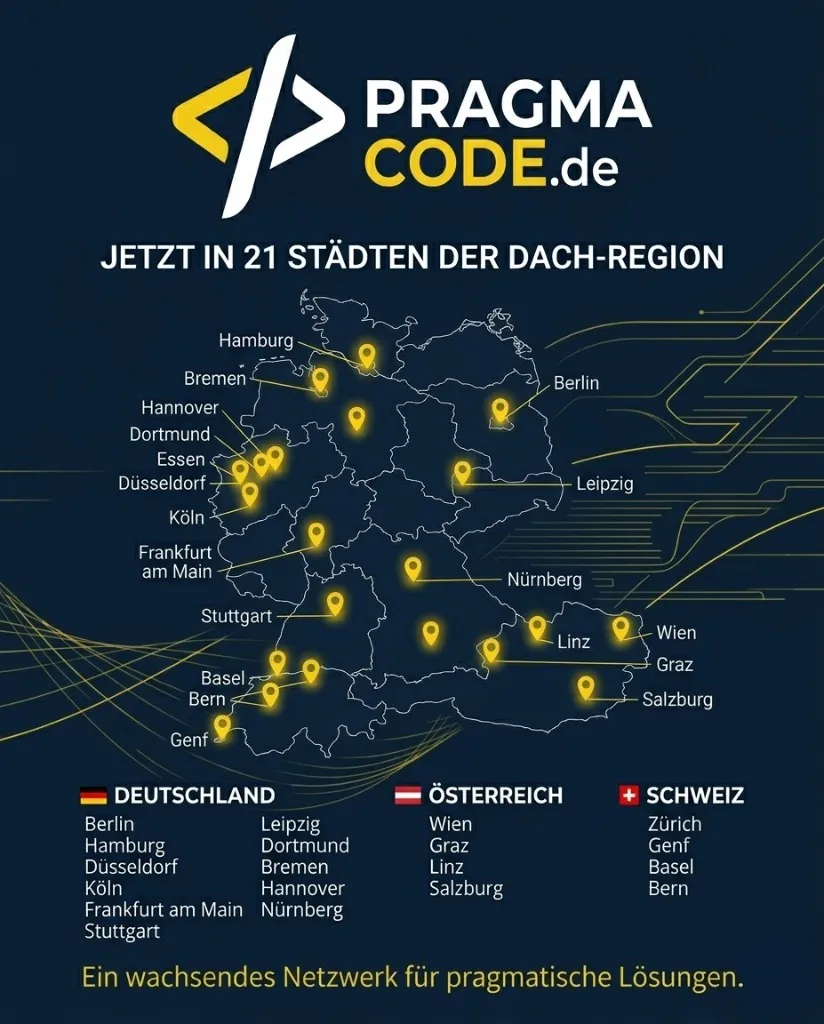
We are your digital partner – regionally anchored and successfully scaling across borders.
Have a vision?
Let's check together how we can make your idea take flight.
Book your free strategy call nowExtended Specialized Glossary
Workforce Transformation
The strategic process of aligning employee organizational structures, skills, and role profiles with technological shifts such as AI automation.
Cognitive Copilot
An AI-based software system that assists employees in real time with complex knowledge work, text analysis, document generation, and decision-making.
Upskilling
The targeted training and advancement of existing staff to master new digital tools and AI-driven workflows.
Reskilling
Retraining employees whose previous responsibilities are automated into newly emerging, future-proof role requirements.