


Germany stands at a historic threshold: according to a comprehensive study by the renowned management consultancy McKinsey, the Federal Republic possesses the largest absolute potential for AI automation in all of Europe. By 2030, the strategic deployment of cognitive agents and advanced robotics could unlock economic value of up to 486 billion US dollars. For the German Mittelstand (SMEs), this is not a distant future scenario but an urgent call to action on a macro level. In this detailed guide, we analyze the McKinsey potential and show SMEs concrete, tangible ways to secure their long-term competitiveness.
This article is an in-depth expert contribution from our content cluster. Discover the complete overview on our main page: AI & Automation for Businesses →
- $486 Billion Economic Leverage: Germany leads Europe in economic value creation potential through AI automation by 2030 – far ahead of the UK and France.
- Cognitive Trumps Physical: A staggering 82% of the identified potential lies in cognitive software agents taking over administrative, planning, and data-intensive tasks; only 18% is related to physical robotics on shop floors.
- Re-architecting Work: Unlocking this potential is fundamentally a matter of re-architecting workflows rather than merely purchasing software. SMEs must transition from isolated point tools to integrated agent pipelines.
- 1. The Untapped Potential: Why Germany Leads Europe
- 2. The 4 Strategic Pillars of Germany's AI Leadership
- 3. Concrete Action Fields for SMEs: Unlocking AI Value
- 4. The Cost of Inaction: What Hesitation Costs Medium-Sized Enterprises
- 5. B2B Premium Checklist: Calculate Your Automation Potential
- 6. Pragma-Code as a Partner: Strategies for Unlocking Potential
- 7. Conclusion & Outlook
The Paradigm Shift: From Fragile RPA to Autonomous Reasoning Agents
The McKinsey study highlights a watershed moment for European enterprise: while legacy automation and brittle RPA scripts frequently break across shifting interfaces, state-of-the-art reasoning agents can comprehend unstructured data, make nuanced decisions, and execute multi-step processes reliably across existing ERP environments. For European Mittelstand leaders, long-term competitiveness will not be won by collecting software subscriptions, but by orchestrating sovereign, GDPR-compliant AI agent pipelines.
1. The Untapped Potential: Why Germany Leads Europe
The European economy is in the midst of a profound structural transformation. Faced with demographic shifts, a severe labor shortage, and rising energy costs, companies across the DACH region are searching for new sources of productivity. The McKinsey study titled “Agents, robots, and us: How AI reshapes work and skills in Europe” reveals a fascinating opportunity: Germany possesses by far the largest absolute potential for AI automation in Europe.
According to the study, German enterprises could realize economic benefits worth up to 486 billion US dollars by 2030. In comparison, the United Kingdom follows in second place with 375 billion US dollars, while France ranks third among the leading Western European economies with 238 billion US dollars. Germany's massive volume is primarily driven by two structural pillars: its strong manufacturing sector (the verarbeitendes Gewerbe) and a high density of cognitively demanding professional occupations in sales, engineering, logistics, and corporate administration.
Why does Germany lead the continent so clearly? The study's authors emphasize that the country's technical automation potential stands at approximately 59% of current working hours. This means that more than half of all hours worked in Germany could theoretically be automated or substantially accelerated using today's technology. The crucial driver is unambiguous: office environments, planning departments, and backoffices – where knowledge workers spend countless hours moving data manually between siloed systems.
European Comparison
Comparing these structures reveals significant differences in European economic landscapes. While countries like the UK focus heavily on the financial and creative service sectors, Germany benefits from its dual nature combining manufacturing excellence with a robust B2B SME landscape. The following comparison matrix illustrates the position of the leading European economies:
Germany (Leader)
Economic Potential by 2030
$486 BillionDriven by manufacturing depth, high cognitive task density, and 59% technical automation potential.
United Kingdom
Economic Potential by 2030
$375 BillionStrong focus on financial services and creative industries, with high cognitive but lower industrial share.
France follows with $238 billion, demonstrating that the leverage in Germany is almost twice as high as that of our French neighbors. For German SMEs, this represents an immense opportunity: investing in these technologies today not only creates a competitive advantage at home but also secures a leading position in the broader European market.
2. The 4 Strategic Pillars of Germany's AI Leadership
Germany's top European ranking is not coincidental; it stems directly from the structural fabric of the DACH economic ecosystem. To unlock the $486 billion in value, leaders must understand the four key pillars supporting this leverage:
1. Industrial Manufacturing & OT Convergence
Unlike purely service-based economies, Germany features a deeply integrated physical value chain where PLCs, industrial sensors, and shop-floor machines connect directly with ERP systems. When cognitive agents bridge these interfaces, self-optimizing feedback loops emerge between production and management.
2. Knowledge-Intensive Administrative Workflows
A widespread misconception assumes automation primarily impacts factory floors. McKinsey proves the opposite: 82% of the financial upside comes from cognitive office work – including tender analysis, CAD matching, customs clearing, and mandatory CSRD/ESG documentation.
3. Resilient Dual Education & Skilled Teams
Theoretical automation potential is useless without an educated workforce capable of operating modern tools. Germany's renowned vocational training provides the ideal ground to upskill personnel into strategic supervisors of AI agents, forming symbiotic human-AI teams.
4. Legal Certainty & EU AI Act Compliance
European data privacy rules (GDPR, EU AI Act) were previously seen as competitive hurdles. Today, they serve as quality seals: enterprises deploying private-cloud or on-premise AI architectures deliver auditable, tamper-resistant processes for multinational partners.
3. Concrete Action Fields for SMEs: Unlocking AI Value
McKinsey's massive potential of 486 billion US dollars is not guaranteed to materialize on its own. It is spread across thousands of medium-sized businesses in Germany, Austria, and Switzerland. To capture this value, companies must translate theory into concrete, operational action fields. We have identified three core areas where SMEs can start today.
Optimizing Manufacturing and Logistics with AI
Enormous efficiency reserves lie dormant in the supply chain and production. SMEs can implement intelligent systems that go far beyond classic, rule-based automation (such as basic RPA (Robotic Process Automation)). A key accelerator is the automated evaluation and connection of machine data with logistics software. As we detailed in our guide on n8n in Industry 4.0, SMEs can now capture machine data in real time without expensive enterprise licenses and trigger automated downstream logistics workflows.
A prime example is the supply chain. If an autonomous agent detects disruptions in a transport route – for instance, due to weather events, strike notices, or border delays –, it can independently calculate alternative routes, compare freight rates, and draft contract adjustments. We describe these cognitive capabilities in depth in our article on Agentic Logistics. Coupling AI systems with real-time sensor measurements also helps reduce production defects and refine predictive maintenance schedules.
💡 Supply Chain Compliance Benefits
By automating data collection directly at the production line, SMEs can ensure product quality while seamlessly generating the audit-proof documentation required by European supply chain laws (LkSG) and ESG standards, eliminating manual overhead.
Boosting Efficiency in Administration and Customer Service
Administrative overhead is one of the biggest bottlenecks for German SMEs. Valuable employee hours are spent copying invoices, reconciling Excel sheets, or answering repetitive customer inquiries. This is where Cognitive Agents come in. These systems understand unstructured data, extract relevant information, and enter it directly into ERP and CRM systems.
In customer service and sales, B2B customer portals with integrated AI assistants provide significant relief. Inquiries about delivery times, individual pricing, or product specifications are resolved in seconds. This reduces response times for customers while freeing up sales teams to focus on complex, high-value consulting and relationship management. We explore these portal integrations in our guide to modern B2B customer portals.
Accelerating Innovation in Product Development
An often overlooked aspect of the AI transition is research and development (R&D). Generative AI acts as a catalyst here. During the design phase of new products, agents can analyze patent databases, evaluate technical requirements, and simulate design variations. This significantly reduces time-to-market. By utilizing simulations and AI-assisted code generation (which we do daily using tools like Cursor and Claude in our development workflows), companies can prototype and validate digital services for physical products in record time.
4. The Cost of Inaction: What Hesitation Costs Medium-Sized Enterprises
Many executives hesitate to invest in autonomous agents, arguing that generative AI is still too volatile or that their existing manual processes have functioned reliably for decades. McKinsey's data exposes this wait-and-see mindset as a critical strategic fallacy. In reality, the cost of inaction easily dwarfs implementation budgets:
The Demographic Cliff: Millions Retiring Without Knowledge Transfer
Over the next few years, European industries will lose millions of seasoned veterans to retirement. Companies that fail to codify undocumented institutional knowledge into digital reasoning workflows face permanent loss of operational capabilities.
Skyrocketing Compliance and Operational Overhead
Ever-stricter EU directives such as CSRD and LkSG consume growing shares of managerial bandwidth. Handling these complex reporting obligations manually incurs exorbitant recurring administrative costs.
Firms that delay process modularization and API integration risk falling into an inescapable margin squeeze: surging labor overhead coupled with talent shortages will lengthen lead times and erode pricing power against agile, automated international competitors.
5. B2B Premium Checklist: Calculate Your Automation Potential
The biggest hurdle for many business owners is: "Where do I start?". To help you structure your approach, we have created an interactive checklist. Review the following points to get an immediate indication of the untapped automation potential in your organization.
🔍 SME AI Potential Checklist for the DACH Region
Select the statements that apply to your business to calculate your optimization potential instantly:
1. Administration & Back Office
2. Sales, Support & Customer Service
3. Manufacturing, Logistics & IT Infrastructure
6. Pragma-Code as a Partner: Strategies for Unlocking Potential
Unlocking hundreds of billions of dollars in productivity potential is not an isolated IT task; it requires a structured, strategic methodology. Many SMEs do not fail due to the technology itself, but due to integration gaps and isolated software systems. Pragma-Code accompanies you as a strategic partner – from the initial potential analysis to the deployment of tailored, autonomous AI systems.
We have developed a proven three-step process that ensures your technology investments yield direct, measurable business results.
Maturity Assessment & AI Roadmap
We analyze your existing business workflows, identify manual data handoffs, and evaluate the return on investment (ROI) of potential automation solutions. This results in a clear, prioritized implementation roadmap.
Deploying Custom AI Solutions
We develop custom cognitive agents, establish high-performance integrations (e.g., using n8n), and connect your existing software (ERP, CRM, databases) into a cohesive, intelligent ecosystem free of data silos.
Building AI Competencies
Technology only reaches its full potential when your team understands and actively leverages it. We train your staff in prompt engineering and cognitive agent interactions, enabling them to refine workflows independently.
Our strategic approach prioritizes avoiding proprietary lock-in. We focus on flexible, open-source, or modularly extensible platforms that remain under your full control. This guarantees your technological sovereignty while ensuring compliance with strict European data protection regulations (GDPR).
Expert Tip: Start Small, Think Big
Never begin your AI journey with a massive, company-wide transformation project. Instead, identify a narrow, well-defined process with high error rates or high time consumption (a "Quick Win") – such as automated classification and data extraction of incoming customer support tickets. A successful pilot builds employee trust and validates the budget for future expansion.
7. Conclusion & Outlook
McKinsey's study provides empirical backing for what is already obvious in practice: automating cognitive processes is no longer optional for SMEs; it is an existential necessity for maintaining global competitiveness. The 59% technical automation potential shows how much untapped productivity is currently locked in the administrative processes of European offices and factories.
SMEs in the DACH region now have a historic opportunity to lead this shift. By systematically evaluating workflows, eliminating manual system gaps, and fostering collaboration between humans and cognitive agents, companies can reduce costs and mitigate the impact of labor shortages. Germany has the potential to become Europe's automation champion – the lever is in the hands of its business leaders.
Ready to unlock the McKinsey potential in your business?
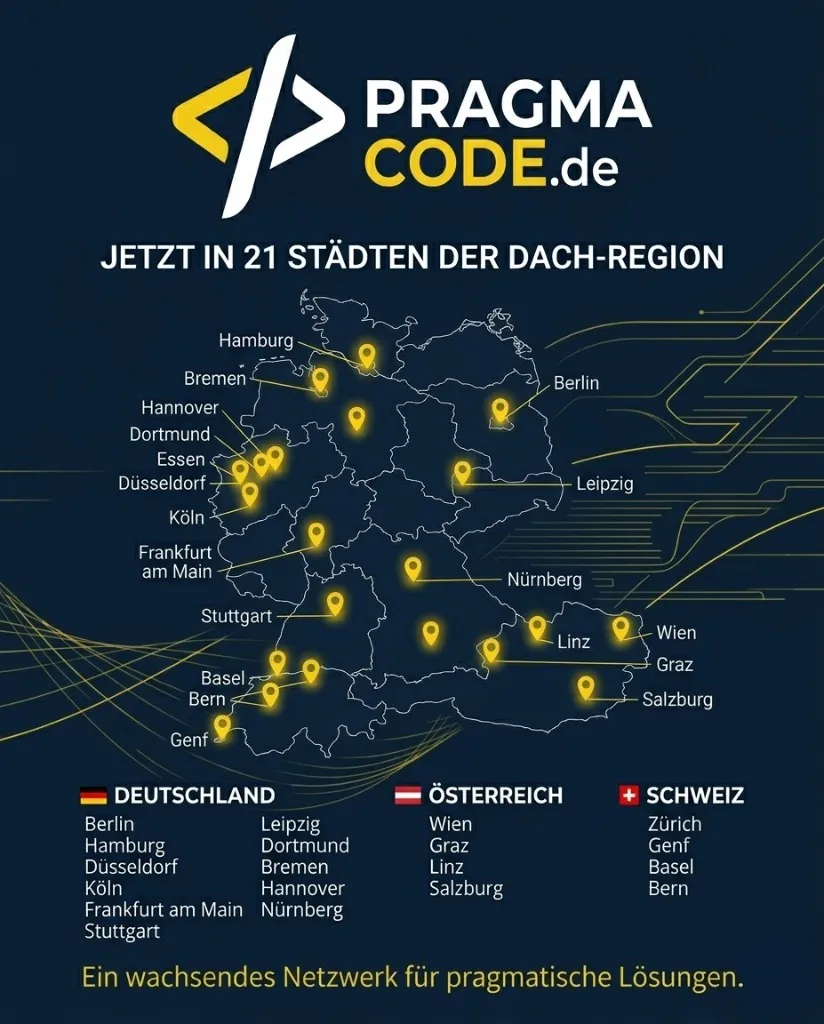
Schedule a Free Initial ConsultationOur Regional Expertise
We are your digital partner – regionally anchored and successfully scaling across borders.
AI automation for your business?
I deliver this for small and mid-sized businesses: at a fixed price agreed upfront, working directly with the person who builds it. Process, scope and pricing are on the service page.
See service & pricing Or request a free intro callExtended Specialized Glossary
AI Automation
The fusion of Artificial Intelligence and classic automation technologies to intelligently and independently execute complex, cognitive business processes.
Cognitive Agent
An autonomous AI system that can independently handle multi-step workflows using reasoning, long-term planning, and digital tool integration.
Technical Automation Potential
The calculated share of total work hours or tasks that could be automated using the current state of technological development.