

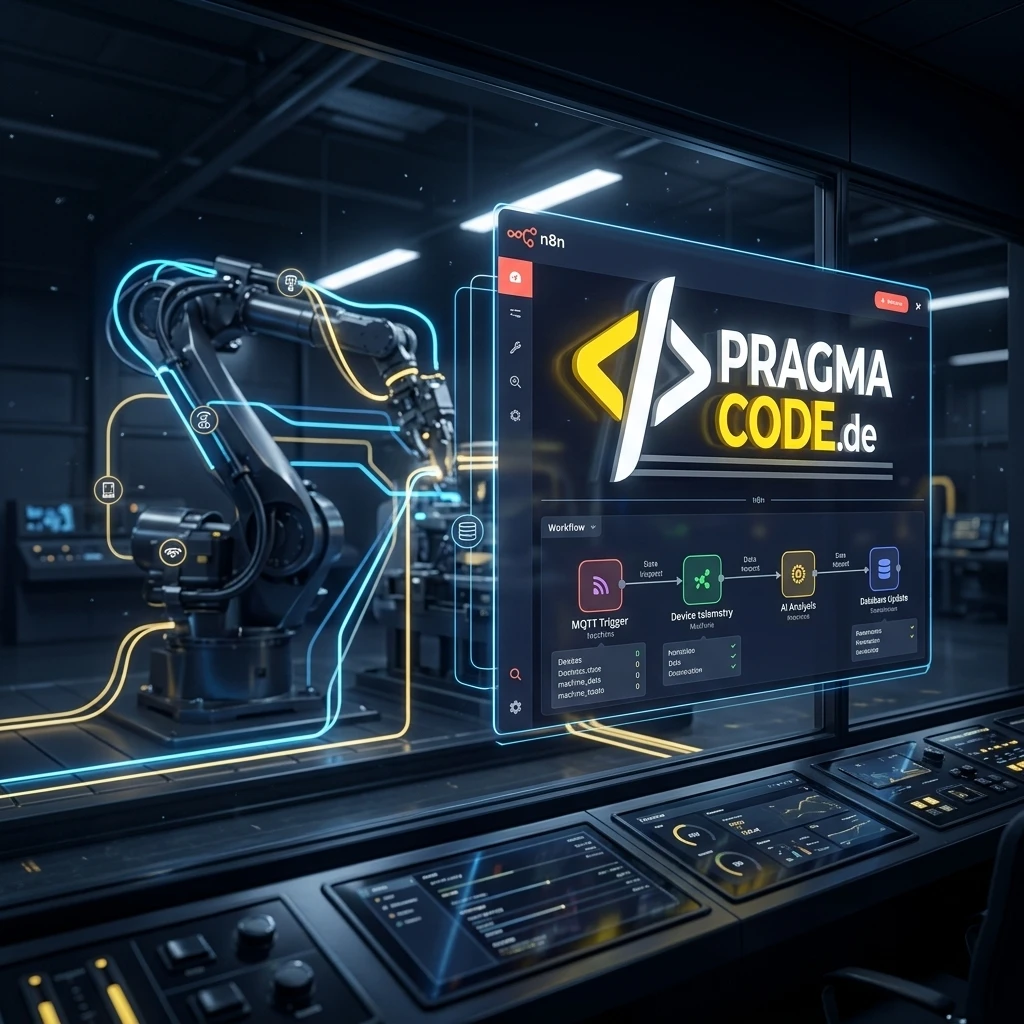
Proprietary industrial middleware and rigid licensing models hinder manufacturing digitization in SMEs. Discover how mid-sized enterprises leverage n8n, open IoT protocols, and Edge AI to capture machine data in real time, break down data silos, and deploy profitable automation workflows.
This article is an in-depth expert contribution from our content cluster. Discover the complete overview on our main page:n8n Automation →
- Breaking Cost Barriers: Traditional proprietary interfaces like OPC gateways and middleware licensing (e.g. billed per tag or data point) inflate budgets unnecessarily. n8n offers unlimited workflows with full data sovereignty when self-hosted.
- Open Protocol Standards: By combining MQTT (including Sparkplug B), Modbus TCP, and OPC UA with n8n, machine telemetry feeds directly into ERP, CRM, time-series, and analytics systems.
- Focus on the Software & AI Layer: Pragma Code builds the intelligent software architecture above the shop floor—from high-performance time-series databases (TimescaleDB) to autonomous AI agents for predictive maintenance.
The Sensor-to-API Workflow in the Age of Autonomous Agents
Simply dumping machine data into SQL tables is no longer enough: modern manufacturing facilities couple n8n workflows with local AI agents to classify PLC error codes semantically within milliseconds, anticipate spare part demands, and trigger maintenance workflows fully automatically.
1. Introduction: Why Machine Data is a Sleeping Giant in SMEs
Across the shop floors of manufacturing SMEs, a massive productivity treasure lies dormant: machine data. Whether spindle temperatures, operating hours, vibration patterns, error codes, or precise cycle counts – modern industrial assets, CNC machining centers, and PLC controllers continuously produce high-value telemetry. Yet, the reality across many small and medium-sized factories remains fragmented: sensor data stays siloed in programmable logic controllers (PLCs), gets noted manually on paper clipboards by machine operators, or sits unlinked in spreadsheet archives.
This lack of real-time data pipelines severely undermines operational competitiveness. Without automated transmission into higher-level enterprise systems (such as ERP, inventory management, BI dashboards, or maintenance platforms), dynamic production scheduling, exact post-calculations, and modern Predictive Maintenance strategies remain purely theoretical.
Traditional approaches rely on heavyweight, proprietary industrial middleware such as Kepware or specialized OPC routers. For mid-sized enterprises, however, these solutions come with prohibitive barriers to entry: licensing models structured around connected data points ("tag licensing") force companies into painful compromises regarding what data to collect.
This is where n8n enters as a pragmatic and technologically superior open-source alternative. As an extensible integration and workflow platform, n8n seamlessly bridges the operational field level (Operational Technology, OT) with corporate business IT (Information Technology, IT) – flexibly, transparently, and at a fraction of the total cost of ownership of legacy middleware. How the physical foundation below is engineered is covered in detail in our guide to connecting hardware to the cloud.
- 1. Introduction: Why Machine Data is a Sleeping Giant in SMEs
- 2. The Cost Trap of Proprietary Industrial Interfaces
- 3. n8n as a Bridge: From Machine Sensor to Enterprise IT
- 4. Technical Protocols Put to the Test: MQTT, Modbus & OPC UA
- 5. B2B Comparison: n8n Self-Hosted vs. Proprietary Industrial Gateways
- 6. The 4-Layer Architecture: How Pragma Code Builds the Software Stack
- 7. Practical Use Cases: AI-Driven Manufacturing Automation in Reality
- 8. OT/IT Security, Latency, and NIS-2 Compliance on the Factory Floor
- 9. Roadmap: 5 Steps to an Automated Factory
- 10. Conclusion: Start Your IoT Automation with n8n
2. The Cost Trap of Proprietary Industrial Interfaces
Anyone looking to unlock telemetry from existing machinery (brownfield assets) quickly runs into established software vendor monopolies. While these systems perform their basic duties, a closer inspection reveals them to be major brakes on cost efficiency and innovation:
Astronomical Licensing Fees & Tag Limits
Classic industrial gateways demand high four- to five-figure upfront licensing costs plus mandatory annual software maintenance contracts. On top of that, billing per data point (tag) punishes growth – every added valve or temperature probe increases recurring license expenses.
Vendor Lock-in & Siloed Ecosystems
Proprietary gateways encapsulate their logic in closed data structures. Connecting modern REST APIs, cloud storage, or AI services requires expensive add-on modules or certified external integration consultants.
Outdated Software Architecture
Many legacy industrial tools run as monolithic Windows services engineered in the 2000s without containerization support (Docker), without Git version control, and without native JSON/webhook capabilities.
Lack of Native AI and Event Pipelines
Proprietary interfaces are largely confined to rigid SQL database inserts. Querying vector databases, feeding LLMs for diagnostic insights, or triggering agentic workflows is impossible with legacy tools.
By deploying n8n in a self-hosted environment, manufacturers eliminate these artificial restrictions. Machine telemetry becomes open, easily manipulable JSON payloads ready for downstream enterprise processing.
3. n8n as a Bridge: From Machine Sensor to Enterprise IT
n8n is a workflow automation platform that unifies visual Low-Code canvas modeling with the full power of JavaScript/TypeScript (Pro-Code). Workflows are built as intuitive node graphs while retaining the capability to execute complex mathematical transforms, data validations, and AI inference steps.
In Industry 4.0, n8n functions as the central nervous system connecting the factory floor to management systems:
Capture & Subscribe: n8n ingests machine telemetry via native MQTT triggers in real time or polls PLC registers periodically via lightweight edge services.
Filter, Validate & Transform: Erroneous sensor spikes are filtered out, engineering units normalized, and raw signals enriched with ERP master data.
Route & Execute: Aggregated data is routed to time-series databases (TimescaleDB), ticketing tools, Slack/Teams, or automated accounting and inventory APIs.
Thanks to complete Self-Hosting (e.g. on an on-premise industrial PC or private server cluster), intellectual property, machine states, and shift logs never leave the company's premises unless explicitly intended.
4. Technical Protocols Put to the Test: MQTT, Modbus & OPC UA
To extract data from PLCs (such as Siemens S7, Beckhoff, WAGO, or Allen-Bradley) into n8n, open industrial communication standards are used. Each protocol delivers distinct advantages in manufacturing:
MQTT / Sparkplug B
MQTT & Sparkplug B
The premier publish/subscribe protocol for IoT sensors and distributed production lines. Bandwidth-efficient, stateful (QoS levels), and ideal for high message frequencies.
OPC UA
OPC Unified Architecture
The global standard for semantic machine interoperability. Features structured object models, built-in end-to-end encryption, and native support in modern controllers.
Modbus TCP / RTU
Modbus TCP
The robust workhorse for legacy assets, power meters, and basic measuring devices. Direct reading of holding registers without semantic protocol overhead.
How n8n Orchestrates These Protocols in Practice
n8n includes native MQTT trigger and action nodes. As soon as a machine or sensor publishes a telemetry payload to a central MQTT broker (e.g. Eclipse Mosquitto or HiveMQ), the associated n8n workflow executes within milliseconds.
For OPC UA and Modbus assets, professional deployments leverage a lightweight, containerized edge gateway (e.g., Node-RED or Telegraf). This gateway reads raw register bits from the PLC, packages them into clean JSON structures, and forwards them via local MQTT or webhooks to n8n. This design relieves PLCs from processing loads and ensures a clean, modular architecture.
5. B2B Comparison: n8n Self-Hosted vs. Proprietary Industrial Gateways
A direct comparison illustrates the technical and financial merits of an open n8n-based integration layer over legacy tools:
Comparison: Traditional Middleware vs. n8n Integration Platform
- License Trap: High initial purchase costs and strict tag/data-point volume restrictions.
- Maintenance Overhead: Mandatory recurring software support contracts (18–22% of license cost annually).
- Siloed Architecture: Designed primarily for SQL relational databases; complex to connect to modern APIs.
- No Native AI: Lacks connectors for local LLMs, vector search engines, or autonomous agents.
- Cost Control: 0 € per-tag licensing fees under self-hosting – unlimited data points, sensors, and workflows.
- API-First Ecosystem: Hundreds of built-in nodes for ERP, CRM, Slack, Microsoft 365, and webhooks.
- AI & LLM Ready: Native integration with local AI runtimes (Ollama, vLLM) and vector stores (pgvector).
- Git & CI/CD Enabled: Workflows stored as version-controlled JSON files for professional deployment pipelines.
6. The 4-Layer Architecture: How Pragma Code Builds the Software Stack
A fundamental principle in industrial automation is maintaining a clear division of responsibilities: at Pragma Code, we are not PLC programmers or field electricians. We do not alter hardwired emergency stops or physical safety logic – that core domain remains strictly in the hands of your machine manufacturers and maintenance engineers.
Pragma Code builds the intelligent software layer above the machinery. We interface with existing data endpoints (OPC UA servers, MQTT brokers, PLC data blocks) and transform raw telemetry into enterprise business value:
1. Sensors & Controllers
Physical machinery, PLCs (Siemens S7, Beckhoff ADS, Modbus RTU), and IO-Link sensors record process states and populate data blocks.
2. Edge Gateway & MQTT Broker
Industrial PCs convert proprietary fieldbuses into standardized MQTT/JSON and buffer telemetry locally during network drops (Store & Forward).
3. n8n Integration Engine
Visual workflow pipelines aggregate signals, compute performance metrics (OEE), execute validation logic, and trigger automated downstream actions.
4. ERP, Analytics & AI Agents
TimescaleDB time-series storage, Grafana live dashboards, automated ERP bookings (SAP, Odoo, proALPHA), and LLM-assisted diagnostic reasoning.
Expert Tip: Store-and-Forward for Network Resilience
Never rely on a permanent 100% network link between the factory floor and central ERP servers. Always configure a local disk-backed buffer (e.g., via SQLite or persistent MQTT queues) on the edge gateway. If the local network experiences hiccups, the edge gateway caches all readings locally and flushes them to n8n without data loss once reconnected.
7. Practical Use Cases: AI-Driven Manufacturing Automation in Reality
How do n8n, open IoT protocols, and modern AI models transform daily operations in mid-sized manufacturing plants? Three established real-world scenarios:
1. Predictive Maintenance with AI Alarm Triage
An accelerometer mounted on a main spindle records vibration patterns and streams FFT frequency spectra via MQTT to n8n. If readings deviate from historical baselines, n8n feeds the diagnostic context to a local AI model (e.g. Nous Hermes Agent). The model identifies the likely bearing degradation, extracts the correct repair procedure from vector manuals (Multi-Modal RAG), and generates a prioritized maintenance ticket including required spare part numbers.
2. Automated Real-Time OEE Tracking
Using Modbus cycle pulses and PLC operational bits, n8n records good parts, scrap counts, and downtime down to the second. Data streams directly into a TimescaleDB time-series store. n8n continuously computes Overall Equipment Effectiveness (OEE = Availability × Performance × Quality) and updates live dashboards on the shop floor. If performance drops below 85%, shift leads receive immediate automated alerts.
3. ERP Feedback & Automated Inventory Booking
When a CNC milling machine finishes a scheduled production lot, it emits a completion event. An n8n workflow catches the event, verifies batch identifiers, logs finished goods into the ERP system (e.g. SAP, proALPHA, or Odoo), and flags the production order as completed. Manual paper scanning and data-entry errors are eliminated entirely.
8. OT/IT Security, Latency, and NIS-2 Compliance on the Factory Floor
In industrial environments (OT), security is uncompromising: machines must never be exposed directly to the public internet. At the same time, the European NIS-2 Directive requires manufacturing supply chains to implement stringent cyber resilience controls.
Strict VLAN Segmentation (Purdue Model)
PLCs and controllers reside in an isolated manufacturing VLAN with zero internet access. Only the edge gateway connects to the designated read interface.
TLS Encryption & Token Authentication
All communication between edge gateways, MQTT brokers, and n8n is protected by TLS encryption, utilizing mTLS client certificates or strict token-based authentication.
Clear Latency Demarcation
n8n is engineered for monitoring, telemetry pipelines, and enterprise automation operating in the second and minute range. Hard real-time control loops in the millisecond domain remain strictly on the PLC layer.
Government Grants for SMEs: Many manufacturing SMEs in Germany and Europe can leverage public innovation grants such as the BAFA funding program or regional digitalization subsidies to co-finance up to 50% of the advisory and implementation costs for modern automation architecture.
9. Roadmap: 5 Steps to an Automated Factory
Connecting shop-floor machinery to modern enterprise IT does not have to be an overwhelming undertaking. An agile milestone plan delivers rapid, quantifiable results:
-
Step 1: OT Interface Audit
Together with your maintenance team, we audit your machine assets: which controllers (Siemens, Beckhoff, Heidenhain, etc.) are installed, which protocols (OPC UA, Modbus TCP, MQTT) are available, and which telemetry points yield the fastest business ROI?
-
Step 2: Edge Gateway & Sandbox Setup
Deploying a hardened industrial edge PC in the factory network. Connecting the pilot machine, establishing a local MQTT broker, and verifying uninterrupted data capture without affecting PLC scan cycles.
-
Step 3: n8n Workflow & Database Deployment
Setting up the containerized n8n environment and configuring an optimized time-series database (TimescaleDB). Constructing transformation pipelines for telemetry cleanup and OEE calculation.
-
Step 4: ERP Integration & Dashboard Visualization
Connecting downstream systems: building interactive Grafana dashboards for shop-floor displays and establishing bidirectional API connectors to your ERP and ticketing platforms.
-
Step 5: Go-Live, Alerting & AI Expansion
Transitioning into production, enabling automated alert notifications (Slack, SMS, email), and optionally plugging in local AI agents for automated alarm triage.
Quick-Check: Is Your Factory Ready for n8n Telemetry?
10. Conclusion: Start Your IoT Automation with n8n
Digitizing the shop floor in manufacturing SMEs rarely fails because of machine hardware; it falters due to overpriced, rigid software middleware. n8n democratizes data access: it gives SMEs the freedom to capture, process, and act upon machine telemetry independently, cost-effectively, and with complete data sovereignty.
Pragma Code designs and implements your entire software and integration stack – from edge brokers and n8n pipelines to real-time dashboards and agentic AI extensions.
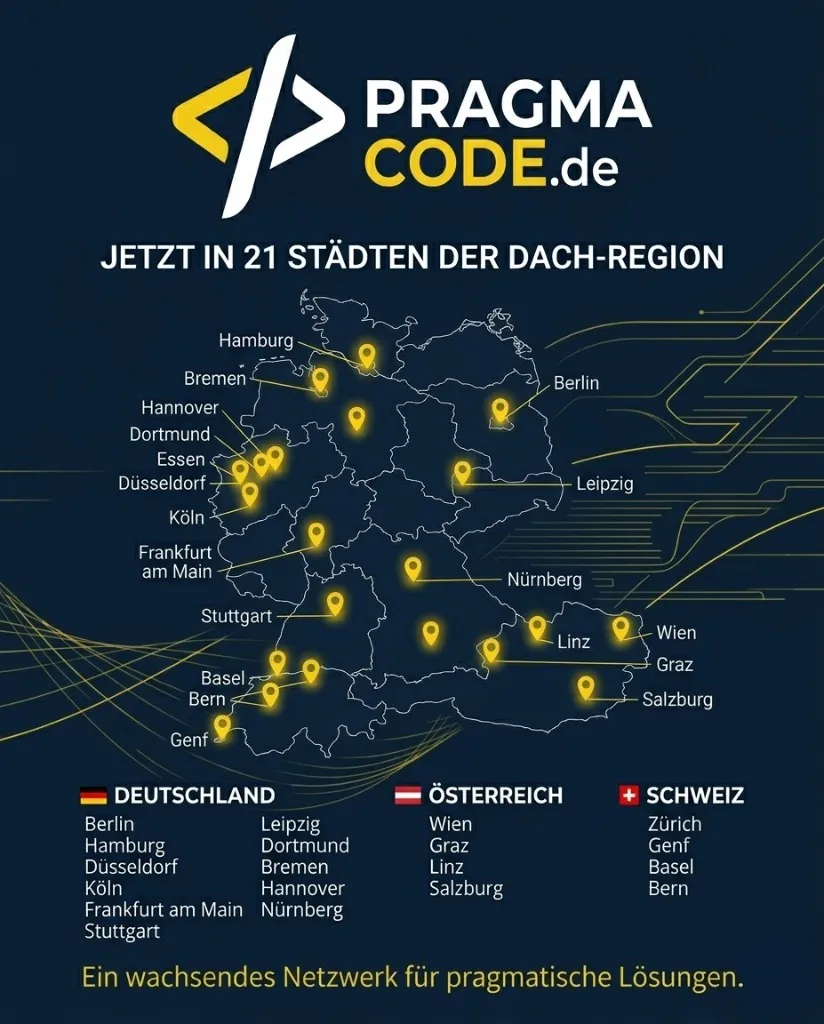
Our Regional Expertise
We are your digital partner – regionally anchored and successfully scaling across borders.
Have a vision?
Let's check together how we can make your idea take flight.
Book your free strategy call nowExtended Specialized Glossary
n8n
An open-source, node-based workflow automation software that enables companies to flexibly connect various APIs, databases, and services via visual workflows without high licensing costs.
Industry 4.0
The fourth industrial revolution, characterized by comprehensive digitization, networking, and automated data exchange between machines, plants, and IT systems in production.
OPC UA
A standardized, platform-independent industrial protocol for secure and reliable data exchange between machines, controllers, and software systems.
MQTT
An extremely lightweight network protocol for machine-to-machine (M2M) communication, optimized for resource-constrained IoT devices and unstable networks.
Modbus
An established, open industrial communication protocol designed for simple and reliable transmission of measurement and control data between PLCs and sensors/actuators.