

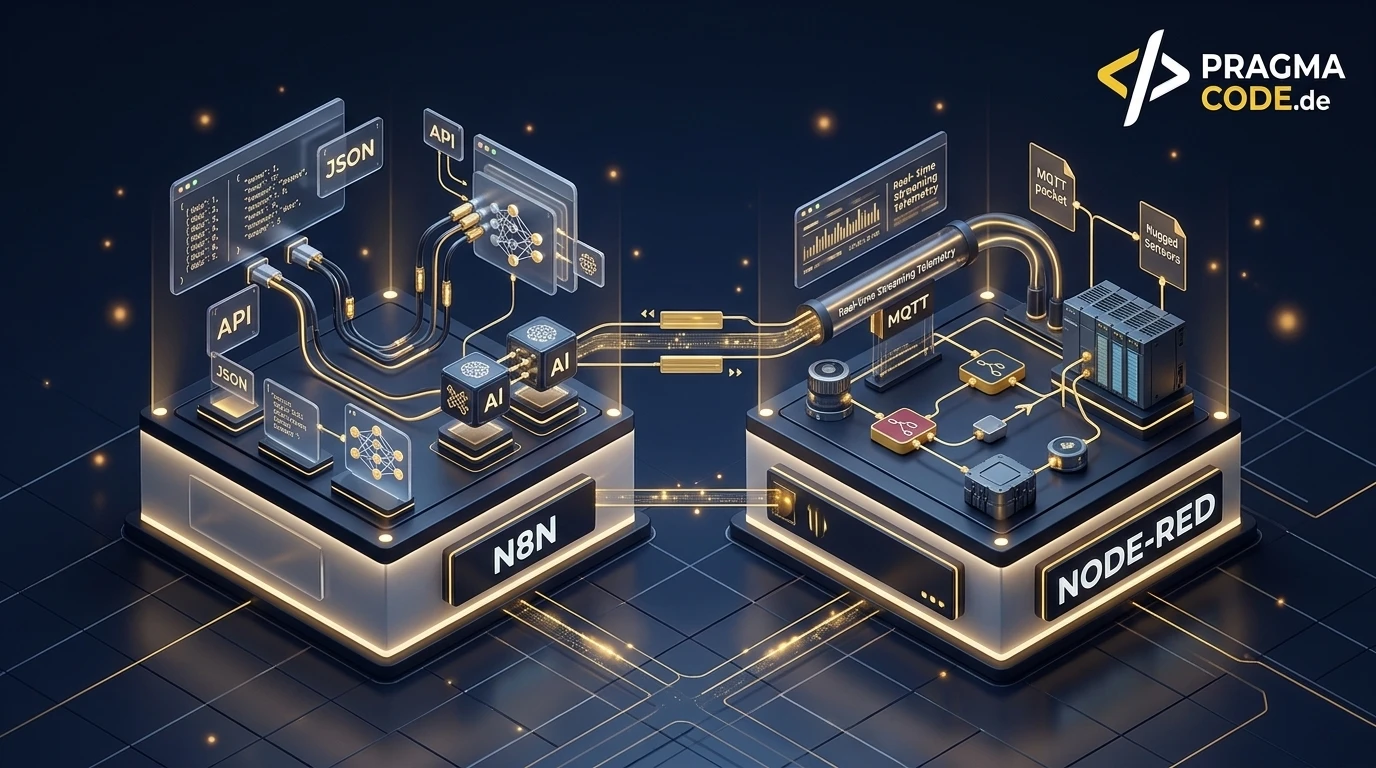
Bridging the gap between industrial OT streaming and agile IT business process orchestration, SME leaders face a fundamental architectural choice: n8n or Node-RED? We provide an in-depth comparison of both leading open-source automation platforms across architecture, data paradigms, GDPR compliance, and real-world ROI.
This article is an in-depth expert contribution from our content cluster. Discover the complete overview on our main page: n8n Automation →
IT Business Workflows vs. OT Machine Telemetry in European Industry
While companies spent years relying on proprietary US cloud automation services like Zapier or Make, spiraling task fees, strict GDPR compliance standards, and NIS-2 cybersecurity mandates have catalyzed a major shift toward self-hosted sovereignty. Today, European enterprise leaders require absolute data control, auditable open-source codebases, and the freedom to deploy workflows on-premises via self-hosting. In this landscape, n8n and Node-RED represent two premier open-source automation platforms. Yet, they originate from entirely different engineering philosophies: n8n dominates enterprise IT business workflows, REST APIs, and generative AI pipelines, while Node-RED has been the undisputed standard for Industrial IoT, programmable logic controllers (PLCs), and edge hardware for over a decade.
Two Complementary Engineering Domains
Node-RED excels in Operational Technology (OT) through asynchronous, message-driven event streams (msg.payload), sub-millisecond latencies, and native industrial protocols (MQTT, Modbus, OPC-UA). n8n leads in Information Technology (IT), REST web services, SaaS integrations, and autonomous generative AI agent pipelines.
Contrasting Data Paradigms
Node-RED handles individual events sequentially in real time. n8n processes structured datasets as homogeneous JSON object arrays, dramatically simplifying business iterations, ERP reconciliations, and batch transformations.
The Hybrid Industry 4.0 Best Practice
Advanced manufacturers deploy both in tandem: Node-RED operates as a ruggedized edge agent directly on the shop floor to filter and preprocess telemetry data, dispatching aggregated status events via webhook to n8n, which orchestrates ERP ledger entries, CRM updates, and Teams alerts.
Editorial Scope Note: While our comprehensive guide to n8n Automation covers platform architecture and multi-agent workflows, and our article on n8n in Industry 4.0 explores shopfloor telemetry, this analysis provides an architectural deep dive comparing n8n vs. Node-RED directly. We break down protocol support, licensing considerations, operational overhead, and provide a practical, hands-on tutorial demonstrating how European enterprises build durable, future-proof automation backbones.
1. Architecture Comparison: n8n vs. Node-RED
Understanding where each platform shines requires examining their distinct engineering origins and data-handling foundations. While both run on Node.js and JavaScript, their underlying execution models could not be more divergent.
Flow Paradigms: Event Streams (Msg) vs. Batch Objects (JSON Array)
The core structural distinction between n8n vs. Node-RED lies in how information travels between connected nodes:
Node-RED: Event-Driven Stream
In a Node-RED flow, every packet is an isolated JavaScript object termed msg, containing a payload property msg.payload. If an industrial vibration sensor publishes 100 readings per second, Node-RED dispatches 100 distinct messages sequentially through the flow. For high-frequency telemetry, binary fieldbuses, and threshold alerts, this stream architecture is lightweight and exceptionally fast.
n8n: Batch & Record-Oriented
Every node in n8n consistently outputs a JSON array ([{ json: { ... } }]). When a database node queries 500 open customer invoices from an ERP system, all 500 records are packaged into a unified array and passed to subsequent nodes. Downstream nodes automatically execute their designated operations across each item in the batch without requiring manual split-join loops.
For administrative business logic—such as cross-referencing invoice line items, synchronizing CRM contacts, or processing multi-tiered eCommerce orders—n8n's native array paradigm eliminates days of tedious pipeline plumbing. In Node-RED, handling the same dataset demands splitting arrays with dedicated splitter nodes, persisting state in temporary flow context memory, and synchronizing outputs with join collectors.
Protocol Landscapes: MQTT & Modbus vs. REST, GraphQL & Webhooks
The native connectivity layer highlights each platform's natural habitat:
Node-RED dominates wherever physical machinery, edge gateways, and industrial fieldbuses communicate. With battle-tested nodes for MQTT broker connections, Modbus TCP/RTU, OPC-UA, Siemens S7, BACnet, and Serial protocols, Node-RED connects directly to programmable logic controllers (PLCs), variable frequency drives, and edge sensors without intermediary protocol translators. Latencies operate comfortably in single-digit milliseconds, and memory consumption is remarkably modest: a standard instance consumes between 60 MB and 150 MB of RAM, allowing it to run smoothly on edge appliances like Raspberry Pi, Phoenix Contact PLCnext, or Siemens IOT2050 gateways installed inside electrical cabinets.
n8n, on the other hand, is the gold standard for cloud-native software and corporate IT infrastructures. Featuring over 400 prebuilt integration nodes for enterprise systems including SAP, HubSpot, Salesforce, Microsoft 365, Google Workspace, Jira, SeaTable, PostgreSQL, and Stripe, n8n speaks fluent REST API, GraphQL, gRPC, and webhooks. While integrating cloud SaaS in Node-RED often requires manual HTTP Request nodes, complex OAuth2 handshake flows, and custom authentication scripts, n8n provides built-in credential management, automated token refreshing, graphical schema mappings, and structured error routes out of the box.
Direct Comparison: Node-RED (OT & IoT) vs. n8n (IT & Business)
- Primary Focus: Shopfloor sensors, edge telemetry, embedded Linux hardware, and building automation.
- Data Model: Discrete, event-driven message streams (
msg.payload) triggered reactively per incoming pulse. - Protocols: MQTT, Modbus, OPC-UA, Siemens S7, WebSockets, Serial, BACnet.
- Footprint: Extremely light (~60–150 MB RAM), runs effortlessly on edge microcontrollers and industrial PCs.
- Developer Experience: Requires substantial custom JavaScript inside Function nodes; manual OAuth handshakes.
- Licensing: Pure permissive open-source license (Apache 2.0) under the OpenJS Foundation.
- Primary Focus: Business workflows, ERP/CRM synchronization, cloud SaaS integrations, and generative AI agents.
- Data Model: Structured JSON object arrays with automatic batch loops and field-mapping previews.
- Protocols: REST APIs, GraphQL, Webhooks, SQL/NoSQL databases, cloud object storage.
- Footprint: Moderate resource footprint (~512 MB–2 GB RAM in production Docker clusters with PostgreSQL & Redis).
- Developer Experience: High-productivity visual canvas with data pinning, expressions, and zero-code mappings.
- Licensing: Sustainable Use License (Fair-code: source-available, completely free for internal company use).
Expert Tip: Maintain Clear Domain Boundaries
Avoid forcing either system outside its primary strengths. Node-RED is unmatched at the industrial edge for ingesting, smoothing, and translating machine telemetry. However, once business entities, CRM records, PDF invoices, or AI reasoning agents enter the picture, n8n delivers dramatically higher development speed, observability, and long-term maintainability.
2. n8n Simple Example: Step-by-Step Production Workflow
A frequent inquiry among enterprise developers exploring open-source workflow platforms is: "What does a realistic, simple n8n example look like?" Many engineers are intrigued by visual automation but want to see concrete code and data structures. Below, we walk through a standard B2B automation pattern: Inbound lead qualification, duplicate validation, and CRM synchronization.
Production Scenario: Inbound Webhook → Sanitization → CRM Sync & Slack Alert
When an enterprise prospective client submits an inquiry form on your website, instead of dispatching unencrypted emails or relying on manual data entry, n8n automates the entire ingestion pipeline:
Webhook Trigger: Event Ingestion
The workflow triggers instantaneously whenever the frontend web form posts a payload to the n8n webhook URL. n8n verifies request headers and exposes the body as clean JSON.
Code Node: Normalization & Sanitization
A concise JavaScript or Python node formats phone numbers into international E.164 standards, trims whitespace, and validates corporate email domains.
If Node: Business Domain Classification
A conditional branching node evaluates whether the submitted email stems from a consumer freemail provider (e.g., gmail.com) or a verified corporate domain.
CRM / ERP Node: Deduplication & Record Creation
Using native connectors for HubSpot, Salesforce, or Odoo, n8n queries the database for existing records, updating active contacts or creating new qualified leads.
Alert Node: Real-Time Sales Notification
A formatted Teams or Slack webhook notifies account executives instantly with contact metadata and a direct link to the newly created CRM deal record.
Hands-On Code: Data Normalization in n8n
In step 02, n8n's native Code Node demonstrates how cleanly structured payloads are parsed before reaching downstream destinations:
// n8n Code Node (Execute Once for All Items)
// Ingests an array of items provided by the upstream Webhook Trigger
return $input.all().map(item => {
    const raw = item.json;

    // Clean and normalize phone numbers into international E.164 format
    let cleanPhone = (raw.phone || '').replace(/[^0-9+]/g, '');
    if (cleanPhone.startsWith('00')) cleanPhone = '+' + cleanPhone.slice(2);
    if (cleanPhone.startsWith('0')) cleanPhone = '+49' + cleanPhone.slice(1);

    // Business email validation vs. freemail detection
    const domain = (raw.email || '').split('@')[1]?.toLowerCase() || '';
    const freeMailers = ['gmail.com', 'yahoo.com', 'hotmail.com', 'outlook.com', 'gmx.de'];
    const isBusinessLead = !freeMailers.includes(domain) && domain.length > 3;

    return {
        json: {
            ...raw,
            phone: cleanPhone,
            domain: domain,
            isBusinessLead: isBusinessLead,
            processedAt: new Date().toISOString()
        }
    };
});
Why is this workflow so much simpler to maintain in n8n than in Node-RED? In n8n, developers can inspect incoming and outgoing data at every single node on the canvas. The built-in Data Pinning capability lets engineers lock in actual production test payloads to test individual branching conditions repeatedly without re-submitting test web forms. In Node-RED, observing payload transformations requires wiring separate Debug nodes and toggling between the flow canvas and the debug sidebar.
3. AI Integration & Low-Code Automation in 2026
In 2026, automation has evolved far beyond static conditional rules. Modern enterprises require cognitive systems capable of interpreting unstructured documents, reasoning across customer queries, and invoking external tools dynamically.
Native AI Agents in n8n: LangChain & Autonomous Tools
n8n has established an commanding lead in generative AI orchestration. By embedding the LangChain framework directly into its visual low-code interface, n8n transforms complex agentic patterns into intuitive, modular building blocks:
1. Multi-Model Support & Local Offline LLMs
Seamlessly integrate commercial frontier models (OpenAI GPT-4o, Anthropic Claude 3.7 Sonnet) alongside fully local, air-gapped open-source models via Ollama (Llama 3.3, Mistral, Qwen) for strict corporate compliance.
2. Vector Databases & Retrieval-Augmented Generation (RAG)
Native connectors for Qdrant, Pinecone, Milvus, and pgvector empower agents to ground answers directly in company knowledge bases, product catalogs, and operating manuals.
3. Dynamic Tool Calling
Any sub-workflow or integration node can be exposed as an autonomous Tool to the AI agent. When the model determines an order lookup is required, it calls the ERP tool with extracted parameters automatically.
4. Conversational Memory & Session Management
Turnkey session persistence via Redis or PostgreSQL enables multi-turn customer dialogues, context retention, and clarification loops without writing bespoke state management routines.
Node-RED and AI: The Streaming Challenge
Can engineers run LLM queries within Node-RED? Yes, community packages like node-red-contrib-openai or custom HTTP Request nodes can reach model endpoints. However, teams quickly encounter architectural roadblocks when scaling agentic workloads:
1. State Management Complexity
Managing multi-turn conversation memory and session retention requires brittle global- or flow-scoped variables that risk thread pollution during concurrent user queries.
2. Fragile Dynamic Tool Calling
Implementing autonomous tool execution where the LLM selects parameters dynamically requires sprawling layers of custom switch and function nodes instead of declarative tool sockets.
3. Tangled Spaghetti Flows
Constructing multi-agent pipelines (routing, classifying, verifying outputs) in Node-RED generates labyrinthine flow graphs that are exceedingly hard to audit and maintain.
For mid-market enterprises modernizing administrative back-office workflows, customer support, and CRM operations with generative AI, n8n is undeniably the superior choice.
4. Data Sovereignty, GDPR & Hosting for Mid-Market Firms
European organizations face stringent regulatory mandates under the General Data Protection Regulation (GDPR) and the NIS-2 Directive. Relying on US-hosted multi-tenant SaaS providers for sensitive trade secrets or personally identifiable information (PII) introduces significant compliance liabilities.
Self-Hosting Infrastructure: Docker Compose & Scalable Clusters
Both platforms can be hosted independently on self-managed infrastructure—either on bare-metal servers inside local facilities or across certified European cloud hosting providers (e.g., Hetzner, IONOS, OVHcloud):
Node-RED: Minimalist Single-Process
Node-RED is remarkably lightweight, requiring only the core Node.js runtime and storing flow definitions as raw JSON files on disk. A minimalist container allocated 256 MB of RAM can easily process thousands of signals per minute, though reconstructing past incidents requires external logging pipelines (e.g., Grafana Loki, Elasticsearch).
n8n: High-Availability Queue Mode
n8n records every workflow execution, input/output payload, and credential revision inside PostgreSQL. For enterprise high availability, n8n operates in Queue Mode: incoming webhooks are routed to Redis, and distributed worker instances process execution tasks concurrently.
Security & Compliance: Four Core Pillars for Mid-Market IT
When operating open-source automation platforms in production, IT teams must implement four defensive controls:
1. Encrypted Secrets Management
Database passwords, API credentials, and private keys must never exist in plaintext within flow definitions. n8n enforces AES-256 encryption at rest for all stored credentials and integrates with external secret vaults (HashiCorp Vault, AWS Secrets Manager).
2. Local Data Residency Without Third-Country Transfers
Hosting on European servers ensures that customer records and operational metrics never transit outside EU legal jurisdictions. This eliminates the need for cross-border Data Processing Agreements (DPAs) required by US SaaS platforms.
3. OT/IT Network Segmentation (DMZ Demarcation)
Node-RED field gateways should reside inside isolated OT VLANs without direct external internet access. Communication into the corporate IT layer (n8n) must be restricted to hardened, internal API endpoints through stateful firewall boundaries.
4. Immutable Audit Trails & Enterprise RBAC
To satisfy NIS-2 compliance, workflow changes, credential updates, and administrative logins must be auditable. n8n Enterprise offers granular Role-Based Access Control (RBAC), SSO via SAML/OIDC, and tamper-resistant audit logs.
5. Decision Matrix: When to Pick n8n, Node-RED, or Both?
To provide actionable clarity for enterprise architects and engineering leaders, here is a breakdown of optimal tool selection by operational domain:
Strategic Rule of Thumb: Platform Assignment by Use Case
Do you have questions about automation with n8n & Node-RED?
Schedule a free consultation6. Sources & Official Documentation (as of October 2026)
- n8n Documentation & Fair-Code Licensing: Official architecture guides, queue mode specifications, and licensing terms published by n8n GmbH (docs.n8n.io, accessed October 2026).
- Node-RED Official Guide & Architecture: OpenJS Foundation documentation covering message-driven flow architectures and IoT protocol nodes (nodered.org, accessed October 2026).
- German Federal Office for Information Security (BSI): Architectural standards for secure OT/IT convergence, industrial network isolation, and NIS-2 compliance guidelines (bsi.bund.de).
- LangChain & Agentic Workflow Standards: Technical documentation for dynamic tool orchestration, conversational memory, and enterprise vector storage.
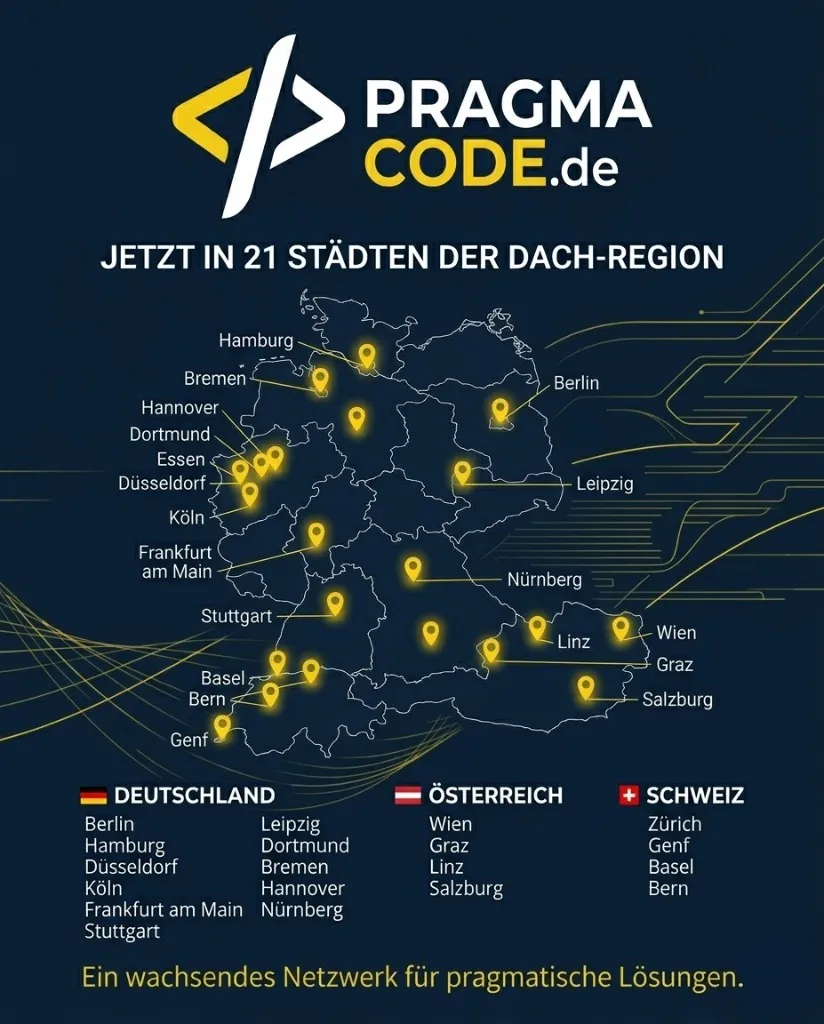
Our Regional Expertise
We are your digital partner – regionally anchored and successfully scaling across borders.
Have a vision?
Let's check together how we can make your idea take flight.
Book your free strategy call nowExtended Specialized Glossary
Node-RED Flow
An event-driven flow in Node-RED where individual message objects (msg) are asynchronously passed between nodes.
JSON Array
The standardized data structure in n8n where records are grouped and processed as a homogeneous list of JSON objects.
MQTT Broker
A lightweight publish/subscribe messaging protocol widely used for sensors and telemetry in the Industrial Internet of Things (IIoT).
Webhook
An HTTP callback mechanism delivering real-time event payloads from third-party applications to workflow endpoints.
REST API
Stateless HTTP web service interface used to query and manipulate structured business entities across modern software systems.
Self-Hosting
The independent deployment of open-source software on company-owned infrastructure or dedicated European bare-metal servers without vendor lock-in.
LangChain
An open-source orchestration framework that connects Large Language Models with dynamic tools, vector databases, and enterprise data.