


Manufacturing SMEs in the DACH region are drowning in unstructured data: PDF manuals, CAD drawings, and service protocols. Multi-modal RAG systems read text and images in parallel, enabling engineers to access their entire corporate knowledge base in seconds.
This article is an in-depth expert contribution from our content cluster. Discover the complete overview on our main page: AI & Automation →
The End of Blind Search
In the era of Agentic AI and Generative Engine Optimization, text-based search is no longer sufficient. Multi-modal RAG systems connect vision AI with vector databases, making an organization's entire technical knowledge - including drawings, schematics, and tables - searchable in seconds.
- Beyond Text RAG: Classic RAG systems capture only running text. Multi-modal RAG systems additionally process CAD drawings, schematics, tables, and photographs - covering up to 60% of previously invisible corporate knowledge in manufacturing.
- Production-Ready Architecture: A pipeline combining OCR/vision processing, vector embeddings (pgvector), and n8n automation can be gradually introduced in SMEs - without six-figure licensing costs.
- GDPR-Compliant and On-Premise: Sensitive design data stays on company-owned servers. Local vision LLMs like LLaVA or Gemma 3 eliminate the need for cloud APIs for image analysis.
1. The Knowledge Silo in Engineering - When Text Search Fails
A mid-sized mechanical engineering company with 150 employees typically manages tens of thousands of technical documents: design drawings in DWG and PDF format, schematics for control electronics, maintenance manuals with photographic instructions, inspection protocols with handwritten notes, and spare parts lists in tabular form. The core problem: Most critical information is embedded not in running text, but in graphics, dimension chains, bills of materials, and annotated drawings.
Classic RAG systems, as described in our foundational article Local Enterprise RAG, solve the text problem excellently. They extract running text from PDFs, chunk it, generate embeddings, and make it searchable via a vector database. But what happens when a service technician asks: "Show me the lubrication chart for hydraulic unit type HE-3200"? The answer lies in an exploded-view drawing on page 47 of the maintenance manual - pure text RAG delivers zero results.
This phenomenon is not an edge case but the normal state of affairs in industry. According to industry analyses, over 50% of documented knowledge in manufacturing companies exists in non-textual formats: technical drawings, photographs, tables, flow diagrams, and circuit diagrams. A RAG system that only understands text captures, at best, half of the corporate knowledge.
"A RAG system that can't read images is like an engineer who only understands novels but not technical drawings - half of reality is missing."
2. The Breakthrough of Multi-Modal LLMs
The technological foundation for multi-modal RAG is the new generation of vision LLMs - large language models that process text and images simultaneously. Models like GPT-4o, Gemini Pro Vision, LLaVA (Large Language and Vision Assistant), or the compact Gemma 3 can "look at" a CAD drawing and describe its contents in natural language: part designations, dimensions, tolerances, material specifications, and position numbers.
This capability fundamentally changes the RAG pipeline. Instead of only chunking and embedding text, a multi-modal system processes each document page in three parallel tracks:
Text Extraction
Running text is extracted as usual via PDF parsers or Tesseract OCR. This layer captures headings, paragraphs, footnotes, and machine-readable tables.
Vision Analysis
Each page is passed as an image to a vision LLM, which converts the visual content into a structured text description: part names, dimensions, position numbers, and relationships between components.
Table Parsing
Structured tables (bills of materials, tolerance tables, inspection protocols) are separately recognized and converted into a query-friendly format - including row/column structure and cross-references.
The decisive advantage: Text descriptions from the vision analysis are converted into vector embeddings together with the extracted running text. This creates a unified, searchable knowledge base that responds to both textual and graphical queries.
Comparison: Text RAG vs. Multi-Modal RAG
- Data Sources: Only machine-readable running text from PDFs, Word documents, and notes.
- Drawings: Completely ignored. Dimensions, bills of materials, and annotations in graphics are invisible.
- Tables: Only simple tables with clear text structure. Complex layouts are lost.
- Coverage: Captures approx. 40-50% of documented knowledge in manufacturing companies.
- Data Sources: Text, images, drawings, schematics, photos, scanned documents, and tables.
- Drawings: Vision LLMs describe parts, dimensions, and positions. CAD content becomes searchable.
- Tables: Specialized parsers correctly recognize even complex, multi-level table structures.
- Coverage: Potentially captures 90-95% of documented corporate knowledge.
3. Architecture of an Industrial RAG System
The architecture of a multi-modal RAG system for manufacturing can be represented as a five-stage pipeline. Each stage builds on open-source components that can also be operated on-premise in the DACH region. The following architecture blueprint shows the data flow from raw file to answer:
Architecture Blueprint: Data Flow in Multi-Modal RAG
Document Ingestion: Technical documents (PDF manuals, DWG/DXF exports, photographed type plates, scanned inspection protocols) are automatically ingested from network drives, Nextcloud, or DMS systems. n8n triggers monitor defined folders and start the pipeline when new or modified files are detected.
OCR/Vision Processing: Each document page passes through two parallel paths. Path A: Tesseract OCR extracts machine-readable text. Path B: A vision LLM (e.g., LLaVA 1.6, Gemma 3, or GPT-4o) analyzes the page as an image and generates a structured description of all visual elements - part names, dimension chains, position numbers, circuit symbols.
Vector Store (pgvector): Vectors are stored together with the original text and metadata (filename, page number, document type, creation date) in PostgreSQL/pgvector. HNSW indexes accelerate similarity search to millisecond-level performance - even with hundreds of thousands of chunks.
n8n RAG Agent + LLM: When a user submits a query, an n8n workflow orchestrates the search: the query is embedded, the top-k most relevant chunks are retrieved from pgvector and passed together with the query to the LLM (Llama 3, Mistral, or a cloud model). The model generates a source-based answer with references to document name and page number.
Expert Tip: Hybrid Approach for Maximum Quality
Combine local vision models (LLaVA for bulk recognition) with a cloud API fallback (GPT-4o for particularly complex schematics). The n8n workflow can automatically decide: Does the drawing contain more than 20 components? Then use the cloud fallback with anonymized metadata. This maximizes recognition quality without sending all data to the cloud.
Technology Stack in Detail
The following overview shows the recommended components for each layer of the stack. All tools are open source or offer a free self-hosted variant:
PostgreSQL + pgvector / Supabase
Battle-tested relational database with vector extension. Supabase offers a managed variant with integrated pgvector, Edge Functions, and Row Level Security - ideal for quick onboarding.
Ollama + LLaVA / Gemma 3
Ollama orchestrates local models via API. LLaVA (13B) or Gemma 3 (27B) deliver vision capabilities for image analysis. For pure text generation, Llama 3 (70B quantized to 4-bit) is the ideal choice.
n8n (Self-Hosted)
Workflow engine with native AI Agent node, pgvector integration, and over 400 connectors. Orchestrates the entire pipeline without code - from file detection to Slack/Teams notifications.
Tesseract OCR + pdf2image
Open-source OCR engine for text extraction from scanned documents. Combined with pdf2image (Python), PDF pages are converted to images that then undergo parallel OCR and vision analysis.
4. Case Study: Service Time Model Calculation
To make the value of a multi-modal RAG system tangible, let's examine a transparent model calculation for a mid-sized manufacturer with 30 service technicians:
ROI Model Calculation: Service Queries With and Without Multi-Modal RAG
Without Multi-Modal RAG
Manual searching through file cabinets, PDF collections, and file systems
~ 12 min / queryWith 30 technicians at 8 queries/day = 240 queries/day. Search time: 2,880 min/day = 48 person-hours/day. At 220 working days and EUR 45/hr = EUR 475,200/year in pure search costs.
With Multi-Modal RAG
AI-powered search across text and drawings in seconds
~ 1.5 min / querySame 240 queries/day. Search time: 360 min/day = 6 person-hours/day. At 220 working days and EUR 45/hr = EUR 59,400/year in search costs. Savings: approx. EUR 415,800/year (87.5% reduction).
Expert Tip: Transparent Derivation Instead of Blanket Numbers
The model calculation above is based on conservative assumptions. In practice, search times vary considerably depending on documentation quality and folder structure. We recommend measuring actual search times in your team before an RAG project (e.g., 2-week tally sheet) and using that data to calculate your individual business case.
Beyond pure time savings, additional strategic benefits emerge: new employees get up to speed significantly faster (onboarding acceleration), experienced knowledge is preserved even after experts leave the company (knowledge retention), and the error rate during service calls decreases because technicians find the right drawings and specifications immediately instead of working from memory.
Typical Use Cases in Manufacturing
Service & Maintenance
Technicians search by free text for spare parts, lubrication plans, or torque values - the system finds the relevant drawing and highlights the position.
Quality Assurance
Inspection protocols with handwritten annotations and photos become searchable. Auditors find evidence in seconds instead of hours.
Design & Engineering
Engineers search for parts with specific specifications across thousands of existing drawings - ideal for reusing proven designs.
Spare Parts Management
Bills of materials in exploded-view drawings are automatically indexed. Searching for a part number instantly returns the associated drawing, supplier, and current inventory level.
5. Data Protection & On-Premise: GDPR-Compliant Implementation
Technical design data is among the most sensitive intellectual property of a manufacturer. CAD drawings, manufacturing tolerances, and material specifications are often the result of decades of development work. Transmitting this data to cloud APIs (even in encrypted form) carries significant risks - from industrial espionage to GDPR violations involving personal data in inspection protocols.
A multi-modal RAG system can be operated entirely on-premise. The key components and their data protection characteristics:
Security Architecture for Sensitive Design Data
Local Vision Models
LLaVA and Gemma 3 run entirely locally on company-owned GPU hardware (from NVIDIA RTX 4090 or A6000). No API calls, no data leakage. Image analysis happens within the corporate network.
Encrypted Vector Database
PostgreSQL supports Transparent Data Encryption (TDE) and SSL-encrypted connections. Row Level Security ensures that only authorized users can access specific document classes.
n8n Self-Hosted with Access Control
n8n runs as a Docker container within the corporate network. Workflow credentials are stored with AES-256 encryption. Audit logs document every access to the RAG pipeline. More details in our article on n8n data sovereignty.
Air-Gap Capability
The entire system can be operated in a network segment without internet access (air-gap). Model updates are installed offline via USB or internal mirror - ideal for defense industry and critical infrastructure organizations.
6. Implementation Roadmap
Introducing a multi-modal RAG system in manufacturing follows a phase-based approach. We recommend starting with a clearly defined pilot project and expanding the system iteratively:
-
Phase 1: Audit & Data Landscape (Week 1-2)
Inventory of existing document types, formats, and storage locations. Identification of the 3-5 most common search scenarios in the service team. Assessment of available hardware (GPU capacity) and network infrastructure. Result: prioritized document list and hardware recommendation.
-
Phase 2: Build Text RAG Foundation (Week 3-5)
Setting up the base infrastructure following the proven pattern from our Enterprise RAG guide: install PostgreSQL/pgvector, configure Ollama with Llama 3, create n8n workflows for the text pipeline. Initial test runs with pure text PDFs.
-
Phase 3: Integrate Vision Pipeline (Week 6-8)
Integration of vision models (LLaVA or Gemma 3) into the n8n pipeline. Configuration of parallel OCR/vision processing. Setup of table parsers. Initial tests with engineering drawings and schematics. Fine-tuning of chunk sizes and prompt templates for vision analysis.
-
Phase 4: Pilot Operation & Feedback (Week 9-12)
Rollout to 5-10 pilot users (service technicians, design engineers). Systematic feedback tracking: Which queries deliver good results? Where does the system hallucinate? Iterative improvement of prompt templates and chunking strategies based on real usage data.
-
Phase 5: Full Operation & Scaling (from Week 13)
Expansion to all departments. Integration into existing chat interfaces (Slack, Teams, custom intranet portal). Automated quality assurance: regular precision/recall tests with a benchmark question catalog. Connection of additional data sources (ERP bills of materials, MES protocols).
7. Conclusion: From Paper Chaos to Intelligent Engineering AI
Multi-modal RAG is not a theoretical future concept but a technology deployable today that revolutionizes access to an organization's entire technical knowledge. For manufacturing SMEs in the DACH region, the combination of local vision LLMs, pgvector, and n8n automation offers a unique opportunity: making the previously invisible knowledge in drawings, schematics, and tables finally usable - without surrendering data to cloud providers.
The key to success lies not in a big-bang project but in an iterative approach: start with the proven text RAG foundation, gradually expand with vision capabilities, and measure ROI against concrete service KPIs. The technology is mature, the open-source components are battle-tested, and the funding landscape supports exactly these digitalization projects.
Quick Check: Your Path to Multi-Modal RAG
Have questions about Multi-Modal RAG in Manufacturing?
Schedule a Free ConsultationOur Regional Expertise
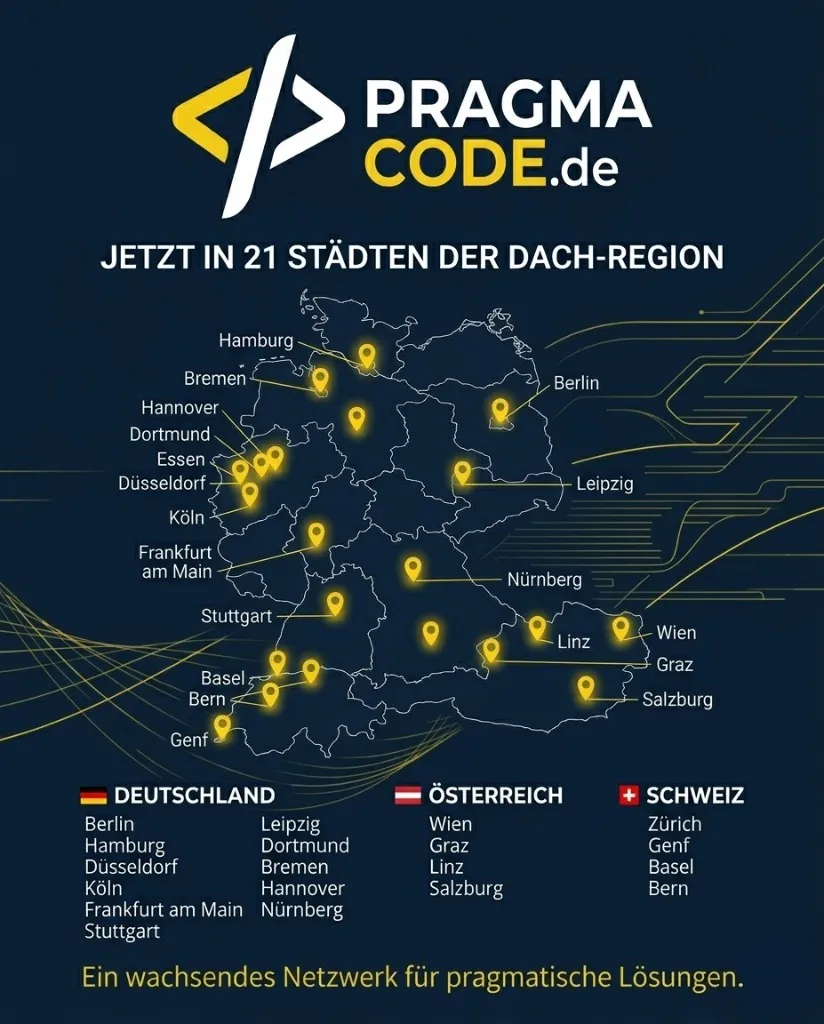
We are your digital partner – regionally anchored and successfully scaling across borders.
Have a vision?
Let's check together how we can make your idea take flight.
Book your free strategy call nowExtended Specialized Glossary
Multi-Modal RAG
An extension of Retrieval-Augmented Generation that converts not only text but also images, diagrams, and tables into vector embeddings, enabling holistic search across all document types.
Vision LLM
A large language model with integrated image understanding capabilities (e.g., GPT-4o, Gemini Pro Vision) that can simultaneously analyze and describe texts and graphics.
CAD (Computer-Aided Design)
Computer-aided design - software and file formats for creating technical drawings, 2D plans, and 3D models in mechanical engineering and architecture.
Tesseract OCR
An open-source engine for optical character recognition (OCR) that converts printed text in images and scanned documents into machine-readable text.
Embedding
A numerical vector representation of text, images, or other data that maps semantic meaning in a high-dimensional space and enables similarity searches.
Chunking
The process of splitting large documents into smaller, semantically coherent sections (chunks) to efficiently store them in a vector database and deliver precise results for search queries.