

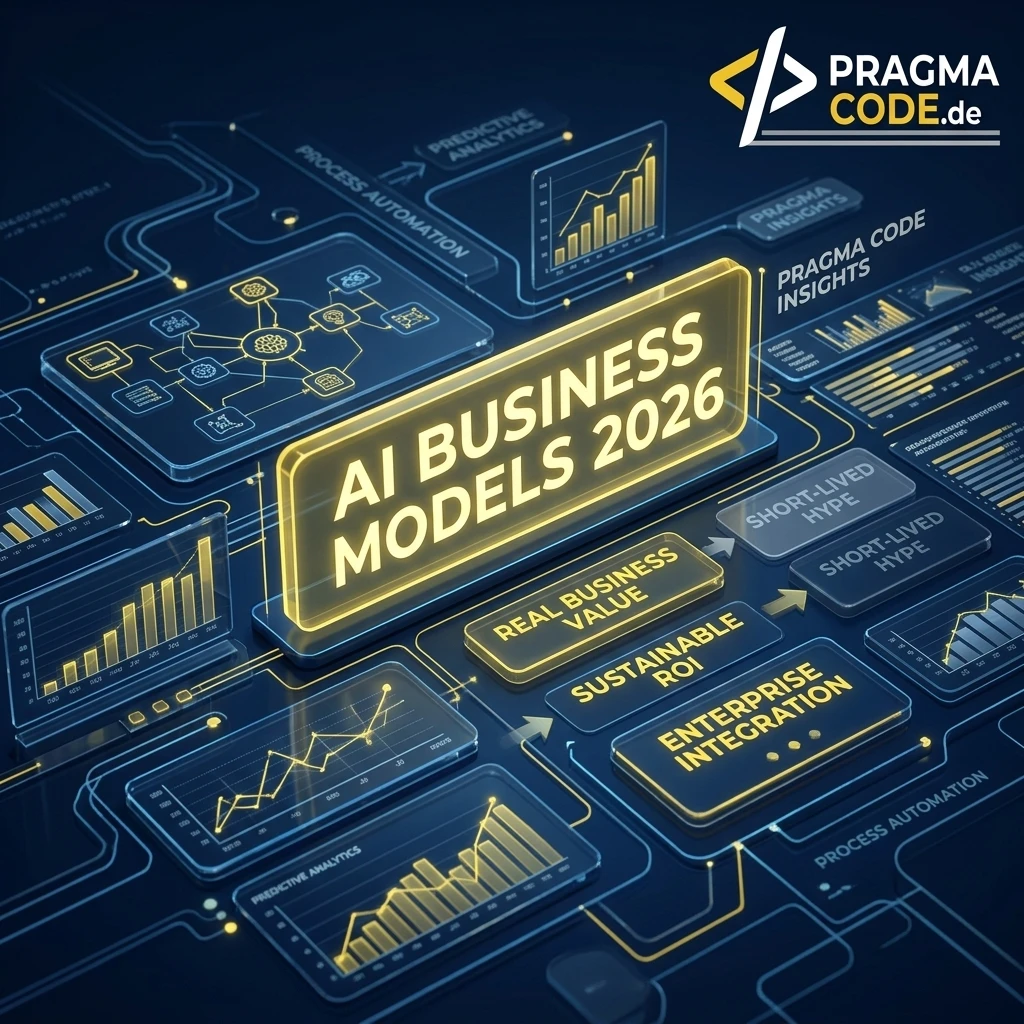
The year 2026 marks the end of superficial prompt experimentation for SMEs: Standardized chatbots and generic cloud tools burn budgets, while customized AI solutions deeply integrated into ERP and CRM landscapes deliver substantial competitive advantages. Learn which B2B business models generate measurable ROI, how to preserve data sovereignty under GDPR, and where the market ruthlessly weeds out non-viable solutions.
This article is an in-depth expert contribution from our content cluster. Discover the complete overview on our main page:AI & Automation →
The Maturity Test for Enterprise AI in Europe
Following years of uncoordinated pilot projects, European SMEs in 2026 face an undeniable reality: With the full enforcement of the EU AI Act, the widespread adoption of the Model Context Protocol (MCP), and plummeting token costs, genuine value creation has decisively broken away from superficial SaaS wrappers.
- Deep System Integration Beats Surface Tools: Isolated chatbots and prompt wrappers no longer generate tangible value in 2026. Sustainable ROI is achieved exclusively through the bidirectional integration of LLMs with internal ERP, CRM, and SQL database systems via standardized protocols such as the Model Context Protocol (MCP).
- Data Sovereignty as an Uncompromising Prerequisite: Across the DACH and European markets, private cloud and on-premise deployments featuring guaranteed Zero-Data Retention dominate. Transmitting proprietary knowledge or confidential customer records unencrypted to overseas public cloud APIs triggers severe compliance penalties under the EU AI Act and GDPR.
- Disruption of Custom Software by Agentic Coding: Driven by autonomous software engineering agents, the development costs for bespoke B2B applications have dropped by up to 70 %. Rigid, expensive enterprise SaaS subscriptions are rapidly being replaced by highly customized, low-maintenance proprietary software.
- 1. The 2026 Turning Point: From Prompt Hype to Hard B2B Profitability
- 2. The Four Pillars of Future-Proof B2B AI Business Models
- 3. Highly Profitable Low-Hanging Fruits for SMEs
- 4. The Costly Hype Flops: Where Millions Are Burned in 2026
- 5. Direct System Comparison: Hype Models vs. Sustainable Value
- 6. Step-by-Step Implementation Roadmap for Profitable AI Transformation
- 7. Practical ROI Calculations & Cost-Benefit Models
- 8. Conclusion & Strategic Recommendations
1. The 2026 Turning Point: From Prompt Hype to Hard B2B Profitability
We have reached the year 2026, and the era of casual technology experimentation in the B2B sector has come to a definitive close. During 2023 and 2024, many enterprises were content with granting employees web access to commercial chat interfaces or experimenting with basic API connections to overseas cloud providers. Today, the sobering results of that initial adoption wave are clear: more than 80 percent of these isolated pilot initiatives failed to produce measurable commercial value in real-world operations.
This failure stems directly from two fundamental design flaws in first-generation enterprise AI adoption: a complete lack of backend process depth and the neglect of European regulatory compliance standards. A language model operating in an isolated web browser tab has no visibility into real-time ERP inventory levels, nor does it comprehend the specialized contract terms negotiated with high-volume accounts in the CRM. The consequence was an explosion of time-consuming copy-paste routines, data fragmentation, and unmanaged model hallucinations.
Concurrently, the legal framework governing enterprise IT across Europe has tightened dramatically. With the enforcement mechanisms of the EU AI Act now fully operational and rigorously policed by regulatory bodies, C-level executives and managing directors face direct liability for the lawful deployment of algorithmic systems. Exposing sensitive customer data, engineering blueprints, or financial forecasts to public third-party cloud APIs risks severe financial sanctions and long-term brand damage.
As specialist consultants and engineers for AI infrastructure and business process automation at Pragma Code, we witness this corporate paradigm shift every day: companies no longer demand superficial demo prototypes, but resilient, GDPR-compliant enterprise architectures that deliver verifiable ROI. In this comprehensive guide, we analyze which AI business models generate lasting value in 2026 and which traps you should decisively avoid.
“In 2026, enterprise artificial intelligence is no longer an experimental indulgence. In the B2B arena, the only metric that matters is flawless integration with existing operational data and uncompromised compliance with European data security standards.”
2. The Four Pillars of Future-Proof B2B AI Business Models
Enterprises securing sustainable competitive advantages through artificial intelligence in 2026 do not invest in generic mass-market tools. Instead, they implement focused architectural patterns characterized by strong technological barriers to entry, absolute data sovereignty, and direct alignment with core value streams:
1. Corporate LLMs & Local RAG
Enterprise knowledge retrieval systems built upon isolated Corporate LLMs and on-premise RAG (Retrieval-Augmented Generation) pipelines. Proprietary documentation, contracts, and engineering schematics are indexed within internal vector databases (such as PostgreSQL with pgvector) and processed entirely within sovereign private clouds or on-premise servers using high-throughput engines like vLLM.
2. Agentic Coding & Custom Apps
Engineering bespoke B2B applications utilizing autonomous coding agents. Development projects that historically required multi-month release cycles and six-figure budgets are now completed within weeks through Agentic Coding. Autonomous agents generate comprehensive test suites, type definitions, and automated CI/CD pipelines perfectly aligned with internal workflows.
3. Autonomous Process Pipelines via MCP
Bidirectional integration connecting ERP, CRM, and ticketing platforms via the open Model Context Protocol (MCP) and workflow engines like n8n. Utilizing structured client-host-server topologies, AI agents receive strict, stateless permissions to execute operational transactions reliably with complete audit logs.
4. AI Governance, Audits & Evals
Comprehensive security audits, risk classifications, and automated continuous evaluation pipelines (Evals). Ensuring full alignment with the EU AI Act, hardening systems against prompt injection attacks, and maintaining automated benchmark evaluations to guard against latent model drift in production.
3. Highly Profitable Low-Hanging Fruits for SMEs
Beyond highly customized enterprise infrastructure, several standardizable use cases offer rapid deployment schedules and short payback periods. For small and medium-sized enterprises across Europe, the following four application areas represent the fastest routes to tangible productivity gains:
1. Intelligent AI Voice Agents for Reception & Customer Support
Automated telephone assistants are transforming primary customer touchpoints across professional service firms, trade businesses, logistics operators, and healthcare providers. A modern Voice Agent answers calls 24/7 in natural conversational language, pre-qualifies client inquiries based on predefined criteria, checks calendar availability in real time, and logs confirmed bookings directly into the CRM. Speech processing operates on low-latency, GDPR-compliant European server clusters without ad-network data tracking.
2. No-Touch Document Processing & RFP Analysis
Manual review of supplier invoices, delivery slips, customs declarations, and complex requests for proposal (RFPs) ties up hundreds of hours of high-value staff time. Using multimodal document ingestion pipelines, AI agents automatically extract structured table data, reconcile line items against active ERP purchase orders, and validate compliance specifications. Anomalous records are flagged for human inspection, while routine items process entirely hands-free.
3. Microsoft Copilot & Workspace Infrastructure Tuning
Nearly half of all mid-sized enterprises maintain active Microsoft 365 Copilot licenses but fail to unlock meaningful business impact. The underlying cause: poor permission hygiene across SharePoint and Teams results in either over-restrictive searches or accidental exposure of confidential executive records. Through professional permission audits, semantic tagging, and targeted team workflow training, Copilot evolves from an expensive line item into a genuine productivity engine.
4. Autonomous API Gateways & WebMCP Integrations
Rather than purchasing costly proprietary middleware suites, modern organizations connect legacy databases and internal tools through standardized API gateways. By pairing open-source automation platforms (such as n8n) with the Model Context Protocol, existing systems become AI-accessible without modifying legacy source code. This enables agents to automatically unlock client portals, issue shipment tracking updates, or calculate dynamic quotes in real time.
4. The Costly Hype Flops: Where Millions Are Burned in 2026
Whenever corporate investment budgets meet technological opacity, speculative and ineffective business models thrive. In 2026, several high-profile offerings frequently promoted across social channels collapse under rigorous operational, technical, and regulatory scrutiny:
1. Generative Content Mills & Mass-SEO Agencies
Agencies promising to generate hundreds of automated AI blog posts every month cause severe harm to organic visibility. Search engines reliably identify unverified, synthetic mass content and de-index affected domains. Without genuine primary data, verifiable author credentials (E-E-A-T), and authoritative editorial substance, these mass content services represent a complete waste of marketing capital.
2. Isolated "Stupid Chatbots" Lacking Backend Integration
Basic iframe chat widgets that do nothing more than paraphrase static FAQ pages and lack read-write access to core backends (inventory levels, order milestones, user accounts) create customer frustration. Dissatisfied users abandon the experience within seconds. In 2026, any customer-facing conversational interface must possess transactional capability and deep system awareness.
3. Faceless Social Media Automation & Cold AI Outreach Spam
Fully automated social profiles and mass AI email outreach campaigns in B2B sales are routinely intercepted by modern spam heuristics and email authentication filters (SPF, DKIM, DMARC). In professional European B2B relationships, deals are won on trust, peer references, and authentic expertise. Automated outreach spam permanently degrades brand reputation.
4. Generic "AI Wrappers" Devoid of Proprietary IP
Resellers offering a basic UI layered over a third-party API endpoint while charging recurring monthly subscription fees face rapid obsolescence. Whenever foundational model providers update their native tooling, these thin wrappers lose their entire value proposition overnight. Enterprises should never commit capital to software lacking proprietary IP or sovereign data control.
5. Direct System Comparison: Hype Models vs. Sustainable Value
To provide business leaders and IT architects with a reliable decision-making framework, the matrix below highlights the core differences between short-lived trend solutions and resilient enterprise architectures:
Direct Comparison: Short-Lived Hype vs. Sustainable B2B Architecture
- Compliance Blind Spot: Transmitting confidential business data to public cloud endpoints without Zero-Data Retention contracts.
- Lack of System Depth: Disconnected standalone tools requiring manual copy-paste handling and creating data silos.
- Vendor Dependency: Proprietary lock-in with overseas SaaS vendors subject to unpredicted licensing hikes.
- Legal Liability: Unaddressed compliance under the EU AI Act, unverified hallucinations, and lack of audit trails.
- Complete Data Sovereignty: Dedicated hosting in European data centers or on-premise under 100% GDPR compliance.
- Bidirectional Connectivity: Seamless integration into ERP, CRM, and SQL databases via Model Context Protocol (MCP).
- Open Architecture: Leveraging state-of-the-art open-weights models (such as Llama 3.3 or Qwen) with zero variable fees.
- Audit-Ready Governance: Tamper-resistant logging mechanisms, structured evaluation benchmarks, and full regulatory alignment.
6. Step-by-Step Implementation Roadmap for Profitable AI Transformation
Deploying enterprise AI systems across mid-market organizations requires a structured, phased methodology rather than speculative experimentation. We guide our clients through the following four-stage implementation framework:
-
Phase 1: Data & Compliance Audit (Weeks 1–2)
Comprehensive cataloging of all internal documentation repositories, database schemas, and existing API surfaces. Executing a formal risk assessment under the EU AI Act and establishing strict data handling policies to prevent PII exposure.
-
Phase 2: High-ROI MVP Deployment (Weeks 3–5)
Developing a focused, high-leverage application targeting immediate cost reduction (such as an on-premise RAG system for field service engineers or automated accounts payable invoice parsing). Rapid delivery of an operational, verifiable prototype.
-
Phase 3: Deep System Integration & Automation (Weeks 6–8)
Connecting the AI engine directly into core production systems (ERP, CRM, ticketing) using MCP servers and authenticated API gateways. Implementing automated verification safeguards and human-in-the-loop escalation paths.
-
Phase 4: Scaling & Continuous Evaluation (Week 9 Onward)
Enterprise-wide rollout, structured staff enablement workshops, and continuous automated evaluation benchmarking (Evals) to monitor inference quality and detect model drift over time.
7. Practical ROI Calculations & Cost-Benefit Models
Strategic IT investments must be justified to executive stakeholders through concrete financial metrics. Examining a typical mid-sized engineering and manufacturing company (120 employees, with an 8-person technical customer support team) demonstrates the immense financial leverage of an on-premise Corporate RAG solution:
Real-World Case Study: Technical Field Service & Document Retrieval
Baseline Situation: 8 service engineers spend an average of 1.5 hours per working day manually searching through complex PDF wiring diagrams, technical manuals, and fault diagnostic histories. At an hourly rate of €65, this represents annual labor costs of approximately €190,000 dedicated solely to information retrieval.
Solution: Implementation of a sovereign on-premise RAG system powered by semantic vector search and integrated directly into the company's ticketing workflow.
Result: 75% reduction in average search duration (saving more than €140,000 annually). With one-time implementation costs of approximately €38,000 and ongoing maintenance of €800 per month, the entire investment reached full financial break-even in under 3.8 months.
A critical factor behind this return is that the organization pays zero variable per-token API charges to external vendors, because inference runs locally on dedicated hardware. The marginal cost for every additional search query is virtually zero, while all intellectual property remains strictly within the corporate firewall.
8. Conclusion & Strategic Recommendations
The year 2026 has decisively reshaped the enterprise AI ecosystem. Organizations that chased superficial hype tools and unvetted cloud services lost valuable momentum and now face complex regulatory hurdles. The clear winners of European digital transformation are enterprises that treat AI as a core architectural asset, building robust, GDPR-compliant systems embedded directly in everyday operations.
Leverage the current financial year to structure your knowledge assets for autonomous agents, eliminate legacy media breaks, and transition away from rigid proprietary silos. With the right strategic architecture, artificial intelligence transforms from an unpredictable risk into your company's most powerful long-term productivity driver.
Quick Checklist: Building Your Sovereign B2B AI Infrastructure
Are you planning productive AI deployment in your organization?
Let us analyze your current workflows during a complimentary strategy consultation to identify the highest-ROI automation opportunities and design an audit-proof architecture under the EU AI Act.
Schedule a Free ConsultationOur Regional Expertise
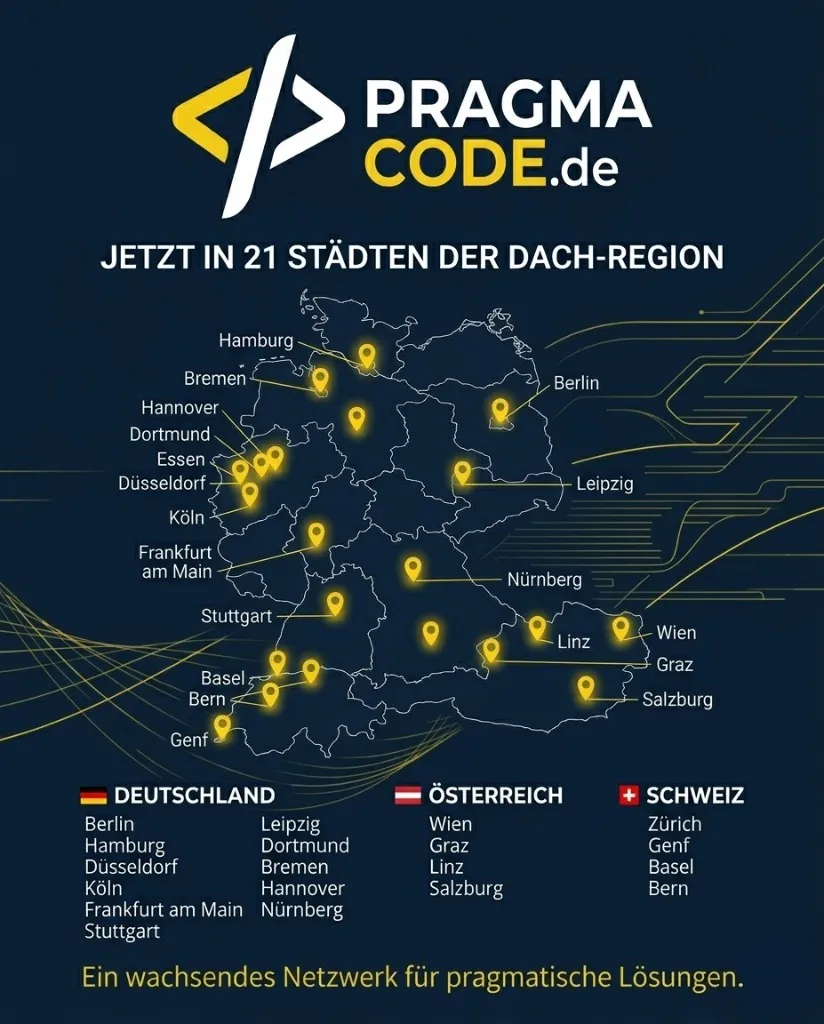
We are your digital partner – regionally anchored and successfully scaling across borders.
Have a vision?
Let's check together how we can make your idea take flight.
Book your free strategy call nowExtended Specialized Glossary
Agentic Coding
A software development paradigm in which autonomous AI agents independently generate, test, refactor, and deploy code, drastically shortening development cycles for custom enterprise applications.
Corporate LLM
A large language model deployed in an isolated private cloud or on-premise infrastructure that exclusively accesses authorized corporate data and completely prevents external data leakage.
Model Context Protocol (MCP)
An open interface standard by Anthropic enabling AI models to interact with disparate enterprise systems (ERP, CRM, SQL) through secure, standardized read and write tool calls.
Vector Database
A specialized database engineered to store mathematical vector embeddings, enabling lightning-fast semantic similarity searches across unstructured enterprise documents.
Voice Agent
An autonomous real-time conversational AI assistant that handles incoming phone calls, pre-qualifies customer inquiries, and schedules appointments under strict GDPR compliance.
Zero-Data Retention
A contractual and technical guarantee by AI providers ensuring that transmitted enterprise data is discarded immediately after inference and never stored or used for model training.
EU AI Act
The European Union's comprehensive regulation on artificial intelligence, establishing mandatory risk-based compliance, governance, and transparency requirements for B2B enterprises.