

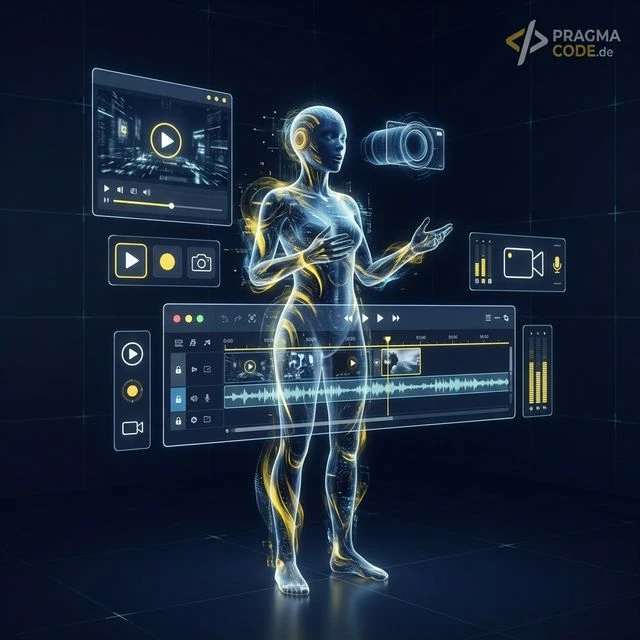
In 2026, corporate video production has undergone a fundamental transformation: What once required shooting days, camera crews, sound studios, and five-figure budgets is now generated in minutes via automated AI pipelines. From photorealistic AI avatars and cinematic text-to-video diffusion to programmatic React renderings with Remotion: Discover how B2B enterprises scale their video output, reduce production costs by up to 85%, and generate measurable ROI across marketing, sales, and customer support.
This article is an in-depth expert contribution from our content cluster. Discover the complete overview on our main page:AI Automation for Business →
The Paradigm Shift: From Shooting Days to Programmatic Video Pipelines
In 2026, video is the dominant communication medium in B2B commerce. Yet traditional video shoots and protracted editing cycles throttle the speed required for agile performance marketing and instant customer support. The convergence of neural avatars, text-to-video diffusion engines, and code-based automation empowers enterprises to generate broadcast-grade, personalized video content on demand.
- 80% Cost Efficiency & Faster Time-to-Market: Eliminating studio rentals, physical locations, and voice talent reduces video production costs from €3,000–€10,000 down to €200–€800, compressing turnaround from weeks to hours.
- Effortless Localization across 50+ Languages: Leveraging neural Voice Cloning and automated Lip Synchronization (Lip Sync), product demos and training assets are instantly localized for global markets without reshoots.
- Enterprise Compliance & EU AI Act Readiness: Professional 2026 workflows integrate cryptographic content credentials (C2PA, SynthID), fully meeting the mandatory transparency obligations under Article 50 of the EU AI Act.
- 1. The Evolution of AI Video Production – The 2026 Technological Frontier
- 2. Technology Comparison: The 2026 B2B Tool Ecosystem
- 3. B2B Use Cases in Detail: Delivering Measurable Enterprise ROI
- 4. 4-Tier Enterprise Architecture for Automated Video Pipelines
- 5. Cost Breakdown, ROI & Total Cost of Ownership for SMEs
- 6. Common Pitfalls & Cost Traps in AI Video Adoption
- 7. Regulatory Guardrails, EU AI Act & Content Provenance (C2PA)
- 8. Implementation Roadmap: 5 Phases to an Operative Video System
- 9. B2B Readiness Checklist, Conclusion & Strategic Outlook
1. The Evolution of AI Video Production – The 2026 Technological Frontier
Only a few years ago, producing corporate video assets in the B2B sector involved substantial operational friction. A two-minute product demonstration or explainer video required scripts, actor casting calls, studio rentals, gaffers, audio engineers, and weeks of tedious post-production in Premiere Pro or DaVinci Resolve. When a software enterprise needed to explain a new capability in five international markets, translation multiplied recording fees and editing overhead by five. Consequently, mid-sized enterprises often avoided regular video publishing altogether, relying instead on static PDF brochures.
By 2026, generative artificial intelligence has dismantled these barriers. State-of-the-art B2B video production is built on three technological pillars that operate in seamless harmony:
Neural Avatar Synthesis
Photorealistic AI Avatars (HeyGen 2.0, Synthesia) replicate facial micro-expressions, gestures, and authentic eye contact. They deliver scripts with perfect lip sync, completely eliminating the need for physical shooting days.
Cinematic Diffusion Engines
Frontier Text-to-Video and image-to-video models like OpenAI Sora, Runway Gen-3 Alpha, and Kling 1.5 generate high-fidelity B-roll, industrial environments, and dynamic 3D scenes directly from prompt instructions.
Programmatic Video Rendering
Code-driven video engines like Remotion (React) composite brand overlays, motion graphics, live data charts, and localized subtitles on the fly via serverless Webhook pipelines.
The generative video market is expanding at over 28% CAGR, rapidly transitioning from experimental pilot projects into mission-critical infrastructure. For B2B decision-makers in 2026, the question is no longer whether to adopt AI video – but how rapidly they can deploy a resilient, brand-compliant, and automated production pipeline.
Expert Recommendation: Why Hybrid Pipelines Outperform Generic Single-App Tools
Consumer SaaS applications frequently produce a recognizable, generic "AI look". Forward-thinking B2B organizations in 2026 combine neural presenters for the human narrative with generative diffusion B-roll (Sora / Runway) and anchor the final composition in Remotion React components for pixel-perfect typography, certified brand assets, and custom motion design.
2. Technology Comparison: The 2026 B2B Tool Ecosystem
The enterprise video generation landscape has matured into specialized operational categories. Different corporate scenarios demand tailored paradigms: While human avatars are optimal for onboarding, customer training, and personalized sales, generative diffusion engines dominate emotional storytelling, brand campaigns, and creative B-roll.
Comparison: The 3 Core Paradigms of AI Video Production 2026
- Focus: Presenter-led videos for product demos, LMS training, executive updates, and sales outreach.
- Strengths: Deceptively real Lip Synchronization, natural eye contact, instant localization in 50+ languages.
- Limitations: Not suited for complex action scenes or free 3D physical camera sweeps.
- Turnaround: Minutes per clip; custom enterprise studio avatar generated in 2–3 business days.
- Focus: Cinematic B-roll footage, emotional brand commercials, visual metaphors, and atmospheric visuals.
- Strengths: Photorealistic lighting, dynamic camera motions, and high-fidelity texture simulation.
- Limitations: Maintaining strict typography and exact CAD product dimensions requires rigorous Prompt Engineering.
- Turnaround: Scene rendering and visual iterations completed in 1–4 minutes.
To identify the optimal toolstack for your enterprise objectives, consider the leading platforms operating in the 2026 landscape:
1. HeyGen (Enterprise Edition 2026)
The global benchmark for presenter-driven B2B communications. Offering 4K Studio Avatars, enterprise Voice Cloning, and real-time streaming APIs for Interactive Avatars in customer support. Ideal for scalable product demos, personalized outbound video prospecting, and LinkedIn thought leadership. Includes automated multi-language lip-sync engines.
2. Synthesia (Enterprise V4)
The European enterprise solution designed for regulated environments and large-scale corporate rollouts. Synthesia offers ISO 27001 compliance, turnkey SCORM and LMS integrations, and custom corporate avatars for leadership teams. Unmatched for scalable employee training and compliance education.
3. OpenAI Sora
The industry benchmark for generative physical world simulation. Sora creates up to 60-second continuous clips with sophisticated lighting, multi-angle camera choreography, and accurate object permanence. Widely used for cinematic B-roll, hero banners, and trade show video installations.
4. Runway Gen-3 Alpha
The preferred suite for creative directors and motion designers. Runway delivers granular scene control via Motion Brush, director-level camera controls, and keyframe interpolation, turning static industrial CAD renderings into fluid, broadcast-ready footage.
5. Kling AI 1.5 & MiniMax Hailuo
High-performance frontier models known for exceptional motion dynamics, fluid physics, and cost-effective credit architectures. Excellent for high-volume paid social iterations, vertical mobile ad creative, and rapid concept testing.
6. Remotion (React Video Infrastructure)
The developer-centric open-source framework enabling programmatic video generation directly in React. Perfect for dynamic data-driven video reporting, personalized customer dashboards, CI/CD automated video assets, and animated typographic overlays.
3. B2B Use Cases in Detail: Delivering Measurable Enterprise ROI
AI video delivers profound business value when embedded directly into operational workflows. In 2026, six high-impact use cases generate substantial ROI across mid-sized and enterprise B2B organizations:
1. Scaled Product Demos & Feature Walkthroughs
Following every software release or product update, automated pipelines generate bilingual video walkthroughs in minutes, synchronized with your CMS, documentation, and customer success portals.
2. Hyper-Personalized ABM Sales Pitches
Sales teams send high-value prospects personalized video messages where the AI avatar addresses the stakeholder by name and presents custom ROI calculations. Click-through and response rates increase by up to 300%.
3. NIS2, GDPR & Compliance Training
Mandatory regulatory training modules are broken down into digestible 2-minute micro-lessons. When statutory requirements evolve, updating the script re-renders the complete curriculum in minutes.
4. Dynamic Creative Video Ads (Paid Social)
Marketing teams generate 20–50 video ad variations weekly for LinkedIn, Google, and Meta campaigns, testing divergent hooks, value props, and CTAs to optimize performance and lower customer acquisition costs (CAC).
5. Thought Leadership & Personal Branding
C-level executives and technical leaders repurpose long-form articles and whitepapers into polished vertical video shorts for LinkedIn and YouTube, establishing authority without hours in front of a camera.
6. 24/7 Real-Time Interactive Support Avatars
Websites and client portals integrate low-latency Interactive Avatars that converse with visitors in real-time video dialogues, answering complex technical queries and guiding users through workflows.
This functional breadth demonstrates that AI video has evolved far beyond superficial marketing gimmicks into core operational infrastructure spanning the entire customer lifecycle.
4. 4-Tier Enterprise Architecture for Automated Video Pipelines
To eliminate manual repetitive clicks and build a self-sustaining "Content Factory", modern enterprise architects adopt a 4-tier modular blueprint that cleanly separates data, generation, rendering, and distribution:
1. Multimodal Scripting & Prompt Engine
Large Language Models (LLMs such as Gemini 1.5 Pro or GPT-4o) digest whitepapers, release notes, or raw CRM inputs. They structure the narrative into hook, value proposition, scene-by-scene B-roll prompts, and call-to-action.
2. Avatar & Video Generation APIs
REST and webhook interfaces trigger HeyGen, Synthesia, ElevenLabs, and Sora. This layer synthesizes raw video streams of human avatars, speech tracks with millisecond accuracy, and contextual B-roll clips.
3. Programmatic Motion Rendering (Remotion)
Remotion composites raw avatar footage, animated kinetic typography, corporate badges, audio tracks, and live data charts. Cryptographic C2PA provenance manifests are injected into the video container.
4. Automated Multi-Channel Publishing
Serverless automation workflows via n8n or Make push rendered media files to YouTube, LinkedIn, Instagram, headless CMS storage, and Cloudflare Stream, while streaming engagement telemetry into the CRM.
5. Cost Breakdown, ROI & Total Cost of Ownership for SMEs
The financial advantage of an enterprise AI video pipeline over traditional agency production is easily quantified. A direct comparison illustrates both the dramatic reduction in direct costs and the exponential acceleration in delivery time:
Traditional Video Agency
Camera crew, sound stages, actors, editors, sound engineers
€2,500 – €12,000Per finished B2B video asset. Turnaround time: 3–6 weeks. Any script revision or language translation requires costly studio re-shoots.
Managed AI Video Pipeline (Pragma Code)
Custom enterprise avatar, voice cloning & automated Remotion engine
€150 – €600Per finished video asset including quality assurance and automation. Turnaround: 1–2 business days. Updates deployed in minutes.
Concrete B2B ROI Calculation for a Mid-Sized Enterprise (100 Employees)
A manufacturing enterprise produces 24 training and product demonstration videos annually in English and German (48 assets total). Traditional agency production expenses: approximately €144,000 accompanied by lengthy production delays. Leveraging a standardized AI video pipeline deployed by Pragma Code, total annual expenditure (including setup and rendering infrastructure) is approximately €18,500. Net annual savings exceed €125,000 (87%) – while tripling content output frequency.
6. Common Pitfalls & Cost Traps in AI Video Adoption
Despite the revolutionary potential, unprepared organizations frequently encounter avoidable pitfalls. Blindly adopting fragmented consumer tools risks brand erosion and compliance exposure:
Trap 1: The "Uncanny Valley" from Low-Grade Avataring
Outdated or poorly trained avatars display rigid posture, misaligned lip movements, and unnatural gaze patterns. B2B buyers perceive these videos as cheap or untrustworthy. Remedy: Deploy only studio-grade 4K avatars built on modern neural tracking architectures.
Trap 2: Diluted Brand Identity & Generic SaaS Aesthetic
Videos assembled exclusively from standard cloud SaaS templates look generic and uninspired. Remedy: Integrate Remotion for programmatic control over corporate typography, certified brand colors, dynamic animations, and authenticated B-roll assets.
Trap 3: Commercial Licensing & Copyright Vulnerabilities
Not all public AI models grant comprehensive commercial rights or protect against copyright infringement claims. Remedy: Use enterprise-tier subscriptions with full legal indemnification and transparently documented model training provenance.
Trap 4: Disconnected Tool Silos Lacking Automation
When staff spend hours manually copying scripts and downloading video clips from web dashboards, productivity gains evaporate. Remedy: Implement end-to-end API orchestration through n8n workflows connected to your CMS and CRM.
7. Regulatory Guardrails, EU AI Act & Content Provenance (C2PA)
Deploying synthetic media within the European Union requires strict compliance with modern regulatory standards. Enterprise B2B deployments in 2026 must adhere to four core governance pillars:
EU AI Act Article 50: Mandatory Transparency
Synthetically generated audio and video content depicting realistic individuals must be clearly and visibly identified as AI-generated for end viewers through on-screen badges or contextual notices.
C2PA Content Credentials & SynthID
Enterprise video pipelines embed cryptographic provenance metadata complying with the open C2PA standard and imperceptible neural watermarks (Google SynthID) directly into video containers to prove authenticity.
Voice Cloning & Personality Rights
Cloning executive or employee voices requires explicit, written consent under GDPR Articles 6 and 9. Synthesizing voices without clear contractual authorization violates personality rights and carries substantial liability.
GDPR in Personalized Video Generation
When rendering dynamic video pitches containing customer names or company data, Data Processing Agreements (DPAs) with API providers must enforce a zero-data-retention policy to prevent proprietary information from entering public training datasets.
8. Implementation Roadmap: 5 Phases to an Operative Video System
Implementing an enterprise-grade AI video infrastructure is most successfully achieved through a structured, phased rollout. Pragma Code guides you through each milestone:
-
1. Content Audit & High-Impact Use Case Selection
Systematic review of existing technical documentation, manuals, sales presentations, and blog articles to identify high-conversion visual opportunities, defining core KPIs (e.g., pipeline acceleration, support ticket deflection).
-
2. Studio Avatar Production & Voice Clone Calibration
High-resolution studio recording of your official corporate spokesperson or selection of premium licensed avatars, paired with neural voice cloning for authentic pronunciation across multiple languages.
-
3. Remotion Template Engineering & Brand Guardrails
Development of code-based video templates in Remotion, codifying corporate color palettes, typography, animated lower-thirds, and standardized CTAs for 100% brand fidelity.
-
4. Workflow Automation & Enterprise API Integration
Integrating video generation triggers with your CMS, CRM, and email marketing stacks via n8n automation pipelines to enable hands-free batch rendering on new product or content events.
-
5. Scaling, Multi-Variant Testing & Global Localization
Ongoing performance measurement, automated A/B testing of video hooks, and instant localization across international markets through automated multilingual audio synthesis.
9. B2B Readiness Checklist, Conclusion & Strategic Outlook
Transforming into a video-first B2B organization is a vital competitive reality in 2026. Enterprises that establish automated video generation pipelines secure an enduring advantage in customer engagement, brand authority, and sales conversion velocity.
Quick-Check: Your 2026 B2B Video Readiness
The next frontier is already emerging: The integration of multimodal reasoning agents with real-time interactive avatars will unlock autonomous video sales consultants in 2026/2027 – conducting live video meetings, demonstrating solutions, and closing contracts. Laying your video automation foundations today ensures your business leads this next technological wave.
Ready to Launch Your Enterprise AI Video Pipeline?
Pragma Code designs, engineers, and automates turnkey AI video production systems for mid-sized enterprises – from custom studio avatars and Remotion templates to production-grade n8n pipelines.
Schedule a Free Discovery CallOur Regional Expertise
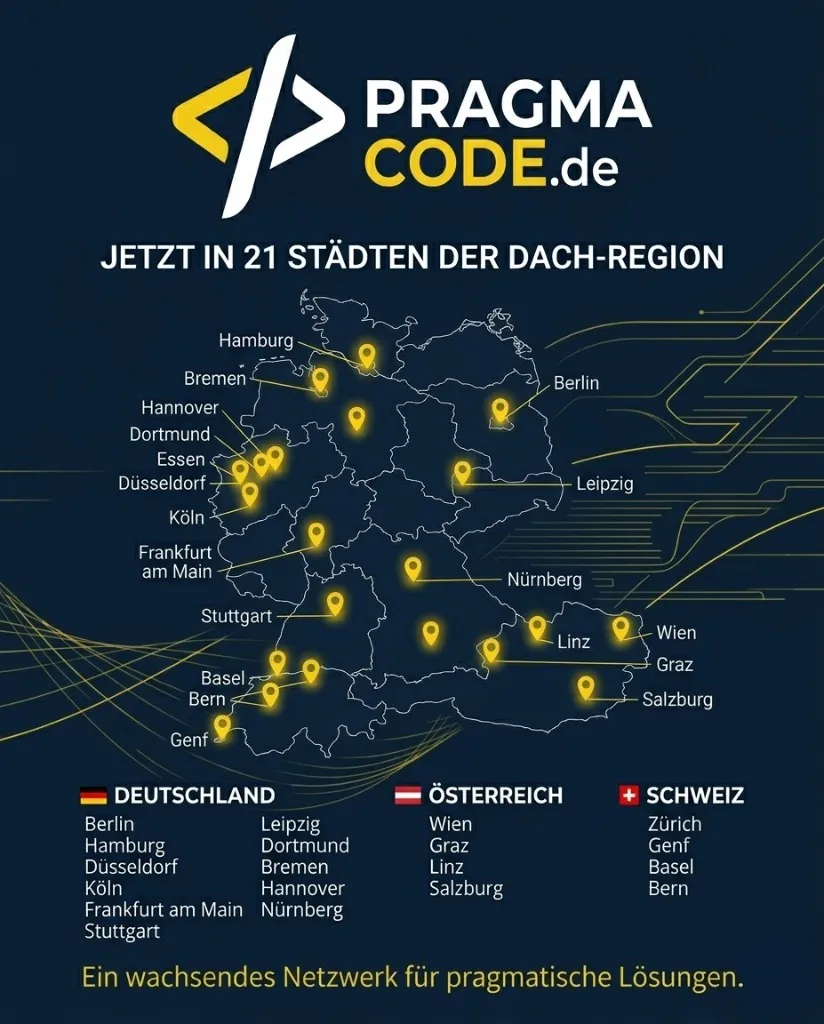
We are your digital partner – regionally anchored and successfully scaling across borders.
Have a vision?
Let's check together how we can make your idea take flight.
Book your free strategy call nowExtended Specialized Glossary
AI Avatar
A photorealistic, digitally generated presenter who speaks based on a text or audio input. Modern avatars (HeyGen, Synthesia) are deceptively real and perfectly lip-synced.
Text-to-Video
Technology that creates fully AI-generated video footage from a text description. Key players: OpenAI Sora, Runway Gen-3, Kling AI.
Voice Cloning
The creation of a synthetic copy of a human voice based on speech samples. Used to enable consistent, natural-sounding narrators in AI videos without repeated recording sessions.
Deepfake Detection
AI-based technology to identify manipulated or fully generated videos. Deployed by platforms and authorities to prevent misuse and maintain content integrity.
Video Personalization
The automatic adaptation of video content for specific viewers – e.g., through spoken names, individual product recommendations, or country-specific versions.
Lip Synchronization (Lip Sync)
The precise alignment of mouth movements with spoken audio. In AI avatars, realized by neural networks – enabling convincingly natural presenters in real time.
C2PA
An open industry standard (Coalition for Content Provenance and Authenticity) for cryptographically signing and verifying the provenance, authorship, and edit history of digital media and AI content.
Interactive Avatar
A real-time AI video avatar that dynamically responds to user questions and conversational dialogue with ultra-low latency (<500 ms) across customer support and sales touchpoints.