


Why do digital transformation initiatives in medium-sized enterprises so often stall in endless committee approvals, 200-page specification documents, and PowerPoint marathons? In his two-hour deep dive with Lex Fridman, Jeff Bezos unpacked the operational engine behind Amazon and Blue Origin—delivering five powerful levers for managing directors and technology leaders.
This article is an in-depth expert contribution from our content cluster. Discover the complete overview on our main page: Digital Solutions & Software Strategy →
Decision Velocity Beats Perfectionism
In an enterprise landscape transformed by autonomous AI agents, generative search engines, and accelerated technology cycles, hesitation is the single greatest business risk. Organizations that spend six months writing technical specifications for every software initiative are committing capital to obsolete assumptions. The Lex Fridman interview with Jeff Bezos proves that the world's most enduring organizations owe their competitive edge not to infinite resources, but to an uncompromising architecture built for rapid, reversible execution.
- Decentralize reversible decisions: More than 90 percent of all IT and digitization initiatives are Two-Way Door decisions. Treating them like irreversible bets paralyzes progress. Clickable prototypes consistently beat lengthy requirement specifications.
- Replace PowerPoint decks with narrative memos: Bullet points conceal sloppy logic and unexamined assumptions. A structured six-page memo combined with 30 minutes of silent reading creates synchronized context and cuts debate time in half.
- Radically decouple operational teams: When teams must constantly coordinate to deploy software, the root cause is architectural, not communicative. Autonomous two-pizza teams interacting via clear APIs eliminate friction and allow seamless integration of AI coworkers.
- 1. Context: A Master Builder on Operational Excellence
- 2. Principle 1: Type 1 vs. Type 2 Decisions (One-Way vs. Two-Way Doors)
- 3. Principle 2: The Six-Page Memo & The PowerPoint Ban
- 4. Principle 3: Two-Pizza Teams & Decoupling in the AI Era
- 5. Principle 4: Wandering vs. Efficiency & The Day 1 Mentality
- 6. Principle 5: High-Leverage Leadership & The 3-Decisions Rule
- 7. Conclusion & Actionable SME Roadmap
1. Context: A Master Builder on Operational Excellence
When Jeff Bezos sat down with Lex Fridman in December 2023 for Episode #405, it marked his first comprehensive, unvarnished podcast interview in years. For two hours and eleven minutes, the founder of Amazon and Blue Origin skipped superficial leadership buzzwords to dissect the fundamental physics and organizational dynamics required to construct multi-billion-dollar operating systems.
For mid-sized companies—frequently characterized by high engineering precision yet burdened by rigid approval hierarchies—this dialogue delivers an invaluable operating manual. Bezos seamlessly connects the practical resourcefulness of a mid-sized workshop with the industrial scaling mechanisms of a global powerhouse.
The Texas Ranch: Why "Resourcefulness" Precedes Innovation
At the outset of the conversation, Bezos reflected on his formative summers between the ages of four and sixteen, spent on his grandfather's remote cattle ranch in Cotulla, Texas. His grandfather, Lawrence Preston Gise—a former regional director of the U.S. Atomic Energy Commission—tackled every mechanical and operational breakdown with his own hands.
"My grandfather bought an old, broken-down 1955 Caterpillar D6 bulldozer for $5,000. New, it would have cost over $100,000. We spent an entire summer repairing it. We ordered giant transmission gears by mail. When they arrived, they were far too heavy to lift—so we built a crane ourselves out of scrap metal to hoist them into place. He didn't call anybody. He figured out how to solve it himself. That attitude—resourcefulness—shaped my entire worldview."
— Jeff Bezos, Lex Fridman Podcast #405 [02:48]
This vignette is far more than sentimental biography: It represents the polar opposite of the corporate advisory culture that demands seven-figure retainers and theoretical whitepapers before writing a single line of functional code. Resourcefulness—the pragmatic drive to assemble functional solutions from available building blocks—is the core DNA of successful mid-market innovators. Yet while this ethos is celebrated on factory floors, it is frequently abandoned when embarking on software engineering and digital infrastructure projects.
2. Principle 1: Type 1 vs. Type 2 Decisions (One-Way vs. Two-Way Doors)
Perhaps the single most impactful mental model Bezos outlined in the interview is the classification of all organizational decisions into two fundamental categories: Type 1 (One-Way Doors) and Type 2 (Two-Way Doors).
Bezos emphasized that the stagnation of established enterprises stems almost entirely from treating reversible Type 2 decisions with the bureaucratic weight reserved for irreversible Type 1 commitments:
"Most decisions are reversible. They are two-way doors. You can go through the door, and if you don't like what you see on the other side, you can walk back through and pick another door. Those decisions should be made quickly, by individuals or small autonomous teams. But as organizations grow, there is a systemic tendency to apply the heavy, consensus-driven Type 1 process to every decision. The result is excruciating slowness and the death of innovation."
— Jeff Bezos, Lex Fridman Podcast #405 [1:36:50]
Comparison: Type 1 Decision vs. Type 2 Decision
- Consequences: One-way passage. Reversing course causes severe capital loss, reputational damage, or operational breakdown.
- Examples: Building a new production facility, selling equity stakes, migrating legacy enterprise ERP systems.
- Decision Process: Deliberate, thorough, exhaustive stress-testing, sign-off required from managing directors and board members.
- Data Requirements: Maximum available evidentiary basis, scenario modeling, comprehensive downside protection.
- Consequences: Revolving door. If the outcome falls short, the team reverts or refines the initiative within days.
- Examples: Interactive software prototypes, customer support AI agents, landing page A/B tests, new pricing tiers.
- Decision Process: Rapid, decentralized, delegated directly to operational teams without executive escalation.
- Data Requirements: Approximately 70 percent certainty is optimal—waiting for 90 percent paralyzes business velocity.
The Prototyping Paradigm: How SMEs Eliminate Expensive Implementation Risks
This dichotomy highlights a critical vulnerability in mid-market software procurement. When a company decides to launch a customer portal, an automated dispatch engine, or an internal workflow tool, executive teams routinely categorize the initiative as a Type 1 decision: They spend six months writing a 180-page specification document, solicit proposals exceeding 250,000 euros, and schedule biweekly steering committee checkpoints.
The predictable outcome? Twelve months later, the delivered system fails user adoption because the operational realities evolved while the specification gathered dust.
The antidote is "Prototypes Instead of Specifications": By deliberately structuring digital initiatives as Type 2 decisions, engineering partners build a functional, clickable application deployed to a private staging URL within two to three weeks. Testing actual workflows with live operational data instantly clarifies functional requirements. Capital exposure drops from a high-stakes capital expenditure to a predictable fixed fee of several thousand euros.
Expert Tip: The 70 Percent Rule for Digital Initiatives
If you wait until you have gathered 90 percent of all theoretical data points before making a decision, your competitors have already captured the market. Execute Type 2 decisions at roughly 70 percent confidence. If adjustments are necessary, pivot quickly—the overall cost of course-correction is negligible compared to the compounding cost of inaction.
3. Principle 2: The Six-Page Memo & The PowerPoint Ban
Among Amazon's most celebrated organizational innovations is its strict prohibition against presentation slide decks in executive meetings. Slides are banned. Every consequential decision meeting centers instead on a structured, narrative document known as the six-page memo.
In his interview with Fridman, Bezos explained the cognitive rationale driving this policy:
"PowerPoint is easy for the presenter, but difficult for the audience. A narrative memo is extremely difficult to write, but remarkably easy for the reader. Bullet points allow an author to hide sloppy, incomplete thinking behind punchy phrases. You can put a bullet point on a slide that sounds profound, but upon scrutiny is completely contradictory. In a cohesive narrative essay with full sentences and paragraphs, logical fallacies immediately reveal themselves."
— Jeff Bezos, Lex Fridman Podcast #405 [1:43:20]
The 30-Minute Silent Reading Ritual: Transforming Meeting Productivity
In most corporate settings, meeting preparation is deeply flawed. Briefing materials are emailed 48 hours in advance. In practice, two attendees skimmed the text, one read the executive summary, and the rest pretend to be fully informed during the opening remarks.
Amazon enforces a disciplined meeting ritual that eliminates this dynamic entirely:
1. Narrative Memo Drafting
The author crafts a structured narrative: Problem definition, current baseline, proposed solution, anticipated customer impact, and critical risks. Bullet points are replaced with thorough causal explanations.
2. The 30-Minute Silent Reading Window
The meeting starts without spoken intros. Attendees sit together and read the document in total silence for 30 minutes, writing handwritten critiques directly in the margins.
3. The 30-Minute Focused Debate
Because every participant has absorbed identical context, the remainder of the hour focuses directly on challenging assumptions and making the decision.
For mid-market leadership teams, adopting narrative memos resolves chronic meeting fatigue. By moving analytical rigor before the session, meeting time transitions from passive presentations into high-yield decision engines.
4. Principle 3: Two-Pizza Teams & Decoupling in the AI Era
As headcount grows, internal communication overhead expands quadratically according to the mathematical formula N × (N - 1) / 2. A group of 10 people manages 45 interpersonal communication links; a team of 50 people requires 1,225 channels.
To prevent coordination gridlock, Bezos established the two-pizza team standard: No unit should exceed the headcount that two large pizzas can comfortably feed—typically six to eight individuals.
Critically, Bezos dispelled a widespread misunderstanding during the interview: The objective is not to encourage more communication, but to require dramatically less.
"People always assumed we wanted to improve communication. No! Communication is terrible! Communication represents friction, coordination drag, and bureaucratic overhead. Our objective was to decouple teams so they could execute autonomously without needing to talk to each other constantly. They interact through well-defined APIs, just like modern software services."
— Jeff Bezos, Lex Fridman Podcast #405 [1:49:15]
1. API-First Data Contracts
Operational teams share assets and transactional data via standardized, automated interfaces rather than ad-hoc status meetings or spreadsheet email chains.
2. End-to-End Domain Ownership
A single squad owns a product workflow from initial design through live operations ("You build it, you run it"). Hand-offs to external maintenance silos are eliminated.
3. Eliminating Approval Bottlenecks
Squads operate with dedicated authority and tooling to release improvements within agreed operational guardrails without waiting for board approvals.
4. Autonomous AI Team Members
In modern architectures, two-pizza teams integrate autonomous AI workers (such as the Hermes AI Agent) to handle routine research, ticket dispatch, and data synchronization.
5. Principle 4: Wandering vs. Efficiency & The Day 1 Mentality
The conceptual bedrock of Amazon's corporate philosophy is the Day 1 Mentality: Day 1 embodies the vigor, curiosity, experimentation, and customer devotion of an early-stage startup. Day 2 represents corporate stagnation, bureaucratic complacency, and eventual irrelevance.
When asked by Lex Fridman how an enterprise preserves Day 1 across decades, Bezos highlighted the dynamic equilibrium between operational efficiency and unstructured exploration (wandering):
"Efficiency is fantastic when you are solving a known problem. When you are optimizing a logistics center or moving a parcel from A to B, every fraction of a second matters. But genuine breakthrough invention rarely emerges from linear efficiency. It comes from wandering—from exploratory experimentation, curiosity, and trial-and-error. You have to intentionally create room for inefficiency inside an organization so people can explore ideas that don't yet have an obvious return on investment."
— Jeff Bezos, Lex Fridman Podcast #405 [1:38:40]
1. Customer Obsession Over Competitor Parity
Watching competitors means reacting to yesterday's ideas. Listening deeply to customer friction uncovers latent opportunities before markets shift.
2. Disagree and Commit
Consensus is not mandatory for progress. When viewpoints diverge, leadership declares: "I don't share your view, but I trust your capability—let's build it."
3. Protected Capacity for Wandering
Allocating designated engineering capacity for pilot validation without demanding burdensome upfront business cases.
4. Rigorous Respect for Physical Truths
Laws of physics, real performance telemetry, and user friction cannot be negotiated away in executive committee meetings ("Truth-Seeking").
5. Healthy Skepticism of Bureaucracy
Processes are instruments, not dogmatic ends. When a compliance procedure impedes the right customer outcome, reform the rule, not the mission.
6. Principle 5: High-Leverage Leadership & The 3-Decisions Rule
During the final segment of the interview, Fridman examined Bezos' personal cognitive management routines. In an executive culture that frequently treats 80-hour workweeks and perpetual connectivity as status symbols, Bezos presented a surprisingly disciplined countermodel.
"I prioritize eight hours of sleep every night. Unless I'm crossing multiple time zones, it is non-negotiable. I need it to sustain physical energy, maintain mental clarity, and keep an optimistic disposition. As a senior executive, what are you actually paid to do? You're not paid to make a thousand trivial decisions every day. You're paid to make a very small number of high-quality decisions. If I make three good decisions a day, that is more than enough."
— Jeff Bezos, Lex Fridman Podcast #405 [1:57:10]
Bezos deliberately schedules his most critical strategic discussions between 10:00 AM and 12:00 PM. Prior to 10:00 AM, he spends unstructured time reading news, enjoying coffee, and thinking without agenda ("puttering time"). Crucially, he refuses to make high-stakes, irreversible commitments after 5:00 PM, acknowledging that cognitive exhaustion degrades judgment quality.
For managing directors and business owners overseeing 50 to 500 team members, this insight carries immediate practical relevance: Operational busyness is frequently an avoidance mechanism for rigorous strategic thinking. Leaders who consume their working hours with micromanagement sacrifice the foresight required to steer long-term competitiveness.
7. Conclusion & Actionable SME Roadmap
The Lex Fridman interview with Jeff Bezos dispels the illusion that market leadership is the exclusive byproduct of venture capital or proprietary scale. The foundational operating systems of Amazon and Blue Origin rest upon explicit, disciplined principles: Eliminating unnecessary bureaucracy, decentralizing execution, and maintaining high reversibility.
Quick-Check: Building Your Agile Decision Architecture
Official Sources & Primary Documentation
- Lex Fridman (Dec 14, 2023): "Jeff Bezos: Amazon and Blue Origin | Lex Fridman Podcast #405" – Full video interview exploring early life, aerospace engineering, Amazon leadership principles, and corporate governance.
- Lex Fridman Transcripts (Dec 14, 2023): "Jeff Bezos: Amazon and Blue Origin Transcript" – Official verbatim transcript covering the full dialogue with verified timecodes and direct quotes.
- Amazon Inc. Shareholder Letters (1997–2020): "Jeff Bezos Letter to Shareholders 2016: Being a Day 1 Company" – Primary source documenting the architectural definitions of Type 1 vs. Type 2 decisions and the Day 1 management philosophy.
- Pragma Code Digital Agency (2026): "Packages & Pricing: Fixed-Price Prototyping for SMEs" – Transparent turnkey packages delivering functional software prototypes on private staging URLs within 2 to 3 weeks.
Ready to Validate Software Prototyping in Your Organization?
Instead of spending months drafting speculative specifications, we develop a working, clickable software prototype on a dedicated staging environment in two to three weeks. Predictable fixed pricing from 4,900 euros.
Schedule a Free Strategic ConsultationOur Regional Expertise
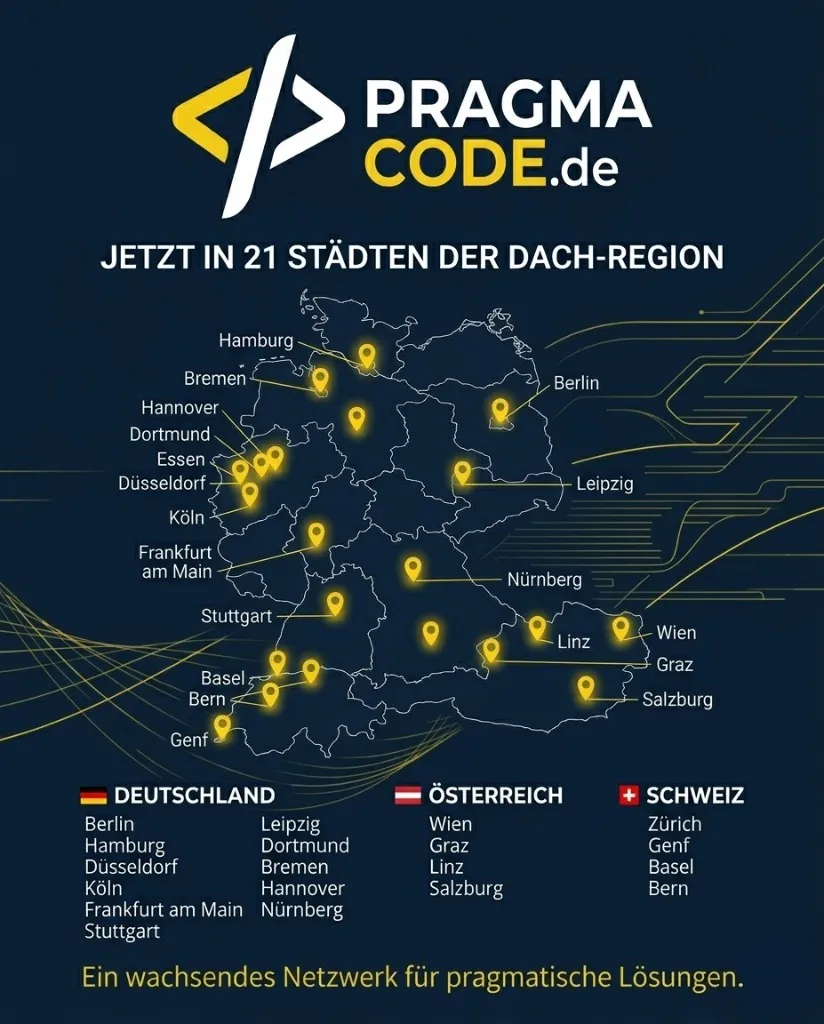
We are your digital partner – regionally anchored and successfully scaling across borders.
Have a vision?
Let's check together how we can make your idea take flight.
Book your free strategy call now