


Since August 2026, the strict transparency obligations under Article 50 of the EU AI Act have entered into force. Any business using AI-generated images, videos, audio, or editorial copy commercially must clearly label them – or face penalties of up to €15 million and severe unfair competition lawsuits.
This article is an in-depth expert contribution from our content cluster. Discover the complete overview on our main page:IT Security & Compliance →
- Article 50 in Full Effect: As of August 2026, commercially deployed AI content (images, videos, voice generation) must be visibly labeled as synthetic directly within the media asset upon first view.
- Deployer vs. Provider Liability: Companies, agencies, e-commerce stores, and creators act as legal deployers (users) and bear full liability for published marketing assets.
- Broad EU Deepfake Scope: The labeling mandate extends far beyond celebrity counterfeits to cover any photorealistic synthetic fashion models, virtual rooms, or artificially generated product shots.
- Human-in-the-Loop Safe Harbor for Copy: AI-generated text published commercially does not require disclosure if a qualified human editor conducts a factual review and assumes editorial responsibility.
- Severe Penalties & Litigation Risk: Non-compliance triggers fines up to €15 million or 3% of global annual turnover – alongside immediate risk of competitor cease-and-desist lawsuits.
The Turning Point for Enterprise AI Content
While public debates over the EU AI Act previously focused on abstract future scenarios and high-risk AI models, August 2026 marks the arrival of rules that directly impact daily operations for millions of businesses: mandatory transparency obligations under Article 50 of the EU AI Act.
- 1. Introduction: Why the Grace Period for AI Content Has Ended
- 2. Provider vs. Deployer: Who Holds Legal Liability?
- 3. The Surprising Breadth of the EU Deepfake Definition
- 4. Where and How to Label AI Content (Images & Video)
- 5. The Special Case for Text: The Human-in-the-Loop Exception
- 6. Penalties, Supervisory Authorities & Unfair Competition Lawsuits
- 7. Step-by-Step Roadmap to Legal AI Compliance
- 8. Conclusion & Outlook: Trust as a Competitive Advantage
1. Introduction: Why the Grace Period for AI Content Has Ended
For months, marketing departments, e-commerce merchants, and creative agencies operated under the assumption of business as usual. AI image generators like Midjourney, DALL-E 3, or Flux.1 were routinely integrated into ad campaigns, synthetic fashion models replaced photoshoots, and AI voiceovers dubbed social media reels. However, with the enforcement of the latest phase of the EU AI Act (Article 50) in August 2026, publishing unlabeled AI-generated media content became instantly unlawful.
European regulators pursue a clear objective: in an era where synthetic media is visually and audibly indistinguishable from authentic camera captures, citizens' right to information authenticity must be protected. Anyone interacting with media must be able to discern at first glance whether an asset represents authentic physical reality or an artificially generated synthesis.
Many enterprises dangerously underestimate the magnitude of this shift. This is not a soft guideline or voluntary industry code; it is binding European law. Regulatory bodies across member states are initiating market surveillance operations. Even more pressing than administrative fines, however, is the threat of private enforcement: competitors and consumer watchdogs stand ready to issue costly cease-and-desist claims under fair competition statutes.
Expert Insight: Legal Analysis on Article 50
"The transparency obligations under Article 50 of the EU AI Act impact more organizations and companies than almost any other provision in the regulation. Any business or commercial creator utilizing AI cannot rely on hidden captions or footer notes. The disclosure must be perceptually visible directly within the image or video canvas."
2. Provider vs. Deployer: Who Holds Legal Liability?
To accurately structure corporate compliance, organizations must understand the fundamental legal distinction drawn within the regulation: the boundary between Providers and Deployers of AI systems.
Providers
Developers and tech corporations that develop and release AI models to the market under their brand name (e.g., OpenAI, Google, Midjourney, Anthropic).
Deployers
Businesses, agencies, e-commerce merchants, publishers, and creators who utilize AI systems under their own authority for commercial purposes.
For enterprise practice, this distinction is critical. A company cannot evade liability by pointing out that Midjourney or OpenAI generated the asset. The moment an enterprise, internal marketing team, or contracted agency publishes generated media across corporate websites, product catalogs, social media channels, or ad campaigns, the enterprise legally becomes the Deployer.
Who Qualifies as a Deployer?
Commercial deployers include any entity using AI tools within professional or commercial operations:
E-Commerce Retailers & Merchants
Using AI to render product visuals, virtual fashion models, or background scenes.
Marketing & Creative Agencies
Producing campaign imagery, graphics, or promotional clips for clients via generative AI.
Corporate Publishers & Media
Publishing corporate blogs, whitepapers, magazines, and press releases containing AI graphics.
Social Media Creators & Influencers
Monetizing channels or promoting brands legally disqualifies creators from personal use exemptions.
Within corporations, the legal entity (GmbH, Inc., PLC) remains the responsible deployer. Individual employees or external freelancers do not carry primary regulatory liability toward the public – responsibility stays squarely with the operating enterprise.
3. The Surprising Breadth of the EU Deepfake Definition
The most widespread misconception among executive teams involves what legally constitutes a deepfake under European law. Those assuming deepfakes refer solely to malicious politician face-swaps or fraudulent CEO impersonations are operating under a dangerous legal misconception.
Under Article 50, the European Commission defines a deepfake as: any AI-generated or manipulated image, audio, or video content that noticeably resembles real persons, objects, places, or events and could falsely appear authentic to a reasonable observer.
Legal Classification: What Requires Mandatory Labeling?
- Synthetic Fashion Models: Artificially generated human faces in fashion stores.
- Virtual Scenery: AI-generated hotel lobbies, office interiors, or landscapes.
- Synthetic Product Shots: Photorealistic products rendered in AI environments.
- AI Voiceovers: Synthetically cloned or generated voices in video presentations.
- Comics & Fantasy: Cartoon characters, stylized illustrations, or mythical creatures.
- Technical Retouching: Removing background objects or trash cans from real photos.
- Color Grading: Standard adjustments to contrast, exposure, and color balance.
- Pure Charts: Abstract diagrams, infographics, and vector maps.
The legal interpretation is unequivocal: deceptive intent or impersonating a specific real individual is not required for the obligation to apply. The sole determining factor is whether the asset could reasonably convey to an observer that it represents an authentic capture from the physical world.
When an enterprise uses a synthetic model that looks like a real human being, that image must be labeled as AI-generated – even if that person has never existed in real life.
4. Where and How to Label AI Content (Images & Video)
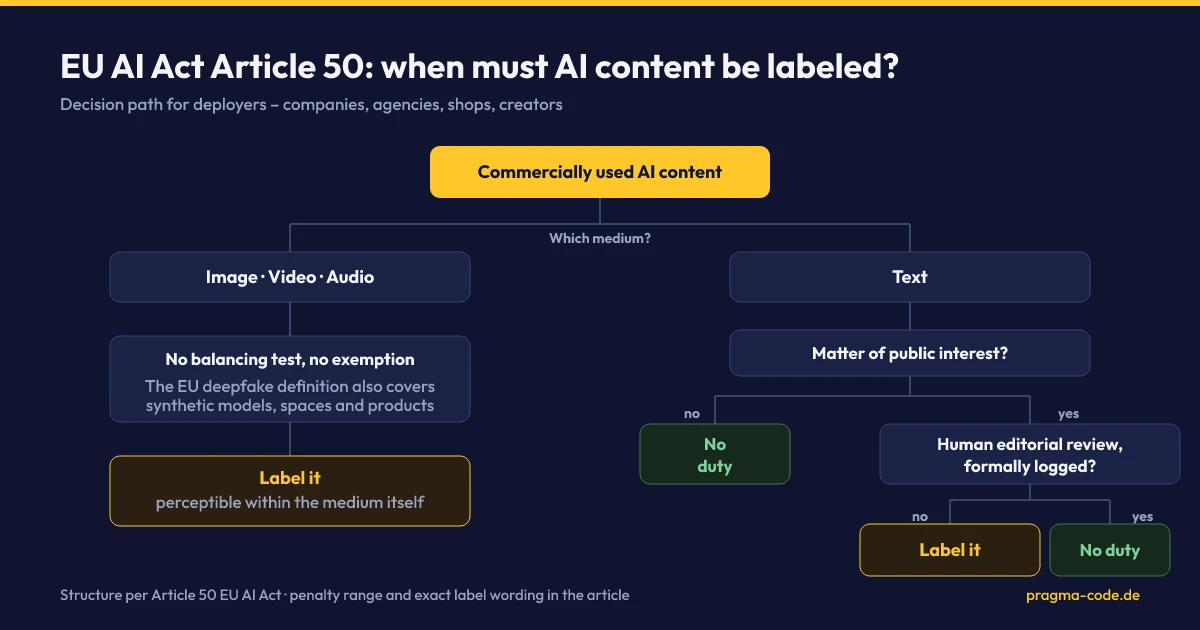
Article 50(4) of the EU AI Act specifies that disclosures must be perceptually visible to users without requiring technical tools, occurring at the latest upon first contact with the content.
This requirement creates operational friction. Many marketing teams assume that placing a note in HTML alt-tags, YouTube description boxes, video end credits, or Instagram captions suffices. Legal reality dictates otherwise: hidden or secondary disclosures generally fail statutory requirements.
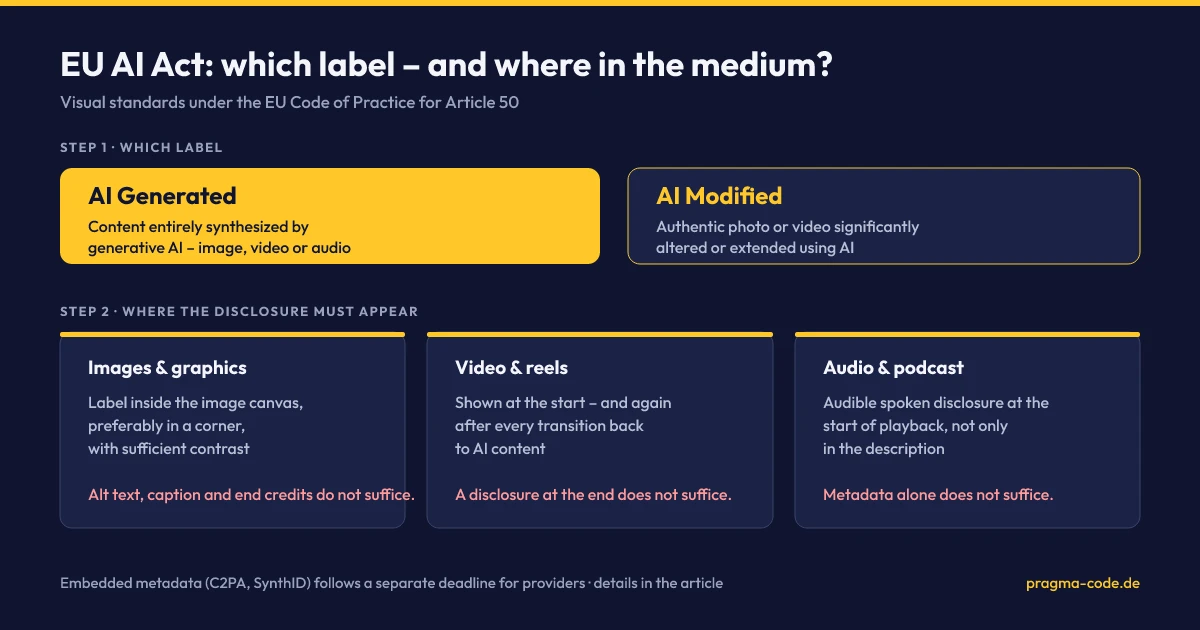
Standards under the EU Code of Practice
To assist in fulfilling transparency obligations, European regulatory working groups recommend clear visual standards:
Label "AI Generated"
Mandatory for media assets entirely synthesized by generative AI (e.g., fully synthetic images, AI videos, or artificial voice clips).
Label "AI Modified"
Designated for media assets where an authentic base photo or video has been significantly altered, expanded, or modified using AI tools.
Specific Placement Rules by Media Format
The label (e.g., "AI Generated") must be placed directly within the image canvas – preferably in one of the corners with sufficient visual contrast.
The visual disclosure must appear at the beginning of the video stream. Following stream interruptions or scene transitions back to AI content, the disclosure must be repeated.
For synthetic voiceovers or AI audio, an audible verbal disclosure must play at the start of playback (e.g., "This recording contains AI-generated voice synthesis").
Important Note on Technical Metadata (C2PA / SynthID)
Mandatory metadata embedding and invisible digital watermarking (such as C2PA or Google SynthID) for AI tool developers becomes legally binding on December 2, 2026. However, for commercial deployers publishing content, visual canvas disclosures apply immediately.
5. The Special Case for Text: The Human-in-the-Loop Exception
In addition to media assets, Article 50 governs published AI-generated text. Here, the framework distinguishes carefully based on publication context and editorial governance.
In principle, text disclosure mandates apply to published AI copy intended to inform the public on matters of public interest (e.g., public health, policy, consumer rights, or societal topics). Standard promotional copy, e-commerce product descriptions, internal emails, and routine corporate announcements are generally exempt from mandatory tagging.
The Compliance Safe Harbor: Human Editorial Responsibility
Even for public-interest informational articles, the regulation provides an essential safe harbor mechanism known as the Human-in-the-Loop principle:
"Where AI-generated text has undergone a process of human editorial review and oversight, and a natural person holds legal and editorial responsibility for the published work, mandatory labeling as AI text does not apply."
This provision represents vital protection for corporate publishing, content marketing, and professional SEO teams – provided clear internal editorial workflows are documented.
Warning: What Does NOT Qualify as Human Review
Running automated spell-checks or using a secondary LLM (e.g., GPT-4o) to review text does not qualify as human oversight. A human editor must fact-check the copy, take editorial ownership, and log formal approval.
6. Penalties, Supervisory Authorities & Unfair Competition Lawsuits
Penalties for non-compliance under Article 50 are severe, reflecting the deterrence structure established by European data protection precedents (GDPR).
Transparency Non-Compliance Fines
Commercial deployment of unlabeled synthetic content
Up to €15 Millionor up to 3% of total global annual turnover, whichever amount is higher.
Direct Enforcement Powers
Immediate administrative action
No Prior WarningSupervisory authorities possess statutory authority to issue immediate administrative fines without mandatory warning letters.
The Immediate Threat: Civil Competition Litigation
While administrative enforcement by state authorities takes time to scale up, enterprises face an immediate threat from private litigation and commercial competitors.
Under fair competition and consumer protection statutes across EU member states, violating statutory market conduct obligations (including Article 50 AI labeling duties) constitutes unfair commercial practice. Competitors and commercial protection associations can issue formal cease-and-desist notices, seeking immediate injunctions and demanding payment of legal fees.
Similar to previous waves of privacy litigation (e.g., website tracking disclosures), commercial entities using unlabeled AI images or video across websites and social platforms face imminent exposure to systematic legal challenges.
7. Step-by-Step Roadmap to Legal AI Compliance
To safeguard your enterprise against regulatory fines, brand damage, and competitor litigation, implement the following five-step compliance roadmap immediately:
-
1. Content Audit & Asset Inventory
Conduct a comprehensive audit of media assets published across corporate websites, marketing catalogs, social channels, and ad campaigns. Catalog all images, graphics, videos, and audio clips generated or enhanced via AI.
-
2. Establish Deployer Governance & Guidelines
Define explicit corporate policies establishing accountability for AI content approval and labeling. Contractually obligate external agencies and freelancers to adhere strictly to Article 50 standards.
-
3. Implement Visual Media Overlays
Standardize visual overlay templates. Integrate explicit "AI Generated" labels for fully artificial assets and "AI Modified" labels for retouched media directly within image and video files.
-
4. Formalize Documented Human-in-the-Loop Editorial Workflows
Establish a documented editorial review process for all corporate articles, research papers, and technical guides. Maintain records showing a named editor verified the factual accuracy and approved publication.
-
5. Execute Mandatory AI Literacy Training
The EU AI Act requires employers to ensure personnel operating AI systems possess adequate AI literacy. Conduct compliance workshops for marketing, IT, and legal teams and archive training records.
8. Conclusion & Outlook: Trust as a Competitive Advantage
The transparency mandates of the EU AI Act present immediate operational requirements for enterprise marketing and IT leaders. However, forward-thinking organizations that treat AI disclosure not as a bureaucratic burden, but as a commitment to authenticity and brand integrity, will establish an enduring trust advantage in the market.
Consumers, B2B buyers, and enterprise partners are growing increasingly vigilant regarding media authenticity. Companies that operate with transparent labeling, verifiable content provenance, and robust human oversight protect themselves against multi-million euro fines while positioning their brand as an authoritative leader in the era of generative AI.
Quick Compliance Checklist for Enterprise
And who keeps this current in day-to-day operation?
Logging, human oversight and a documented model and version state are not a one-off task — they go stale with every model change and every silent fallback. The Agent Operations product line takes exactly that over on an ongoing basis: monitoring, a monthly quality sample against a fixed set of test cases and, in the "Operations & Evidence" tier, the AI-Act-relevant documentation. From €390 per month, cancel monthly.
Do you have questions about implementing AI compliance in your enterprise?
We assist organizations with technical integration of content provenance standards, automated AI labeling, and legally resilient IT architecture.
Schedule a Free ConsultationOur Regional Expertise
We are your digital partner – regionally anchored and successfully scaling across borders.
Have a vision?
Let's check together how we can make your idea take flight.
Book your free strategy call nowExtended Specialized Glossary
EU AI Act Article 50
The core provision of the EU AI Act legally establishing transparency and labeling duties for generative AI systems and deepfakes.
Transparency Obligations (EU AI Act)
Legal mandates requiring deployers and providers to visibly label AI-generated media (images, video, audio) for users without requiring technical tools.
AI Modified
A standardized transparency label under the EU Code of Practice identifying media that has been significantly modified or retouched using generative AI.
Deepfake
AI-generated or manipulated media content depicting real or realistic people, objects, or locations that could appear authentic to viewers.