

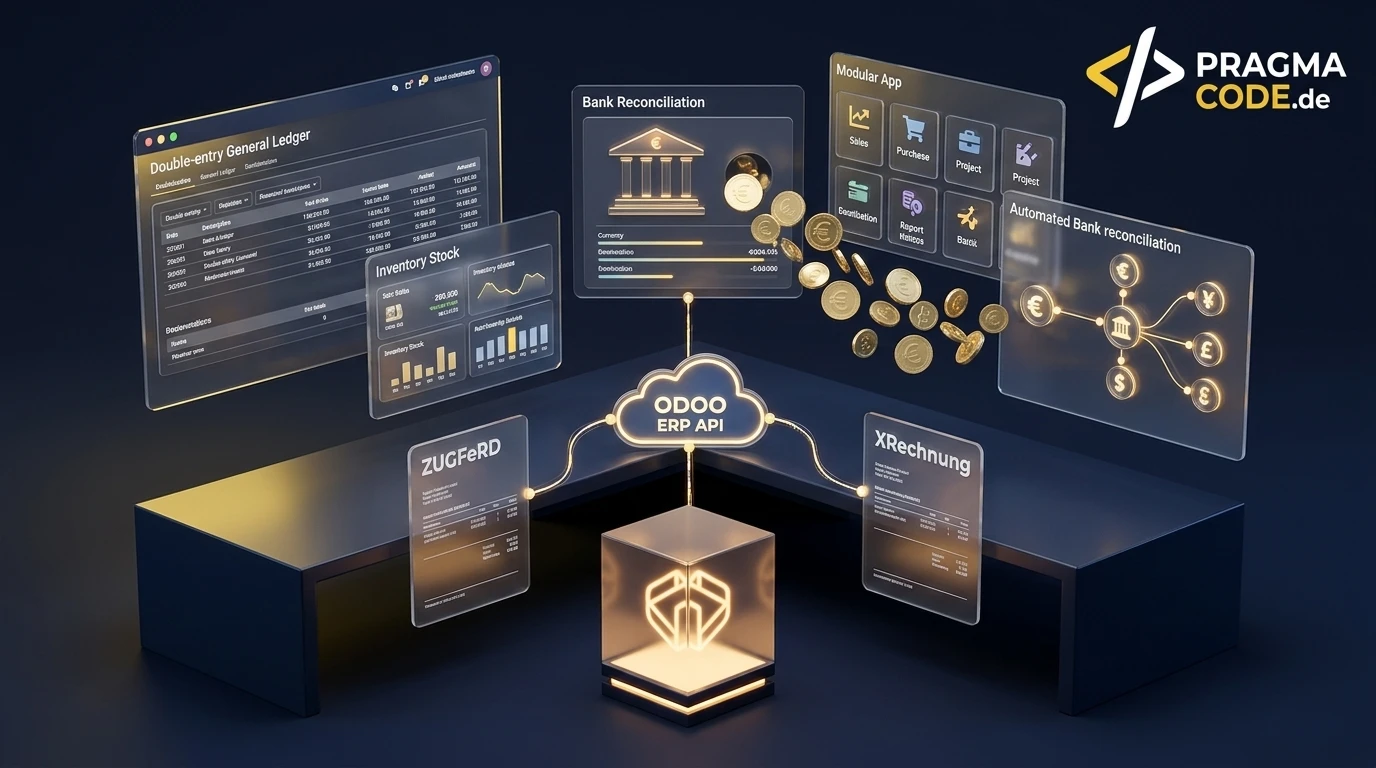
From an open-source challenger to a modular ERP heavyweight for the mid-market: Odoo merges full-scale double-entry bookkeeping, warehouse inventory, and manufacturing management with a flexible XML-RPC and JSON API. In light of mandatory B2B e-invoicing for 2026/2027, deep n8n workflows, and certified DATEV exports, we examine architecture, German localization, and scaling opportunities in detail.
This article is an in-depth expert contribution from our content cluster. Discover the complete overview on our main page: AI Automation for Modern Businesses →
- Full-Scale ERP Rather Than Isolated Billing Tools: Odoo integrates double-entry financial accounting, CRM, warehouse inventory management (WMS), purchasing, and discrete manufacturing within a single unified database.
- Legally Compliant E-Invoicing (EN 16931): Native issuance, validation, and automated parsing of hybrid ZUGFeRD and pure XRechnung XML records directly into journal entries.
- German Localization with SKR03 & SKR04: Standard charts of accounts, automated tax computation, advance VAT declarations, and certified DATEV export modules for external tax advisors.
- Extensible API Architecture: Universal XML-RPC and JSON-RPC APIs supporting Python, Node.js, and PHP, complemented by official connectors in n8n for building autonomous business workflows.
- Flexible Deployment & Licensing: Choose between a self-hosted Open Source Community Edition, the managed Odoo.sh Cloud PaaS, or dedicated on-premise infrastructure for maximum data sovereignty.
Introduction: The Mid-Market ERP Transformation
For many scaling enterprises, there inevitably comes a moment when simple SaaS invoicing apps like FastBill or sevDesk reach their systemic limits. When goods must be managed across multiple physical warehouses, complex multi-tier bills of materials (BOM) are needed for assembly, or executive management requires a real-time balance sheet and profit-and-loss (P&L) statement, isolated software tools crumble under the strain.
Yet traditional enterprise monolithic platforms such as SAP S/4HANA or Microsoft Dynamics 365 prove prohibitively rigid, cumbersome, and expensive for mid-sized organizations, often requiring seven-figure integration budgets and multi-year rollouts. At this exact intersection, Odoo has emerged as the premier global open-source enterprise suite. Serving more than 12 million business users, the Belgian platform unites enterprise-grade capabilities with the responsiveness of modern web applications.
In 2026, Odoo benefits immensely from European e-invoicing regulations. While legacy systems scramble to retrofit cumbersome third-party modules, Odoo delivers out-of-the-box EN 16931 compliance, machine-learning receipt scanning, and open integration hooks. In this architectural guide, we evaluate Odoo’s financial suite, explore European and German localization, and demonstrate how engineers orchestrate it via n8n into an automated operational powerhouse.
Core Architecture: Where Financial Accounting Meets Operations
Unlike single-purpose invoicing tools, Odoo is engineered from the ground up as a double-entry general ledger. Every operational event across your business – from goods receipt at the loading dock to deal sign-off in the CRM and supplier bills – automatically records the corresponding debits and credits in the background.
Double-Entry General Ledger
Comprehensive support for European and German charts of accounts (SKR03 and SKR04) featuring automatic VAT derivation, input tax deductions, reverse-charge logic, and intra-community acquisitions. Real-time balance sheets, P&L reports, and trial balances are available instantly.
Native Operations Integration
Invoices are generated directly from verified sales orders or confirmed warehouse receipts (three-way purchase matching). This eliminates discrepancies between billed quantities and physical inventory.
Automated Bank Reconciliation
Link European corporate bank accounts via PSD2, FinTS, EBICS, or FinTech gateways (including Finom, bunq, and Revolut). The smart reconciliation widget matches transactions against open items with over 90% out-of-the-box accuracy.
Multi-Company & Multi-Warehouse
Administer multiple corporate legal entities, international branch offices, and currencies within a single database instance. Automated intercompany mirror entries eliminate manual reconciliation between parent and subsidiary entities.
Edition Comparison: Odoo Community vs. Odoo Enterprise
Organizations implementing Odoo must choose between two core delivery tiers:
- Odoo Community Edition: The open-source branch (LGPLv3 license) is completely free to self-host. It encompasses core CRM, sales, procurement, and warehouse modules. However, advanced accounting features – such as full double-entry ledger journals, automated bank feeds, and certified DATEV export modules – are omitted or must be assembled from community plugins provided by the Odoo Community Association (OCA).
- Odoo Enterprise Edition: The commercial release includes the complete accounting and financial reporting suite, AI receipt OCR, native mobile apps, automated dunning engines, and the Odoo.sh cloud platform featuring automated CI/CD staging environments.
Mandatory E-Invoicing 2026/2027: ZUGFeRD & XRechnung in Odoo
Under statutory European and German legislation (including the German Growth Opportunities Act), issuing and accepting electronic invoices is legally required for domestic B2B trade. Odoo has integrated the European EN 16931 standards directly into its invoicing journals.
Odoo natively generates, parses, and validates electronic invoices conforming to ZUGFeRD 2.2 / Factur-X (hybrid PDF/A-3) and pure XML XRechnung standards. Inbound files are checked syntactically against Peppol business rules directly within accounting journals.
1. ZUGFeRD: Hybrid Documents in the Sales Journal
When validating and dispatching customer invoices, Odoo automatically embeds a validated XML payload into an archival-grade PDF/A-3 document. The recipient receives a clean, branded document for manual review, while their financial ERP reads the embedded XML metadata directly without OCR error.
2. XRechnung for Public Procurement (B2G)
For public sector transactions, Odoo compiles pure XML XRechnung documents using UBL or UN/CEFACT syntax. Mandatory procurement parameters – including routing IDs (Leitweg-ID), buyer reference numbers, and government contract codes – are configured in customer records and verified against KoSIT schematrons upon posting.
Accountant Collaboration & DATEV Interfaces
A crucial requirement for operating an ERP system in Central Europe is reliable data exchange with certified tax advisors. Odoo Enterprise provides dedicated integration paths:
- Standardized DATEV Format Export: Odoo compiles audit-proof monthly DATEV booking batches (CSV files conforming to official DATEV transfer specifications) encompassing customer, vendor, and general ledger records.
- DATEV Document Image Service: Along with ledger entries, Odoo links digital source documents (PDF scans of incoming and outgoing invoices) into DATEV Unternehmen online, giving external accountants immediate visual verification for every line item.
- Analytic Accounting & Cost Centers: Cost centers configured in Odoo’s analytic accounts map directly into DATEV dimensions (Kost 1 / Kost 2) to empower detailed cost tracking.
Developer Architecture: Odoo External API & Webhooks
A decisive advantage of Odoo over proprietary legacy ERP suites is its open developer architecture. The External API is built on XML-RPC and JSON-RPC, enabling external software to query and modify any underlying database model and field.
API Authentication & Execution (Python / curl)
API requests authenticate against the target database using the database name, username, and a private API key:
import xmlrpc.client

url = "https://yourcompany.odoo.com"
db = "your_database"
username = "api_user@yourcompany.com"
api_key = "YOUR_ODOO_API_KEY"

common = xmlrpc.client.ServerProxy(f"{url}/xmlrpc/2/common")
uid = common.authenticate(db, username, api_key, {})

models = xmlrpc.client.ServerProxy(f"{url}/xmlrpc/2/object")
invoices = models.execute_kw(
    db, uid, api_key,
    'account.move', 'search_read',
    [[['move_type', '=', 'out_invoice'], ['payment_state', '=', 'not_paid']]],
    {'fields': ['name', 'partner_id', 'amount_total', 'invoice_date_due'], 'limit': 10}
)
print("Open Receivables:", invoices)
Essential Enterprise API Automation Scenarios
E-Commerce & High-Volume Fulfillment
Orders from external channels (Shopify, Amazon, custom web apps) generate picking tasks in Odoo WMS, update stock levels across storage locations, and render ZUGFeRD invoices upon dispatch.
B2B Customer Portals & Self-Service
Enterprise clients access account histories, active quotes, shipment tracking, and invoice archives through a custom Next.js front-end connected directly to Odoo's JSON-RPC endpoints.
Autonomous AI Agent Verification
AI agents inspect incoming supplier invoices, verify pricing against pre-negotiated purchase order contracts, and automatically approve routine bills while routing variances for human review.
Production Blueprint: Automated Workflows with n8n
Connecting Odoo with the workflow orchestration engine n8n allows companies to build resilient financial pipelines without custom microservice maintenance. The following architecture demonstrates an automated accounts payable pipeline:
Inbound Invoice Ingestion & AI OCR
An email trigger in n8n captures incoming supplier bills from an accounts-payable inbox. An AI OCR parser extracts VAT IDs, IBANs, invoice numbers, line items, and tax amounts.
Vendor Matching in Odoo Partner Records
The n8n Odoo node queries the res.partner model using the supplier's VAT ID or IBAN. Once matched, it retrieves default payment terms, expense accounts, and bank records.
Vendor Bill Draft Generation
n8n creates a draft entry in the account.move model (type: in_invoice), attaches the original PDF document, and sets the approval state to ready for management review.
Approval & Automated Payment Execution
Upon executive approval, Odoo generates a SEPA XML payment batch or pushes the disbursement through linked FinTech business accounts (e.g., Finom). The bill reconciles and updates to paid status automatically.
Security Architecture & GoBD Verification
As an organization’s central financial source of truth, Odoo complies with demanding operational and security requirements:
Tamper-Proof Audit Journals
Entries recorded in validated journals cannot be overwritten or silently erased. Sequential numbering is strictly maintained, and corrections must be recorded through offsetting credit entries.
Data Sovereignty & On-Premise Hosting
Organizations can run Odoo on their own dedicated servers in Germany or utilize ISO 27001-certified European cloud infrastructure to ensure complete governance over financial assets.
Role-Based Access Control & 2FA
Granular access control policies segregate duties across warehouse, procurement, sales, and accounting personnel. Mandatory two-factor authentication (TOTP) prevents unauthorized access.
Comprehensive Audit Trail
Every transaction, price change, and configuration adjustment is recorded in the built-in chatter log with timestamp, user ID, and before-and-after values.
Implementation Challenges & Strategic Considerations
While Odoo offers unparalleled operational breadth, adopting it is not an overnight endeavor. Decision-makers should evaluate key implementation factors:
Key Considerations for Odoo Implementations
- Configuration Complexity: Establishing chart of accounts structures, multi-currency tax derivation, inventory valuation methods (FIFO vs. standard costing), and permission matrices requires experienced ERP and accounting guidance.
- Customization Lifecycle Management: Heavy custom Python modules must be maintained and migrated during annual major release cycles (e.g., from version 18 to 19).
- Master Data Quality: In an integrated ERP ecosystem, inaccurate article costs or inventory counts flow directly into the financial ledger. Strict operational discipline is paramount.
5-Step Implementation Roadmap for Odoo ERP
Following a structured, phased roadmap ensures a smooth, budget-conscious deployment:
-
1. Process Scoping & Module Selection
Identify core processes (billing, inventory, procurement, manufacturing) and select the initial module footprint. Leverage standard workflows wherever possible to minimize custom development.
-
2. Master Data Cleansing & Ledger Configuration
Import cleansed customer, vendor, and article catalogs. Configure European or German charts of accounts (SKR03 / SKR04) and align revenue accounts with your tax advisor.
-
3. E-Invoicing & Banking Feed Integration
Activate ZUGFeRD and XRechnung journals, upload corporate stationery, and connect primary operating bank accounts via FinTS/PSD2 for automated bank reconciliation.
-
4. DATEV Test Batch & Accountant Review
Run test bookings across a typical operational cycle and export a sample DATEV batch. Validate the files with your tax accountant in DATEV Kanzlei-Rechnungswesen.
-
5. API Automation & Production Cutover
Connect external e-commerce shops, CRMs, and n8n workflows through the XML-RPC/JSON API. Train end users, execute final data migration, and decommission legacy software.
Conclusion: Odoo as the Future-Proof Core for Growing SMEs
In our 2026 evaluation, Odoo proves that modern ERP platforms can be agile, scalable, and cost-effective. The union of full double-entry accounting, native EN 16931 e-invoicing compliance, unified inventory tracking, and an open API makes Odoo an outstanding long-term investment for businesses that have outgrown basic billing tools.
Coupled with workflow engines like n8n, Odoo serves as an adaptable corporate operating system that drives operational efficiency while ensuring total sovereignty over your financial and process data.
Frequently Asked Questions (FAQ)
Is Odoo ERP ready for European and German 2026/2027 e-invoicing laws?
Yes. Odoo natively generates, validates, and imports electronic invoices in hybrid ZUGFeRD format (PDF with embedded XML) and pure XRechnung XML format adhering to EN 16931 standards.
Does Odoo support full double-entry general ledger accounting?
Yes. Unlike basic invoicing apps, Odoo Enterprise provides complete double-entry bookkeeping, standardized charts of accounts (such as SKR03 and SKR04), automated balance sheets, P&L reports, cost centers, and asset depreciation.
How does DATEV data export work in Odoo?
Odoo exports standardized DATEV CSV posting batches alongside matched document images, allowing external accountants to import records smoothly into DATEV Unternehmen online and Kanzlei-Rechnungswesen.
Can Odoo connect to n8n and external cloud services?
Yes. Odoo features open XML-RPC and JSON-RPC APIs. Using official n8n nodes or custom API connectors, developers can synchronize partners, sales orders, invoices, and inventory events in real time.
Sources & Official Documentation
- Odoo S.A.: Official Financial Accounting and Developer Documentation (2026) – odoo.com
- German Federal Ministry of Finance (BMF): Growth Opportunities Act & B2B E-Invoicing Mandate – bundesfinanzministerium.de
- Coordination Office for IT Standards (KoSIT): XRechnung Standard EN 16931 – xoev.de
- Forum for Electronic Invoicing Germany (FeRD): ZUGFeRD 2.2 Specification – ferd-net.de
- DATEV eG: Format Specifications for External Ledger Data Import – datev.de
Have a vision?
Let's check together how we can make your idea take flight.
Book your free strategy call nowExtended Specialized Glossary
Odoo
A modular open-source ERP system by Belgium-based Odoo S.A. providing integrated suites for financial accounting, CRM, inventory (WMS), manufacturing (MRP), and API endpoints.
ZUGFeRD
A hybrid electronic invoice format combining a visual PDF file with embedded, machine-readable XML data complying with the European EN 16931 standard.
n8n
An extensible open-source workflow automation platform for connecting APIs, enterprise data, and AI agents.
GoBD
German principles for the proper management and storage of books, records, and documents in electronic form and for data access.