

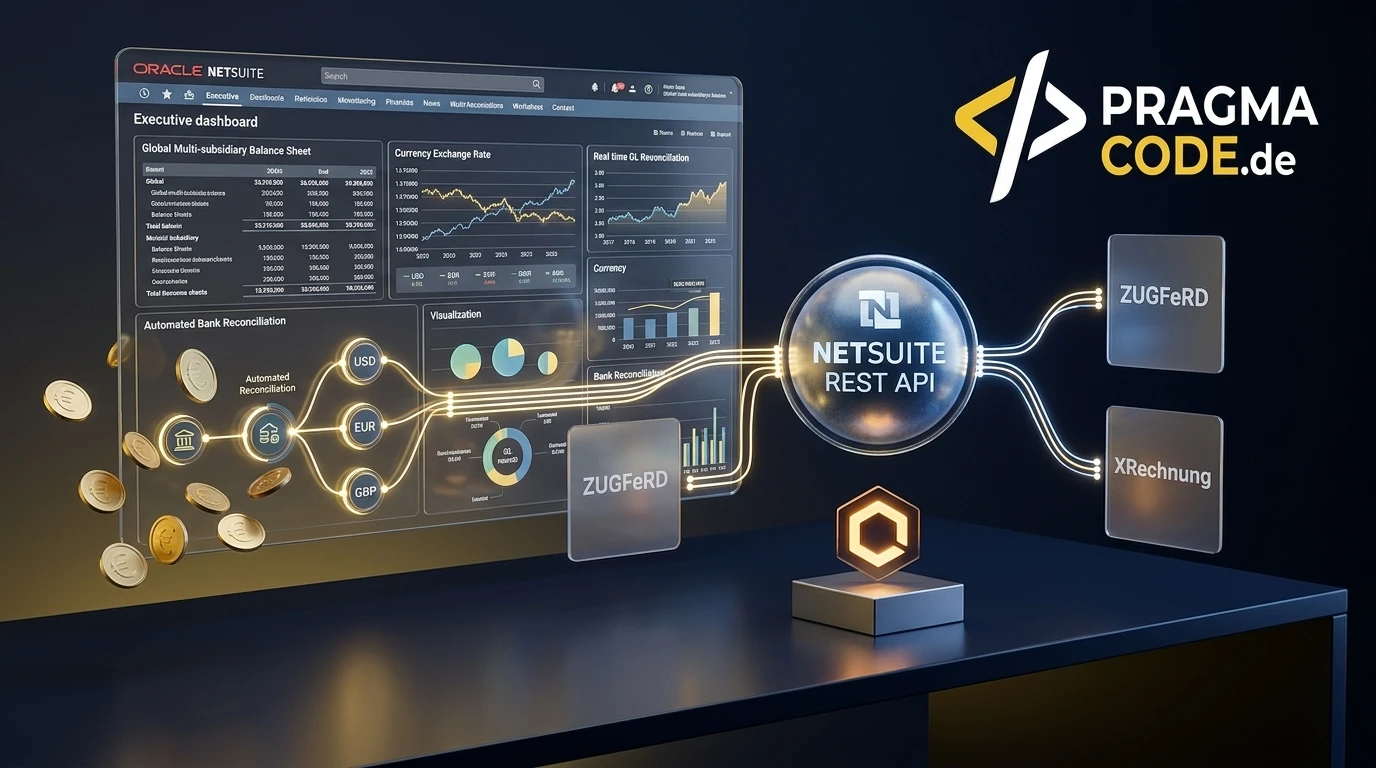
From the global cloud ERP pioneer to a scalable operational core for mid-market leaders: Oracle NetSuite merges international multi-entity consolidation, GoBD-compliant financial accounting, and omni-channel order pipelines with the SuiteTalk REST API. In light of mandatory European e-invoicing for 2026/2027, deep n8n workflows, and certified DATEV connectors, we examine architecture, DACH localization, and automation potentials in detail.
This article is an in-depth expert contribution from our content cluster. Discover the complete overview on our main page: AI Automation for Modern Businesses →
- Global Multi-Entity Financial Consolidation: With Oracle NetSuite and its OneWorld architecture, international mid-market enterprises consolidate hundreds of legal subsidiaries, currencies, and tax jurisdictions within a single unified cloud database.
- Legally Compliant E-Invoicing (EN 16931): Through the native Electronic Invoicing SuiteApp, NetSuite generates, validates, and ingests electronic invoices in ZUGFeRD and XRechnung formats satisfying European and German B2B mandates.
- Modern Developer Tooling: The SuiteTalk REST API and the server-side JavaScript/TypeScript runtime SuiteScript 2.1 unlock robust automation pipelines with n8n and custom corporate portals.
- European Accounting Standards & DATEV Integration: Full compliance with HGB, GoBD, and IFRS, featuring configurable charts of accounts (SKR03/SKR04), cost center accounting, and certified DATEV posting batch exports.
- Unified End-to-End Business Operations: Seamless operational continuity across CRM, global supply chain, warehouse fulfillment (WMS), digital commerce, and professional services automation.
Introduction: The Cloud ERP Standard for Scaling Enterprises
When ambitious mid-market enterprises expand across international borders, establish operating subsidiaries in multiple European member states, or orchestrate omnichannel distribution channels, standard point SaaS billing software rapidly fractures. Reconciling multi-currency cash flows, calculating intercompany transfer pricing, and simultaneously maintaining compliance with local statutory accounting laws (like German HGB) alongside global standards (IFRS or US-GAAP) necessitates an enterprise-grade infrastructure.
Acquired by Oracle Corporation in 2016, Oracle NetSuite stands as the undisputed pioneer of pure-cloud enterprise resource planning. Powering more than 38,000 corporate clients globally, NetSuite bridges the gap between nimble SME solutions and cumbersome legacy ERP giants like SAP S/4HANA.
In 2026, mid-market organizations and international corporate groups face strict regulatory pressures to implement structured e-invoicing under the European EN 16931 standard. Compounding this is the urgency to orchestrate corporate data pipelines through open REST APIs and autonomous orchestration engines like n8n. In this comprehensive guide, we test NetSuite 2026: evaluating its European localization, reviewing the SuiteTalk REST API, and demonstrating how enterprises establish NetSuite as a global financial operational core.
Core Architecture: Financial Operations & NetSuite OneWorld
The foundational backbone of Oracle NetSuite is its financial management engine, expanded by the OneWorld architecture to unify multinational operations under a single pane of glass.
NetSuite OneWorld & Multi-Subsidiary Core
Manage unlimited legal operating entities across diverse global jurisdictions. Foreign exchange conversions execute in real time using central bank reference feeds, and intercompany transactions clear automatically through automated elimination journals.
Multi-Book Accounting (Local GAAP & IFRS)
Maintain multiple parallel accounting ledgers from a single underlying transaction. One primary transaction records locally compliant HGB entries for national tax audits while simultaneously updating IFRS books for international corporate group reporting.
Bank Feeds SuiteApp & Automated Matching
Directly link European and international commercial banking institutions via PSD2, FinTS, and EBICS feeds. Intelligent matching rules reconcile statements against open receivables and payables continuously, automatically capturing early-payment cash discounts.
Unified Supply Chain & Order Management
Frictionless workflows bridging sales orders, procurement, multi-location inventory logistics, fulfillment, and revenue recognition without hazardous data silos between front-office CRM and back-office accounting.
NetSuite in Contrast to SAP S/4HANA and Odoo
Compared to traditional on-premise implementations of SAP S/4HANA, NetSuite achieves significantly faster deployment timelines (typically three to six months rather than multiple years) accompanied by a pure multi-tenant cloud delivery model. Oracle rolls out biannual system upgrades automatically and backwards-compatibly.
Against modular open-source platforms like Odoo, NetSuite delivers unmatched depth in automated enterprise consolidation, SOX compliance audit readiness, and fine-grained role segregation required by public companies and regulated financial operations.
E-Invoicing 2026/2027: ZUGFeRD & XRechnung in NetSuite
Statutory obligations requiring structured electronic invoice exchange in European B2B transactions demand strict standards compliance. NetSuite fulfills these mandates via its official Electronic Invoicing SuiteApp.
The NetSuite Electronic Invoicing SuiteApp provides native generation, cryptographic signing, and inbound parsing for e-invoices adhering to the European EN 16931 standard. For German and Central European trade, ZUGFeRD 2.2 (Factur-X) and pure XRechnung XML (UBL and UN/CEFACT) are natively supported.
1. ZUGFeRD: Hybrid Documents in the Sales Ledger
When generating customer invoices, NetSuite produces a hybrid PDF/A-3 document. The visual appearance reflects the corporate identity of the issuing subsidiary, while a validated XML dataset (COMFORT or EXTENDED profile) is embedded in the document layer. Customers can review the document visually or ingest the XML stream directly into their accounts payable software.
2. XRechnung & Peppol Access Point Routing
For public procurement contracts (B2G), NetSuite compiles pure XML XRechnung files. Mandatory governmental metadata – such as buyer routing codes (Leitweg-ID), purchase order references, and contract numbers – are drawn directly from customer master files. Through certified Peppol access points, NetSuite dispatches invoices directly to national procurement portals without manual intervention.
Tax Advisor Integration & DATEV Workflows
Despite operating on a global scale, enterprises doing business in Germany require reliable data transmission into external tax advisor platforms like DATEV. In NetSuite, this is delivered through certified integration modules:
- Standardized DATEV Posting Batch Export: Compiles monthly audit-proof posting batches in official DATEV CSV format. Ledger entries include standardized chart of accounts mapping (SKR03 / SKR04), cost center assignments (Kost 1 / Kost 2), and statutory tax keys.
- DATEV Document Image Service: Transmits digital source document scans (PDFs of accounts payable and receivable) directly into DATEV Unternehmen online, giving external accountants real-time verification for every line item.
- Fixed Assets & Depreciation Sync: Exports periodic asset depreciation batches from NetSuite’s Fixed Assets Management into the tax advisor’s general ledger.
Developer Architecture: SuiteTalk REST API & SuiteScript 2.1
A cornerstone of NetSuite’s agility within modern enterprise software stacks is its developer tooling. The SuiteTalk REST API complies with OpenAPI 3.0 standards, providing comprehensive endpoints for programmatic CRUD operations across all ERP business records.
Authentication & REST API Invocation
API requests authenticate securely through Token-Based Authentication (TBA / OAuth 1.0a) or OAuth 2.0 Client Credentials grants:
curl -s -X GET "https://1234567.suitetalk.api.netsuite.com/services/rest/record/v1/invoice" \
  -H "Authorization: Bearer YOUR_OAUTH2_ACCESS_TOKEN" \
  -H "Content-Type: application/json" \
  -H "Prefer: transient"
SuiteScript 2.1: Server-Side Logic in Production
With SuiteScript 2.1, software engineers write modern JavaScript (ES6+) and TypeScript logic executed directly on Oracle’s cloud infrastructure:
- User Event Scripts: Validate required transaction fields and enforce multi-tier approval policies before transactions commit to the database.
- Scheduled & Map/Reduce Scripts: Execute parallelized nightly batch routines across millions of ledger records (such as interest calculations or foreign exchange reconciliations).
- RESTlets: Custom, low-latency microservice endpoints designed for external consumers with dedicated data transformations.
- Client Scripts: Drive real-time field calculations and browser-level data validations for finance users.
/**
 * @NApiVersion 2.1
 * @NScriptType UserEventScript
 * @NModuleScope SameAccount
 */
define(['N/record', 'N/log'], (record, log) => {
    function beforeSubmit(context) {
        if (context.type !== context.UserEventType.CREATE) return;
        const newInvoice = context.newRecord;
        const subsidiaryId = newInvoice.getValue({ fieldId: 'subsidiary' });
        const vatId = newInvoice.getValue({ fieldId: 'vatregnum' });

        // Enforce VAT registration validation for European operating subsidiaries
        if (subsidiaryId === '1' && !vatId) {
            log.audit({ title: 'E-Invoicing Policy Check', details: 'B2B invoice lacking VAT ID routed to approval queue.' });
            newInvoice.setValue({ fieldId: 'approvalstatus', value: 1 }); // Pending Approval
        }
    }
    return { beforeSubmit };
});
International Tax Engine: OneWorld, OSS, and Nexus Rules
A standout differentiator of NetSuite is its built-in SuiteTax engine. Unlike regionally constrained accounting applications, NetSuite automates cross-border tax compliance:
- One-Stop-Shop (OSS) for Cross-Border E-Commerce: For merchants shipping consumer goods across European borders, NetSuite computes exact member-state VAT rates automatically and aggregates liabilities into standard OSS reporting journals.
- Reverse-Charge & Intra-Community Supplies: For intra-EU B2B transactions, validation rules verify recipient VAT numbers against European databases and print mandatory statutory reverse-charge notifications into ZUGFeRD XML files.
- Automated Exchange Rate Ingestion: NetSuite pulls official currency exchange rates from the European Central Bank daily, automatically recognizing realized and unrealized FX gains or losses upon bill settlement.
Production Blueprint: Enterprise Workflow Automation with n8n
Connecting NetSuite with the open-source workflow automation engine n8n allows organizations to establish agile integration channels between enterprise CRMs, e-commerce stores, and AI agents without licensing exorbitant proprietary iPaaS packages.
Event Trigger (CRM Deal Closure or Enterprise Checkout)
An n8n webhook captures signed enterprise contracts from Salesforce or high-volume wholesale orders from a B2B portal. The payload supplies line items, contract terms, and customer references.
NetSuite Customer & Operating Subsidiary Matching
Through the SuiteTalk REST API, n8n verifies customer records and routes the order to the correct operating subsidiary based on country and tax nexus rules.
Sales Order & ZUGFeRD E-Invoice Generation
n8n creates a sales order, triggers warehouse fulfillment routines, and generates a finalized invoice. The Electronic Invoicing SuiteApp compiles the compliant ZUGFeRD XML payload.
Banking Settlement & Executive Notifications
When settlement clears on the operating bank account, NetSuite closes the invoice. An outbound webhook notifies n8n to update revenue metrics and alert executive channels in Slack.
Security Architecture & Global Compliance (SOX, GoBD, ISO 27001)
Operating as the corporate system of record, NetSuite satisfies stringent compliance benchmarks:
Immutable Accounting Ledgers
Financial accounting periods lock permanently following month-end close. Any necessary adjustments must be posted through transparent reversing journals with complete historical audit trails.
Oracle Cloud Infrastructure (OCI)
Hosted in Tier-IV Oracle data centers in Frankfurt am Main with geographical redundancy, continuous disaster recovery, and SOC 1 / SOC 2 Type II certifications.
Enterprise Identity & Access Governance
Single Sign-On (SSO) integration via Okta, Microsoft Entra ID, and Google Workspace with enforced multi-factor authentication and role-based privilege boundaries.
Implementation Constraints: When Is NetSuite Over-Engineered?
Despite its market-leading depth, NetSuite is not appropriate for every corporate scale:
Strategic Boundaries & Cost Factors
- Substantial Licensing & Setup Investment: Annual core platform licenses (starting at approximately €10,000 to €25,000+) plus user seats and partner implementation fees make NetSuite uneconomical for small businesses.
- Implementation Requirements: Setting up multi-subsidiary hierarchies, custom ledger accounts, and approval matrices requires certified NetSuite consulting expertise.
- Operational Complexity: Companies that simply need to generate dozens of basic invoices per month will find the extensive configuration options and role menus overwhelming.
5-Step Implementation Roadmap for Oracle NetSuite
Rolling out an enterprise cloud ERP succeeds through a disciplined implementation framework:
-
1. Scope Definition & Subsidiary Blueprint
Define the legal entity hierarchy in OneWorld (holding, operating subsidiaries, currencies, consolidation levels). Align local statutory accounting rules with group reporting standards.
-
2. Chart of Accounts & DATEV Configuration
Map standardized charts of accounts (SKR03 / SKR04), cost centers, and tax keys. Coordinate the reporting interface with your external auditors and tax advisors.
-
3. E-Invoicing SuiteApp & Banking Connectivity
Deploy and test the Electronic Invoicing SuiteApp for ZUGFeRD and XRechnung. Link corporate banking portals via PSD2/FinTS feeds for automated statement imports.
-
4. Data Migration & User Acceptance Testing
Migrate customer, vendor, and catalog master data along with opening balances. Execute end-to-end operational test cycles covering order-to-cash and procure-to-pay processes.
-
5. SuiteTalk Integration & Production Go-Live
Activate token-based API credentials connecting n8n, CRM, and e-commerce platforms. Execute the formal cutover and monitor operations through SuiteAnalytics dashboards.
Conclusion: Oracle NetSuite as an Enterprise Growth Engine
Our 2026 evaluation demonstrates Oracle NetSuite’s leadership in the upper mid-market: for internationally expanding enterprises, technology-driven scale-ups, and omnichannel distributors, few platforms unite multi-subsidiary consolidation, statutory e-invoicing compliance, and robust REST APIs so effectively.
In tandem with n8n or modern integration architectures, NetSuite serves as a durable operational operating system for global success – highly scalable, audit-proof, and engineered for the era of autonomous, AI-driven corporate finance.
Frequently Asked Questions (FAQ)
Is Oracle NetSuite fully certified for European and German e-invoicing?
Yes. Through its official Electronic Invoicing SuiteApp, NetSuite natively creates, receives, and validates electronic invoices in ZUGFeRD and XRechnung formats conforming to the EN 16931 standard.
How does DATEV integration operate within NetSuite?
Using certified European localization apps, NetSuite generates standardized DATEV CSV posting batches and synchronizes source document images directly with DATEV Unternehmen online.
Can NetSuite be orchestrated through n8n workflows?
Yes. Through its SuiteTalk REST API and OAuth 2.0 authentication, all core ERP objects – including invoices, customers, sales orders, and payments – can be automated in event-driven n8n pipelines.
What company size is Oracle NetSuite suited for?
NetSuite is primarily designed for organizations with 30 to 5,000+ employees, multinational groups managing foreign subsidiaries, and fast-scaling enterprises requiring unified ERP consolidation.
Sources & Official Documentation
- Oracle NetSuite: Official Enterprise Accounting and SuiteTalk REST API Guide (2026) – netsuite.com
- German Federal Ministry of Finance (BMF): Growth Opportunities Act & Mandatory B2B E-Invoicing – bundesfinanzministerium.de
- Coordination Office for IT Standards (KoSIT): XRechnung Standard EN 16931 – xoev.de
- Forum for Electronic Invoicing Germany (FeRD): ZUGFeRD 2.2 Specification & Profiles – ferd-net.de
- DATEV eG: Technical Guidelines for Importing External Ledger Batches – datev.de
Have a vision?
Let's check together how we can make your idea take flight.
Book your free strategy call nowExtended Specialized Glossary
Oracle NetSuite
A leading enterprise cloud ERP suite by Oracle Corporation for upper mid-market and multinational corporations featuring financial management, global consolidation (OneWorld), and REST APIs.
ZUGFeRD
A hybrid electronic invoice format combining a visual PDF file with embedded, machine-readable XML data complying with the European EN 16931 standard.
n8n
An extensible open-source workflow automation platform for connecting APIs, enterprise data, and AI agents.
SuiteTalk
The official web services integration interface (REST and SOAP) of Oracle NetSuite for integrating external platforms, custom applications, and middleware.