

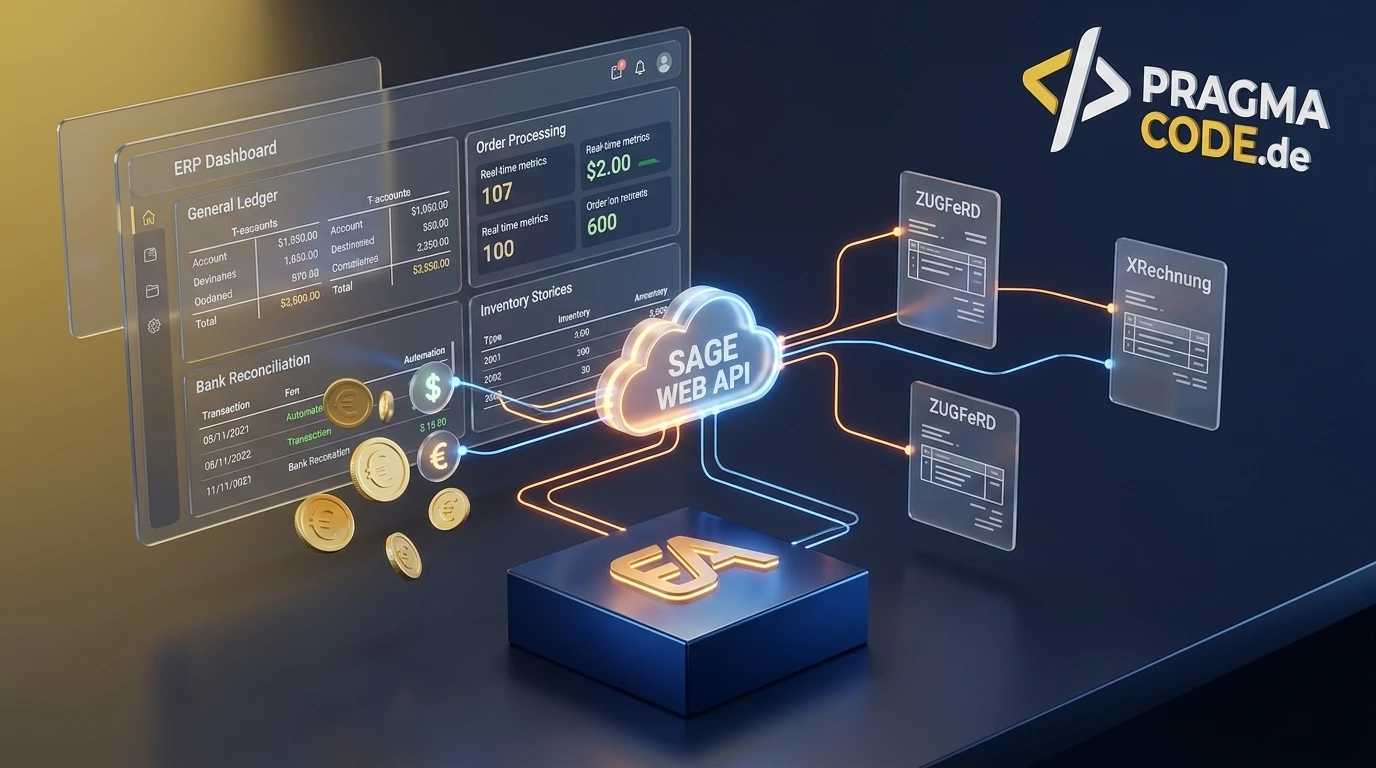
From a trusted market leader in Central European manufacturing and trade to a modern platform for automated operations: Sage unites full-scale double-entry accounting, manufacturing control, and proven compliance with the modern Sage Web API. In light of mandatory B2B e-invoicing for 2026/2027, deep n8n workflows, and certified DATEV connectors, we examine Sage 100 and Sage 50 in detail.
This article is an in-depth expert contribution from our content cluster. Discover the complete overview on our main page: AI Automation for Modern Businesses →
- Mid-Market Operating Core for Manufacturing & Wholesale: Sage ERP (notably Sage 100 and Sage 50 Connected) unites robust double-entry general ledgers, sales order processing, and warehouse management tailored to European regulatory environments.
- Legally Compliant E-Invoicing (EN 16931): Native generation, automated validation, and digital receipt ingestion for ZUGFeRD and XRechnung documents fulfilling mandatory statutory B2B electronic billing laws.
- Comprehensive Statutory Localization: Full integration of standard charts of accounts (SKR03 and SKR04), advance VAT returns (Elster), certified GoBD audit compliance, and DATEV cloud services.
- Modern Developer Connectivity: The Sage Web API (REST) and automation engines like n8n connect online shops, CRMs, and logistics platforms without expensive proprietary middleware.
- Data Sovereignty & Security: Enterprise data protection with granular role-based access controls and flexible deployment choices: on-premise, managed private cloud, or hybrid cloud configurations.
Introduction: The Operational Bedrock of Mid-Sized Industry
Across mechanical engineering, industrial wholesale, craft manufacturing, and technical distribution, Sage has served as an essential IT staple for decades. While global conglomerates implement monolithic mega-suites and startups leverage lightweight SaaS apps, tens of thousands of established mid-market companies rely on Sage 100 or Sage 50 Connected.
The key to this endurance lies in deep statutory localization: from rigorous German Commercial Code (HGB) accounting and tax compliance (GoBD) to fluid collaboration with external tax advisors via DATEV, Sage maps the operational realities of mid-sized commerce with meticulous accuracy.
In 2026, even the most established ERP systems must modernize: European e-invoicing mandates leave no room for manual paperwork handoffs, and modern IT landscapes demand open REST APIs for event-driven orchestration with automation platforms like n8n. In this comprehensive evaluation, we analyze Sage ERP 2026, test e-invoicing pipelines, and show how organizations modernize their existing Sage infrastructure for the cloud era.
Product Ecosystem: Sage 100 and Sage 50 in Detail
The Sage product portfolio is structured into distinct tiers addressing diverse organizational scales and functional complexities:
Sage 100: Modular Mid-Market ERP
Engineered for companies with 10 to 250 workstations. Combines general ledger accounting, fixed assets, cost accounting, inventory, manufacturing resource planning (MRP), project billing, and CRM into an extensible core.
Sage 50 Connected: For Small Business & Trades
Integrated operational solution for self-employed professionals, contractors, and trades. Manages quotes, invoicing, customer accounts, stock, and pre-accounting workflows efficiently.
Sage Active & Sage Intacct
Pure cloud-native financial management suites for agile service enterprises and technology businesses, featuring automated background software updates and modern browser interfaces.
Integrated Multi-Banking Feeds
Connect commercial bank accounts via PSD2, FinTS, and EBICS. Automated matching of account statements against open receivables, electronic SEPA debit generation, and digital payment advice notes.
Mandatory E-Invoicing 2026/2027: ZUGFeRD & XRechnung in Sage
Transitioning to mandatory electronic invoicing for domestic B2B trade represents a critical milestone for Sage users. Both statutory formats – ZUGFeRD and XRechnung – are integrated into procurement and sales workflows.
Sage 100 and Sage 50 natively generate and process electronic invoices complying with the European EN 16931 standard. Hybrid ZUGFeRD 2.2 / Factur-X files and pure XML XRechnung documents for public sector procurement (B2G) are supported out of the box.
1. ZUGFeRD in the Outbound Sales Pipeline
When generating or dispatching an outbound invoice, Sage embeds verified XML data directly into an archival PDF/A-3 container. The recipient receives an on-brand invoice for visual inspection, while their accounting software extracts line items, VAT rates, and payment metadata automatically.
2. Inbound XRechnung Validation & Posting
Inbound XRechnung XML files (conforming to UBL or UN/CEFACT syntax) are processed via the built-in document inbox. Sage validates the payload against official KoSIT schematron rules, matches purchase order references, and verifies vendor records. Once approved, Sage records the corresponding vendor liability in the accounts payable ledger and archives the source XML file in its audit-proof document management system (DMS).
Tax Advisor Synergy & DATEV Integration
Frictionless collaboration with external certified tax accountants is a core pillar of Sage ERP. The platform provides several certified data exchange pathways:
- Standardized DATEV Format Export: Sage compiles monthly audit-proof posting batches in official DATEV CSV format. Entries include chart of accounts mappings (SKR03 / SKR04), cost center allocations (Kost 1 / Kost 2), and tax keys.
- DATEVconnect online & Document Image Sync: Through DATEVconnect online, transaction batches and paired source document scans (PDFs of receivables and payables) transfer directly into DATEV Unternehmen online.
- Tax Audit Export (GDPdU / GoBD): For official tax audits, Sage compiles compliant data export bundles with metadata index files (index.xml) ready for ingestion by fiscal audit software like IDEA.
Developer Architecture: Sage Web API & Data Hub
While legacy ERP systems were once viewed as isolated on-premise islands, the modern Sage Web API equips Sage 100 with a RESTful interface connecting the operational core to online stores, customer portals, and integration middleware.
Authentication & API Request Pattern
Authentication uses API tokens or HTTP Basic Authentication over encrypted TLS connections to the hosted or local Web API gateway:
curl -s -X GET "https://erp.yourcompany.com/SageWebAPI/api/v1/Verkauf/Kunden" \
  -H "Authorization: Bearer YOUR_SAGE_API_TOKEN" \
  -H "Accept: application/json"
Essential Enterprise API Automation Scenarios
E-Commerce & Omnichannel Order Sync
Bi-directional integration with Shopware, WooCommerce, or Shopify. Online purchases convert into Sage sales orders, inventory balances update continuously, and shipment tracking numbers return to web buyers.
Mobile Barcode Scanning (WMS)
Warehouse personnel scan barcode labels and QR codes using rugged Android mobile terminals. The Web API logs inbound receipts, bin transfers, and order picks into Sage in real time.
CRM & B2B Customer Portal Connectivity
Sales representatives review open balances, credit limits, and purchase histories in mobile CRM interfaces, while corporate clients download historical ZUGFeRD invoices in a customer web portal.
Sage AppDesigner & Data Hub: Upgrade-Safe Customization
A standout capability of Sage 100 is the Sage AppDesigner. Rather than writing intrusive database triggers that complicate future upgrades, the AppDesigner enables release-safe extensions to tables, user forms, and business logic:
- Custom Schema Without Upgrade Friction: User-defined database fields (such as marketplace tracking IDs, customs tariff numbers, or hazardous material codes) persist cleanly across annual release upgrades.
- Sage Data Hub for BI Analytics: Central aggregation layer feeding business intelligence tools like Microsoft Power BI or custom corporate dashboards for real-time margin and liquidity analytics.
- Instant REST API Exposure: Every custom field and table configured in the AppDesigner automatically reflects in the Sage Web API, giving downstream n8n pipelines immediate access to specialized data.
Cost Accounting & Managerial Controlling
For industrial manufacturers and distributors, basic financial ledgers are insufficient. Sage 100 delivers an integrated managerial cost and performance accounting module (KLR):
- Cost Centers (Kost 1): Assign operating revenues and expenditures to organizational departments (administration, sales, production line 1, assembly).
- Cost Objects & Project Orders (Kost 2): Order-level post-calculation comparing actual material costs and labor hours against pre-calculated quotation margins.
- Multi-Stage Contribution Margin Analysis: Calculates contribution margins I through IV to uncover unprofitable product lines or high-maintenance customer accounts.
Production Blueprint: Automated Workflows with n8n
Integrating the Sage Web API with the open-source automation engine n8n allows mid-market businesses to construct responsive cloud pipelines without paying costly per-connector licensing fees.
Event Trigger (Webshop Order Placed)
An n8n webhook receives an incoming order payload from an online store or B2B customer portal. The workflow validates addresses, tax identifiers, and payment authorizations.
Customer Profile Lookup & Creation via API
n8n queries the Sage Web API endpoint /api/v1/Verkauf/Kunden. If the customer does not exist, the API automatically generates the profile complete with assigned credit terms and VAT numbers.
Sales Order Entry & Warehouse Reservation
The n8n pipeline creates a sales order in Sage 100. The system reserves warehouse stock and automatically prints pick lists on warehouse dispatch printers.
Invoice Finalization & ZUGFeRD Dispatch
Following parcel dispatch, Sage posts the final invoice, renders a compliant ZUGFeRD PDF/A-3 file, and emails the document to the customer. A status webhook alerts n8n to complete the webshop order.
Security Architecture & Audit Compliance (GoBD)
Engineered for auditable mid-market enterprises, Sage adheres to stringent compliance standards:
Tamper-Proof Audit Logging
Ledger entries lock permanently following monthly period closure. Any corrections must be executed through transparent offsetting reversing entries with historical audit trails.
Hosting Sovereignty & Choice
Organizations retain complete governance over their corporate records: Sage can run on local on-premise servers, in private data centers in Germany, or within secured private cloud environments.
Granular Role-Based Access Controls
Sophisticated privilege matrices segregate duties across warehouse staff, purchasing agents, accountants, and executive officers across ledgers, journals, and data fields.
Systemic Boundaries: When Does Sage Reach Its Limits?
Despite its proven track record, Sage has specific architectural boundaries:
Architectural Boundaries of Sage ERP
- Hybrid Client-Server Heritage (Sage 100): While newer modules run in web browsers, Sage 100 originates from a Windows client-server architecture, requiring terminal servers or specialized web gateways for remote web workstations.
- Global Multi-Entity Consolidation: Multinational groups requiring real-time consolidation across dozens of foreign legal entities under disparate international tax laws will find Oracle NetSuite or SAP S/4HANA better equipped.
- Custom Development Overhead: Deep custom code extensions require specialized Sage development expertise and maintenance during major version upgrades.
5-Step Modernization Roadmap for Sage ERP
Modernizing an established Sage installation for e-invoicing and cloud APIs proceeds through this structured roadmap:
-
1. Version Assessment & E-Invoicing Update
Audit your current Sage installation version. Deploy the latest annual service release to activate native ZUGFeRD 2.2 and XRechnung generation and parsing tools.
-
2. Chart of Accounts Alignment & DATEV Validation
Review charts of accounts (SKR03 / SKR04), cost centers, and VAT codes with your tax accountant. Run a trial DATEV CSV export to verify accounting mappings.
-
3. Banking & Payment Integration
Activate PSD2 or EBICS bank feeds for automatic transaction imports, and configure automated SEPA payment runs and customer direct debit schedules.
-
4. Deploying the Sage Web API
Install the Sage Web API service on your application server, generate secure API tokens, and configure TLS encryption alongside firewall access rules.
-
5. Orchestrating n8n Automation Workflows
Build event-driven n8n workflows connecting your e-commerce channels, CRM platforms, and logistics carriers to automate repetitive financial routines.
Conclusion: Sage ERP as a Resilient and Modernizable Core
Our 2026 review demonstrates why Sage ERP remains one of the most reliable backbones of mid-market business: the combination of robust double-entry accounting, compliant EN 16931 e-invoicing, seamless DATEV integration, and modern REST APIs makes Sage a dependable operational asset.
By connecting existing Sage infrastructure to n8n and modern cloud platforms, organizations protect long-term ERP investments while achieving agile automation and total data sovereignty.
Frequently Asked Questions (FAQ)
Is Sage ERP fully prepared for European and German e-invoicing mandates?
Yes. Both Sage 100 and Sage 50 natively generate, import, and validate electronic invoices in hybrid ZUGFeRD and pure XRechnung XML formats complying with EN 16931 standards.
How does DATEV integration function within Sage?
Sage exports monthly posting batches in official DATEV CSV format and transmits matched receipt images directly to DATEV Unternehmen online via DATEVconnect online.
Can Sage 100 be automated through APIs and n8n?
Yes. Through the modern Sage Web API (REST), customer records, item catalogs, sales orders, and invoices can be managed programmatically and orchestrated in n8n pipelines.
Where are customer records hosted in Sage ERP?
Organizations maintain full choice: Sage can be hosted on local on-premise servers, in private German data centers, or within secure private cloud environments to ensure maximum GDPR compliance.
Sources & Official Documentation
- Sage GmbH: Official Product and Web API Documentation for Sage 100 and Sage 50 (2026) – sage.com
- German Federal Ministry of Finance (BMF): Growth Opportunities Act & B2B E-Invoicing Regulations – bundesfinanzministerium.de
- Coordination Office for IT Standards (KoSIT): XRechnung Standard EN 16931 – xoev.de
- Forum for Electronic Invoicing Germany (FeRD): ZUGFeRD 2.2 Specification – ferd-net.de
- DATEV eG: Format Guidelines for External Ledger Data Batches – datev.de
Have a vision?
Let's check together how we can make your idea take flight.
Book your free strategy call nowExtended Specialized Glossary
Sage ERP
An enterprise management software suite by Sage GmbH for mid-market businesses (Sage 100 and Sage 50) encompassing financial accounting, inventory, manufacturing, and REST Web APIs.
ZUGFeRD
A hybrid electronic invoice format combining a visual PDF file with embedded, machine-readable XML data complying with the European EN 16931 standard.
n8n
An extensible open-source workflow automation platform for connecting APIs, enterprise data, and AI agents.
DATEVconnect online
A cloud API interface by DATEV that allows third-party software systems to securely transfer digital receipts and booking records into DATEV Unternehmen online in real time.