

With the rollout of dedicated Generative AI performance reports under 'Performance → Generative AI' in Google Search Console, Google provides site owners with isolated visibility metrics for AI Overviews and AI Search Mode for the first time. Discover available metrics, key data gaps (CTR, clicks, prompts), and how businesses must refine their digital visibility strategy for the AI era.
This article is an in-depth expert contribution from our content cluster. Discover the complete overview on our main page: AI Visibility Monitoring →
- Paradigm Shift in Search Analytics: Google separates organic standard search results from impressions in generative AI features (AI Overviews, AI Mode) under Performance → Generative AI in Google Search Console.
- Focus on Impressions: The report provides granular breakdowns by URLs, countries, devices, and time series. However, click data (CTR), specific user prompt queries, and position rankings remain undisclosed.
- Strategic Action for B2B & SEO: Pure click-through optimization is giving way to entity authority and citation optimization. Companies must realign content for Information Gain, structured entities, and GEO (Generative Engine Optimization) standards.
The Turning Point for Digital Visibility Measurement
With the phased rollout of dedicated Generative AI performance reports, Google officially acknowledges that search engine result pages (SERPs) no longer operate purely on legacy mechanisms. In 2026, failing to track how frequently your content is cited inside AI summaries means losing oversight of your digital brand footprint.
- 1. Introduction: The Rollout of Generative AI Reports
- 2. Anatomy of the New GSC Report: Data Delivered by Google
- 3. Comparison: Traditional Search vs. Generative AI Performance
- 4. The Major Data Gaps: Why CTR and Prompts Are Missing
- 5. 5-Step GEO Roadmap: Translating Data into Action
- 6. The 4 Biggest Pitfalls When Handling AI Search Data
- 7. Conclusion and Outlook: The Future of Search Monitoring
1. Introduction: The Rollout of Generative AI Reports
The search engine landscape is undergoing its most profound evolution since the launch of the Knowledge Graph. Generative answers, synthesized summaries, and interactive conversational overlays have become deeply embedded in the daily routines of millions of search users. When decision-makers search for complex B2B workflows, technical comparisons, or compliance frameworks, Google increasingly serves AI Overviews (formerly SGE) directly at the top of the results page.
For content strategists, SEO managers, and enterprise executives, one fundamental question has remained unanswered until now: How much of our overall search visibility is driven by these AI answers, and how does it affect our actual web traffic?
With the official launch of the Generative AI Performance Reports in Google Search Console in June 2026, Google provides its first substantive answer. Located in the left-hand navigation of Search Console — directly under the familiar Performance tab — eligible property owners now have access to a dedicated menu item called Generative AI.
This milestone shifts digital marketing from speculation to empirical data. Business leaders who learn to interpret this new report can systematically evaluate which specific URLs on their domain serve as trusted citation sources for synthetic AI answers. However, leveraging this data effectively requires a clear understanding of metrics, reporting boundaries, and remaining analytical blind spots.
Expert Tip: Check Your Report Availability
Google is rolling out these reports gradually across Search Console properties to manage server infrastructure and validate data models. If the Generative AI tab is not yet visible in your console, your data is not lost: it is already included within your aggregate traditional performance report numbers, though not yet visually isolated.
2. Anatomy of the New GSC Report: Data Delivered by Google
Opening the new report reveals a tailored dashboard interface modeled after the familiar performance graph, equipped with specific filters and operational constraints.
The core metric within the Generative AI report is the Impression. An impression is registered whenever a URL from your domain is loaded and rendered visibly within an AI-generated response block (e.g., as a highlighted inline text link, citation card, footnote anchor, or carousel snippet) on a user’s screen.
URL-Level Citation Analytics
The report pinpoints exactly which specific pages on your website are most frequently cited as foundational sources in generative AI responses.
Time Series & Trend Analysis
Filter across daily, weekly, and monthly timeframes to observe how content updates or algorithmic changes impact your AI citation frequency over time.
Geographic & Device Segmentation
Analyze whether your AI visibility originates primarily from mobile devices or desktop environments, as well as across key regional markets.
Google explicitly emphasizes that the metrics displayed here are not newly invented data points. Mathematically, they represent a subset of total organic search performance. Previously, AI impressions were blended indistinguishably into standard organic search metrics. The new report functions like a specialized lens, isolating this specific segment from the broader performance pool.
Governance & Control: The New Property Setting in Detail
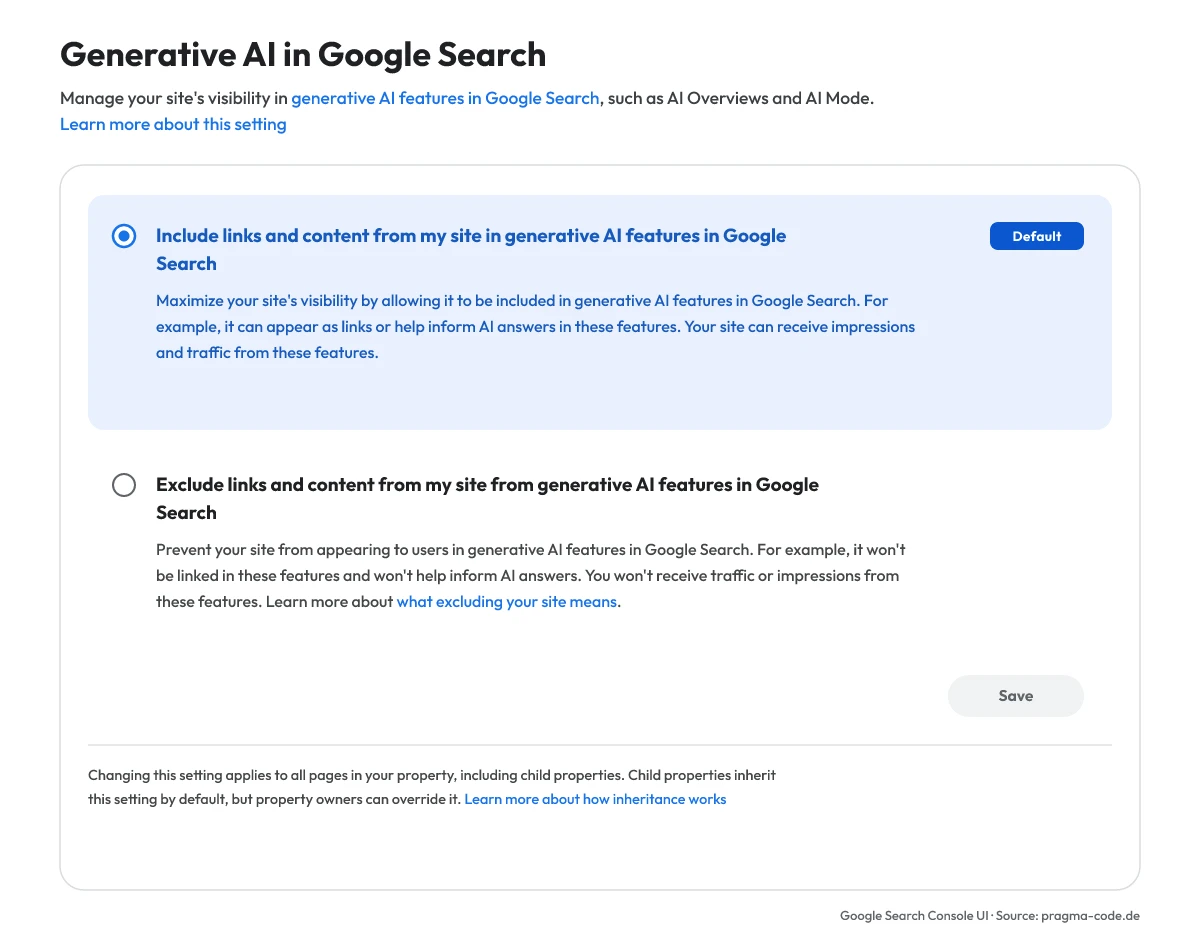
Alongside performance reports, Google introduced a foundational control switch in property settings under Settings → Generative AI in Google Search. Site owners can choose between two configurations:
Your web pages remain fully eligible for citation inside AI Overviews, generative syntheses, and interactive conversational AI search modes.
Opting out ensures your pages will not appear as linked citations or grounding sources in AI answers. Standard organic SERP indexation remains completely unaffected.
Property Inheritance Across Domain & Sub-Properties
Critically for enterprise platforms and multi-property environments: This setting applies across your entire domain property and is automatically inherited by child URL-prefix properties, though child property owners retain the authority to override it locally.
3. Comparison: Traditional Search vs. Generative AI Performance
Understanding this data requires a fundamental shift in marketing perspective. In traditional organic search, user behavior followed a predictable linear path: Enter search query → Scan SERP listing → Click blue headline → Arrive on landing page.
In generative AI search, user interaction is fundamentally different. Users receive a synthesized, comprehensive answer upfront and frequently absorb information directly within the interface. Outbound links function as verification anchors, trust signals, and deep-dive references.
Comparison: Traditional Organic Search vs. Generative AI Responses
- Core Metric: Clicks and Click-Through Rate (CTR) drive strategic success.
- Ranking Model: Fixed numerical positions (1–10) on Page 1 based on keywords & backlinks.
- User Intent: Searching for lists, directory links, and direct page destinations.
- Data Transparency: Exact keyword queries and click volume reported per page.
- Core Metric: Impressions and Entity Visibility (Brand Citations & Citations Share).
- Ranking Model: Dynamic multi-source synthesis based on E-E-A-T & Information Gain.
- User Intent: Synthesizing complex concepts; consuming answers directly in SERP.
- Data Transparency: Aggregated impressions; clicks and user prompts currently anonymized.
This comparison highlights a critical reality: a high volume of AI impressions does not automatically guarantee a proportional rise in direct site traffic. However, failing to appear as a cited source inside AI summaries eliminates your brand from the user’s consideration set entirely. The focus shifts from raw traffic capture to digital brand authority and citation dominance.
4. The Major Data Gaps: Why CTR and Prompts Are Missing
While the rollout of these reports is a welcome advance, data analysts and digital strategists must acknowledge the current technical limitations. Drawing unexamined conclusions from partial data can lead to flawed marketing investments.
Currently, the report features three major data gaps:
1. Absence of Click Data and CTR Metrics
Unlike standard performance reports, the Generative AI view currently provides no click counts and no calculated Click-Through Rate (CTR). While you can confirm that a page accumulated 50,000 AI impressions, the report does not reveal how many users clicked through to your site.
2. Anonymization of User Prompts (Queries)
Google does not expose specific search prompts or queries within this report. Because conversational AI prompts are often long, highly personalized, and complex, Google cites user privacy protections and prompt synthesis complexity as rationale.
3. Omission of Position Metrics
Generative AI answers do not feature traditional "Position 1" or "Position 3" placements. Source citations may appear as inline text links, side-panel cards, or expandable drawer footnotes. Consequently, Google omits average position metrics from the AI report.
Google justifies these omissions on two main grounds: First, to prevent black-hat marketers from attempting to gaming specific conversational prompt variations through primitive keyword stuffing. Second, AI Overview UI layouts undergo continuous A/B testing, rendering stable position and CTR metrics technically volatile.
Expert Tip: How to Estimate AI Referral Traffic
To estimate referral traffic coming from generative AI search features, combine Search Console impression trends with Google Analytics 4 (GA4) custom segmentations. Monitor referral traffic sources carrying specific Google referrer headers or UTM parameters alongside organic landing page traffic shifts on long-tail informational URLs.
5. 5-Step GEO Roadmap: Translating Data into Action
How should businesses respond to the insights revealed in Search Console’s Generative AI reports? The solution lies in executing a structured Generative Engine Optimization (GEO) strategy.
Follow this 5-step roadmap to translate raw impression metrics into concrete content enhancements:
-
Step 1: Conduct a Citation Audit
In your GSC Generative AI report, identify the top 20 URLs with the highest impression counts. These pages demonstrate strong authority within Google's LLM pipeline (e.g., Gemini) and serve as foundational reference assets.
-
Step 2: Analyze Information Gain
Evaluate why these specific pages earn AI citations. LLMs favor proprietary primary data, structured tables, unambiguous definitions, and expert insights over generic filler text. Amplify this "Information Gain" across underperforming pages.
-
Step 3: Expand Structured Data & Schema.org
Implement comprehensive Schema.org JSON-LD markup (Schema.org/JSON-LD), including
Article,FAQPage,Organization, andHowTo. Clear semantic structures allow AI parsers to process and extract your data accurately. -
Step 4: Modularize Content Formats for AI Crawlers
Structure long-form articles with concise Executive Summaries, explicit
<h2>and<h3>hierarchies, and scannable HTML comparison tables. AI web scrapers extract modular content blocks with significantly higher accuracy. -
Step 5: Continuous Monitoring & Iterative Refinement
Track month-over-month trends in AI impression volume. If visibility declines for key assets, inspect whether competitors updated their data structures or published more precise answers that AI models now prefer.
6. The 4 Biggest Pitfalls When Handling AI Search Data
When presenting AI search performance reports to executive stakeholders or clients, analytical missteps can easily distort decision-making. Avoid these four common traps:
Pitfall 1: Equating AI Impressions with Direct Traffic
A 200% surge in AI impressions does not imply a 200% increase in website traffic. Celebrate impression growth as a measure of brand reach, but evaluate business performance against conversions and qualified pipeline.
Pitfall 2: Double-Counting Metrics in Analytics Dashboards
Because AI impressions are already included in standard total GSC performance totals, NEVER add AI report metrics to overall organic totals. Doing so artificially inflates total visibility numbers.
Pitfall 3: Neglecting Fundamental SEO Best Practices
Google selects citation sources for AI Overviews predominantly from high-ranking pages in traditional search. Neglecting core SEO fundamentals (PageSpeed, backlinks, crawlability) directly undermines AI visibility.
Pitfall 4: Overreacting to Short-Term Volatility
Google frequently tests new UI presentation formats for AI Overviews. Weekly fluctuations in AI impressions are normal and often stem from interface testing rather than content defects on your website.
7. Conclusion and Outlook: The Future of Search Monitoring
The launch of Generative AI Performance Reports in Google Search Console marks a milestone for the digital industry. For the first time, Google pulls back the curtain to offer official visibility metrics for its generative AI search features.
For B2B enterprises and mid-market organizations, this creates a clear strategic opportunity: companies that master AI citation patterns and transition their content frameworks from legacy keyword SEO to GEO (Generative Engine Optimization) will secure dominant brand positioning in tomorrow’s search ecosystem.
However, existing data gaps in click reporting and prompt details remind us that AI analytics is still in its infancy. Further reporting enhancements will emerge over time. Organizations that invest today in structured data, E-E-A-T, and high-information-gain content will emerge as the preferred citation sources for leading AI engines.
Quick Check: Your Path to AI Visibility
Want to Optimize Your Visibility in AI Search Engines?
Pragma Code helps enterprises analyze Google Search Console data, build strategic GEO frameworks, and optimize digital assets for maximum citation in AI Overviews.
Schedule a Free Strategy ConsultationHave a vision?
Let's check together how we can make your idea take flight.
Book your free strategy call nowExtended Specialized Glossary
Generative AI Performance Reports
Specialized analytics view in Google Search Console measuring impressions within AI Overviews and generative AI search modes.
AI Overviews
AI-generated synthesis blocks displayed above traditional organic Google search results.
Generative Engine Optimization (GEO)
The strategic optimization of digital content to be cited and synthesized by Large Language Models and AI search engines.
Impression Share (AI)
The percentage of search queries where a website is visibly included within AI-generated responses.
Search Console Insights
Google's analytics hub designed to provide clear breakdowns of performance trends, content performance, and audience engagement.