

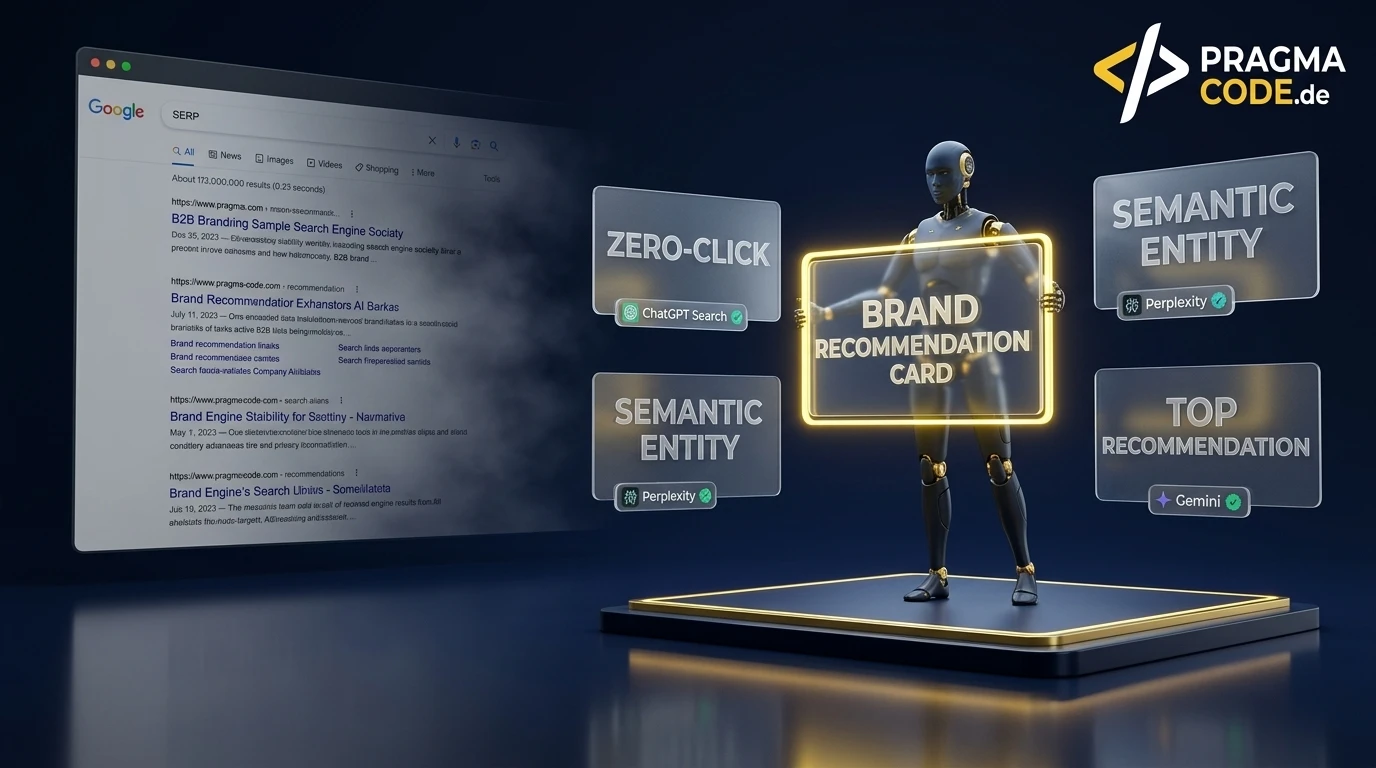
The way decision-makers in the DACH region search for service providers and solutions is changing fundamentally. Traditional search engines are increasingly giving way to intelligent chatbots and AI assistants. In this guide, you will learn how to adapt your SEO strategy to the era of ChatGPT, Perplexity, and Google Gemini, securing your brand's visibility for the long term.
This article is an in-depth expert contribution from our content cluster. Discover the complete overview on our main page: SEO-Optimized Blog Articles →
- The Paradigm Shift: The traditional Google SERP is losing market share to AI-powered, conversational assistants like ChatGPT and Perplexity, which deliver direct, synthesized answers instead of lists of links.
- Optimization via Entities: Pure keyword stuffing is useless. AI models interpret web data via semantic relationships (Knowledge Graphs) and reward structured, factual, and highly citable content.
- E-E-A-T & Authority: Having your brand mentioned in authentic testimonials, professional publications, and by influencers serves as the strongest trust signal for LLMs during recommendation synthesis.
- The Era of AI-Powered Search Assistants
- 1. The Shift in Visibility: From SERP to Chatbot Answer
- 2. Strategies for AI-Optimized Content
- 3. Influencer Marketing as a Booster for AI-SEO
- AI-SEO Readiness Checklist for SMEs
- Expert Tips: Implementing AI-SEO in the DACH Region
- Conclusion: Actively Shaping the Future of Online Presence
The Era of AI-Powered Search Assistants – Beyond Google and the Traditional SERP
For decades, digital customer acquisition in the B2B sector has relied on a simple principle: a user enters a search query into Google, receives a list of blue links (the Search Engine Results Pages, or SERPs), clicks on one of the top results, and lands on a company's website. However, this familiar model is dissolving. With the rise of multimodal frontier models such as OpenAI's GPT-4o and o3, Anthropic's Claude 3.5 and 3.7, and Google's Gemini 2.0, as well as specialized answer engines like Perplexity AI and ChatGPT Search, research behavior has changed fundamentally.
Today, users are increasingly utilizing conversational search. Instead of typing fragmented keywords, they ask complex questions in natural language and expect a complete, consolidated answer. This shift presents small and medium-sized enterprises (SMEs) in the DACH region with an existential challenge: if the chatbot answers the question directly without the user ever visiting your website, how does your brand remain visible? The answer lies in a new discipline: AI-SEO (also known as Generative Engine Optimization, or GEO). In this article, we will show you how to align your content so that it is understood, selected, and cited by the new gatekeepers of the web.
1. The Shift in Visibility: From SERP to Chatbot Answer
Challenges and Opportunities of ChatGPT, Perplexity & Co.
The biggest challenge for traditional marketing is the phenomenon of so-called "zero-click searches." According to recent industry data (SparkToro), over 68% of web searches in 2026 now conclude without a single click on an external website. If a buyer or IT manager asks: "Which ERP systems are suitable for medium-sized manufacturing companies in Germany with SAP integration?", Perplexity or ChatGPT Search generates a detailed overview, including a comparison table and direct brand recommendations. The user theoretically no longer needs to click on a single manufacturer's website. The traditional traffic model collapses as a result. Just how steep that impact is, is analyzed with concrete data in our forecast Why GEO Replaces Traditional SEO by Late 2026.
Yet, where there are risks, there are also enormous opportunities. Chatbots do not generate their answers out of thin air; they aggregate and structure information from the web. Platforms like Perplexity or ChatGPT (with web search enabled) increasingly rely on source citations. They link the sources used directly in the footnotes or within the body text. If you manage to appear as a trustworthy source in these answers, you will receive highly qualified traffic from users who are already at the end of their decision-making process.
How AI Models Aggregate, Interpret, and Present Information
To become visible in AI answers, you must understand how LLMs work. Unlike traditional search engines, which primarily analyze text patterns and keyword density on pages, AI models work with semantic vectors. They attempt to understand the intent behind a question in detail. During a query, modern systems like Perplexity or Gemini go through a multi-stage process:
Query Expansion
The user's conversational query is broken down into several precise search queries.
Retrieval (RAG)
Relevant web pages are searched and read in real time via a web index. This process is based on Retrieval-Augmented Generation (RAG).
Reranking & Synthesis
The most promising text sections are selected, analyzed by the model, summarized, and formulated into a fluid answer.
Your content must therefore not only be discoverable by search crawlers, but above all structured in such a way that an AI model can easily extract, compare, and cite it as evidence.
The Influence of Trustworthiness and Authority on AI Answers
AI models have an inherent problem: hallucinations. To avoid spreading misinformation, the algorithms evaluate the trustworthiness of a source extremely strictly. This is where the E-E-A-T principles (Experience, Expertise, Authoritativeness, Trustworthiness) established by Google come into play in an even stricter form. An AI model prefers citations from established industry experts, official studies, well-known media outlets, and specialist portals. If your brand is barely mentioned on the web, or if your content lacks clear author signals and scientific or practical evidence, the AI will ignore you when generating its response.
Comparison: Traditional SEO vs. AI-SEO (GEO)
- Focus: Keyword optimization and search volume
- Goal: Top 10 ranking in Google's list of links
- Structure: Standard H2/H3 hierarchy for search crawlers
- Metrics: Organic clicks, impressions, keyword rankings
- Linking: Pure internal link structures and backlinks
- Focus: Semantic context, entities, and intent
- Goal: Citation and linking as a source in chatbot answers
- Structure: Structured data, FAQs, directly extractable tables
- Metrics: Share of Voice in LLMs, citation rate, brand mentions
- Linking: E-E-A-T signals, Knowledge Graph integration, PR
2. Strategies for AI-Optimized Content
Semantic SEO and Contextual Understanding: Deeper Content Structuring
To make your content fit for AI search, you must move away from focusing on isolated keywords. The key lies in Semantic SEO. This means lighting up a topic in all its facets and logical connections. Stop writing short, superficial articles that only answer a single question. instead, create comprehensive pillar pages and deep-dive technical articles that explore a topic completely.
Structure your paragraphs logically. Use precise subheadings formulated as questions, and answer them directly in the first sentence of the following paragraph. This makes it easier for the AI model to perform "information retrieval." Furthermore, use definitions that you highlight visually and structurally so they can be extracted directly as citation snippets.
Strengthening Entities and Knowledge Graphs: From Keywords to Knowledge Networks
Modern search systems no longer understand the world as a collection of words, but as a network of entities (people, companies, places, concepts) and their relationships to one another. Google uses its Knowledge Graph for this, and LLMs are essentially giant neural knowledge networks. To be perceived as an entity, you must give the AI clear, structured hints.
This is best achieved through the consistent use of structured data (Schema.org). Do not just use standard markups like Article or Organization, but link your content using specific entity markups. If you are writing about a software solution, define it using SoftwareApplication and link it to the industry standard via the sameAs attribute (e.g., to the corresponding Wikipedia or Wikidata entry). The clearer the relationships are for the AI, the more likely it is to identify your brand as a market participant and expert.
Expert Tip: Entity Mapping
Link your most important technical terms on the website specifically to Wikidata IDs in your schema markup. For example, if you offer a service in "IT Consulting," add the property "sameAs": "https://www.wikidata.org/wiki/Q1056584" in the JSON-LD. This eliminates any ambiguity for AI crawlers.
Creating Content for Precise, Factual, and Citable Answers
AI models prefer content that is based on hard facts. To be selected as a citable source, your content should meet the following criteria:
Precise Data and Numbers
Use concrete statistics, percentages, and measurable results. Always cite the primary source.
Structured Lists and Tables
LLMs love tables because they are excellent for synthesizing comparisons. A clean HTML table is highly likely to be copied directly into a chatbot response.
Clear Language
Avoid vague marketing speak. Instead, formulate your points in clear, concise sentences. Instead of \"We revolutionize your IT infrastructure through innovative approaches,\" write: \"We reduce server latency by 35% using edge-native architectures.\"
3. Influencer Marketing as a Booster for AI-SEO and Brand Presence
Authenticity and Authority in the AI World: Why Influencer Signals Are Becoming More Important
An often-overlooked aspect of optimizing for AI search assistants is the origin of the training and web data. LLMs are trained on massive datasets that include social networks, forums (like Reddit), specialist blogs, and digital publications. In addition, real-time search engines like Perplexity use social platforms and news feeds to query current opinions and trends. This is where influencer marketing comes in, especially in the B2B sector (Key Opinion Leaders).
When recognized industry experts talk about and recommend your brand on LinkedIn, YouTube, or in specialized podcasts, it generates valuable digital signals. These signals are captured by the crawlers of AI models. If a brand is continuously mentioned positively on social networks and specialist media in the context of a specific topic (e.g., \"marketing automation\"), the likelihood increases that the LLM will recommend this brand when a corresponding user question is asked.
Leveraging Synergies: How Influencers Send Signals to AI Models and Build Trust
Collaboration with B2B influencers sends two types of signals to AI models:
Implicit Co-Mentions
If your company name is frequently mentioned in the same sentence or paragraph as established industry terms and experts, the AI model learns this semantic proximity in vector space.
High-Quality Backlinks
Links from influencers' specialist articles and blogs to your whitepapers or case studies strengthen traditional domain authority, which continues to serve as a filter for RAG systems.
Best Practices for an Integrated Strategy in the DACH Region
To use influencer marketing effectively for your AI SEO, B2B companies in the DACH region should proceed strategically. It is not about short-term product placements, but about building long-term authority:
Guest Posts and Interviews
Let your internal experts speak on influencers' platforms. Every published interview strengthens the E-E-A-T status of the people involved and links your brand to the specialist topic in the Knowledge Graph.
Joint Studies and Whitepapers
Create data-driven industry reports together with well-known thought leaders. These reports are frequently cited, which in turn generates highly relevant, fact-based data sources that LLMs prefer to read.
Transcribe Podcasts
B2B podcasts are content goldmines. Make sure that every podcast episode is published as a detailed, clean, and structured text transcript on your website. Although search crawlers and AI models can increasingly analyze audio content, text remains the easiest data source to interpret.
AI-SEO Readiness Checklist for SMEs
Prepare your web presence systematically for the requirements of ChatGPT, Perplexity, and Google Gemini. The following overview shows the most important optimization levers:
Integrate a FAQ section with real user questions on every service page. Use the FAQPage schema so that RAG systems can read the answers precisely.
Add a detailed author box with a short biography, link to their LinkedIn profile, and proof of expertise to every blog post. Link the author as a Person via schema markup (author).
Use Schema.org markup for organizations, products, and services. Use sameAs links to Wikipedia and Wikidata entries to clarify semantic context.
Replace promotional phrases with concrete metrics and data-driven statements. Provide downloadable tables and bullet points that can be easily extracted as citations.
Through PR, B2B influencer collaborations, and specialist articles, ensure that your brand name is mentioned on the web in direct connection with your core competencies.
Expert Tips for SMEs: Implementing AI-SEO – Step by Step
Shifting your SEO strategy toward AI visibility does not require an unaffordable budget, but rather a structured approach. Follow this proven process to establish your brand as a trustworthy source of information:
Test the popular LLMs (ChatGPT, Gemini, Perplexity) with your key B2B search phrases. Check if your brand is already mentioned and which sources the AI cites instead.
Identify your top-performing content and optimize it specifically: add tables, clarify key statements, and complete schema markups.
Create a structured industry glossary on your website. This not only attracts organic search traffic but also serves as an excellent definition database for AI assistants.
Cooperate with key opinion leaders in your niche. Have them write about your solutions to build trusted mentions outside of your own website.
Conclusion: Actively Shaping the Future of Online Presence – Outperforming the Competition with AI-SEO
The evolution of web search toward artificial intelligence is not a threat, but a tectonic shift in the rules of the game. SMEs in the DACH region that act now and expand their SEO strategy to include AI SEO and entity optimization will secure a decisive advantage. By providing precise, structured, and expert-backed content, you make it easy for AI models to present your brand as the leading authority. Actively shape your digital future – before your competitors do.
Do you have questions about AI-SEO and your brand visibility?
Arrange a free initial consultationOur Regional Expertise
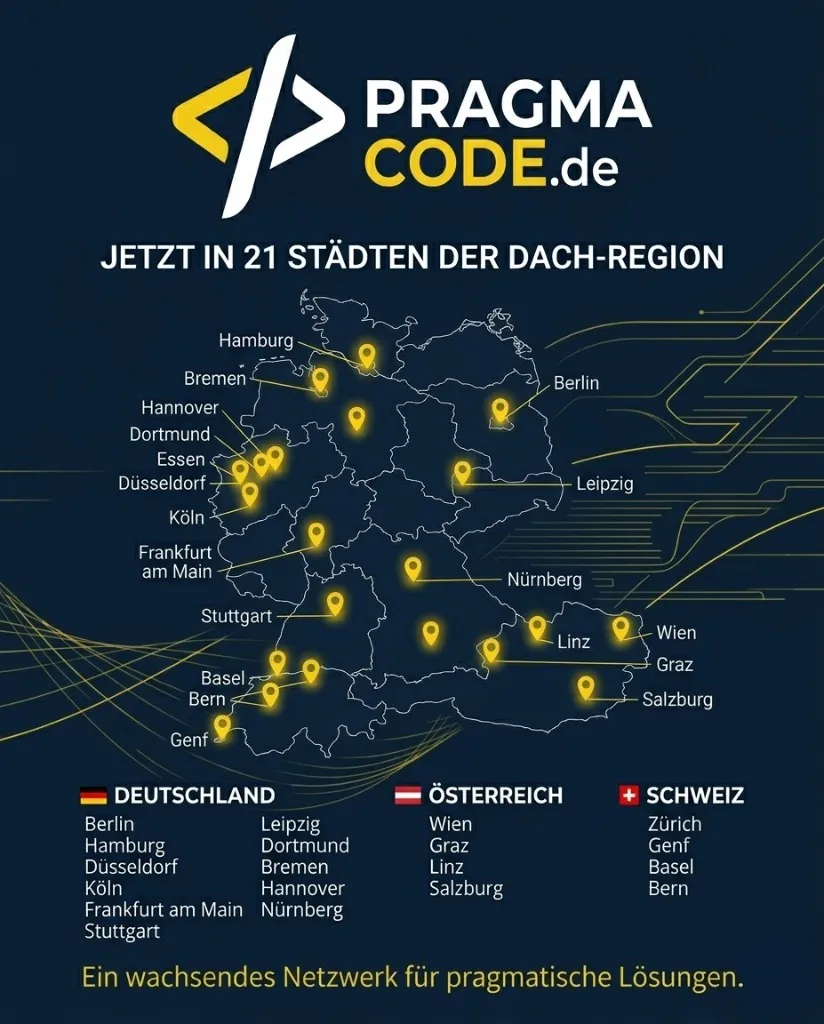
We are your digital partner – regionally anchored and successfully scaling across borders.
SEO blog articles for your business?
I deliver this for small and mid-sized businesses: at a fixed price agreed upfront, working directly with the person who builds it. Process, scope and pricing are on the service page.
See service & pricing Or request a free intro callExtended Specialized Glossary
AI SEO
Search engine optimization for artificial intelligence, aimed at getting a brand mentioned and linked within the answers of AI models like ChatGPT and Perplexity.
ChatGPT SEO
The deliberate process of optimizing web content so that it is selected and cited as a primary information source by OpenAI's ChatGPT.
Perplexity SEO
Optimization strategies for the Perplexity AI search engine, which uses real-time web search and links sources directly in its answers.
Conversational Search
Search queries in natural language, where users interact with the search engine as if they were in a real conversation.