


Useful page titles begin with what a page actually offers. This annotated collection shows how to align titles, meta descriptions and headings across service pages, products, guides, local pages and homepages.
This article is an in-depth expert contribution from our content cluster. Discover the complete overview on our main page: SEO Landing Pages →
A title such as “Our solutions” leaves the subject largely unexplained. “Maintenance software for workshops” identifies an offer and an intended audience. The practical writing question is therefore straightforward: what expectation does the wording create, and does the destination page meet it? This article helps you compare and refine those expectations.
The distinction from our article on optimising complete SEO landing pages is scope. That guide addresses the destination page as a whole. This collection concentrates on the text in its document head and headings, with annotated examples you can adapt. The wider service is described on the SEO Landing Pages page. Start with an existing page whose purpose you can explain without relying on broad marketing language.
Illustrative examples: Every offer, product and business situation below is fictional. No real companies or customers are described. “Weak” and “better” refer to editorial clarity within the stated scenario, rather than measured search performance.
Distinguishing the title, meta description and H1
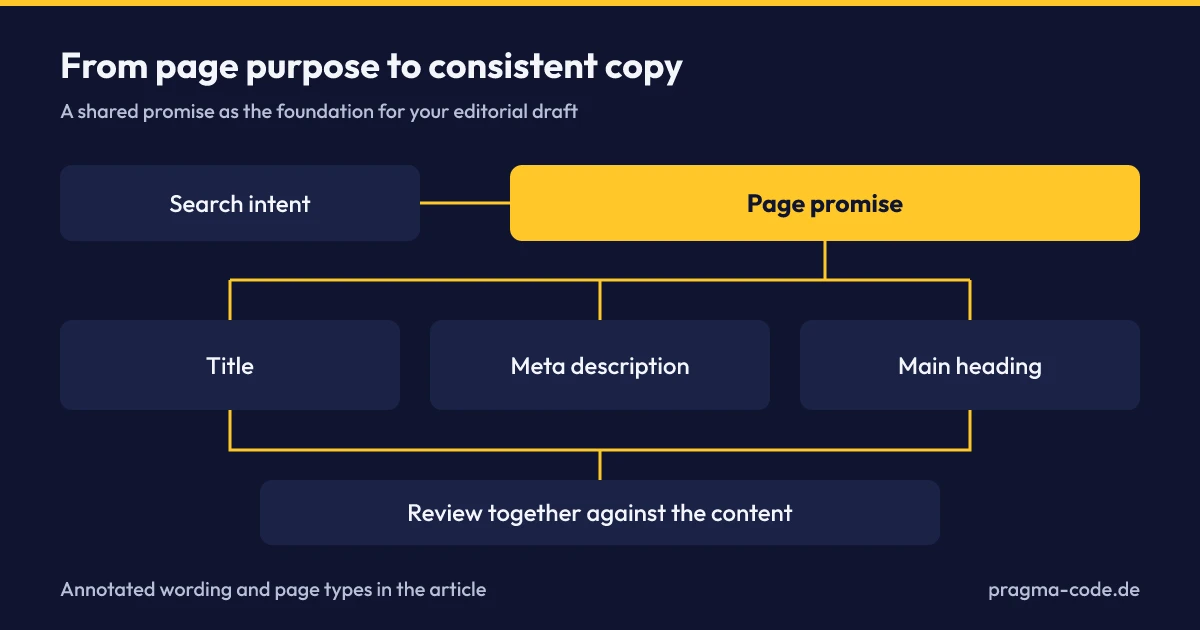
The title is supplied in the HTML document head. The meta description is a description supplied there, while the H1 is a visible main heading within the page content. Draft them together, but give them distinct editorial jobs: identify the page, explain its usefulness and introduce its content.
Begin with User Intent. Is the visitor comparing services, looking for instructions or trying to find a local provider? Describe the expected answer in everyday language before drafting the title. This helps you notice a guide that sounds like a sales page, or a service page that promises instructions it never provides. The important relationship is between a reader’s likely expectation and the material available after they arrive.
Google specifies no fixed title length limit; displayed titles are truncated as needed to fit device width. Google recommends concise, descriptive titles without keyword repetition or boilerplate. Source: Google Search Central: title links. When drafting, put the essential subject early and review readability.
SEO title examples for B2B service pages
A service page needs a recognisable subject. “We transform your business” does not tell a potential buyer whether the offer involves consulting, software development or an ongoing managed service. Start with the actual service and qualify it using information the page supports. Each comparison below assumes that the revised wording is explained in the destination content. If that explanation is missing, improve the page before adopting a more specific promise in its title.
Illustrative example: systems integration
“Digital solutions for your success”
“Systems integration for inventory platforms and online stores”
The revised version identifies the service and the categories of systems involved. A procurement manager can assess whether the subject matches the problem they are trying to solve. There is no promise of a specific delivery time or compatibility with every platform. The page should then explain which information moves between systems and where the service boundaries lie. Name individual platforms only when they genuinely fall within the scope you can deliver and describe.
Illustrative example: business website maintenance
“Expert website services”
“Business website maintenance: updates and ongoing support”
Here, a vague claim to expertise becomes an understandable service description. However, “updates and ongoing support” is still a commitment that needs explaining. Describe what support covers and what requires a separate engagement. If the page only offers a technical review, website maintenance would be too broad a label. A useful title may describe a narrower service than the original marketing line, provided that narrower description is more faithful to the offer available on the page.
Illustrative example: process discovery consulting
“Automation, digital transformation, consulting, software”
“Automation consulting: review business processes before implementation”
The revision identifies a stage of work: advice before technical implementation. It would misrepresent a page selling a fully operated automation service without an initial consulting offer. The example also illustrates why a string of related keywords cannot replace a decision about page purpose. A separate implementation page can carry its own specific promise. It does not need the same general list of terms as a consulting page aimed at buyers still exploring their requirements.
Titles for products, guides, local services and homepages
Avoid forcing every page into the same sentence pattern. For a product, identity and relevant features matter; for a guide, the question being answered is central. A homepage has to establish the overall business offer. Draft these texts separately, then review the vocabulary they share. Their purpose is to demonstrate useful distinctions you can test against your own content.
Illustrative example: product page
“Discover our best shelving today”
“Steel workshop shelving with adjustable shelves”
The revised title identifies an object and a distinguishing feature. It is only appropriate for shelving actually made from steel with adjustable shelves. Check those details against product information before putting them in metadata or a visible heading. For similar variants, draw distinctions from genuine characteristics. Inventing accessories or adding an unsupported superlative is not a useful way to make otherwise similar product titles look different. Clarify the product rather than manufacturing a distinction the buyer cannot verify.
Illustrative example: advice article
“Everything you need to know”
“Choosing workshop shelving: materials and installation options”
This title describes a selection task and the angle the guide takes. The article should support that decision rather than moving straight from a brief introduction into a product pitch. A product page and a guide can address the same subject while serving different purposes. During review, ask whether readers receive the promised decision support without having to look elsewhere for the missing explanation. If the content only covers materials, narrow the title instead of claiming it also explains installation.
Illustrative example: local service page
“Your local partner”
“Workshop shelving installation in Bristol”
Location is part of the fictional service in this example. Include a place in a real title only if the business actually serves it. The page needs to distinguish installation at the customer’s premises from advice delivered remotely. A city name on its own does not explain a local service. Do not simply swap place names while leaving readers without information about what is available in their area. Match the wording to an actual service boundary and explain that boundary in the page content.
Illustrative example: homepage
“Welcome to our website”
“Workshop equipment for trade businesses”
The homepage establishes the overall offer rather than listing every item in a catalogue. If the fictional supplier plans workstations as well as supplying shelving, the broader wording may make sense. Still, check whether the rest of the page supports that scope. A dedicated installation page should carry a more specific promise than the homepage. Let the homepage orient the reader, while the service and product pages explain their own subjects in greater depth and with appropriate detail.
Meta description examples with useful context
Google primarily generates snippets from page content and uses the meta description when it describes the page more accurately. Different queries can produce different snippets. Source: Google Search Central: snippets. Write a self-contained description of the specific page rather than adding promotional phrases.
Google recommends page-specific descriptions. There is no fixed length limit; snippets are truncated as needed, typically to fit device width. Source: Google Search Central: meta descriptions.
Illustrative example: service page description
“The best solutions and the best service. Contact us now!”
“Connect your inventory platform and online store. Learn how we review data flows, plan integrations and prepare the handover to your team.”
The revision outlines an approach and explains what the visitor should find on the page. Use it only if those topics are genuinely covered. If handover is outside the service, remove that promise. The editorial benefit is that the description becomes testable against the content: you can associate each part with an explanation on the page. A collection of positive adjectives offers little help when you need to check whether a description is accurate and useful to a potential customer.
Illustrative example: guide description
“Our complete guide with all the important information.”
“Which workshop shelving suits your space? Compare materials, access and installation using annotated selection scenarios.”
The question introduces a specific problem, while the following sentence explains the help available. An invitation to buy would only fit if it matched the purpose of the page. For an explanatory article, encouraging readers to compare options may be the more accurate approach. Read the description without its title as well. If the subject becomes unclear, supply the missing object or a more useful verb. Resolve the ambiguity with information, rather than adding another broad keyword to the sentence.
H1 examples and supporting H2 headings
Google recommends a distinctive main heading, for example as the first visible H1. With equally prominent headings, Google may use the first for the title link. Source: Google Search Central: identifying the main title.
The title and visible main heading can describe the same subject in different words. The editorial aim is to meet the same expectation. For example, the title “Systems integration for inventory platforms and online stores” can lead into the H1 “Connect your inventory platform and store with a suitable integration”. A heading such as “We shape your future” would discard the specific context established by the title and give the visitor little help in confirming they reached the right page.
Supporting headings can then address the questions a prospective buyer needs answered. The following structure is an illustrative plan for the integration service. Adopt them only if the sections below them actually answer the questions.
“Which data needs to move between the systems?”
Explain the business scope. For example, clarify whether the service concerns orders or product information. Define the work clearly enough for readers to compare their own requirements with what you offer.
“How are data transfer failures handled?”
Describe the planned response to failed transfers without promising universal freedom from errors. This heading identifies a real decision question and gives the section a concrete explanatory task.
“What does your team need before the project starts?”
Explain the business information needed for an initial discussion. Make prerequisites understandable so readers can decide whether they are ready to talk or should first gather requirements internally.
Avoid subheadings that merely repeat the same search term. “Integration benefits” says less than a specific question the section answers. Review the sequence as well: introducing implementation details before explaining the offer may demand knowledge the page has not yet supplied. A useful outline reads as a connected argument even when the paragraphs beneath the headings are temporarily hidden. Use that reading exercise to identify gaps before polishing the wording of individual headings.
During review, consider the perspective of someone who has never encountered your business. Internal project names may mean little to that person. Start with an understandable service description and explain specialist terminology in the relevant section. Then ask a reviewer to describe the offer using only the headings. If their summary differs from the actual service, you have a concrete reason to revise the wording. That way you spot unclear expectations before publication.
When Google rewrites a title: investigate before explaining
Google automatically builds title links from sources including the title, H1, prominent text and link text. Incomplete, outdated, inaccurate or boilerplate titles and language mismatches can prompt changes. Source: Google Search Central: title generation and common issues.
You can nevertheless document an observed difference carefully. Keep the supplied title separate from the wording actually observed in a result. Record the query and the context of the observation, then review whether the title, visible main heading and content describe the same offer.
Observing changes in Search Console
Before making a change, write down an editorial hypothesis you can revisit: “The revised title identifies the service more clearly and should attract people looking for that service.” Record the old wording, new wording and publication date. Distinguish an isolated title revision from a broader page rewrite. If the offer and content change at the same time, a later development cannot cleanly be attributed to the heading alone. Your notes should make that limitation visible to anyone reviewing the work.
When interpreting your Search Console data, use a consistent comparison of the same page under comparable query and contextual conditions. Record the selection behind the analysis. A different period or a different mix of queries can change how the result should be interpreted.
Also consider whether enquiries fit the actual service. More attention for the wrong promise would not constitute editorial success. Where information is lawfully available, read questions from prospective customers alongside the statistical picture. If people continue to confuse the service with another offer, the content may need a clearer explanation. Repeated title changes will not resolve an underlying service description that remains vague or leaves important boundaries unexplained. Revise the page promise before treating the title as an isolated solution.
FAQ about titles and descriptions
What makes SEO title examples useful?
They identify specific page content and explain why a revision is clearer than the weaker version. Retain only details that are true of your own page.
How should I adapt meta description examples?
Apply the pattern of subject, useful content and an appropriate invitation to your own page. Check every statement against the actual content and remove unsupported promises.
Do the title and H1 need identical wording?
They should describe the same subject and offer. Different wording can work when the visible main heading follows through on the title's promise.
Are H1 examples a ranking guarantee?
No. These examples are writing aids. They do not describe measured outcomes, guaranteed rankings or a guaranteed appearance in search results.
Turning an example into your own copy
Choose the page type and explain its specific promise before drafting the title and description. Then review the visible headings against that promise. Do not retain a feature simply because it sounds persuasive in a template. For complementary work on describing content technically, read the article on Schema.org and SEO.
Sources & primary documentation
Stand: 03.11.2026
- Google Search Central: Influencing your title links in search results — title sources, rewrites, best practices and the visible main heading/H1.
- Google Search Central: Control your snippets in search results — meta description selection, query-dependent snippets and description length.
SEO landing pages for your business?
I deliver this for small and mid-sized businesses: at a fixed price agreed upfront, working directly with the person who builds it. Process, scope and pricing are on the service page.
See service & pricing Or request a free intro callExtended Specialized Glossary
User Intent
The purpose behind a search query, such as comparing a service or finding an explanation.
Title
The page title supplied in the HTML title element.
Meta description
A description of page content supplied in the HTML document.