


The European Accessibility Act (EAA) and Germany's BFSG impose strict accessibility mandates across all digital consumer services. Beyond interactive web portals, businesses face a massive liability: thousands of untagged legacy PDFs and dynamic UI components. While manual document tagging is economically impossible and superficial overlay widgets fail in court, AI-powered multi-agent vision pipelines and AST-based code refactoring have emerged as the definitive enterprise standard for scalable compliance.
This article is an in-depth expert contribution from our content cluster. Discover the complete overview on our main page: BFSG Accessibility →
BFSG Enforcement & The Remediation Reality
Following the formal grace periods of European digital accessibility legislation, enforcement agencies and consumer advocacy groups have moved to rigorous technical inspections. Scrutiny no longer stops at cookie banners or landing page contrast ratios; automated crawlers now evaluate hundreds of thousands of linked PDF documents, checkout funnels, and interactive customer portals. Companies relying on manual agency tagging face staggering costs, while those using quick-fix overlay widgets face severe legal challenges. The future belongs to automated AI remediation pipelines that restructure assets at the data and code level in compliance with WCAG 2.2 and PDF/UA (Universal Accessibility).
- The Legacy PDF Crisis: More than 90% of PDFs currently served on corporate websites and portals are 'flat' print exports lacking a semantic Logical Structure Tree. Manual remediation costs €200 to €800 per document—an untenable expense for large document catalogs.
- The Overlay Fallacy: Third-party JavaScript widgets cannot modify downloadable PDF assets or repair deep keyboard traps in dynamic Single Page Applications (SPAs). Courts across the EU and North America increasingly reject overlays as valid compliance measures.
- The AI Remediation Paradigm: Multimodal vision models (Gemini 2.5/3.x, Claude Vision) coupled with geometric layout parsers automatically reconstruct semantic headings, complex data tables, and diagrams into ISO 14289 (PDF/UA) trees, slashing remediation costs by up to 85%.
- AST-Driven Frontend Modernization: Permanent web accessibility fixes (focus trapping, WAI-ARIA 1.2 patterns, dynamic contrast tokens) are injected directly into source code via automated Abstract Syntax Tree refactoring in CI/CD pipelines.
- Human-in-the-Loop & Legal Certainty: A 90% automation rate coupled with expert PAC (PDF Accessibility Checker) validation guarantees 100% legal compliance.
- 1. The BFSG Reality 2026: The Hidden Mountain of Legacy PDFs
- 2. The Failure of Overlay Widgets: Why True Remediation is Non-Negotiable
- 3. Technical Architecture: How AI-Powered PDF Remediation Works
- 4. Automated Web Component Remediation at Source Code Level (AST)
- 5. Quality Assurance: PAC Audits, Synthetic Screen Readers & Human-in-the-Loop
- 6. 90-Day Implementation Roadmap: From Chaos to Certified Infrastructure
- 7. Economics: AI Pipeline Instead of Manual Work
- 8. Conclusion & Strategic Next Steps
1. The BFSG Reality 2026: The Hidden Mountain of Legacy PDFs
With the full enactment of Germany's Barrierefreiheitsstärkungsgesetz (BFSG) and the broader European Accessibility Act (EAA), digital accessibility has transitioned from a niche CSR topic to a core legal and technical compliance requirement. While organizations initially focused on publishing an accessibility statement and adjusting basic color contrasts, regulatory enforcement in 2026 targets the foundational digital assets: PDF documents and transactional web workflows.
Under the European standard EN 301 549 and the Web Content Accessibility Guidelines (WCAG 2.1 & 2.2 AA), every document provided as part of an electronic commerce service, customer onboarding flow, or public utility offering must be accessible to users with disabilities. This includes:
Product Data Sheets & Technical Manuals
Engineering specifications, assembly guides, and full product catalogs in B2B and B2C ecommerce.
Legal Policies & Contractual Downloads
General Terms and Conditions (GTC), cancellation policies, and privacy disclosures provided as downloads.
Transactional Invoices & Statements
Invoices, delivery notes, booking confirmations, and account statements inside customer self-service portals.
Application & Intake Forms
Interactive intake workflows and application PDFs for cooperatives, industry associations, and public institutions.
Financial & CSRD Disclosures
Annual financial reports, CSRD sustainability disclosures, corporate brochures, and whitepapers.
Expert Insight: The E-Commerce Document Trap
Many online retailers assume their platform is fully compliant because their checkout page is keyboard navigable. However, linking an untagged PDF warranty or manual constitutes an actionable legal violation under Section 3 Paragraph 1 BFSG. Specialized consumer legal groups use automated bots that scrape all .pdf endpoints and verify tag compliance within seconds.
The root cause of non-compliant PDF archives lies in desktop publishing software (InDesign, Word, Print-to-PDF drivers), which prioritizes visual print geometry over semantic data. These files contain visual coordinates of characters and vector shapes, but zero information regarding reading order, table headers, or image descriptions. For assistive technologies like NVDA, JAWS, or Apple VoiceOver, untagged PDFs are unreadable blocks of static noise.
Manual Remediation Bottleneck
Manually tagging a complex 30-page PDF catalog in Adobe Acrobat Pro requires 4 to 8 hours of specialized labor. At professional agency rates of €90 to €150 per hour, remediating a single catalog costs €350 to €1,200. For an enterprise library of 2,500 documents, manual conversion quickly exceeds €1 million.
Fines & High Litigation Values
Non-compliance under the BFSG carries regulatory fines of up to €100,000 and potential sales bans. Civil warning letters from specialized legal entities start with dispute values of €20,000+ per audited domain.
Public Procurement Disqualification
Public sector buyers, enterprise corporations, and institutional clients require verifiable EN 301 549 compliance in RFP tender criteria. Inaccessible documentation leads to immediate disqualification from major procurement bids.
2. The Failure of Overlay Widgets: Why True Remediation is Non-Negotiable
Under looming deadlines, numerous companies turned to quick-fix promises: automated JavaScript overlay widgets (such as AccessiBe, UserWay, or EqualWeb). Vendor marketing claimed that inserting a single script tag would make entire websites and digital assets instantly compliant with WCAG 2.2.
In 2026, technical realities and legal precedents have unequivocally debunked this approach:
Comparison: Superficial Accessibility Overlays vs. Deep AI Code Remediation
- Documents: Zero impact on downloadable PDFs, invoices, or manuals, as browser-level JavaScript cannot alter external binary files.
- Screen Reader Clashes: Dynamically alters DOM properties at runtime, often overriding native screen reader settings and creating severe keyboard lockups.
- Legal Ineffectiveness: European and US courts repeatedly rule that overlays do not constitute accessibility compliance. Over 700 global disability advocacy groups actively oppose overlay adoption.
- Performance Degradation: Injects 150–400 KB of third-party script, blocking the main thread and harming Core Web Vitals (INP and LCP metrics).
- Holistic Asset Coverage: Automated structural transformation of all PDF catalogs and transactional documents into certified PDF/UA assets.
- Native Source Code Fixes: Direct AST-level refactoring of ARIA roles, focus traps, and markup semantics inside your Astro, Next.js, or React repositories.
- Audit-Proof Compliance: Fully compliant with EN 301 549, WCAG 2.2 AA, and ISO 14289 standards—verified using PAC and axe-core.
- Zero Runtime Overhead: No third-party trackers, zero added client-side latency, and pristine page load speeds.
True legal protection and genuine accessibility cannot be achieved through client-side visual overlays; they require systematic remediation at the data, document, and source code layers.
3. Technical Architecture: How AI-Powered PDF Remediation Works
Automated PDF Remediation resolves the structural deficiencies of legacy documents through a synergistic blend of geometric layout parsing, multimodal Large Vision Models (LVMs), and deterministic structure tree compilation. Rather than treating a PDF as unformatted text, the AI engine interprets spatial coordinates, visual hierarchies, and typographic intent.
Geometric Parsing & Bounding Box Extraction
The pipeline deconstructs each page into vector graphics, typography streams, and bitmap layers, extracting exact coordinate bounding boxes, font weights, line spacing, and color gamuts.
Multimodal Vision Classification
Advanced vision models (Gemini 2.5/3.x, Claude 3.7 Vision, fine-tuned LayoutLMv3 architectures) analyze overall visual topology, distinguishing document titles (H1), section headers (H2–H6), body paragraphs, footnotes, and sidebars.
Complex Table & Form Reconstruction
Borderless multi-column tables, nested headers spanning multiple columns (Colspan/Rowspan), and form fields are semantically reassembled. The engine builds robust <Table>, <TR>, <TH>, <TD> hierarchies with appropriate cell-to-header relationships.
Generative Alt-Text Injection & Artifact Tagging
Embedded charts, technical schematics, and photos are evaluated by the vision LLM, producing concise, context-aware alternative text descriptions. Background graphics, decorative divider lines, and recurring header/footer elements are tagged as /Artifact to prevent screen reader clutter.
PDF/UA Structure Tree Compilation
The engine compiles a standardized Logical Structure Tree, sets necessary document-level metadata (Language /Lang (en-US), MarkInfo, DisplayDocTitle), and outputs an ISO 14289 compliant PDF/UA file.
This automated pipeline transforms an intensive 4-hour manual tagging task into an autonomous 15-to-45-second execution per document. Enterprise repositories holding tens of thousands of documents can be processed in parallel across serverless cloud nodes or local on-premise clusters.
Strict Reading Order Preservation
Multi-column articles, callout boxes, and margin notes are sequenced logically so assistive technologies read content in proper sequence without disjointed jumps across columns.
Deep Header Cell Association
Every data cell in technical specifications or financial tables is explicitly mapped to row and column headers, ensuring screen reader users maintain context when navigating complex datasets.
Context-Aware Alt Text
Replaces meaningless filenames ('figure1.png') with precise descriptions: 'Bar chart showing Q3 operational cost reduction of 85% achieved via automated AI remediation pipelines'.
PAC 2024 & Matterhorn Validation
Automated validation against the Matterhorn Protocol and ISO 14289 ensures that zero syntax or semantic tree violations remain in the delivered documents.
4. Automated Web Component Remediation at Source Code Level (AST)
Modern web frontends, portals, and online shops frequently suffer from accessibility regressions introduced through custom JavaScript controls, headless UI libraries, or missing semantic markup in React, Next.js, Vue, or Astro.
Rather than patching issues at runtime, AST-Based Web Remediation parses application source code into Abstract Syntax Trees. Specialized agents and static analyzers identify accessibility anti-patterns and perform deterministic automated refactoring across codebase repositories.
Focus Management & Modal Trapping
Injects proper focus trapping into dialogs, sidebars, and drawer navigation using native inert attributes and keyboard listeners, ensuring keyboard users cannot tab behind active overlays and can exit seamlessly via Escape.
WAI-ARIA 1.2 Combobox Modernization
Transforms inaccessible <div class="select"> structures into compliant combobox patterns with complete aria-expanded, aria-controls, and keyboard navigation support.
Dynamic Design Token Contrast Remediation
Audits and recalculates CSS design variables to guarantee minimum contrast ratios of 4.5:1 for body copy and 3:1 for graphical user interface controls across both light and dark themes.
Accessible Form Validation States
Automatically associates form fields with live error messaging containers using aria-describedby and aria-invalid="true", enabling immediate speech synthesis feedback upon validation failures.
Code Walkthrough: Before vs. After AST Refactoring
The code snippet below illustrates an automated AST transformation of an inaccessible custom language selector into a fully compliant WAI-ARIA 1.2 keyboard-operable component:
// BEFORE: Inaccessible custom dropdown (High BFSG liability risk)
export function LanguageDropdown({ items, onSelect }) {
  const [open, setOpen] = useState(false);
  return (
    <div className="dropdown" onClick={() => setOpen(!open)}>
      <span>Select Language</span>
      {open && (
        <div className="menu">
          {items.map(item => (
            <div key={item.code} onClick={() => onSelect(item)}>{item.name}</div>
          ))}
        </div>
      )}
    </div>
  );
}

// AFTER: Automatically transformed WAI-ARIA 1.2 Combobox
export function LanguageDropdown({ items, onSelect }) {
  const [open, setOpen] = useState(false);
  const [focusedIdx, setFocusedIdx] = useState(-1);
  const listboxId = useId();

  const handleKeyDown = (e) => {
    if (e.key === 'ArrowDown') {
      e.preventDefault();
      setOpen(true);
      setFocusedIdx(prev => (prev + 1) % items.length);
    } else if (e.key === 'ArrowUp') {
      e.preventDefault();
      setFocusedIdx(prev => (prev - 1 + items.length) % items.length);
    } else if (e.key === 'Enter' || e.key === ' ') {
      e.preventDefault();
      if (open && focusedIdx >= 0) onSelect(items[focusedIdx]);
      setOpen(!open);
    } else if (e.key === 'Escape') {
      setOpen(false);
    }
  };

  return (
    <div className="dropdown">
      <button
        type="button"
        aria-haspopup="listbox"
        aria-expanded={open}
        aria-controls={listboxId}
        onKeyDown={handleKeyDown}
        onClick={() => setOpen(!open)}
      >
        Select Language
      </button>
      {open && (
        <ul id={listboxId} role="listbox" tabIndex={-1}>
          {items.map((item, idx) => (
            <li
              key={item.code}
              role="option"
              aria-selected={idx === focusedIdx}
              onClick={() => { onSelect(item); setOpen(false); }}
            >
              {item.name}
            </li>
          ))}
        </ul>
      )}
    </div>
  );
}
5. Quality Assurance: PAC Audits, Synthetic Screen Readers & Human-in-the-Loop
While AI models reliably handle 85% to 90% of structural tagging and code synthesis, digital accessibility is inherently human-centric. A machine vision model may successfully identify a visual chart, but evaluating whether the resulting textual explanation communicates critical business nuances requires expert verification.
Pragma Code implements a rigorous three-tier verification architecture:
Automated Rule-Based Verification
Comprehensive automated testing against axe-core (web) and the PAC (PDF Accessibility Checker) engine. Zero syntax errors in color contrast, ARIA bindings, table tags, or PDF metadata are permitted.
Synthetic Screen Reader Auditing
Automated CI/CD pipelines conduct Synthetic Screen Reader Testing, simulating assistive technology traversal to detect infinite navigation loops or unreachable DOM nodes.
Human-in-the-Loop Certification
Certified accessibility specialists perform targeted spot checks on mission-critical customer workflows, complex financial tables, and generated alt text descriptions prior to production release.
6. 90-Day Implementation Roadmap: From Chaos to Certified Infrastructure
Transitioning an enterprise ecosystem from non-compliant legacy sprawl to a certified, accessible infrastructure requires a disciplined, phased execution:
-
Phase 1: Discovery & Risk Profiling (Days 1–15)
Automated crawl across all public web routes, CMS assets, ERP repositories, and S3 buckets. Categorize and rank document archives by traffic, regulatory sensitivity (checkout, contractual agreements), and structural complexity.
-
Phase 2: Automated AI Remediation & AST Refactoring (Days 16–45)
Batch processing of document archives through multimodal vision pipelines to generate ISO 14289 compliant PDF/UA files. Concurrent automated AST refactoring of frontend codebases to resolve focus traps and ARIA issues.
-
Phase 3: PAC Verification & Expert Audit (Days 46–70)
Rigorous PAC engine validation of all processed PDF documents combined with human-in-the-loop screen reader spot checks across key user journeys to confirm total compliance.
-
Phase 4: Compliance Statement & CI/CD Governance (Days 71–90)
Publication of a legally compliant accessibility statement with integrated feedback mechanisms. Integration of automated accessibility gates in CI/CD pipelines to ensure future code commits and PDF uploads remain accessible by default.
7. Economics: AI Pipeline Instead of Manual Work
The financial advantage of an AI-driven remediation model compared to traditional manual agency services is transformative:
Traditional Manual Remediation
1,000 documents at 4 hours of manual labor each
approx. €350,000Project timeline of 9 to 15 months, heavy internal resource drain, and delayed digital product rollouts.
Pragma-Code AI Remediation Pipeline
1,000 documents fully automated with Human-in-the-Loop review
approx. €35,000Over 85% direct cost reduction, 2 to 4 weeks turnaround, and immediate audit-proof scalability.
Quick-Check: Your Roadmap to BFSG & EAA Compliance
8. Conclusion & Strategic Next Steps
The European Accessibility Act and Germany's BFSG are not mere regulatory burdens; they are the catalyst for cleaner software architectures, higher digital product quality, and enhanced user experiences. Accessible PDFs and web applications eliminate legal risks, dramatically improve organic search engine and generative AI (GEO) discoverability, and unlock seamless purchasing experiences for millions of potential customers.
With Pragma Code's AI remediation pipelines, you can transform accessibility from a daunting cost center into a streamlined, automated competitive advantage. Get in touch with our engineering team today to conduct a comprehensive accessibility baseline audit.
Do you have questions about automated PDF & web accessibility under BFSG?
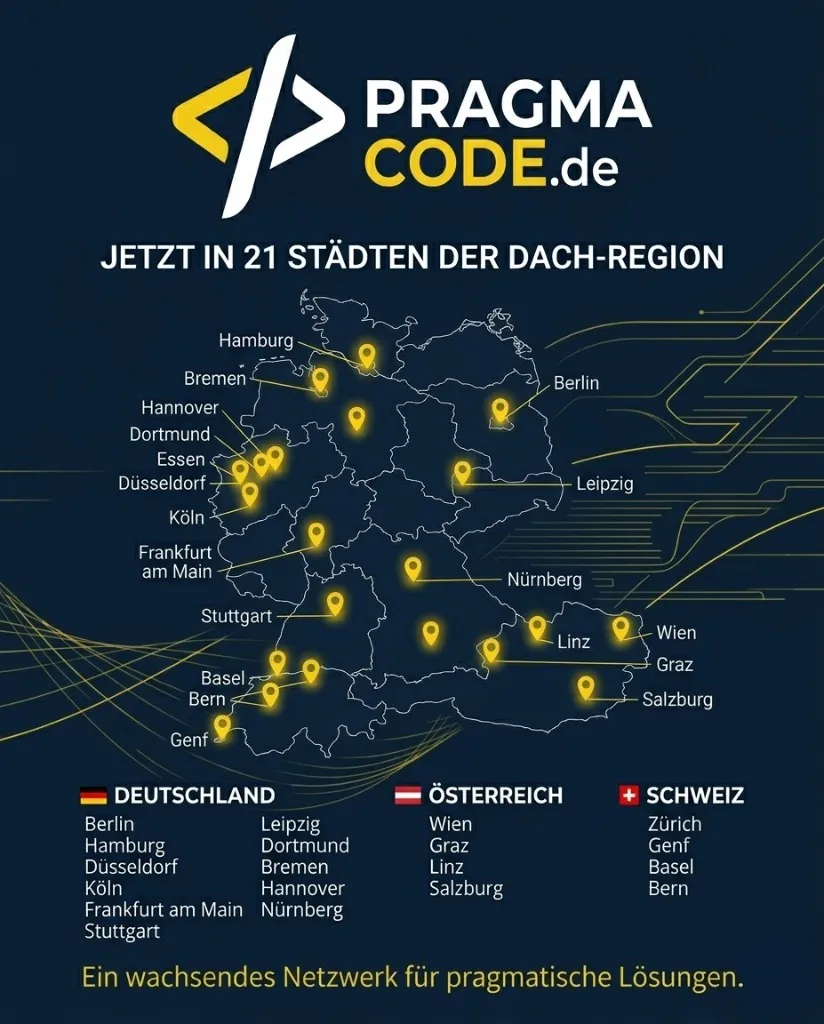
Schedule a Free ConsultationOur Regional Expertise
We are your digital partner – regionally anchored and successfully scaling across borders.
Have a vision?
Let's check together how we can make your idea take flight.
Book your free strategy call nowExtended Specialized Glossary
PDF/UA (Universal Accessibility)
The international ISO standard (ISO 14289) for accessible PDF documents. It defines mandatory technical requirements for tag hierarchies, semantic reading orders, alternative image descriptions, and assistive technology compatibility.
Automated PDF Remediation
The technology- and AI-driven process of retrofitting inaccessible legacy PDFs. Multimodal vision models parse layout geometries, data tables, and diagrams to inject compliant PDF/UA structure trees automatically.
Logical Structure Tree
The hierarchical tag tree within a PDF file (analogous to the HTML DOM). It dictates the logical reading order, heading levels (H1-H6), table cells (TR/TH/TD), and paragraphs for screen readers, independent of visual print styling.
PAC (PDF Accessibility Checker)
The globally recognized freeware validation tool for testing PDF documents against PDF/UA and WCAG standards. It renders a structural inspection tree and flags accessibility violations in screen reader previews.
AST-Based Web Remediation
The automated source code refactoring of frontend components using Abstract Syntax Trees (AST). Accessibility flaws (e.g., missing ARIA attributes, focus traps, inaccessible forms) are permanently fixed in code rather than masked by fragile overlay widgets.
Synthetic Screen Reader Testing
Automated CI/CD testing procedures that simulate the navigation and speech synthesis behavior of assistive technologies (such as NVDA or VoiceOver), catching accessibility regressions before code reaches production.