

Artificial intelligence has outgrown the experimental sandbox in small and medium-sized enterprises (SMEs). In 2026, companies building a real competitive advantage no longer rely on isolated chat prompts. Instead, they deploy deeply integrated AI agents, automated n8n workflows, and data-sovereign architectures. This executive guide shows SME leaders how to execute AI transformation pragmatically, compliantly, and profitably.
This article is an in-depth expert contribution from our content cluster. Discover the complete overview on our main page: AI Automation for Business →
- Paradigm Shift to Agentic AI: Generic conversational chatbots are being replaced by autonomous AI workers that operate directly inside ERP, CRM, and accounting software.
- Data Sovereignty & Compliance: Local open-source models and sovereign European cloud gateways enable 100% GDPR and EU AI Act compliance without data leakage.
- Prototype Over Specification: Launching a functional prototype in 2–3 weeks yields rapid ROI within 3–6 months.
From Experimental Toys to Operational Powerhouses
While 2023 and 2024 were characterized by fragmented prompt experiments, 2026 separates the leaders from the laggards in the middle market. Forward-thinking companies build interconnected agent architectures that alleviate skilled labor shortages and drive measurable cost reductions across daily operations.
- 1. Why Isolated Chatbots Are No Longer Enough in 2026
- 2. The 4 Pillars of Profitable AI Integration in SMEs
- 3. Comparison: Silo Tools vs. Integrated Agent Architecture
- 4. Architecture & Data Sovereignty: Securing Enterprise Data
- 5. EU AI Act & GDPR Compliance for SMEs
- 6. Economics, ROI & Avoiding the 3 Major Cost Traps
- 7. The 5-Phase Implementation Roadmap
- 8. Government Grants & Subsidies: Up to 80% Co-Funding
- 9. Quick-Check: Assessing Your Organizational Readiness
- 10. Conclusion: Pragmatism Beats Perfectionism
1. Why Isolated Chatbots Are No Longer Enough in 2026
Artificial intelligence has become a fixture in modern business discussions. However, in executive boardrooms across small and medium-sized enterprises, initial enthusiasm has frequently given way to disillusionment. Rolling out general-purpose chatbot licenses (such as ChatGPT or standard office copilots) generated sporadic excitement among individual staff members, but failed to deliver measurable improvements on company balance sheets. The underlying problem is evident: an isolated browser window is not a business workflow.
When an employee must copy customer data manually from an ERP system, paste it into a prompt box, evaluate the AI output, and manually re-enter the data into accounting or inventory software, no automated efficiency is achieved. Instead, a new digital bottleneck is created. The continuous manual review and copy-pasting consume nearly all the time saved. Real enterprise value begins when Generative AI steps out of the chat window and functions as an autonomous backend service deeply woven into operational IT infrastructure.
The year 2026 marks a fundamental architectural shift: the transition from passive text generators to Agentic AI. Modern autonomous AI workers do not wait for line-by-line human prompting. They monitor inbound communications, parse complex structured and unstructured documents like invoices or delivery notes, query SQL and relational databases via open standards such as the Model Context Protocol (MCP), and orchestrate automated downstream actions across core enterprise systems such as SAP, Microsoft Dynamics, or bespoke internal platforms.
Strategic Insight: The Leverage of Integrated Workflows
The true business ROI of AI in mid-market companies is not determined by the parameter count of a language model, but by the depth of its system integrations. A specialized, fine-tuned open-source model with direct API connectivity to your core ERP delivers exponentially higher economic value than a massive cloud model trapped behind a disconnected browser tab.
2. The 4 Pillars of Profitable AI Integration in SMEs
To generate substantial operational relief and cost savings for SMEs, artificial intelligence deployments must follow a structured, high-impact framework. At Pragma Code, we organize high-ROI digitalization initiatives into four battle-tested pillars designed for rapid enterprise adoption:
1. No-Touch Backoffice & Document Processing
End-to-end extraction, validation, and posting of incoming invoices, delivery slips, and purchase orders using multimodal vision models and n8n.
2. Predictive Maintenance & Operational AI
Real-time sensor anomaly detection and predictive servicing to eliminate costly machinery downtime in manufacturing and industrial operations.
3. Autonomous 24/7 Support & Voice Agents
Intelligent 1st-level customer service handling with native CRM integration, automated appointment booking, and seamless human escalation paths.
4. Market Intelligence & Decision Support
Continuous competitive and supply chain monitoring via automated data extraction and structured synthesis for executive leadership.
Pillar 1: No-Touch Backoffice & Intelligent Document Processing
In mid-sized companies, manual administrative routines consume significant specialist capacity. Incoming mailboxes overflow with PDF invoices, customs forms, shipping documents, and order confirmations. Traditional legacy automation relied on rigid zone templates: the moment a supplier altered their invoice layout or tax ID placement, the parsing failed and required manual intervention.
Modern vision models coupled with OCR (Optical Character Recognition) eliminate this fragile limitation. The system understands documents semantically, just like an experienced human accountant. Through our No-Touch Accounting workflows, line items are extracted, matched against purchase orders in the ERP, verified for tax compliance, and booked automatically. Human operators only review genuine edge cases or discrepancies exceeding defined risk thresholds.
Pillar 2: Predictive Maintenance & Industrial AI
For manufacturing enterprises, precision engineering firms, and industrial fabricators, unplanned machine stoppages cause devastating financial damage. An unexpected breakdown of a CNC machining center or automated packaging line halts supply chains and triggers severe contractual penalties.
By applying Machine Learning (ML) and Predictive Analytics to continuous IoT telemetry (vibration profiles, thermal signatures, hydraulic pressure, and power consumption), anomaly detection algorithms establish a baseline of operational health. The system detects micro-deviations weeks before catastrophic mechanical failure occurs. Maintenance interventions are scheduled during planned changeovers, reducing spare parts inventory costs and extending asset lifespans.
Pillar 3: Autonomous Support & Voice Agents
Customers, distributors, and partners expect instantaneous support around the clock. Yet maintaining a 24/7 multilingual support team with human staff is financially prohibitive for most mid-sized businesses. An autonomous AI colleague such as our Hermes Agent resolves this trade-off effectively.
Operating across live web chat, ticketing inboxes, or natural voice telephony (NLP), the agent conducts sophisticated, contextual domain dialogues. It interfaces directly with ERP and CRM backends to retrieve shipment tracking numbers, process return authorizations with uploaded photo evidence, pre-qualify sales leads, and book qualified discovery calls directly into sales representatives' calendars. Whenever an inquiry requires human judgment, the agent escalates seamlessly with an executive conversation brief. Explore our deep dive on AI Chatbots & Voice Agents in Customer Support.
Pillar 4: B2B Market & Competitive Intelligence
Specialized mid-market players must keep constant track of market fluctuations, supplier pricing, and competitive developments. Manual web research is tedious and prone to missing critical signals. By deploying autonomous web extraction agents (such as our OpenClaw agent), target distributor portals, tender platforms, and public registries are monitored systematically.
Extracted data is cleaned, cross-referenced with internal benchmarks, and synthesized into weekly strategic intelligence briefings delivered directly to management via Slack or email. Leadership gains actionable market clarity to adjust pricing strategies and capture emerging opportunities ahead of competitors.
3. Comparison: Silo Tools vs. Integrated Agent Architecture
To illustrate the operational difference between ad-hoc AI tools and a fully integrated enterprise architecture, consider the following direct operational comparison:
Comparison: Silo Prompting vs. Integrated Agentic AI
- Data Entry: Manual copy-pasting by employees with high error rates and friction.
- Integration: Zero access to ERP, CRM, inventory databases, or email queues.
- Data Privacy: Risk of PII exposure on non-EU public clouds without zero-retention guarantees.
- Scalability: Linearly constrained by human work hours with no autonomous throughput.
- Economics: Recurring per-seat software licenses with negligible measurable time savings.
- Data Entry: Autonomous data fetching via secure APIs, webhooks, and file bridges.
- Integration: Seamless bidirectional sync with ERP, CRM, and SQL databases via n8n.
- Data Privacy: 100% GDPR-compliant using dedicated local LLMs or sovereign EU cloud endpoints.
- Scalability: Processes hundreds of transactions concurrently without staffing constraints.
- Economics: Direct, measurable savings of 15–25 employee hours every week.
4. Architecture & Data Sovereignty: Securing Enterprise Data
The primary concern among SME leadership regarding AI adoption centers on intellectual property protection, trade secrets, and GDPR compliance. This caution is well justified: transmitting unmasked financial records, engineering CAD specs, or private customer correspondence to standard consumer API endpoints risks severe compliance fines and corporate espionage.
Pragma Code implements a modular four-layer architecture that strictly decouples model reasoning from enterprise data storage, guaranteeing complete institutional data sovereignty:
1. ERP, CRM & File Repositories
Internal SQL databases (PostgreSQL, MS SQL, SAP, Dynamics) and DMS archives stay locked within your protected firewall perimeter.
2. n8n Workflow Engine
The fair-code n8n workflow engine executes business logic, applies PII masking, and coordinates multi-step agent actions.
3. Local & Sovereign LLMs
Execution of Local LLMs (e.g. Llama 3.3, Qwen 2.5) on private GPU hardware or dedicated EU-hosted inference clusters.
4. Model Context Protocol (MCP)
Standardized communication layers securely connect the reasoning model with business tools, messaging clients, and human approval queues.
On-Premise GPU Inference vs. Sovereign EU Cloud Gateways
When running model inference, mid-sized enterprises can choose between two robust, privacy-compliant deployment models:
1. Dedicated On-Premise GPU Hardware: Utilizing local inference engines (such as vLLM or Ollama on dedicated enterprise GPUs) guarantees that sensitive data never crosses network boundaries. This architecture is optimal for highly regulated manufacturers, healthcare developers, defense contractors, and businesses with strict proprietary IP mandates.
2. Sovereign European Cloud Infrastructure: For organizations without in-house GPU clusters, ISO-27001 certified European hosting providers (in Frankfurt, Nuremberg, or Paris) deliver GDPR-compliant inference endpoints with legally binding Zero-Data-Retention agreements. Data resides in volatile memory only for the duration of inference and is instantly expunged without model training.
5. EU AI Act & GDPR Compliance for SMEs
With the full enforcement of the European EU AI Act in 2026, companies must navigate clearly defined compliance standards. The widespread belief that mid-sized businesses are exempt from regulatory scrutiny is mistaken. What matters is the risk classification of each specific AI application:
Minimal Risk (Unrestricted Deployment)
Internal workflow automations, text summaries, spam filters, and standard document parsers fall into the minimal risk category and require no complex conformity audits.
Article 50 Transparency Obligations
Customer-facing AI systems (such as conversational support bots or AI phone assistants) must clearly disclose to human users that they are interacting with an artificial agent.
High-Risk Classifications (Strict Guardrails)
AI utilized in recruitment scoring, credit evaluations, or critical safety systems mandates formalized risk management, comprehensive logging, and human oversight controls.
GDPR & Data Processing Agreements
Ensure all service providers sign binding Data Processing Agreements (DPAs) with explicit zero-retention clauses prohibiting data reuse for external model training.
In practice, over 85% of typical SME AI workflows—from invoice processing to automated tier-1 customer inquiries—fall strictly under minimal risk or straightforward transparency rules. By maintaining clean architectural documentation and visible disclaimers, compliance is achieved without administrative drag.
6. Economics, ROI & Avoiding the 3 Major Cost Traps
Many corporate AI initiatives stumble not over technical deficits, but due to poorly defined financial outcomes. Treating AI as an ambiguous innovation experiment burns capital. At Pragma Code, every deployment is tied to rigorous financial benchmarks:
"An AI implementation is successful only if it measurably eliminates routine labor overhead, cuts customer cycle times in half, or expands revenue per employee." – Alexander Ohl, Founder of Pragma Code
To protect digital transformation budgets, executive teams must guard against three prevalent cost drivers:
Trap 1: The Endless PoC Graveyard
Month-long research trials without predefined completion criteria. After six months, an academic report is delivered, yet zero production workflows are active.
Trap 2: Feeding Dirty Data Into RAG
Dumping uncurated, obsolete legacy files into a RAG (Retrieval-Augmented Generation) pipeline without filtering. The result: severe model hallucinations and eroded staff trust.
Trap 3: Fragmented In-House Custom Scripts
Fragile, ad-hoc custom code without central orchestration. When third-party APIs update or an ERP patch is applied, workflows break, creating severe maintenance overhead.
Concrete ROI Business Case: 60-Employee Distributor
Consider a representative mid-sized distribution enterprise processing roughly 1,200 supplier invoices, delivery manifests, and claim requests per month:
Pre-Automation Baseline
Manual data entry, cross-checking, and accounting allocation required 2 full-time staff members spending roughly 2.5 hours daily (100 hours monthly). At a standard blended internal rate of €45/hour, monthly process costs totaled €4,500.
Post-Automation via n8n & Vision AI
88% of standard documents process autonomously through touchless straight-through processing. Only 12% require brief manual confirmation. Human involvement plummets from 100 hours to under 14 hours per month.
Net Monthly Cost Savings
Direct financial savings exceed €3,870 every month, accompanied by a >90% drop in data entry errors, secured cash discount terms, and the elimination of late payment penalties.
Payback Period (ROI)
With fixed-price packages like our AI Sprint (€2,900) or a Focus Prototype (€4,900), the full project investment amortizes entirely within the second month of operation.
7. The 5-Phase Implementation Roadmap ('Prototype Over Specification')
We reject 80-page specification documents that become obsolete before engineering begins. Our structured methodology adheres to the core principle: "Prototype over Specification"—delivering functional, clickable software on a secure staging URL within two to three weeks.
-
Phase 1: Process Audit & ROI Identification (Week 1)
Structured analysis of operational workflows. Identification of the 2–3 highest-leverage processes (high document volume, explicit business rules, high manual labor) and validation of compliance boundaries.
-
Phase 2: Rapid Prototyping on Staging URL (Weeks 2–3)
Development of a functional Focus Prototype featuring genuine database connections, authentication, and role hierarchies. Operational teams test the UI directly in their browsers, eliminating misunderstandings early.
-
Phase 3: Core System Integration & MCP Connectors (Week 4)
Securely connecting the prototype to your backend platforms (SAP, Datev, Weclapp, Microsoft Dynamics, or bespoke SQL databases) via authenticated webhooks, REST APIs, and standard protocols.
-
Phase 4: Human-in-the-Loop & Prompt Optimization (Week 5)
Fine-tuning model behavior through algorithmic prompt optimization (such as DSPy/GEPA) and establishing resilient fallback workflows for human exception handling.
-
Phase 5: Production Rollout & Continuous Telemetry (Week 6)
Transition to production live operation equipped with automated error monitoring, latency tracking, security patches, and adaptive workflow maintenance.
8. Government Grants & Subsidies: Up to 80% Co-Funding
To bolster digital competitiveness, European and regional government agencies provide non-repayable innovation grants for SME digitalization and AI deployment. Which programmes apply to your project depends on location, industry and type of service — and often on who delivers it:
BAFA Advisory Grant (Germany)
Subsidizes consulting delivered by a BAFA-registered consulting firm, not implementation. Companies receive 50% (Western German states) or up to 80% (Eastern German states and structurally disadvantaged regions) non-repayable cost coverage.
ESF-Plus "rückenwind³" Program
Tailored funding for non-profit welfare institutions, healthcare providers, and community organizations facing digital operational transitions and AI enablement.
State-Level Innovation Vouchers
Programs such as Digitalbonus Bayern (extended to 2027), Baden-Württemberg Innovation Vouchers, and MID in North Rhine-Westphalia provide direct financial grants for software engineering and custom automation solutions.
Sequence matters: most programmes require the application before the first implementation phase starts. Pragma Code is not registered with BAFA; whether a regional programme applies to a specific project with me is best clarified with the responsible funding body in advance.
9. Quick-Check: Assessing Your Organizational Readiness
Use this checklist to evaluate whether your organization is primed for a high-impact AI integration:
Quick-Check: Your Path to Productive AI
10. Conclusion: Pragmatism Beats Perfectionism
Successfully integrating artificial intelligence into mid-sized businesses does not require multi-million-euro budgets or sprawling research departments. It demands the pragmatic willingness to scrutinize legacy manual routines and systematically automate them using data-sovereign workflow tools like n8n, open standards, and specialized AI models.
Organizations that delay action risk falling behind faster-moving competitors. Those who start today with a focused pilot project alleviate staff burnout immediately, eliminate costly operational errors, and secure the long-term scalability of their enterprise.
Ready to Unlock AI Potential in Your Enterprise?
Let us analyze your operational workflows in a non-binding 20-minute discovery call to identify your fastest, highest-ROI automation opportunities.
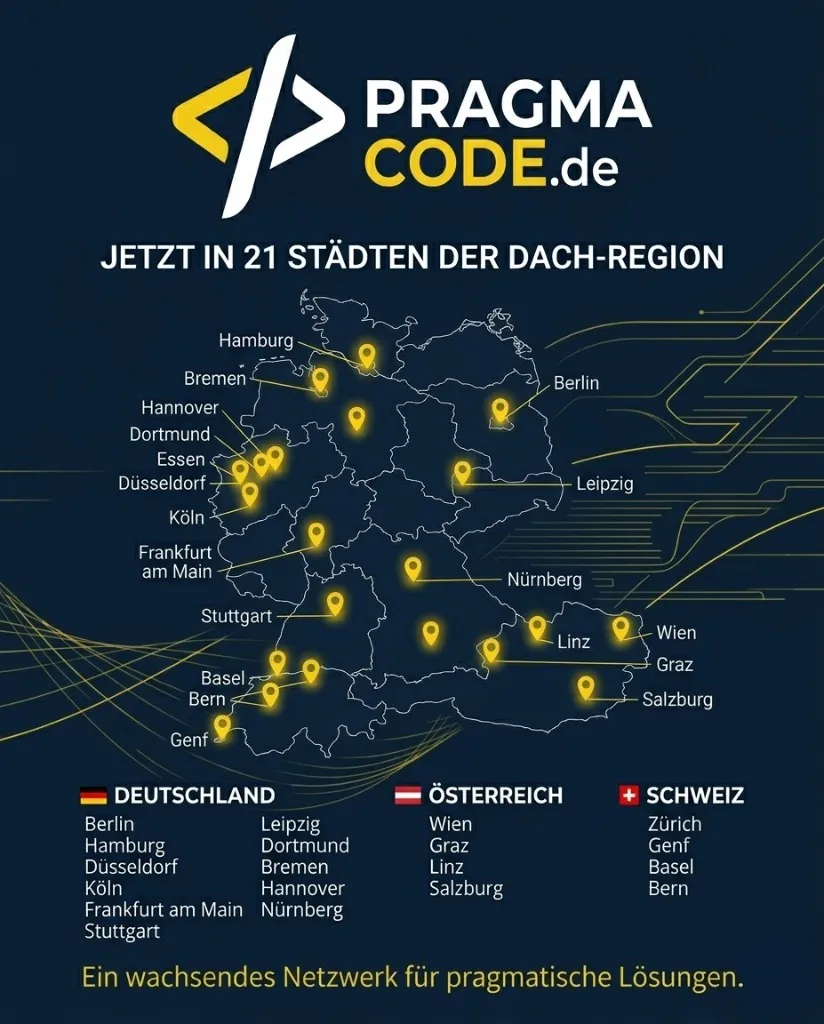
Schedule a Free AI Potential AnalysisOur Regional Expertise
We are your digital partner – regionally anchored and successfully scaling across borders.
AI automation for your business?
I deliver this for small and mid-sized businesses: at a fixed price agreed upfront, working directly with the person who builds it. Process, scope and pricing are on the service page.
See service & pricing Or request a free intro callExtended Specialized Glossary
Agentic AI
Autonomous AI systems designed to pursue multi-step goals independently, make decisions, and execute actions across external software tools.
RPA (Robotic Process Automation)
Software robots that execute rule-based, repetitive tasks across user interfaces and API endpoints automatically.
n8n
A fair-code, privacy-first workflow automation platform that connects AI models, databases, and enterprise software systems seamlessly.
Model Context Protocol (MCP)
An open standard enabling secure, standardized connections between AI agents, local data sources, and business tools.
Local LLM
A large language model hosted directly on on-premise hardware or dedicated private infrastructure, ensuring 100% data sovereignty without external cloud routing.
EU AI Act Risk Category
The four-tier classification system established by EU regulation, defining strict compliance, transparency, and documentation requirements for AI deployments.