


In a 90-minute in-depth conversation with entrepreneur and investor Oskar Hartmann, Andrei Doronichev — former Director of Product at Google (YouTube Mobile, YouTube Premium) and co-founder of BioOptic — delivers one of the most incisive business analyses of 2026: Why the era of pure attention has collapsed, why automated outbound AI sales fail completely, and how a lean 15-person organization directs hundreds of autonomous digital workers to solve complex enterprise problems.
This article is an in-depth expert contribution from our content cluster. Discover the complete overview on our main page: AI Automation for Modern Enterprises →
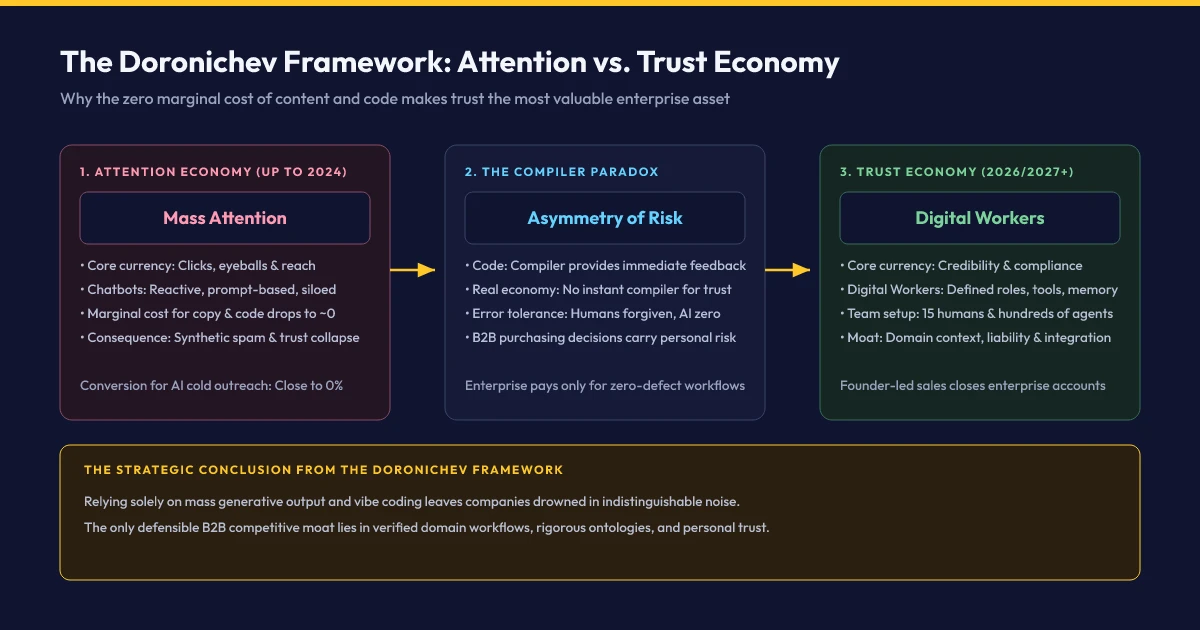
- The Paradigm Shift to the Trust Economy: During Web2, attention was the primary currency. Because generative AI and vibe coding have driven the marginal cost of text, decks, and source code to near-zero, the commercial value of pure attention has collapsed. The only defensible, non-reproducible asset in 2026/2027 is verified, audit-proof trust.
- The Failure of Generic Chatbots in Enterprise B2B: Enterprise organizations do not purchase ChatGPT prompts or raw tokens. They invest in verticalized Digital Workers equipped with persistent tool harnesses, deep domain ontologies, and deterministic verification loops capable of meeting stringent regulatory standards.
- Why Autonomous Outbound AI Sales Fails: Doronichev's real-world experiment automating B2B outbound sales with autonomous agents yielded exactly zero percent conversion. High-stakes B2B decisions represent personal career risks; buyers demand authentic human accountability, empathy, and founder credibility. AI serves as an intelligence prep engine — humans close the contract.
Horizon 2027: The End of Generative Fairy Dust
In a 90-minute interview with tech investor Oskar Hartmann, former Google Product Director Andrei Doronichev breaks down the mechanics of the maturing AI economy. Following DHH on Agentic Engineering and Felix Rieseberg on Claude orchestration, Doronichev provides the strategic business roadmap: How a 15-person core team directs hundreds of digital workers, and why the impending 2027 Capex correction will reward only those generating durable cash flow in the Trust Economy.
- 1. Introduction: From YouTube Mobile to Agentic Biotech
- 2. Attention vs. Trust Economy: The Core Economic Shift
- 3. The Cold Outreach Disaster: Why AI Fails in B2B Sales
- 4. Digital Workers vs. Chatbots: 15 Humans, Hundreds of Agents
- 5. The Compiler Paradox: Why AI Learned to Code First
- 6. The AI Investment Bubble: Preparing for the 2027 Capex Hangover
- 7. „New Version“: Doronichev's Framework for Executive Reinvention
- 8. 5-Step Roadmap: Deploying Digital Workers in Mid-Market Enterprises
- 9. Conclusion & Primary Sources
1. Introduction: From YouTube Mobile to Agentic Biotech
When analyzing digital scale and the integration of artificial intelligence into complex organizations, Andrei Doronichev brings rare, battle-tested credibility. On November 16, 2026, entrepreneur and venture investor Oskar Hartmann published a 90-minute video discussion with Doronichev titled "Что Ждет ЧЕЛОВЕЧЕСТВО в 2027? | Андрей Дороничев". Doronichev is not an academic commentator: He launched his career with 10,000 dollars in initial capital in European mobile content distribution (during the ringtone era of Crazy Frog), turned it into a million-dollar business, and subsequently joined Google in Mountain View.
At Google, Doronichev spearheaded product management for what was initially an underestimated internal effort: YouTube Mobile. By the time he concluded his tenure at YouTube around 2014, the mobile application was installed on over one billion handsets worldwide and generated more than 100 million dollars in Annual Recurring Revenue (ARR) from advertising alone — providing the launchpad for YouTube Premium and YouTube Music, products he helped shape from inception. After leading initiatives in Google's VR/AR division, he departed big tech, raised 11 million dollars in venture capital in 2021 from top-tier firms including Kleiner Perkins and Pantera Capital for his AI company Optic, and later engineered a strategic pivot into BioOptic.
Today, BioOptic operates at the intersection of advanced Agentic AI and global biotechnology — one of the most heavily regulated, zero-tolerance sectors in modern commerce. With a human core team of just 15 employees, BioOptic manages an autonomous workforce of hundreds of specialized digital workers handling clinical literature analysis, FDA compliance filings, and molecular data triage. The dialogue between Hartmann and Doronichev offers business leaders, CTOs, and software architects an unvarnished reality check: Where frontier models stand in late 2026, why simple chatbot assistants have reached diminishing returns, and what enterprise readiness demands heading into 2027.
2. Attention vs. Trust Economy: The Core Economic Shift
The most consequential economic framework Doronichev outlines centers on the shifting foundation of digital value creation. For over two decades — spanning Web 2.0 through 2024 — the internet economy was organized around a single organizing principle: the Attention Economy. Platforms and businesses that captured the highest volume of impressions, video views, social interactions, and engagement dominated digital advertising and brand positioning.
With the maturation of multimodal frontier models, agentic harnesses, and vibe coding, the marginal cost of producing synthetic text, pitch decks, marketing collateral, software prototypes, and cold outreach has dropped to effectively zero. Today, any operator can spawn polished websites, author hundreds of automated articles, or blast thousands of personalized outreach emails in minutes. However, this synthetic hyper-abundance triggers immediate economic depreciation:
Comparison: Attention Economy vs. Trust Economy (2026/2027)
- Core Currency: Clicks, impressions, engagement, and algorithmic reach
- Marginal Cost: Content required measurable human effort and craft
- Interaction Model: Reactive prompts and isolated chatbot sessions
- Systemic Impact: Floods of synthetic noise erode commercial trust
- B2B Conversion: Mass automated outreach conversion drops to near 0%
- Core Currency: Auditability, deep domain expertise, compliance, and liability
- Marginal Cost: Content is free; verified human trust is hyper-scarce
- Interaction Model: Proactive Digital Workers embedded in secure tool harnesses
- Systemic Impact: Verified operational execution beats loud marketing claims
- B2B Conversion: High-trust personal relationships and founder-led sales win
When the supply of digital content approaches infinity, the value of unverified claims collapses to zero. As Doronichev explains: "In an environment where anyone can vibe code an impressive slide deck or prototype in an afternoon, attention has ceased to be scarce. The only currency that cannot be fabricated overnight is trust."
3. The Cold Outreach Disaster: Why AI Fails in B2B Sales
A standout segment of the podcast features Doronichev's candid post-mortem on internal experiments that failed. Like many technology leaders building in 2025, BioOptic investigated what hundreds of AI agencies continue to market aggressively: the end-to-end automation of B2B outbound business development through autonomous agents.
The technical architecture appeared flawless on paper: Agents scraped targeted corporate registries, enriched executive profiles via LinkedIn, digested recent company filings, drafted hyper-personalized email sequences, handled automated follow-ups, and dropped calendar booking links. The pipeline executed flawlessly without human intervention. Yet the commercial outcome was unambiguous: The resulting conversion rate was zero percent.
1. Decision-Maker Spam Fatigue
Enterprise executives receive dozens of AI-drafted messages every morning. Any outreach showing the slightest hint of synthetic template phrasing is filtered directly into spam. Generating massive volume actively repels sophisticated B2B buyers.
2. Personal Career Risk in B2B Procurement
Corporate decision-makers in pharmaceuticals, manufacturing, or banking do not buy enterprise systems based on clever copy. Multi-million-dollar software adoptions carry existential career stakes ("Nobody gets fired for choosing IBM"). No manager offloads that accountability to a chatbot.
3. Complete Absence of AI Liability
An algorithm cannot sign contractual guarantees, assume regulatory liability, or look a client in the eye when deadlines face jeopardy. Enterprise B2B buyers ultimately pay for human responsibility and standing behind the system.
This experience led Doronichev to an uncompromising operating principle: In high-value enterprise B2B sales, the founder or executive owner must remain on stage and sell directly. BioOptic drives its enterprise pipeline through keynote presentations at specialized scientific symposia, mutual peer introductions, and high-trust advisory relationships. The role of AI in sales has flipped: It no longer touches customer communication, but serves as an internal intelligence harness — synthesizing technical whitepapers, profiling customer infrastructure, and arming human sales leaders with unprecedented preparation.
Expert Tip: The Modern Formula for B2B Sales
Never deploy AI agents as public-facing cold outreach bots. Instead, use them as background intelligence operatives: Have agents digest prospective clients' annual 10-K reports, audit logs, and compliance records so your human account executives enter meetings with unmatched context. The human builds trust and closes the partnership.
4. Digital Workers vs. Chatbots: 15 Humans, Hundreds of Agents
How does a deep-tech organization with only 15 core human staff successfully deliver complex services to global pharmaceutical giants? The secret lies in decoupling simple Chatbots (Assistants) from true Digital Workers (Digital Workers).
A chatbot like vanilla ChatGPT is inherently passive: It waits for a human prompt, outputs text, and loses its state the moment the session closes. It holds no tools and bears no ongoing responsibilities. In contrast, a true digital worker is an autonomous agent integrated directly into the corporate operating system:
1. Defined Operational Roles
A digital worker operates with a specific job mandate (e.g. "Validating Phase-II oncology trial documentation against FDA 21 CFR Part 11 requirements") and verifiable success metrics, rather than open-ended conversational prompts.
2. Dedicated Tool Harnesses
It executes real-world utilities autonomously: query relational databases via secure APIs, invoke deterministic Python data scripts, run isolated sandbox computations, and verify cryptographic hashes.
3. Persistent Memory & State
Digital workers maintain multi-week state machines, structured vector knowledge graphs, and persistent project memory to carry complex, multi-stage workflows across business cycles.
4. Deterministic Verification Loops
They never grade their own work. Every output is vetted by automated test suites, schema linters, or independent red-team critique agents (mirroring the Adversarial Review patterns used by Anthropic).
5. Human-in-the-Loop Escalation
Whenever confidence scores drop below calibrated thresholds or ambiguity emerges, the digital worker halts and cleanly escalates to a human manager, eliminating hallucinated output.
At BioOptic, this operational architecture transforms human personnel from manual spreadsheet handlers into orchestrators and quality curators. A single biochemist oversees dozens of digital workers concurrently analyzing hundreds of thousands of research pages. This setup unlocks revenue-per-employee ratios traditionally seen only in hyper-scaled software monopolies.
5. The Compiler Paradox: Why AI Learned to Code First
One of the most illuminating questions Hartmann poses is straightforward: Why did artificial intelligence master computer programming so much faster than sales, medicine, or corporate management?
Many industry observers assumed cognitive tasks followed an intuitive hierarchy of difficulty. The real reason is structural and grounded in the mechanics of feedback: Code has a compiler.
When an agent generates a Python, TypeScript, or Rust function, it immediately pipes the snippet into a compiler, linter, or automated unit test. If there is a syntax error or a broken assertion, the agent receives instant, mathematically unambiguous feedback within 50 milliseconds: Type mismatch on line 42; expected boolean, received integer. The model can fail a thousand times and self-correct seamlessly in complete isolation until the test harness turns green.
The Real Economy Has No Instant Compiler
The broader enterprise world lacks an instantaneous compiler that intercepts mistakes in milliseconds without consequence:
1. Lagging Feedback Loops (6 to 24 Months)
When you adjust your enterprise pricing model, launch an ad campaign, or modify clinical trial protocols, you often wait 6 to 24 months to discover whether the decision was sound.
2. Social and Contextual Ambiguity
Human negotiations, organizational politics, and customer relationships turn on emotional nuance, trust, and tacit knowledge that no digital sensor captures in full.
3. Asymmetric Error Tolerance
When a human colleague introduces a minor typo into an internal memorandum, peers dismiss it without concern. When an enterprise AI hallucinates a single metric in a regulatory filing, the entire system is immediately banned from corporate networks.
This answers Hartmann's core question: "Why do enterprise clients pay large sums to BioOptic when they could simply purchase a ChatGPT subscription?"
Frontier models like GPT-4o or Claude 3.5 Sonnet are powerful raw engines. However, they lack native awareness of enterprise security perimeters, proprietary ERP ontologies, or FDA audit trails. Enterprise buyers do not pay for raw tokens; they pay for the verification ecosystem: hallucination shields, zero-retention data boundaries, and regulatory compliance guarantees that withstand legal scrutiny.
6. The AI Investment Bubble: Preparing for the 2027 Capex Hangover
A crucial economic warning Doronichev sounds relates to the growing chasm between massive hyperscaler Capex and actual enterprise software revenue.
Tech giants (Microsoft, Alphabet, Meta, Amazon) are deploying hundreds of billions of dollars into high-density GPU infrastructure, power grids, and data centers. Venture capital funds continue backing early-stage AI startups at dizzying multiples. However, Doronichev cautions that a market correction is coming: Outside of developer tooling and code generation (such as Cursor / Anysphere scaling rapidly to hundreds of millions in ARR), mainstream enterprise software budgets are not expanding at the pace required to amortize trillions in hardware spend.
How should mid-market leaders and enterprise architects prepare for the 2027 landscape?
Enterprise Resilience Guidelines for AI 2027
7. „New Version“: Doronichev's Framework for Executive Reinvention
In the concluding segment of the interview, Doronichev explores the philosophy behind his book "Новая версия" (New Version). His central thesis: The agile product management principles used to iterate software products (tight feedback loops, rapid hypothesis testing, fearless deprecation of legacy features) must be applied to one's own career and leadership style.
Professionals who remain anchored in static 2024 habits risk swift obsolescence in an agent-driven economy. Doronichev recounts his own journey: emigrating, stepping away from Google's executive perks, and immersing himself in an unfamiliar, highly technical discipline (biopharmaceuticals). The vital leadership capability heading into 2027 is not memorizing prompt templates, but the willingness to execute radical self-iteration.
For executives and senior engineers, this requires letting go of identity tied to manual execution. The modern leader operates as a systems architect who designs processes, specifies acceptance criteria, and orchestrates swarms of digital workers.
8. 5-Step Roadmap: Deploying Digital Workers in Mid-Market Enterprises
How can mid-market enterprises transition from ad-hoc chatbot experiments to auditable, production-grade digital workers? Pragma-Code recommends the following phased roadmap:
-
Phase 1: Identify Compiler-Adjacent Business Processes
Do not begin in creative marketing or sensitive outbound sales. Target processes governed by deterministic rules: reconciling vendor invoices against ERP purchase orders, validating shipping documentation, processing GDPR access requests, or IT security compliance checks. Where rules are clear, agents can iterate safely.
-
Phase 2: Establish Sandboxed Tool Harnesses & API Gateways
Never expose production relational databases directly to raw LLMs. Build intermediate microservices, read-only API facades, and Model Context Protocol (MCP) servers equipped with granular permissioning, rate limits, and audit logs.
-
Phase 3: Implement Dual-Agent Verification (Adversarial Setup)
Never allow a single AI agent to approve its own output. For mission-critical workflows, establish a two-stage pipeline: Agent A generates the deliverable, Agent B (Red Team) aggressively stress-tests for mathematical errors and policy breaches, and a deterministic script validates facts against primary sources.
-
Phase 4: Calibrate Human-in-the-Loop Escalation Triggers
Set hard thresholds where digital workers must pause and alert a human supervisor (e.g. invoice deviations exceeding $5,000, regulatory ambiguities, or missing master data). This prevents cascading automated errors.
-
Phase 5: Strengthen the Human Trust Anchor
Reinvest the administrative hours saved by digital workers into high-impact human touchpoints: deepen customer advisory discussions, conduct on-site client workshops, and position your brand as an island of authentic trust amidst the synthetic flood.
9. Conclusion & Primary Sources
The conversation between Andrei Doronichev and Oskar Hartmann cuts cleanly through the remaining fog of early AI hype. Artificial intelligence will neither destroy civilization by 2027 nor instantly turn companies into push-button money-printing machines.
The future belongs neither to vibe coders accumulating technical debt nor to enterprises encumbered by generic chatbot spam. The leaders of the Trust Economy will be those who digitize core workflows with mathematical rigor, deploy specialized digital workers within secure harnesses, and fiercely protect human accountability as their primary competitive moat.
Official Sources & Primary Documentation
- Oskar Hartmann (November 16, 2026): "Что Ждет ЧЕЛОВЕЧЕСТВО в 2027? | Андрей Дороничев" – 90-minute video discussion covering Google, BioOptic, Digital Workers, the Trust Economy, and enterprise AI reality.
- Andrei Doronichev (Official Biography): Former Director of Product at Google (leading YouTube Mobile, launching YouTube Premium/Music, Google VR). Co-founder of Optic ($11M VC funding) and BioOptic. Author of "Новая версия" (New Version).
- Anthropic Research & Workflows (November 2026): See our companion analysis on Claude Engineering Lead Felix Rieseberg on Adversarial Verification and modern AI workflows.
- David Heinemeier Hansson (September 2026): See our analysis on the Lex Fridman Podcast with DHH on Agentic Engineering vs. Vibe Coding.
Ready to integrate digital workers into your enterprise processes?
Pragma-Code engineers secure, compliance-ready agent harnesses and digital workers for demanding B2B mid-market organizations. Contact us to evaluate which workflows in your organization are prime for agentic automation.
Schedule a Free Initial ConsultationOur Regional Expertise
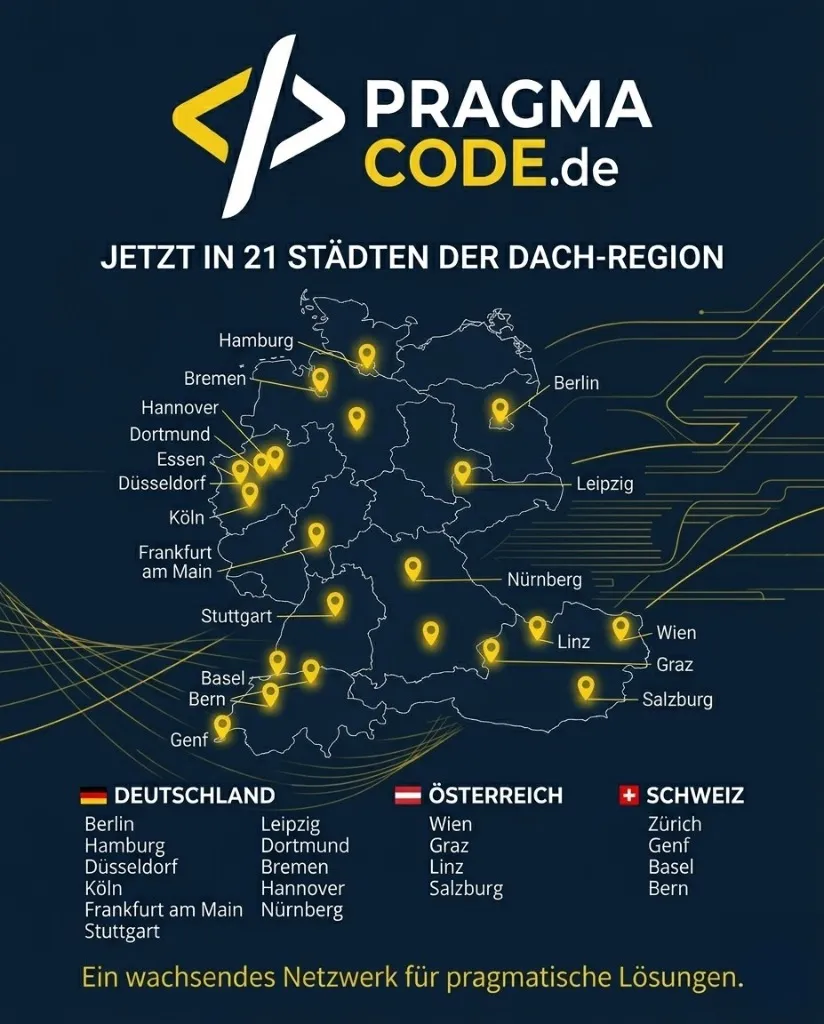
We are your digital partner – regionally anchored and successfully scaling across borders.
AI automation for your business?
I deliver this for small and mid-sized businesses: at a fixed price agreed upfront, working directly with the person who builds it. Process, scope and pricing are on the service page.
See service & pricing Or request a free intro callExtended Specialized Glossary
Digital Workers
Autonomous, software-based AI workers with defined roles, persistent access to enterprise databases, tool harnesses, and independent execution routines under human supervision.
Trust Economy
The economic paradigm of the AI era in which synthetic content collapses the marginal cost of attention, making verified credibility, personal liability, and trust the most scarce assets.
Agentic AI
Artificial intelligence systems that not only respond reactively to prompts but act purposefully, operate tools, decompose multi-step tasks, and self-correct errors autonomously.
Vertical AI
Specialized AI solutions built for concrete industries (e.g. pharmaceuticals, law, legacy ERP) featuring domain ontologies, proprietary integrations, and formal compliance frameworks.