

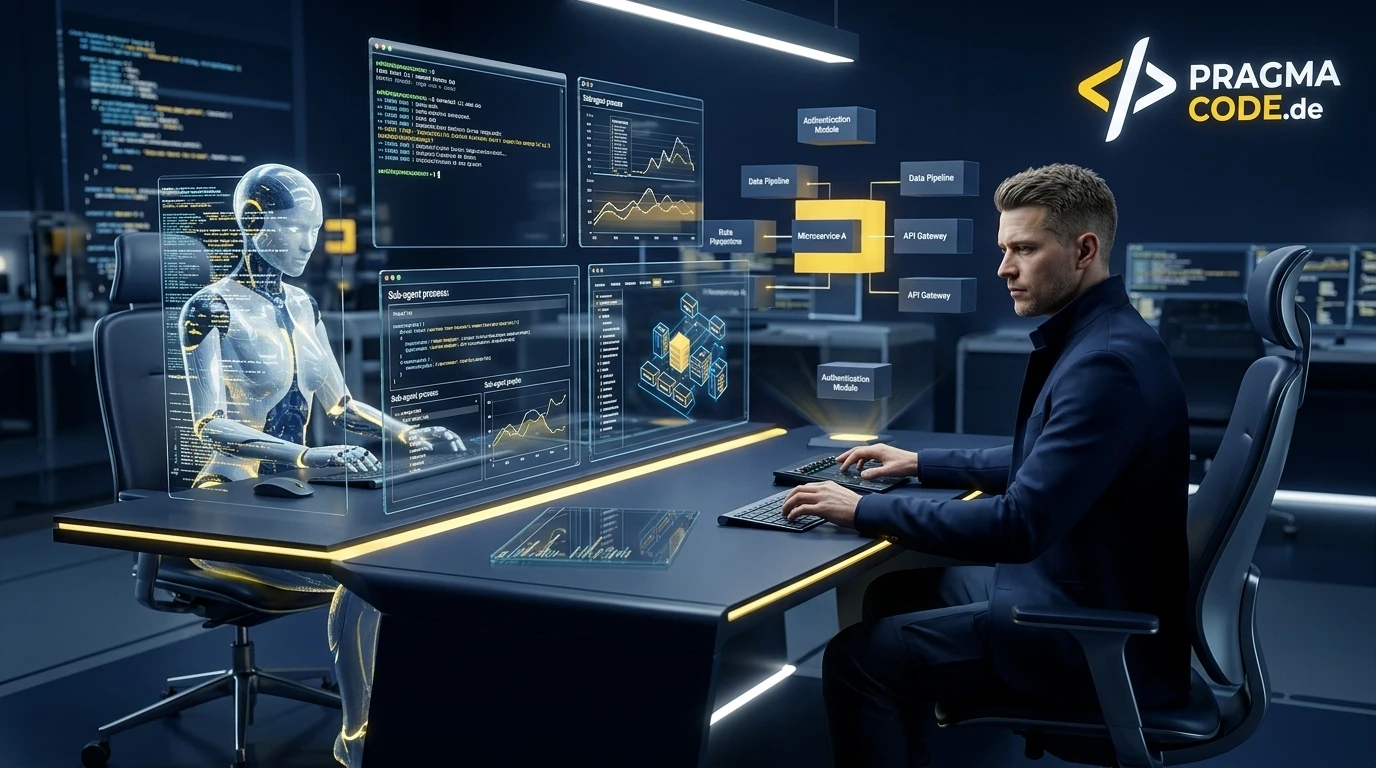
In a landmark conversation with Lex Fridman, David Heinemeier Hansson (DHH), creator of Ruby on Rails and CTO of 37signals, reveals a monumental transformation: After two decades of meticulous craftsmanship, autonomous AI agents now write 100% of his code. Yet, while Silicon Valley celebrates the rise of 'vibe coding,' DHH issues a stark warning against architectural chaos. For enterprise leaders and engineering directors, this interview provides the definitive blueprint for the era of true agentic engineering.
This article is an in-depth expert contribution from our content cluster. Discover the complete overview on our main page: AI Consulting & Enterprise Agent Systems →
- A Historic Watershed Moment: David Heinemeier Hansson (DHH), widely known for 20+ years as the global champion of meticulously handcrafted code and developer happiness, now has autonomous AI agents write 100% of his software in new projects.
- The Basecamp 5 Disaster: During the sprint to Basecamp 5, 37signals allowed designers to "vibe code" product features. While isolated pull requests functioned smoothly, collectively they pulverized system architecture, requiring senior architects to manually untangle the codebase.
- From Typist to System Curator: Syntax-level mechanics (loops, memory allocation, pointers) are becoming commoditized. The indispensable high-leverage skills in 2026 are product management, domain understanding, architectural boundaries, and relentless simplification ("Make it simpler").
- 1. Introduction: When the High Priest of Handcrafted Code Shifts Tools
- 2. From Skeptic to 100% Agentic Developer: The Tipping Point
- 3. The Basecamp 5 Lesson: Why Blind Vibe Coding Destroys Architecture
- 4. Architectural Paradigm: Vibe Coding vs. Enterprise Agentic Engineering
- 5. The 4 Pillars of the Modern Agentic Engineering Stack
- 6. The New Identity: Why Software Engineering Is Now Product Management
- 7. The Strategic Roadmap: How Companies Can Adopt Agentic Workflows
- 8. Sources & Video Reference: Lex Fridman Podcast #501
- 9. Conclusion: The Era of Curation Has Arrived
1. Introduction: When the High Priest of Handcrafted Code Shifts Tools
Every decade or two, tectonic plates shift across the computing landscape. When an enthusiastic social media influencer proclaims they will never write another line of code by hand, the software engineering community barely blinks. But when David Heinemeier Hansson — known worldwide as DHH, co-founder of 37signals, co-creator of Basecamp, and the visionary behind Ruby on Rails — sits down with Lex Fridman to reveal that he hasn't manually written a single line of code for his recent landmark projects, the global software industry takes notice.
For more than twenty years, Hansson epitomized the proud software artisan. His core philosophy was that programming is not merely mechanical instruction for silicon chips, but a poetic craft designed to maximize human joy. Ruby on Rails was engineered around "programmer happiness." Just over a year ago, in mid-2024, Hansson was distinctly skeptical about generative AI: code autocompletion was convenient, and LLM chat windows served as handy tutors, but the deep intellectual labor of chiseling software remained uniquely human.
In Lex Fridman Podcast #501 (released in late August 2026), Hansson presents a radically altered reality. The past nine months have completely transformed his day-to-day work. Meticulous keyboard typing has been replaced by the orchestration of autonomous Sub-Agents. Yet, even as excitement around Vibe Coding sweeps through hackathons and venture-backed incubators, DHH sounds an urgent alarm: treating software development as careless prompting without understanding underlying architecture leads straight to organizational ruin.
2. From Skeptic to 100% Agentic Developer: The Tipping Point
What caused this profound transformation? In the podcast, DHH quotes a famous observation: "There are decades where nothing happens, and there are weeks where decades happen." That exact compression occurred across the software industry between November 2025 and summer 2026.
Until late 2025, developer tooling was dominated by in-editor copilots that merely suggested the next snippet of code, scaffolded basic unit tests, or resolved regular expressions. The human programmer remained locked in the driver's seat, painstakingly directing every turn and spending excessive time correcting subtle hallucinations. Hansson points to November 24, 2025, as the turning point: the arrival of next-generation frontier reasoning models (such as Claude Opus 4.5). For the first time, model outputs demonstrated genuine taste, idiomatic elegance, and reasoning on par with a senior engineer in a state of flow.
Equally critical was the maturation of standardized Agent Harnesses. Moving beyond primitive browser chat boxes, modern harnesses gave agents headless terminal execution, persistent file system access, automated linting, and closed-loop verification. The tool shifted from an interactive search engine into an autonomous collaborator.
Hansson put this paradigm to the ultimate test on one of the most demanding technical projects imaginable: building Omarchy Linux, an opinionated, developer-focused desktop operating system. For the newly released Quattro version, DHH spent over two months without typing a single line of manual C++, Bash, or system configuration. 100% of the shipped code was written by autonomous agents — guided, constrained, and audited by him at the architectural level.
3. The Basecamp 5 Lesson: Why Blind Vibe Coding Destroys Architecture
If autonomous agents can build entire operating systems in record time, why does DHH forcefully reject the popular buzzword "vibe coding"? Hansson openly compares vibe coding to the script kiddies of the early 2000s, who blindly downloaded and deployed PHP scripts without any comprehension of how they functioned under the hood.
To substantiate his critique, Hansson candidly recounts an internal experiment conducted at 37signals during the development sprint for Basecamp 5 in early 2026. Energized by the speed of agentic tools, leadership encouraged product designers to build features directly: "Let the designers code. They know the UI states, they know the interaction flows — let them vibe."
The Illusion of the Working Pull Request
In isolation, each pull request generated by designers worked as advertised. Visual states updated properly, buttons triggered actions, animations ran at 60 FPS, and manual local testing appeared completely flawless.
The Gradual Architectural Meltdown
Aggregated across the repository, architectural coherence disintegrated. Without holistic guidance, each prompt session invented ad-hoc data structures, duplicated database queries, and broke established domain boundaries. The system was unraveling from the inside.
The resulting aftermath required immense cleanup. Basecamp 5's codebase was rapidly suffocating under redundant, conflicting abstractions. Senior software architects at 37signals had to intervene manually, working long hours to excise duplicate logic, unify data models, and restore architectural cohesion.
For mid-sized enterprises and B2B leaders, this case study contains an urgent strategic takeaway: Vibe coding builds impressive prototypes but toxic production assets. Viewing software purely through its surface symptoms — "it looks fine in the browser" — ignores the reality that software is an evolving system. Without disciplined architecture, maintenance costs skyrocket, regression rates multiply, and security vulnerabilities proliferate.
4. Architectural Paradigm: Vibe Coding vs. Enterprise Agentic Engineering
To understand why leading engineering teams reject unstructured prompting in favor of Agentic Engineering, one must compare their core operational dynamics. While vibe coding optimizes for instantaneous output, enterprise agentic engineering focuses on long-term maintainability, security, and systemic resilience.
Comparative Analysis: Superficial Vibe Coding vs. Professional Agentic Engineering
- Focus: Rapid visual output without regard for underlying system mechanics.
- Code Review: Implementation treated as an uninspected black box; no peer reviews.
- Architecture: Uncoordinated ad-hoc generation; each session invents new conventions.
- Error Handling: Blind trial-and-error prompting: "Please fix this runtime error."
- Long-Term Impact: Unmanageable technical debt, security holes, and code rot.
- Focus: Strict interface boundaries, system invariants, and clean modular domains.
- Code Review: Forensic curation of data models, schemas, and API contracts.
- Architecture: Enforced blueprints (e.g. Astro islands, TypeScript, Zod validations).
- Error Handling: Automated regression suites, linters, and closed-loop test harnesses.
- Long-Term Impact: 5x to 10x delivery speed with rock-solid enterprise stability.
The key differentiator resides in the mental posture of the engineer. The vibe coder hopes the AI will magically divine their unstated intent. The agentic engineer acts as an exacting client, architect, and conductor. They establish non-negotiable architectural boundaries, define data schemas before generating logic, and demand strict adherence to existing codebase conventions.
5. The 4 Pillars of the Modern Agentic Engineering Stack
How do elite engineering organizations structure their workflows in 2026? Drawing from Hansson's insights and our everyday experience at Pragma Code, four fundamental pillars characterize industrial-grade agentic development.
1. Terminal & CLI Harnesses
Browser-based chats are inadequate for real software development. High-velocity agents operate natively inside the terminal (such as Claude Code). They possess direct, low-latency access to Git, the file system, compilers, and test runners without manual copy-paste overhead.
2. Concurrent Sub-Agent Swarms
Complex engineering challenges are no longer assigned to a single monolithic prompt. Modern orchestrators decompose tasks: one agent drafts the implementation, two review edge cases, and a fourth executes the automated test suite in parallel.
3. Automated Feedback Loops
Agents must never work in isolation from runtime feedback. Rigid type systems (TypeScript), runtime validation (Zod), and continuous test runners provide instant signals that allow agents to self-correct before code is reviewed by a human.
4. Human Architectural Taste
The irreplaceable domain of human engineering: evaluating proportions and aesthetic restraint. Architects prevent AI-generated bloat by aggressively enforcing simplicity and eliminating redundant abstractions.
Hansson emphasizes the fourth pillar above all else: language models harbor an inherent bias toward over-engineering. They frequently generate intermediate helper layers, convoluted inheritance structures, and superfluous abstractions. In 2026, the senior engineer's most frequent command is not "find the bug," but rather: "Simplify this. Cut the line count in half. Remove the unnecessary abstraction."
6. The New Identity: Why Software Engineering Is Now Product Management
Perhaps DHH's most thought-provoking statement in episode #501 is this: Software engineering has always been product management — but the agentic era has made it undeniable.
Historically, software engineers spent 80% of their cognitive bandwidth grappling with syntax: managing pointers, resolving memory leaks, formatting CSS, balancing braces, and satisfying type checkers. This accidental complexity granted programmers gatekeeper status. Yet, mastering syntax has never guaranteed that the resulting software actually delivers value to customers.
DHH shares a striking insight: during the initial months of agentic development, veteran programmers were frequently outperformed by less dogmatic engineers. Seasoned developers insisted on prescribing the exact mechanical steps to the model, micromanaging its implementation. In contrast, those who clearly framed the problem, articulated the user constraints, and defined the desired outcome achieved far superior, more elegant results.
1. Problem Framing & Scoping
The ability to dissect a complex business problem and ruthlessly isolate the minimum viable scope required for version 1.0.
2. Product Taste & UX Intuition
An instinct for intuitive user experience, tactile responsiveness, and visual restraint — qualities no generic prompt can blindly synthesize.
3. Trade-Off Mastery
Making conscious compromises between runtime latency, memory consumption, infrastructure cost, and long-term maintainability.
4. Interface Discipline
Enforcing clean architectural boundaries between subsystems so that modular components can be independently replaced or scaled.
5. Forensic Verification
Understanding system dynamics through logs, metrics, and behavioral edge cases without needing to handwrite every single line.
This does not mean foundational computer science knowledge is obsolete; quite the opposite. Developers who deeply understand memory management, race conditions, relational indexing, and network latency can evaluate an agent's proposed implementation in seconds. The value has permanently shifted from manual generation to critical verification.
Expert Tip: The "Asynchronous Coworker" Pattern
DHH highlights a major operational breakthrough at Basecamp: instead of treating AI agents like synchronous chat buddies — waiting impatiently before an animated response cursor — 37signals integrates agents directly into Basecamp as coworkers. An architect assigns a card or ticket to an agent, closes the tab, and shifts to high-level strategic tasks. Thirty minutes later, the agent delivers a completed pull request with full test coverage ready for review. Asynchronous delegation decisively outperforms synchronous chat anxiety.
7. The Strategic Roadmap: How Companies Can Adopt Agentic Workflows
How can mid-market enterprises, internal development teams, and digital agencies harness these 10x productivity gains without suffering the architectural debt experienced in the Basecamp 5 experiment? At Pragma Code, we recommend a disciplined four-phase adoption roadmap:
-
Establish Strict Architectural Blueprints & Type Guardrails
Before deploying agents across repositories, solidify non-negotiable fundamentals: clean, modular frameworks (such as Astro for web applications), complete TypeScript coverage, and runtime Zod validation. Without compiler-enforced constraints, models inevitably hallucinate into dead ends.
-
Deploy Automated Test & Audit Verification Harnesses
Build a robust continuous testing pipeline: unit suites, accessibility audits (a11y), performance budgets, and automated vulnerability scanning. Agents must be empowered to run these checks locally, verifying changes and autonomously iterating until green.
-
Transition to Terminal-Based Toolchains & Sub-Agent Orchestration
Migrate engineering teams out of isolated browser tabs. Equip developers with CLI- and TUI-driven environments where agents interact directly with Git, the file system, and concurrent sub-agents.
-
Transform Culture: From Code Producers to System Curators
Evolve performance metrics across your engineering organization. Stop measuring lines of code written. Instead, celebrate architectural clarity, radical simplicity ("deleting code is better than writing it"), and proactive product ownership.
Quick-Check: Is Your Organization Ready for Agentic Engineering?
8. Sources & Video Reference: Lex Fridman Podcast #501
The full interview between Lex Fridman and David Heinemeier Hansson is essential viewing for every engineering manager, technical founder, and CTO planning their organization's technology roadmap for the coming decade. Beyond AI development, the conversation explores the desktop resurgence of Linux, the discipline of performance optimization, and staying resilient amidst public controversy.
Primary Source: Lex Fridman Podcast Episode #501
Featured Guest: David Heinemeier Hansson (DHH) — Creator of Ruby on Rails, CTO of 37signals & Creator of Omarchy Linux.
Episode Duration: 3 hours 14 minutes | Published: August 2026
Watch on YouTube: YouTube: DHH: Future of Programming, AI, Agentic Engineering, Vibe Coding & Linux (Lex Fridman Podcast #501)
Read the Transcript: Official Episode Transcript on lexfridman.com
9. Conclusion: The Era of Curation Has Arrived
The dramatic transformation of David Heinemeier Hansson is not an isolated curiosity — it is the harbinger of a permanent industry realignment. The assumption that handcrafted code holds inherent virtue has evaporated in 2026. Autonomous models can generate syntactically clean code faster, more tirelessly, and across wider domains than any human developer ever could.
Yet, Hansson's warning regarding the vibe coding trap remains the most vital lesson of our era: speed without direction is entropy. Without human judgment, aesthetic refinement, and unwavering architectural discipline, AI-driven development delivers not enterprise value, but an unmaintainable mountain of technical debt.
The winners of this paradigm shift will be the organizations and engineers who stop defining their worth by typing syntax. The future belongs to AI Code Architects: engineers with deep product empathy who wield autonomous agent swarms with surgical precision, shipping in days what once demanded quarters — resilient, elegant, and built to endure.
Ready to transition your engineering team to enterprise agentic workflows?
Schedule a Free Architecture ConsultationOur Regional Expertise
We are your digital partner – regionally anchored and successfully scaling across borders.
Have a vision?
Let's check together how we can make your idea take flight.
Book your free strategy call nowExtended Specialized Glossary
Agentic Engineering
An engineering paradigm where autonomous AI agents execute multi-step development tasks (planning, implementation, testing, refactoring) in collaboration with human software architects.
Vibe Coding
A development methodology where users interact with AI agents primarily in natural language while the AI autonomously generates, tests, and commits code without manual implementation review.
Agent Harness
A standardized runtime environment (CLI, TUI, or orchestrator) providing AI agents with tool execution, file system access, linters, and automated verification loops.
Sub-Agents
Specialized subordinate AI agents spawned by an orchestration agent to analyze, implement, or verify complex software engineering subtasks in parallel.
Omarchy Linux
An opinionated, agent-first developer Linux distribution created by DHH, built completely with AI agent acceleration and modular agent skills.